
Best overall search starting point: guaranteed-pay employment that fits your local household budget. Best for location flexibility: teleradiology. Best for ownership goals: partnership-track practice. This 2026 guide explains how to compare radiology jobs ranked by cost of living adjusted pay using actual offers, not headline salaries; RadBoard aggregates 5,000+ radiology positions from 20 sources.
- Radiology jobs ranked by cost of living adjusted pay require offer-level compensation and household expenses, not state salary averages.
- RadBoard is best for radiologists comparing career opportunities across multiple job sources.
- Guaranteed-pay employment is the default comparison baseline; remote work adds control over where you live.
- Separate recurring compensation from signing incentives, ownership projections, and unconfirmed productivity payments.
Why this matters
The best adjusted-pay offer is the one that leaves you more usable income for an acceptable workload. A larger salary does not settle that question. Housing, taxes, insurance, commuting, and unpaid professional expenses change what reaches your household.
For a 2026 search, compare the proposed job and the proposed place to live together. A statewide living-cost average does not describe your neighborhood, childcare arrangement, or commute.
The ranking below orders job structures by their role in an offer comparison. It is not a measured ranking of employers, cities, or states. Each option has a distinct use case, and none wins on purchasing power without the contract and household budget supporting it.
What makes the best adjusted-pay radiology job?
Use these criteria before comparing employers:
- Guaranteed income: Identify recurring compensation that the contract actually guarantees. Keep conditional production payments separate.
- Household costs: Compare housing, utilities, childcare, transport, and insurance where you intend to live.
- Tax treatment: Estimate take-home income using your filing situation, work locations, and employment structure.
- Employer benefits: Separate cash compensation from retirement contributions, health coverage, paid leave, and professional expense reimbursement.
- Workload: Include scheduled reading, procedures, call, administrative duties, and required travel in the comparison.
- Contract risk: Review repayment obligations, compensation changes, termination provisions, and malpractice responsibilities.
A job that passes the income test can still fail the workload test. Decide which schedules and clinical responsibilities you will accept before sorting offers by money.
Radiology job structures at a glance
This 2026 shortlist gives you a comparison order, not a claim that one employment model always pays more. Starting salaries are deliberately excluded: the decision requires the terms of your specific offer.
| Rank | Job structure | Best for | Standout comparison feature | Key limitation |
|---|---|---|---|---|
| 1 | Guaranteed-pay onsite employment, including rural hospital radiology jobs | Establishing a recurring-income baseline | Contracted compensation can be compared directly with a local budget | Location, call, and benefit terms still determine value |
| 2 | Teleradiology jobs | Choosing where to live | Separates the reading location from an onsite commute | Employer location rules and contract expenses require review |
| 3 | Partnership-track private practice | Evaluating an ownership career | Separates employment income from potential ownership economics | Future distributions are not guaranteed salary |
| 4 | Locum tenens assignments | Comparing defined blocks of work | Lets you evaluate each assignment as a separate income-and-expense unit | Gaps, travel, and benefit replacement affect annual results |
| 5 | Academic radiology employment | Keeping teaching or research central | Allows comparison of compensation with protected duties and benefits | Household purchasing power is only part of the career decision |
1. Guaranteed-pay employment: best for a clear baseline
Guaranteed-pay radiology employment gives you a starting point for comparing recurring income with recurring expenses. Use the compensation floor written into the agreement, rather than the largest amount mentioned during recruitment.
An onsite role also makes geography explicit. Price your intended living arrangement near the actual work sites, not a cheaper location that would create an unacceptable commute.
Guaranteed-pay employment pros:
- A written compensation floor supports a repeatable household budget.
- Documented employer benefits can be evaluated alongside cash income.
- A specified schedule makes workload comparisons more useful.
Guaranteed-pay employment cons:
- A guarantee can expire or change under the contract.
- Required call and additional sites can increase the work behind the salary.
- Relocation commits your household to a particular housing and labor market.
Ask when the guarantee ends, what replaces it, and whether compensation changes during leave. Confirm which expenses the employer pays and which remain yours.
Best for: Radiologists who want a dependable baseline before evaluating variable compensation or ownership.
Verdict: Buy into the search strategy; hold the individual offer until its guarantee, schedule, and local budget are documented.
2. Teleradiology: best for choosing where you live
Teleradiology allows image interpretation away from an onsite reading room. Its adjusted-pay advantage is a decision you control: whether the employer permits you to live somewhere that fits your household budget.
Remote does not mean unrestricted. Confirm permitted work locations, shift timing, licensing responsibilities, equipment arrangements, and the employment or contractor structure before comparing take-home income.
Teleradiology pros:
- A permitted home location lets you compare housing independently of an onsite commute.
- Written shifts make schedule requirements explicit.
- Documented equipment and licensing support clarifies professional expenses.
Teleradiology cons:
- Location restrictions can limit the household-cost strategy.
- Contractor arrangements require a separate benefits and expense calculation.
- Nights, weekends, and production requirements can outweigh the location benefit.
Use the same living-cost assumptions when comparing remote offers. Otherwise, you are comparing different housing choices as much as different jobs.
Best for: Radiologists whose priority is choosing a home location rather than moving near a practice.
Verdict: Buy when the permitted location and written work terms support your budget; skip offers that leave those terms unresolved.
3. Partnership-track practice: best for ownership goals
Partnership-track radiology employment combines a current job with a proposed route to ownership. Compare those stages separately: employed compensation first, ownership economics second.
Do not add projected distributions to guaranteed income. Request the written eligibility rules, buy-in terms, distribution methodology, governance rights, and obligations attached to ownership.
Partnership-track practice pros:
- Written ownership terms let you evaluate a different career model from permanent employment.
- A defined track clarifies the steps between joining and eligibility.
- Financial disclosures allow a separate assessment of ownership economics.
Partnership-track practice cons:
- Eligibility does not guarantee admission or future distributions.
- Buy-in obligations and associated debt change household cash flow.
- A lower employed-stage income cannot be justified by undocumented projections.
Compare the employed stage against a non-partnership offer that you would actually accept. Then decide whether the ownership case independently earns your confidence.
Best for: Radiologists seeking ownership who are prepared to review both the employment contract and practice finances.
Verdict: Hold until the ownership terms are written and independently reviewed.
4. Locum tenens: best for assignment-by-assignment comparisons
Locum tenens work consists of temporary coverage assignments. Evaluate each assignment using confirmed compensation, committed work, travel obligations, and expenses before estimating an annual result.
An assignment rate is not an annual salary. Your household budget must also account for time between assignments, unpaid administrative work, insurance, and benefits that you purchase yourself.
Locum tenens pros:
- A defined assignment supports a bounded income-and-expense comparison.
- Written coverage dates clarify the period you are committing to work.
- Separate contracts let you assess different locations individually.
Locum tenens cons:
- Uncontracted future assignments do not establish recurring income.
- Travel and temporary housing complicate comparisons with permanent employment.
- Cancellation terms can change expected receipts.
Build an assignment ledger rather than multiplying a quoted rate by an assumed full calendar. Record who pays each expense and what happens if coverage is canceled.
Best for: Radiologists who want to assess temporary work in discrete blocks rather than compare permanent relocation offers.
Verdict: Hold until committed work and expense responsibilities support the annual household budget.
5. Academic radiology: best for teaching and research priorities
Academic radiology combines clinical work with duties defined by the institution and appointment. Compare compensation against the actual allocation of reading, teaching, research, administration, and call.
A purchasing-power calculation remains useful, but it cannot tell you whether an academic role fits your career. Make teaching and research requirements explicit instead of treating them as incidental benefits.
Academic radiology pros:
- Written duty allocation clarifies the role you are accepting.
- Documented benefits can be compared with other employment offers.
- Protected time, when contractual, belongs in the workload assessment.
Academic radiology cons:
- Appointment language does not replace a detailed schedule.
- Promotion expectations can add responsibilities beyond clinical reading.
- An institution-centered search narrows your location choices.
Request the clinical expectations, protected-time terms, call responsibilities, and promotion criteria together. Compare the complete appointment, not salary in isolation.
Best for: Radiologists who want teaching or research to remain a central part of their job.
Verdict: Buy for a documented academic fit; skip it as a purchasing-power strategy alone.
Build a local budget before naming a winner
For a 2026 relocation decision, choose the neighborhood and housing arrangement you would realistically use. Then collect current expenses for that choice. A regional index is a screening measure, not your household budget.
Housing comparisons need matching assumptions: bedrooms, commute, parking, household size, and whether you plan to rent or own. For a Fort Worth offer, comparing apartments in Fort Worth by neighborhood and commuting requirements makes the housing estimate specific to the proposed job rather than a citywide label.
Keep the recurring categories separate:
- Housing: Rent or ownership expenses for the property you would consider.
- Childcare: Coverage compatible with the proposed work and call schedule.
- Transport: Commuting, parking, vehicle expenses, and required site travel.
- Insurance: Your share of health coverage and other household policies.
- Professional expenses: Licensing, equipment, education, and malpractice obligations not reimbursed by the employer.
Do not count employer-paid expenses twice. If an employer pays an item directly, reflect that arrangement in the budget rather than adding an assumed cash value to salary.
Calculate adjusted pay consistently
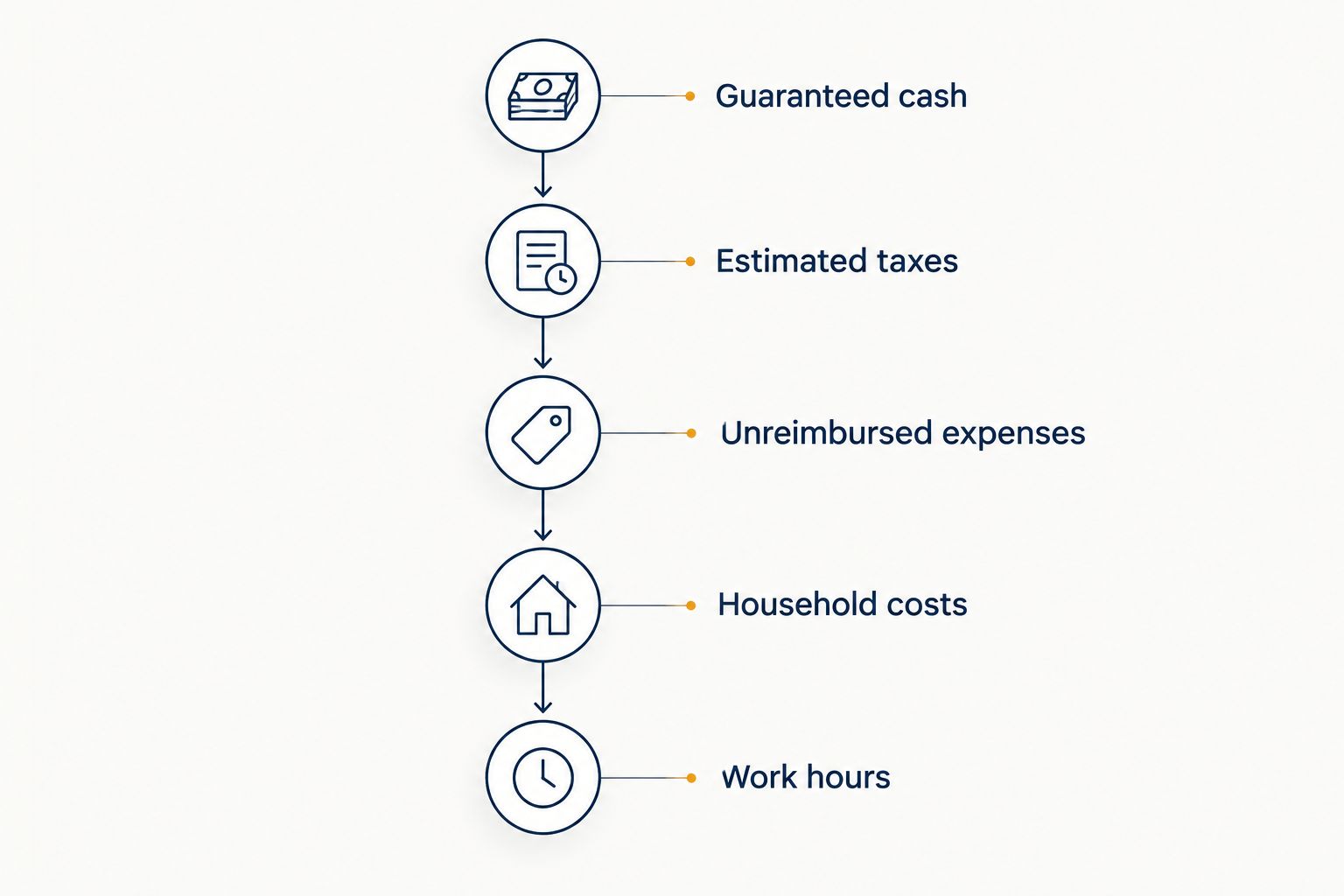
Start with an annual comparison period and use the same period for every offer. Your 2026 worksheet should follow this sequence:
- Guaranteed cash: Enter recurring compensation established by the written offer.
- Estimated taxes: Obtain an estimate reflecting your filing circumstances and work locations.
- Unreimbursed expenses: Subtract professional costs you are responsible for paying.
- Household costs: Subtract your location-specific recurring budget.
- Work hours: Compare the remaining income alongside scheduled and required duties.
Household surplus equals guaranteed cash minus estimated taxes, unreimbursed professional expenses, and household costs. This is a personal cash-flow comparison, not a standardized regional salary index.
If you also use a regional price index, identify its publisher, geography, reference period, and included expenses. Dividing nominal compensation by an index expressed relative to its benchmark produces an index-adjusted figure; it does not calculate after-tax income or your actual spending.
Keep signing incentives outside recurring compensation. Review repayment terms separately, and do not let a temporary payment determine a long-term housing commitment.
How the search strategies are ranked
Guaranteed-pay employment comes first because it establishes the comparison baseline. Teleradiology follows for location choice, partnership-track practice for ownership, locum tenens for defined assignments, and academic employment for teaching and research priorities.
RadBoard radiology job search brings opportunities from 20 sources into one platform. Use search and swipe-to-save features to build your shortlist, then obtain written terms from the employer. Aggregation supports discovery; the contract and your budget determine adjusted pay.
Which radiology job should you choose?
Start with guaranteed-pay employment, then compare alternatives against the same household budget and acceptable workload. Choose teleradiology when location choice is decisive, partnership-track practice when ownership is the objective, locum tenens when defined assignments fit your plan, and academic employment when teaching or research is central.
For your 2026 decision, reject comparisons that mix guaranteed salary with projected bonuses or ownership distributions. A smaller headline number can leave more usable income, but only your completed offer worksheet establishes that result.
FAQ
What's the best way to rank radiology jobs by cost of living adjusted pay?
Compare written compensation with estimated taxes, unreimbursed professional expenses, and your local household budget. Assess workload separately so additional call or required travel does not disappear behind an annual income figure.
Are rural radiology jobs always better for purchasing power?
No, a rural location does not establish better purchasing power. The result depends on the specific offer, housing choice, benefits, professional expenses, and required duties.
Is teleradiology better than onsite radiology for adjusted pay?
Teleradiology is better for location choice when the employer permits your intended work location. It is not automatically better for adjusted pay; compare compensation, taxes, equipment expenses, licensing obligations, and benefits.
Should I include a signing bonus in my adjusted-pay ranking?
Keep a signing bonus separate from recurring compensation. Review payment timing, taxes, and repayment obligations before treating it as money available for household commitments.
How do I compare locum tenens income with an employed salary?
Compare confirmed assignment income after assignment expenses with the employed offer over the same annual period. Include benefits you must replace, unpaid administrative work, and time without contracted assignments.
Does a cost-of-living index calculate my take-home pay?
No, a cost-of-living index does not calculate taxes or personal spending. Use it to screen locations, then build a household budget for the neighborhood and work arrangement you would choose.
Where can I compare radiology career opportunities?
RadBoard aggregates 5,000+ radiology positions from 20 sources for radiologists comparing career opportunities. Use the platform to build a shortlist, then verify compensation, schedule, and contract terms with each employer.
One last thing
Ask what happens to compensation after the initial guarantee ends. A job can lead your first-year comparison and fall behind once its payment model changes. Build a second worksheet for the post-guarantee terms before committing to a move.