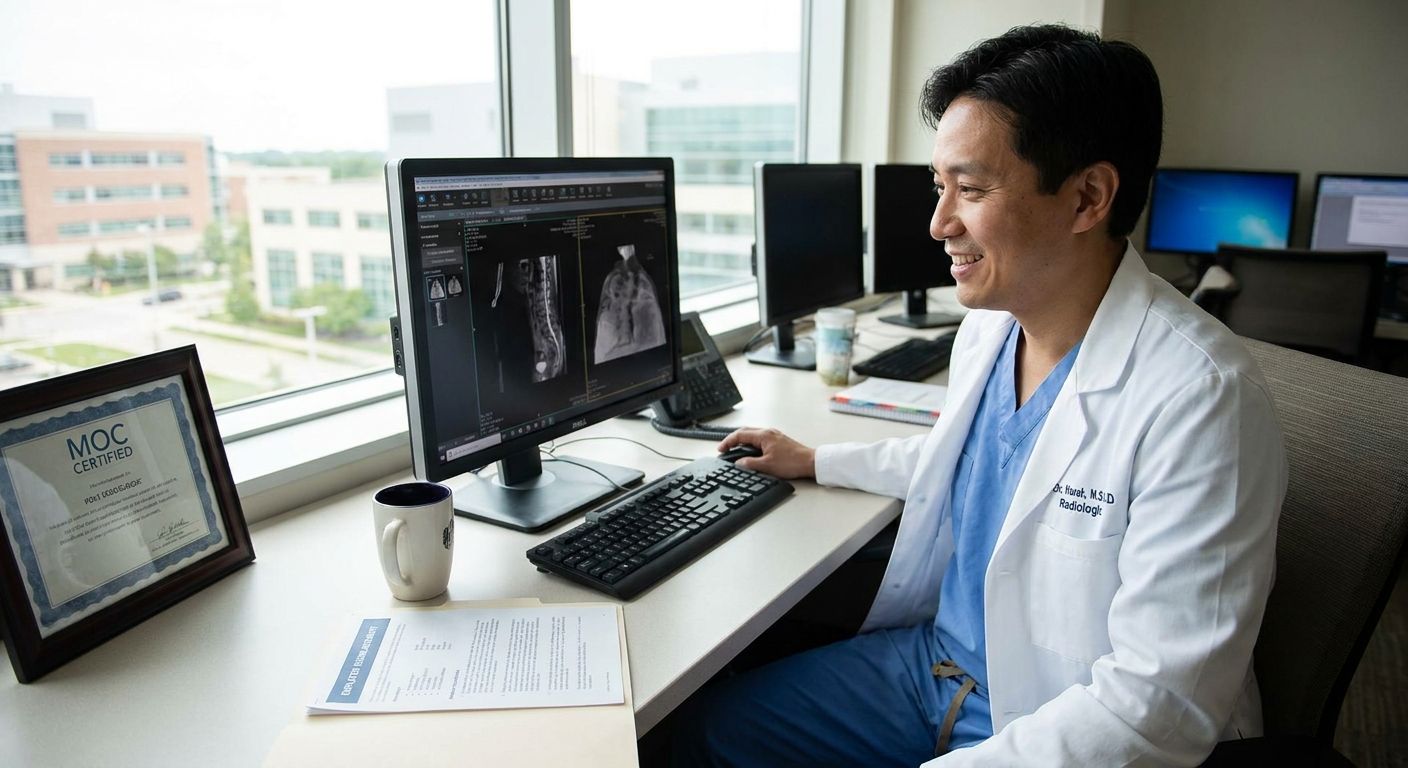
Employer-paid MOC exam reimbursement is the line item most radiology job seekers skip during salary negotiation — and the one that costs the most over a 20-year career. This guide ranks the employer types most likely to cover Continuous Certification costs outright in 2026, with a verdict on each.
- VA hospital radiology jobs and academic radiology jobs lead on employer-paid MOC exam reimbursement in 2026 -- Buy.
- Hospital-employed radiology jobs bundle reimbursement into CME allowances, but caps vary widely -- Consider and verify in writing.
- Private practice partnership-track jobs rarely cover Continuous Certification costs upfront -- Skip unless it's written into the offer.
- RadBoard aggregates 5,000+ radiology jobs from 20 sources, which makes filtering for MOC-covered employers faster than checking listings one by one.
Why this matters
The American Board of Radiology moved most diplomates onto Continuous Certification years ago, replacing the old ten-year recertification exam with ongoing assessment and periodic fees. Whoever pays those fees — you or your employer — is a real number on your total compensation, not a footnote.
Searching RadBoard's radiology job search platform for employer-paid MOC language turns up a clear pattern: certain employer types build it into the offer by default, and others leave it out unless you ask. Knowing which is which before you negotiate saves you from finding out the hard way at renewal time.
Most radiologists never ask about MOC reimbursement in the first interview. By the time it comes up, the offer is already anchored on base salary and RVU targets, and the benefit gets treated as an afterthought. That's backwards — it should be a screening question, not a closing one.
How this list is ranked
Employer types below are ranked by how consistently MOC and Continuous Certification reimbursement appears as a standard benefit rather than a negotiated exception, based on benefit patterns across radiology postings tracked in 2026. Federal and academic employers publish benefit structures openly; private practice and staffing arrangements vary contract to contract, so those land lower on consistency even when individual offers are competitive.
Each entry gets a verdict — Buy, Consider, or Skip — based on how reliably that employer type covers the cost without you having to fight for it.
The ranked list
1. VA hospital radiology jobs — the federal safety net
Federal employment carries a standardized benefits structure that typically includes licensure, board fees, and certification maintenance costs as part of the compensation package rather than a discretionary perk. VA hospital radiology jobs apply the same federal benefits framework across facilities, so what one VA site offers on MOC reimbursement, most others do too.
The tradeoff is base salary, which runs below top private-practice offers in most markets. For a radiologist who values predictability over ceiling, that's an acceptable trade. Verdict: Buy.
2. Academic radiology jobs — the tenure-track ally
Academic medical centers fold certification maintenance into faculty development budgets alongside CME funding, because keeping faculty board-certified is a hospital accreditation requirement, not a favor. Academic radiology jobs for teaching and research physicians commonly list MOC and licensure costs as covered line items in the offer letter.
Compensation trails private practice by a meaningful margin in most 2026 postings, but the certification support is close to guaranteed rather than negotiated. Verdict: Buy.
3. Hospital-employed radiology jobs — the steady bundle
Large health systems increasingly fold MOC exam fees into a broader CME and professional development allowance rather than listing it as its own line. Hospital-employed radiology jobs for physicians wanting stability tend to advertise a total dollar allowance — often covering conferences, journal subscriptions, and certification fees together — rather than reimbursing MOC as a standalone benefit.
The catch: that combined allowance has a hard annual cap, and if you also travel for CME, the MOC fee competes with conference budget in the same bucket. Ask for the specific cap in writing before you count on it. Verdict: Consider.
4. National imaging center chains — the corporate policy
Multi-site imaging chains run standardized HR policies across dozens of locations, and Continuous Certification reimbursement often shows up as a fixed corporate benefit rather than something a local site director negotiates. Radiology jobs at national imaging center chains typically publish these policies in an employee handbook rather than the offer letter itself, which means the benefit exists but you won't see the dollar figure until after you sign.
That opacity is the tradeoff for consistency. Ask HR for the written policy before final signature, not after. Verdict: Consider.
5. Private practice partnership-track jobs — the buy-in play
Partnership-track private practice groups pay well once you're a partner, but pre-partner associates frequently cover their own board maintenance costs out of pocket during the buy-in period. Private practice radiology jobs built around partnership tracks tend to treat MOC reimbursement as a post-partnership perk rather than a day-one benefit, on the logic that associates are already earning less during the vesting years.
If certification cost coverage matters to you now, this employer type makes you wait for it. Verdict: Skip unless the practice explicitly writes pre-partner MOC coverage into the associate contract.
6. Teleradiology companies — the mixed bag
Corporate teleradiology employers vary more than any other category here. Some larger platforms bundle certification cost coverage with their remote-work benefits package as a retention tool in a competitive hiring market; smaller regional teleradiology groups often don't mention it at all. Best teleradiology companies to work for as a remote radiologist differ enough on this specific benefit that you have to ask directly rather than assume parity with the last teleradiology offer you saw.
Verdict: Consider, and confirm in writing before comparing offers on salary alone.
Comparison table
| Employer type | MOC/Continuous Certification reimbursement | Bundled with CME allowance | Verdict |
|---|---|---|---|
| VA hospital | Standard federal benefit | Often separate | Buy |
| Academic center | Standard faculty benefit | Sometimes separate | Buy |
| Hospital-employed | Usually covered | Usually bundled | Consider |
| National imaging chain | Corporate policy, varies by site | Bundled | Consider |
| Private practice (partnership track) | Rare pre-partnership | Rarely bundled | Skip |
| Teleradiology company | Inconsistent | Varies | Consider |
Where to find these jobs
Three sourcing rules cut the search time down:
- Filter by employer type first, benefit second. Federal and academic postings state MOC or certification support openly in the job description far more often than private practice listings do.
- Ask before you apply, not after you're offered. A five-minute email to HR or the recruiter confirming MOC reimbursement policy saves a negotiation headache three interviews later.
- Cross-reference against the CME allowance. A CME allowance and conference stipend that explicitly names board certification costs is worth more than a vague "professional development fund" line.
With 5,000+ radiology positions aggregated from 20 sources, filtering by these criteria across VA, academic, and hospital-employed postings takes minutes instead of hours of manual cross-checking each job board separately.
Find MOC-covered radiology jobs faster
Search 5,000+ radiology jobs from 20 sources and filter by benefit type.
FAQ
What is MOC exam reimbursement in radiology jobs?
MOC exam reimbursement is an employer benefit that covers the cost of American Board of Radiology Continuous Certification fees and related assessment costs. In 2026 it's most commonly bundled into a broader CME or professional development allowance rather than paid as a standalone line item.
Which radiology employers pay for MOC exams?
VA hospitals and academic medical centers are the most consistent about covering Continuous Certification costs, since federal benefits structures and faculty development budgets typically include it by default. Hospital-employed and national imaging chain positions often cover it too, but usually through a capped combined CME allowance.
Do private practice radiology jobs cover MOC costs?
Rarely for pre-partnership associates. Most partnership-track private practice groups treat certification cost coverage as a post-buy-in benefit, so ask specifically about pre-partner coverage before signing.
Is MOC reimbursement the same as a CME allowance?
No, though many employers bundle them. A CME allowance funds conferences and courses, while MOC reimbursement specifically covers Continuous Certification assessment fees -- and a combined allowance can run out before both are paid.
How do I ask about MOC reimbursement in a job interview?
Ask HR or the recruiter directly whether Continuous Certification fees are reimbursed and whether that's separate from the CME allowance. Get the answer in writing in the offer letter, not verbally in the interview.
Do teleradiology companies reimburse MOC exam fees?
It varies by company more than any other employer type in radiology. Some larger teleradiology platforms include certification cost coverage as a retention benefit, while smaller regional groups often leave it out entirely, so confirm before comparing offers.
Does the VA pay for radiologist board certification maintenance?
VA hospital radiology jobs apply standardized federal benefits that commonly include certification maintenance support across facilities. The tradeoff is a base salary that typically runs below top private-practice markets in 2026.
One last thing
The employers most consistent about MOC exam reimbursement in 2026 — VA hospitals and academic centers — are also the ones with the lowest base salaries on this list. If certification cost coverage is the deciding factor, run the math on the actual dollar value of that benefit against the salary gap before you assume it's the better offer.
That gap is usually smaller than radiologists expect once you add up several years of Continuous Certification fees, conference costs, and licensure renewals that a private-practice offer would otherwise leave you to cover.