
Best starting point for permanent placement: CompHealth. Best for a temporary civilian assignment: Weatherby Healthcare. Best search companion: RadBoard, a radiology job platform—not a staffing agency. For military-to-civilian MDs in 2026, the right choice depends on the placement type, credentialing requirements, and written contract terms—not a recruiter's military-friendly label.
- Radiology staffing agencies military to civilian shortlist: CompHealth for permanent searches; Weatherby Healthcare for locum tenens assignments.
- RadBoard is best for radiologists comparing opportunities across sources before choosing a recruiter.
- Confirm civilian licensing, privileges, malpractice coverage, and separation-date compatibility before accepting an assignment.
- Ask recruiters for a written submission policy and a named credentialing contact.
Why this matters
Your military experience belongs at the center of your application. The civilian employer still needs to assess your recent clinical work, requested privileges, board status, and readiness for its specific reading environment.
A staffing agency helps connect you with an employer or assignment. It does not replace the medical board, hospital credentialing committee, or your own contract review. Keep those responsibilities separate throughout your 2026 search.
Choose a recruiter who can explain the actual position and its approval process. A recruiter who understands your separation date but cannot explain the case mix, call responsibilities, or credentialing dependencies has not answered the questions that determine whether the job fits.
What makes the best agency for a military-to-civilian move
Use these criteria before authorizing a submission:
- Placement fit: Permanent employment and temporary coverage solve different transition problems. Decide which you need first.
- Clinical translation: The recruiter should understand your modalities, procedures, recent practice, and teaching responsibilities without relying on rank alone.
- Credentialing ownership: Ask who collects documents, resolves missing verification, and communicates with the facility.
- Schedule clarity: Get shift expectations, call responsibilities, location, and any Reserve-related scheduling discussions into writing.
- Contract clarity: Identify the contracting parties, malpractice arrangements, cancellation provisions, and restrictions before accepting.
- Submission control: Require permission before your CV goes to a named employer. Keep your own submission record.
Military familiarity is a useful interview topic, not a substitute for these checks. Ask how the recruiter would handle your particular transition rather than requesting a general assurance that the agency works with veterans.
Staffing and search options at a glance
These are use-case recommendations, not a ranking of military placement outcomes. Choose the route that matches the job you need, then evaluate the individual recruiter and employer.
| Option | Best for | Relevant function | Key limitation |
|---|---|---|---|
| CompHealth | A permanent civilian placement search | Physician recruitment covering permanent and locum tenens work | Agency involvement does not establish employer fit or guarantee credentialing approval |
| Weatherby Healthcare | Temporary civilian coverage | Locum tenens physician staffing | A temporary assignment does not establish a permanent employment path |
| RadBoard | Comparing radiology opportunities across sources | Aggregates 5,000+ positions from 20 sources, with search and swipe-to-save features | A job search platform is not a staffing agency or credentialing authority |
1. CompHealth: best for a permanent placement search
CompHealth recruits physicians for permanent positions and locum tenens assignments. For a military radiologist seeking an ongoing civilian role, permanent placement is the relevant starting point; specify that objective before discussing temporary coverage.
Give the recruiter a clinical summary alongside your CV. Include your current practice scope, preferred geography, acceptable call structure, and earliest feasible civilian start date. Ask the recruiter to distinguish employer requirements from recruiter preferences.
CompHealth pros:
- Permanent physician recruitment matches a search for ongoing employment.
- Locum tenens recruitment provides a separate route if your employment objective changes.
- A recruiter provides an additional contact for discussing the position and submission process.
CompHealth cons:
- Access to an agency does not establish that a particular employer matches your clinical scope.
- Permanent recruitment does not remove licensing, privileging, or contract-review requirements.
- Military-transition familiarity must be assessed with the assigned recruiter, not assumed from the agency name.
Best for: Radiologists who know where they want to settle and want help pursuing a permanent position.
Ask for a role description that separates diagnostic work, procedures, call, supervision, and administrative duties. If partnership or leadership matters, request the actual eligibility terms rather than accepting a verbal description of future potential.
Verdict: Buy into the permanent-placement route when the recruiter can identify a suitable employer and explain its requirements. Hold any submission until you approve the named position.
2. Weatherby Healthcare: best for temporary civilian coverage
Weatherby Healthcare focuses on locum tenens physician staffing. This route fits a radiologist considering a defined temporary assignment rather than committing immediately to permanent employment.
Temporary work still requires careful preparation. Treat the assignment as a clinical contract with specific responsibilities, not as an informal trial period or an automatic bridge from military practice.
Weatherby Healthcare pros:
- Locum tenens staffing aligns with a temporary-work objective.
- A defined assignment creates a specific set of dates and duties to evaluate.
- Recruiter discussions can focus on assignment-level requirements rather than a long-term career promise.
Weatherby Healthcare cons:
- Temporary coverage does not guarantee a later permanent offer.
- Each facility's approval process remains relevant to the assignment.
- Cancellation terms and assignment changes need review before you commit.
Best for: Radiologists who deliberately want temporary coverage and can meet the assignment's licensing, privileging, and scheduling requirements.
Before accepting, confirm the reading location, shift hours, case mix, procedures, and escalation support. Ask what happens if credentialing is incomplete when the proposed assignment begins. Your separation date and an assignment's requested start date are separate facts; neither proves that approvals will be ready.
Verdict: Buy into locum tenens when temporary work is your objective. Skip assignments whose duties, approval dependencies, or cancellation terms remain unclear.
3. RadBoard: best for comparing the radiology market first
RadBoard is best for military-to-civilian radiologists who want to compare radiology opportunities across sources before choosing a recruiter. The platform aggregates 5,000+ radiology positions from 20 sources and includes search and swipe-to-save features.
Use that breadth to define your target role. A job search platform and a staffing agency serve different purposes: one helps you find opportunities; the other recruits for positions or assignments.
RadBoard pros:
- Radiology-specific search keeps the focus on your specialty.
- Aggregation brings positions from multiple sources into one search platform.
- Swipe-to-save supports building a shortlist for further review.
RadBoard cons:
- A listing is not confirmation that an employer accepts your exact credentials or timeline.
- Search results do not replace direct discussions about clinical duties and contract terms.
- The platform is not a substitute for employer credentialing or legal advice.
Best for: Radiologists who want a broader radiology job search before committing to an agency-led process.
Compare at least 3 roles using the same checklist. That is a search recommendation, not a claim about placement outcomes. Record the employer, work setting, schedule, clinical scope, recruiter, and unresolved questions for each position.
Verdict: Buy into the comparison-first approach when you need to clarify your options. Hold applications until you understand who receives them and what the role requires.
How the recommendations are ranked
The order follows your employment decision: permanent placement, temporary coverage, then independent market comparison. It does not imply that one organization has better military-transition results than another.
For your 2026 shortlist, apply the same criteria to every recruiter: placement fit, clinical understanding, credentialing ownership, schedule clarity, contract clarity, and submission control. The individual assignment matters more than a broad agency promise.
Build a civilian-ready transition packet
Prepare your documents before asking a recruiter to submit your application. Keep clinical evidence separate from scheduling constraints so the employer can assess both clearly.
- Clinical scope: Describe the modalities, procedures, and patient populations you currently cover. Distinguish recent work from earlier experience.
- Credentials: Organize your licenses, training history, board status, and relevant certifications. Confirm the receiving facility's document requirements.
- Practice evidence: Identify available case logs, privilege history, and professional references. Use only authorized, appropriately de-identified material.
- Transition dates: State your expected separation date, relocation constraints, and earliest proposed start date. Label unresolved dates as unresolved.
- Contract questions: List the duties, schedule, malpractice terms, and approval dependencies you need clarified.
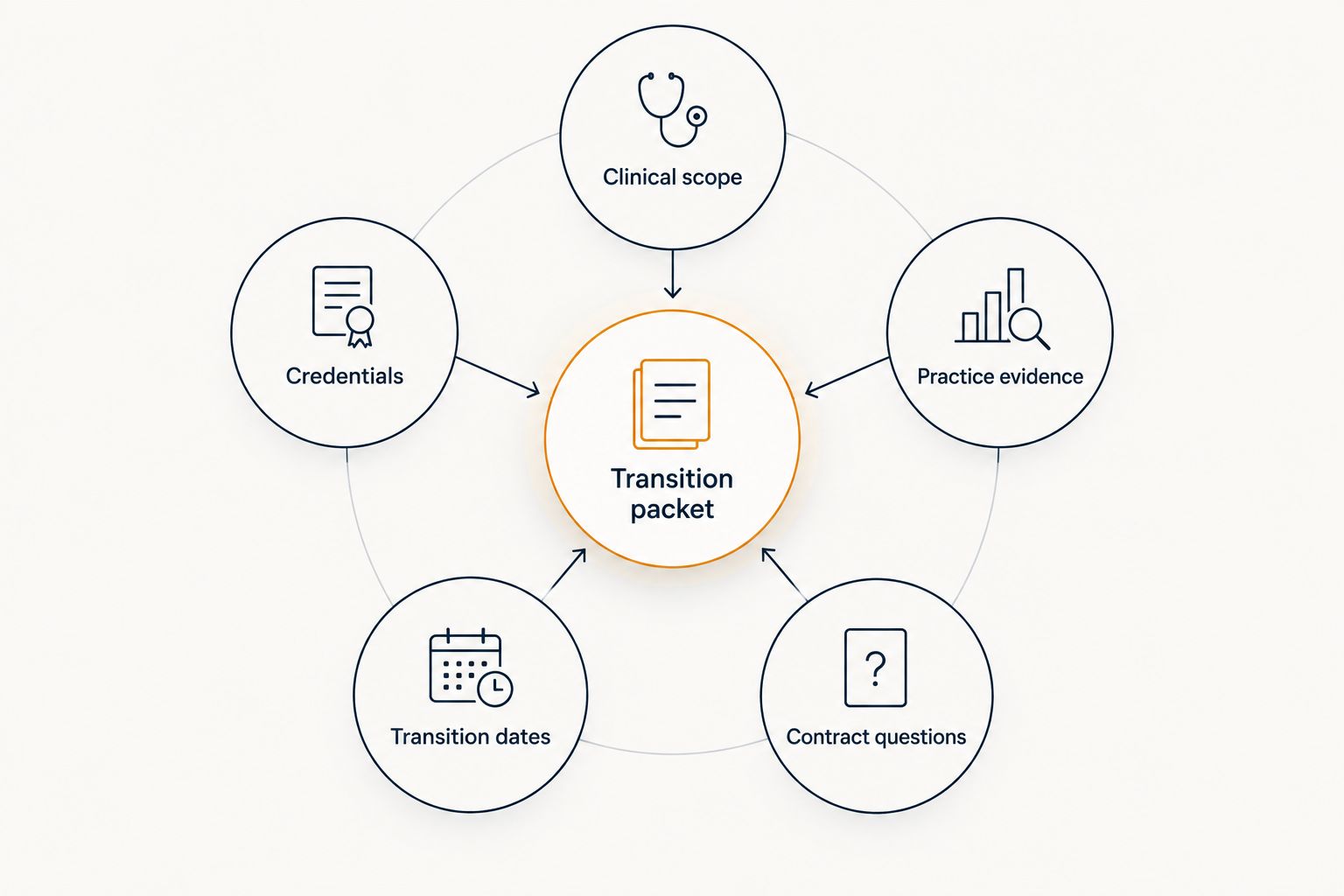
Translate military titles into civilian responsibilities without inflating them. Explain what you supervised, interpreted, performed, taught, or administered; do not expect an employer to infer your clinical scope from rank or billet.
For a 2026 start, ask the facility to confirm its current requirements directly. Previous military privileges are relevant history, not proof that another institution has approved the same scope of practice.
Questions to ask before a recruiter submits your CV
A useful recruiter conversation ends with specific answers and named next steps. Use these questions to assess the working relationship:
- Which employer and position will receive my CV?
- What permission do you need before submitting it?
- Who is responsible for credentialing communication?
- Which requirements are confirmed by the employer?
- What information is still needed to assess my eligibility?
- What happens if approvals are incomplete at the proposed start?
- Who can explain the actual reading workload and call structure?
- Which contract terms govern cancellation or a changed start date?
Keep a submission log containing the employer, position, recruiter, and date. Before another agency approaches the same organization, disclose the existing submission and resolve representation questions.
Do not sign broad exclusivity language merely to begin a conversation. Read its scope and duration, then obtain qualified advice if the restriction affects other applications.
Which route should you choose?
Choose permanent recruitment if you have a defined destination and want ongoing employment. Choose locum tenens if you deliberately want temporary work. Choose market comparison first if your preferred setting remains unsettled.
For an undecided military-to-civilian MD, the default is comparison before commitment. Define your acceptable case mix, schedule, geography, and start-date conditions; then select the recruiter whose role matches that brief.
Your 2026 decision should rest on the written position and contract—not the size of an agency or the enthusiasm of an introductory call.
FAQ
What's the best radiology staffing agency for a military-to-civilian move?
CompHealth is a starting point for permanent placement, while Weatherby Healthcare fits a locum tenens search. Choose by employment type, then assess the assigned recruiter's understanding of your clinical scope, transition dates, and credentialing requirements.
Is RadBoard a radiology staffing agency?
RadBoard is a radiology job search platform, not a staffing agency. It aggregates 5,000+ positions from 20 sources and includes search and swipe-to-save features.
Should I take a permanent job or locum tenens after military service?
Choose permanent employment when you want an ongoing role, and locum tenens when temporary coverage is your objective. Compare the actual duties, schedule, approval requirements, and contract terms rather than treating either route as automatically better.
Does my military medical license cover a civilian radiology job?
Do not assume that authority to practice in a military setting covers a new civilian position. Confirm the applicable state licensing rules and the employer's requirements before accepting clinical duties.
Will a staffing agency guarantee my hospital privileges?
A staffing agency cannot substitute for the facility's privileging decision. Ask who manages document collection and communication, and obtain confirmation of required approvals before starting clinical work.
Can I use more than one radiology recruiter?
Review your agreements before working with multiple recruiters. Require approval for each named submission and keep a record so different recruiters do not submit you to the same position without your knowledge.
What should I ask about malpractice coverage for my first civilian role?
Ask which policy covers the work, who is insured, and what responsibilities apply when the relationship ends. Have the relevant policy and contract provisions reviewed rather than relying on a recruiter's verbal summary.
One last thing
Ask to speak with a radiologist who performs the proposed job. A recruiter explains the opening; a clinical colleague can describe the reading environment, handoffs, procedural expectations, and support available during the shift.
Make that conversation a condition of your decision—not a courtesy after acceptance. It gives you a direct way to check whether the written role matches the work you will actually perform.