
Best overall for hands-on clinical responsibility: interventional radiology. Best for outpatient imaging plus procedures: breast imaging. Best for broad diagnostic practice: body imaging. In 2026, RadBoard is best for radiologists comparing career opportunities across multiple sources, with 5,000+ radiology positions aggregated from 20 sources.
- Among the best radiology subspecialties for job security, interventional radiology ranks first for hands-on treatment responsibilities.
- Breast imaging combines diagnostic interpretation, patient communication, and image-guided procedures.
- Neuroradiology and body imaging suit radiologists who want clinically integrated diagnostic careers.
- RadBoard supports radiology job searches; assess the actual responsibilities behind each subspecialty title.
- No subspecialty guarantees employment security. Compare clinical scope, employer stability, and sustainable workload.
Why this matters
Choosing a fellowship based on a promise of being automation-proof is the wrong decision rule. A subspecialty describes your expertise; an employment contract determines what you actually do, which services you support, and how your workload changes.
For your 2026 search, separate image interpretation from the rest of the job. Procedures, protocol decisions, patient discussions, multidisciplinary consultation, and management of complications are distinct responsibilities. An image-analysis function is not equivalent to the whole clinical role.
This guide ranks 6 subspecialties by those responsibilities, not by measured unemployment rates or predictions of physician replacement. Use it to identify the practice model you want, then evaluate individual employers.
What makes the best radiology subspecialty for job security?
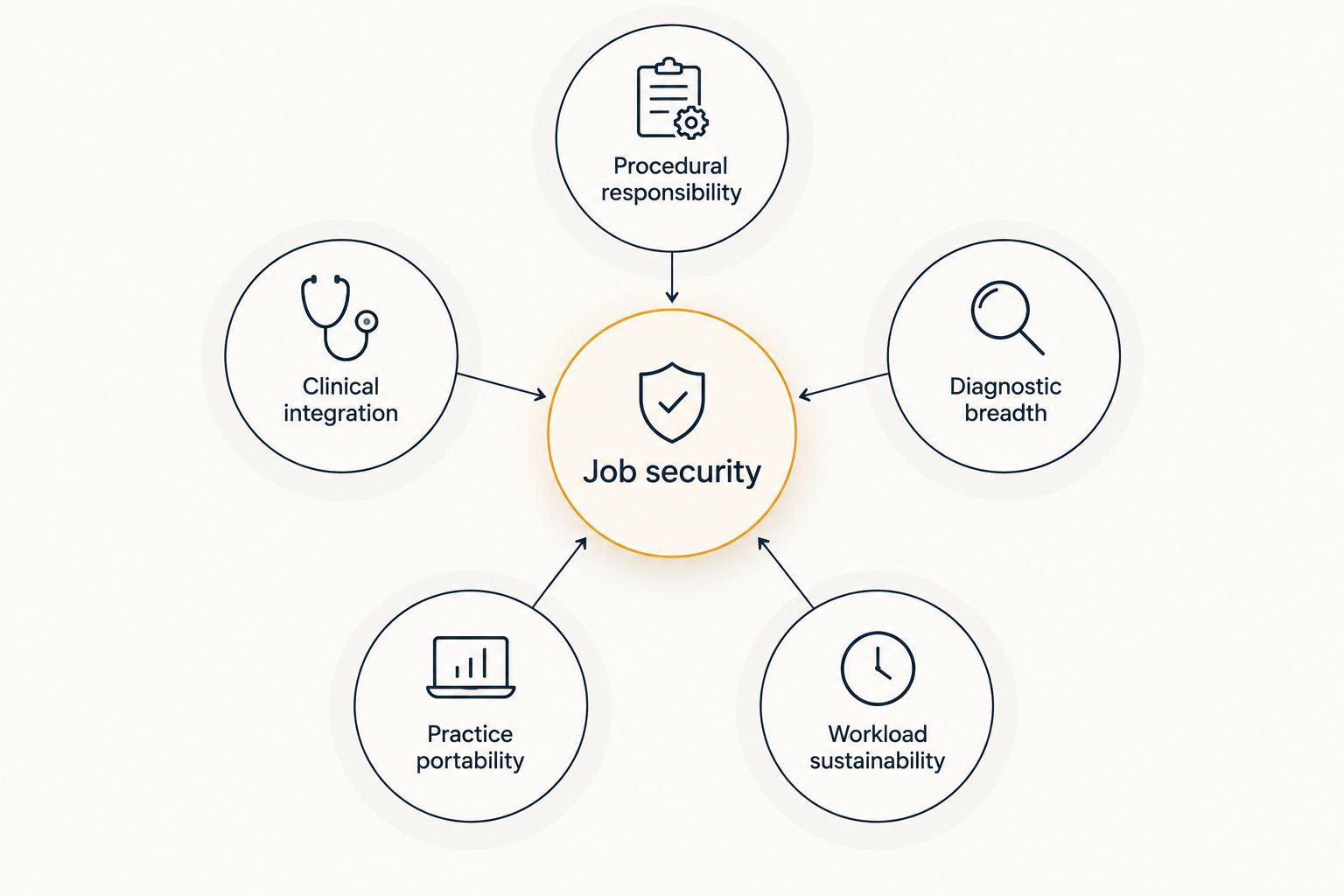
Use these 5 criteria before choosing a fellowship or accepting an attending position:
- Procedural responsibility: Does the role include performing procedures and managing patients before and afterward?
- Clinical integration: Do referring teams depend on your consultation, not just your report?
- Diagnostic breadth: Can your expertise support several clinical services and imaging modalities?
- Practice portability: Can you use your skills across different practice settings without depending on one narrow service?
- Workload sustainability: Can you maintain the required call, pace, and patient-care responsibilities over your career?
These criteria create different winners. Interventional radiology ranks first for procedural responsibility; body imaging is the default for diagnostic breadth. Neither choice overrides your aptitude or the quality of the employer.
Radiology subspecialties at a glance
This 2026 ranking is a decision guide based on clinical scope. It is not a forecast of hiring demand, compensation, or displacement by automation.
| Rank and subspecialty | Best for | Standout responsibility | Key limitation |
|---|---|---|---|
| 1. Interventional radiology | Hands-on treatment | Procedures and peri-procedural patient management | Onsite work and procedural call |
| 2. Breast imaging | Outpatient patient-facing practice | Diagnostic assessment, biopsy, and patient communication | Procedure roles require onsite coverage |
| 3. Neuroradiology | Neurologic consultation | Brain, spine, and head-and-neck interpretation | Reading-only jobs lack procedural responsibilities |
| 4. Pediatric radiology | Children's hospital practice | Age-specific imaging and protocol decisions | Dedicated practice settings restrict location choices |
| 5. Body imaging | Broad diagnostic careers | Abdominal and pelvic imaging across clinical services | Workload depends heavily on the assigned case mix |
| 6. Musculoskeletal radiology | Orthopedic referral practice | MRI interpretation and image-guided procedures | A narrowly defined reading role limits clinical scope |
1. Interventional radiology: best for hands-on treatment
Interventional radiology combines imaging with minimally invasive treatment. The clinical role includes patient selection, consent, procedural execution, and management before and after an intervention—not simply identifying an abnormality.
That makes interventional radiology the first choice in this ranking for radiologists who want treatment responsibilities. The distinction is the work itself, not a claim that every interventional position is secure.
Interventional radiology pros:
- Includes hands-on procedures that image-analysis software does not perform.
- Connects imaging findings directly to treatment decisions.
- Supports consultation and longitudinal care when the practice includes a clinical service.
Interventional radiology cons:
- Requires onsite access to procedural facilities and support staff.
- Call and complication management add responsibilities beyond scheduled procedures.
- A mixed diagnostic/interventional job does not guarantee a substantial procedural workload.
Best for: Radiologists who want patient management and procedures to remain central to their career.
Before accepting a 2026 offer, ask who controls referrals, whether clinic time is supported, and how diagnostic coverage competes with procedures. Obtain a clear description of the intended clinical service rather than relying on an interventional title.
Verdict: Buy into interventional radiology for treatment-focused practice; skip it if avoiding procedures and call is your priority.
2. Breast imaging: best for outpatient patient-facing practice
Breast imaging includes screening, diagnostic workups, ultrasound, MRI, and image-guided tissue sampling. In a patient-facing practice, the radiologist also explains findings and coordinates next steps.
The strongest fit for this guide is a role that combines interpretation with diagnostic assessment and procedures. A remote screening-only position is a different job, even when both positions carry the breast imaging label.
Breast imaging pros:
- Combines interpretation with diagnostic problem-solving and biopsy.
- Includes direct patient communication in onsite diagnostic practice.
- Connects radiologists with breast surgery, pathology, and oncology teams.
Breast imaging cons:
- Procedures and direct patient assessment require onsite participation.
- Screening-heavy positions offer a narrower scope than full diagnostic practice.
- Patient discussions and procedure schedules need time separate from reading targets.
Best for: Radiologists who want outpatient work with a defined patient-facing and procedural component.
Ask how screening, diagnostic examinations, MRI, and biopsies are distributed. Confirm who communicates results and whether those responsibilities are recognized in scheduling. Do not compare a full-service breast position with a screening-only job as though the workloads are equivalent.
Verdict: Buy into full-service breast imaging if you want outpatient clinical responsibility; hold on screening-only offers until the role is clear.
3. Neuroradiology: best for neurologic consultation
Neuroradiology covers imaging of the brain, spine, and head and neck. Its consultative role includes reconciling imaging findings with neurologic symptoms, prior examinations, and the clinical question.
Diagnostic neuroradiology and neurointerventional practice are separate choices. Do not assume a diagnostic fellowship or reading position includes endovascular treatment responsibilities.
Neuroradiology pros:
- Supports clinical decisions across neurology, neurosurgery, and related services.
- Includes complex MRI interpretation and longitudinal comparison.
- Offers a defined diagnostic focus without requiring a procedural career.
Neuroradiology cons:
- Reading-only positions do not include the treatment responsibilities of interventional practice.
- Acute hospital coverage brings time-sensitive communication and shift demands.
- A subspecialty title does not guarantee protected consultation or conference time.
Best for: Radiologists who prefer complex diagnostic work and interaction with neurologic care teams.
For a 2026 neuroradiology search, compare a hospital-integrated role with a remote reading role on responsibilities, not prestige. Ask whether the job includes tumor boards, protocol decisions, postoperative imaging consultation, and acute coverage. Match the service expectations to your preferred schedule.
Verdict: Buy into neuroradiology for diagnostic depth and clinical consultation; skip the assumption that the title alone protects employment.
4. Pediatric radiology: best for children's hospital practice
Pediatric radiology applies age-specific anatomy, disease knowledge, and imaging techniques to infants, children, and adolescents. Protocol decisions include selecting suitable examinations and considering radiation exposure and the child's ability to complete the study.
The career fit is strongest when you want to work within pediatric care. Do not choose it solely as a defensive response to automation.
Pediatric radiology pros:
- Requires age-specific interpretation and examination planning.
- Connects radiologists with pediatric medical and surgical teams.
- Supports a broad pediatric practice spanning different organ systems and modalities.
Pediatric radiology cons:
- Dedicated pediatric practice ties your search to appropriate institutions and services.
- The role includes communication and coordination needs distinct from adult practice.
- A narrowly specialized pediatric position limits the range of jobs that match your experience.
Best for: Radiologists committed to children's hospital or pediatric-focused care.
Ask about the balance between general pediatric imaging and focused work such as pediatric neuroradiology. Confirm how ultrasound, fluoroscopy, emergency coverage, and protocol responsibilities are assigned. Your preferred location matters: a strong professional fit still needs a suitable local employer.
Verdict: Buy into pediatric radiology if pediatric care is your long-term direction; skip it as a purely defensive fellowship choice.
5. Body imaging: best for broad diagnostic practice
Body imaging focuses on abdominal and pelvic disease using modalities including CT, MRI, and ultrasound. Its clinical scope connects radiologists with oncology, surgery, gastroenterology, urology, and other services.
For the undecided diagnostic radiologist, body imaging is this guide's default. It offers a broad clinical base without making procedural work the defining requirement.
Body imaging pros:
- Supports several referring specialties rather than one clinical service.
- Combines cross-sectional imaging with longitudinal disease assessment.
- Includes opportunities for protocol development, consultation, and image-guided procedures where assigned.
Body imaging cons:
- The title covers substantially different workloads between employers.
- A production-focused reading role does not automatically include consultation or procedures.
- Preserving breadth requires continued experience beyond a narrow examination type.
Best for: Radiologists who want broad diagnostic practice with room to develop a focused interest.
Ask whether the position includes abdominal MRI, oncologic follow-up, ultrasound, and procedures—or primarily a general CT worklist. Confirm whether subspecialty expertise changes the assigned work. A fellowship label without a matching case mix does not deliver the career you selected.
Verdict: Buy into body imaging as the broad diagnostic default; hold on offers that cannot define the actual case mix.
6. Musculoskeletal radiology: best for orthopedic referral practice
Musculoskeletal radiology covers bones, joints, soft tissues, and related injuries and disease. Depending on the role and privileges, practice also includes arthrography, joint injections, and image-guided biopsy.
The differentiator is the combination of interpretation and orthopedic consultation. A narrow remote MRI role offers a different scope from an onsite position with procedures and referral-team contact.
Musculoskeletal radiology pros:
- Connects imaging interpretation with orthopedic treatment planning.
- Includes procedural work in appropriately structured practices.
- Offers a focused diagnostic career across MRI and other musculoskeletal imaging.
Musculoskeletal radiology cons:
- Procedure experience requires an employer that actually assigns those procedures.
- A sports-imaging focus is narrower than the full musculoskeletal field.
- Restricted case assignments reduce opportunities to maintain broader diagnostic skills.
Best for: Radiologists who want an orthopedic-focused diagnostic and procedural practice.
Ask which referring services the position supports and whether tumor, infection, postoperative, and trauma imaging are included. Confirm procedure access before treating it as part of the offer.
Verdict: Buy into musculoskeletal radiology for orthopedic integration; hold on narrowly defined reading roles until you understand their scope.
How this ranking works
The ranking prioritizes procedural responsibility and clinical integration, then diagnostic breadth, portability, and sustainable workload. It compares established clinical responsibilities; it does not measure future employment outcomes.
RadBoard radiology job searches help you compare opportunities across 20 sources. Treat the platform's 5,000+ positions as a search resource, not evidence that one subspecialty has better job security than another.
For each offer, request answers to 3 questions:
- Clinical scope: Which procedures, consultations, and patient-care duties belong to you?
- Employer dependence: Which facilities and referral services does the position support?
- Workload changes: Who approves changes to case assignments, coverage, and performance targets?
Record the answers alongside the contract terms. Compare actual responsibilities rather than counting attractive phrases in advertisements.
Which radiology subspecialty should you choose?
Choose interventional radiology if treatment responsibilities are the priority; choose body imaging if you want the broad diagnostic default. Breast imaging is the outpatient patient-facing choice, while neuroradiology, pediatric radiology, and musculoskeletal radiology suit their respective clinical interests.
In 2026, choose the field whose demanding work you want to keep doing. Training for a role you dislike is not a sound response to uncertainty about technology.
RadBoard radiology job searches support the next step: compare how employers define that field. Reject an offer that depends on duties, privileges, or protected clinical time the employer will not clarify.
FAQ
What's the best radiology subspecialty for job security?
Interventional radiology ranks first in this guide for hands-on treatment responsibilities. That is a comparison of clinical scope, not a guarantee of employment security; employer stability and workload still matter.
Is any radiology subspecialty safe from automation?
No subspecialty should be selected on a promise of immunity from automation. Compare the complete role, including procedures, patient management, consultation, and interpretation, rather than treating image analysis as the whole job.
Is breast imaging a better choice than neuroradiology?
Breast imaging is the better fit for outpatient patient-facing work with diagnostic assessment and biopsy. Neuroradiology is the better fit for radiologists who prefer neurologic imaging and consultation; the choice depends on your intended clinical role.
What's the best choice if I don't want a procedural career?
Body imaging is this guide's default for a broad diagnostic career. Neuroradiology and musculoskeletal radiology are alternatives for a more focused clinical interest; verify the actual case mix before accepting a position.
Does working remotely make a radiology job less secure?
Remote location alone does not determine job security. Evaluate employer dependence, contract terms, case assignments, and clinical responsibilities; an onsite job is not automatically a stable job.
Should I choose a fellowship just to protect my career from automation?
No—choose a fellowship for clinical work you want to perform and skills you intend to maintain. Then assess whether available practice settings support that work and your preferred schedule.
How can RadBoard help me compare subspecialty careers?
RadBoard aggregates 5,000+ radiology positions from 20 sources and offers search and swipe-to-save features. Use it to identify opportunities, then confirm case mix, procedural responsibilities, and employment terms directly with each employer.
One last thing
A clinical responsibility only strengthens your role if the employer actually assigns it to you. A procedure listed in your training history is not the same as procedural privileges, scheduled time, referral access, and support in your next job.
Before signing a 2026 contract, ask for those details. The useful question is not which fellowship sounds hardest to automate; it is which responsibilities the practice expects you to own.