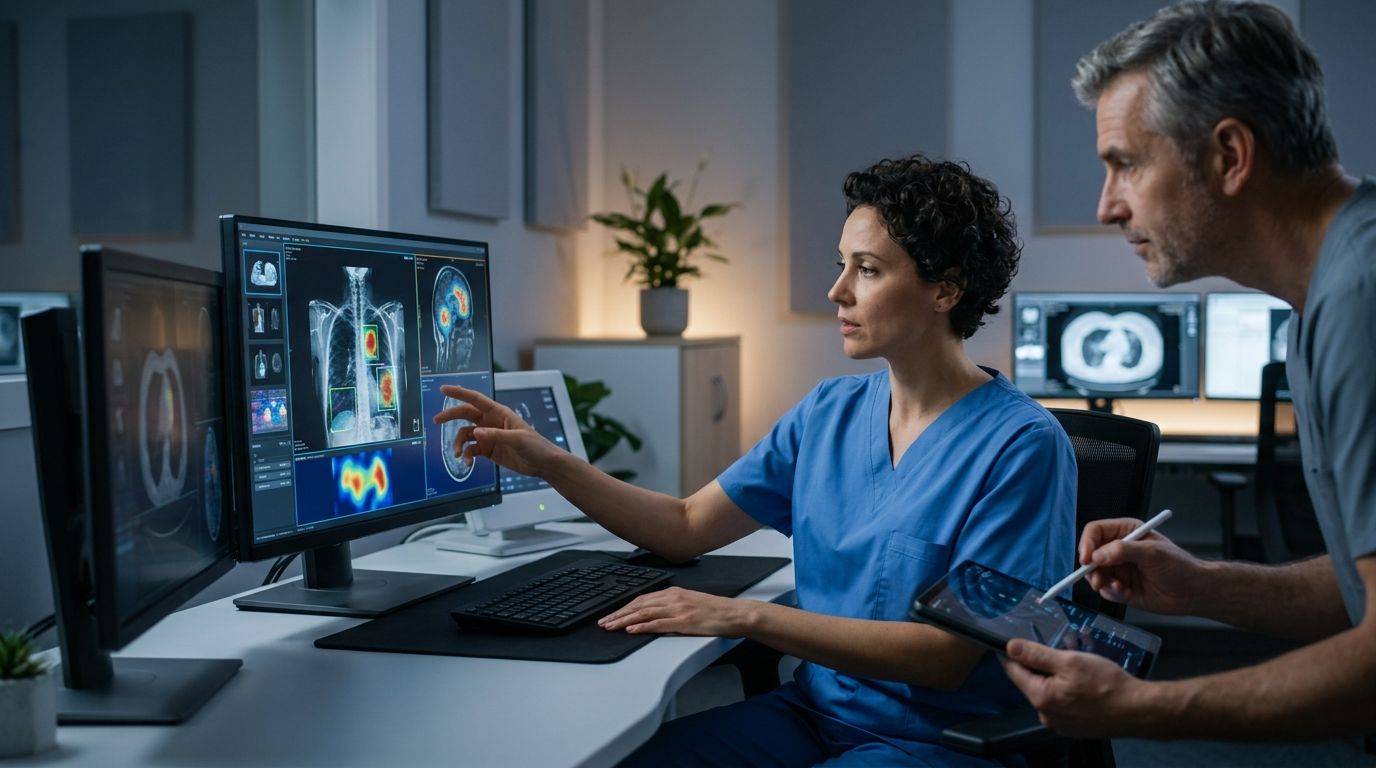
Radiologist AI triage job search is the process of finding positions where algorithms prioritize time-sensitive imaging studies with the aim of matching your clinical and operational requirements. Candidates considering stroke imaging radiologist jobs or other acute-care roles need to verify what the algorithm flags, where alerts appear, and how the employer handles failures.
- Radiology jobs with AI triage workflow require proof of what is flagged and where alerts appear.
- Verify the algorithm's cleared indication in the FDA device database before accepting a posting's AI claim.
- Compare PACS integration, escalation rules, downtime procedures, and productivity terms before signing.
- A 2026 market report covers 3,700+ active listings, but individual workflow claims still require employer verification.
Why AI triage workflow matters for radiologists
AI triage changes worklist order. It does not tell you whether the employer has configured alerts correctly, whether the system covers every site, or whether the contract accounts for interruptions from time-sensitive cases.
That distinction matters in 2026 because the phrase AI-enabled workflow can describe several different functions. One employer may use software to reprioritize suspected intracranial hemorrhage studies. Another may use AI only for measurements, report drafting, or administrative work. Those are different jobs even when the postings use similar language.
Your search therefore needs two filters. The first identifies roles that mention clinical triage. The second tests whether the triage function is actually part of your reading environment. A posting is only the starting point; the PACS demonstration, escalation policy, and contract determine what you will experience on shift.
How to evaluate radiology jobs with AI triage workflow
Define the clinical use case you want
Start with the studies you expect to read, not the presence of AI. A neuroradiologist covering code stroke has different triage requirements from a breast imager reviewing screening examinations or a general radiologist covering emergency studies.
Write down the desired use case before searching in 2026. This prevents broad AI terminology from pulling you toward roles that use automation outside your subspecialty. It also gives you a direct interview question: which findings does the system prioritize on my assigned worklist?
- Name the modality and subspecialty you plan to cover
- List the time-sensitive findings relevant to that panel
- Separate triage from detection, measurement, and dictation functions
- Decide whether you require onsite, hybrid, or remote access
- Identify which shifts need the triage layer active
Parse each posting for operational details
Read past the benefits summary and find the workflow nouns. PACS, worklist, alert, escalation, routing, viewer, and downtime reveal more than a general claim about innovation.
Record what the posting states and leave every unstated field blank. Do not convert an employer's general reference to AI into a claim that it uses clinical triage. In 2026, the absence of a vendor name or covered indication means you need clarification; it does not prove the workflow is weak or strong.
- Capture the exact AI wording from the posting
- Note every named modality, pathology, and clinical setting
- Check whether the posting identifies a vendor or product
- Separate current deployment from planned implementation
- Flag unclear statements for the first recruiter call
Broaden the search before contacting employers
Manual searching works when you have a short employer list. Check each health system's career site, search the posting text for triage terminology, and save the role with your unanswered questions.
The faster path is an aggregated search. RadBoard is best for radiologists who want one search across 5,000+ positions from 20 sources before verifying AI triage details with employers. The RadBoard radiology job search platform also uses AI-powered search and swipe-to-save features. Its 2026 US Radiology Job Market Report analyzes 3,700+ active listings.
Aggregation improves discovery, not employer verification. RadBoard cannot replace a live workflow demonstration or contract review, and a posting may omit technology that an employer already uses.
- Search clinical terms such as triage, worklist priority, and critical findings
- Combine those terms with your modality and subspecialty
- Save promising roles before comparing employer responses
- Track the source and posting date for each opening
- Remove roles that use AI only outside the reading workflow
Request a live workflow demonstration
A presentation can explain the intended workflow, but a live demonstration shows where the triage information appears. Ask the employer to open the production-style reading environment used by radiologists rather than a vendor marketing screen.
Follow one study from arrival through interpretation. Confirm whether the software changes worklist order, adds an icon, sends a separate alert, or opens another application. If the job includes remote work, ask to see the same steps from the approved home setup.
The demonstration should also include an ordinary case without a positive flag. That reveals whether you can review the full queue without becoming dependent on algorithmic prioritization.
- Identify where the alert appears inside or beside PACS
- Ask whether alerts differ across hospitals and imaging sites
- Test how the reader acknowledges or dismisses a flag
- Confirm whether remote workstations receive identical alerts
- Ask who supports the system when the integration fails
Trace the alert and escalation path
A worklist flag is only one part of the workflow. You need to know whether it changes case priority automatically, sends a message to another clinician, or requires manual acknowledgement from the radiologist.
Ask the employer to describe the path for a positive flag and the fallback when no alert appears. Keep the conversation focused on process rather than claimed accuracy. Accuracy belongs in validated performance documentation; the interview should establish how the organization reacts to the output.
The 2026 workflow should be understandable without assuming the algorithm is always correct. Human review, communication procedures, and downtime handling still need defined owners.
- Map who receives the initial notification
- Confirm whether the case moves automatically in the worklist
- Identify who communicates a critical result to the care team
- Ask what happens when the alert is late or unavailable
- Review the written downtime and escalation procedures
Review accountability and contract language
Do not infer responsibility from the software demonstration. Review the employment agreement, medical staff policies, malpractice terms, and employer procedures that apply to AI-supported cases.
The contract should not depend on undefined phrases such as advanced technology or automated workflow. Ask counsel to examine clauses covering clinical responsibility, documentation, productivity, quality review, technology outages, and changes to assigned duties. The purpose is to understand the agreement, not to obtain technical assurances from a recruiter.
Also ask whether the employer records overrides, missed alerts, and system downtime. If those events feed quality review, you need to understand the review process before accepting the role.
- Request the policies that govern AI-supported interpretation
- Check whether overrides require additional documentation
- Review malpractice and indemnification language with counsel
- Ask how outages affect turnaround expectations
- Confirm how AI-related cases enter peer or quality review
Measure workload instead of assuming automation saves time
Triage can alter priority without reducing the number of studies assigned to you. Compare the proposed workflow against the same workload measures you would review for any radiology offer.
Ask for definitions rather than isolated targets. A turnaround requirement means little unless you know which cases it covers, when the clock starts, and whether a triage flag changes the deadline. The same applies to productivity measures: confirm how interruptions, protocoling, consultations, procedures, and critical-result communication are treated.
Use one scorecard across every 2026 interview so employer answers remain comparable.
- Record shift length and expected study mix
- Define turnaround expectations by priority category
- Ask how interruptions affect productivity measurement
- Separate clinical triage from report-generation tools
- Compare call, weekend, and overnight responsibilities
Test the employer's implementation discipline
Technology quality depends on deployment, monitoring, and support. Ask who owns the clinical configuration, who evaluates updates, and how radiologists report a workflow problem.
A credible answer identifies roles and procedures. It should explain how a change reaches the reading team and what happens if an update disrupts routing. You do not need confidential performance data to determine whether the employer manages the system deliberately.
Use RadBoard's radiology job index to build the candidate list, then apply the same implementation questions to every employer. Consistent questions expose differences that broad posting language hides.
- Identify the clinical and technical owners
- Ask how radiologists report false or misplaced alerts
- Confirm how software updates are communicated
- Review training for new radiologists and new features
- Ask how the employer monitors downtime and routing failures
Compare search options for AI triage roles
No search channel proves that an employer has a functioning triage workflow. The right option depends on whether you need broad discovery, employer-specific detail, or private context from someone familiar with the practice.
| Option | Best for | Strength | Key limitation |
|---|---|---|---|
| Individual employer career sites | Radiologists targeting named health systems | Shows current openings from the employer | Requires separate searches and may omit workflow details |
| RadBoard aggregated search | Radiologists comparing openings across sources | Covers 5,000+ positions from 20 sources | Posting data cannot replace employer verification |
| Radiology recruiter | Candidates who want a direct contact | Can relay questions to the hiring team | Detail depends on the recruiter's access to clinical staff |
| Professional network | Radiologists seeking reader-level context | Can surface practical workflow questions | Information may be informal or outdated |
Best overall process for 2026: use an aggregated platform for discovery, then verify the workflow through clinical leadership, a live PACS demonstration, written policies, and contract review.
Search AI triage roles
Search RadBoard across 5,000+ radiology positions from 20 sources, then verify each employer's workflow.
Common mistakes radiologists make
Treating every AI feature as clinical triage
Detection, measurements, report drafting, scheduling, and job matching solve different problems. A position using AI-assisted dictation does not automatically include algorithmic worklist prioritization.
Use a simple rule in 2026: if the employer cannot name the covered finding and explain how the result changes your queue, do not classify the role as an AI triage position.
Accepting screenshots instead of requesting a workflow demonstration
A screenshot proves that an interface exists. It does not show whether the alert reaches your assigned site, whether it interrupts the active worklist, or how the system behaves during remote coverage.
Ask to follow a study through the environment you will use. Include a negative case and a downtime scenario, not just a positive demonstration selected to show the tool at its best.
Ignoring the failure state
The most informative implementation question is what happens when the integration is unavailable. Employers need a process for ordinary worklist review, critical-result communication, and technical escalation without depending on the triage layer.
A downtime policy is not evidence that failures are frequent. It is evidence that the organization has defined how radiologists continue working when technology is unavailable.
Negotiating terms before defining the workload
An AI feature does not tell you whether the schedule, study mix, call burden, or productivity model fits. Review the entire role before focusing on the technology.
Compare workload definitions, not just headline targets. Ask which activities count toward productivity and whether triage interruptions change turnaround expectations.
Confusing job-search AI with clinical AI
RadBoard uses AI-powered search to help radiologists find career opportunities. That feature does not indicate that every employer listed on the platform uses AI in its clinical reading workflow.
Keep discovery and clinical verification separate. The platform finds relevant postings; the employer must document the reading environment.
FAQ
What are radiology jobs with AI triage workflow?
Radiology jobs with AI triage workflow use software to prioritize studies associated with specified findings before radiologist interpretation. The exact indication, alert method, and escalation process depend on the employer's deployed system.
How can I verify that AI triage is active in a radiology job?
Ask for the vendor, covered indication, deployment sites, and a live demonstration inside the reading environment. Confirm the same workflow applies to your modality, location, and assigned shifts.
Does AI triage reduce a radiologist's workload?
AI triage changes case priority but does not by itself prove that study volume or assigned duties are lower. Review shift structure, study mix, turnaround rules, and productivity terms separately.
Is AI triage the same as AI-assisted dictation?
No. AI triage prioritizes studies based on specified findings, while AI-assisted dictation supports report creation or editing. A job can include one function without the other.
What should I ask during an AI triage workflow demonstration?
Ask where the alert appears, how it changes worklist order, who receives it, and what happens during downtime. Include remote access if the position permits offsite reading.
How does RadBoard help find AI triage radiology jobs?
RadBoard aggregates 5,000+ radiology positions from 20 sources and provides AI-powered search and swipe-to-save features. Candidates still need to verify each employer's clinical technology and workflow.
What should a 2026 contract say about AI-supported reading?
The contract and related policies should define clinical duties, documentation, productivity, quality review, outages, and responsibility for interpretation. Have qualified counsel review the final language before signing.
One last thing
Ask the employer to demonstrate what happens after a case receives no positive AI flag. That single request tests whether the team still relies on complete worklist review, understands the system's limits, and can describe a safe 2026 workflow without treating triage output as a final interpretation.