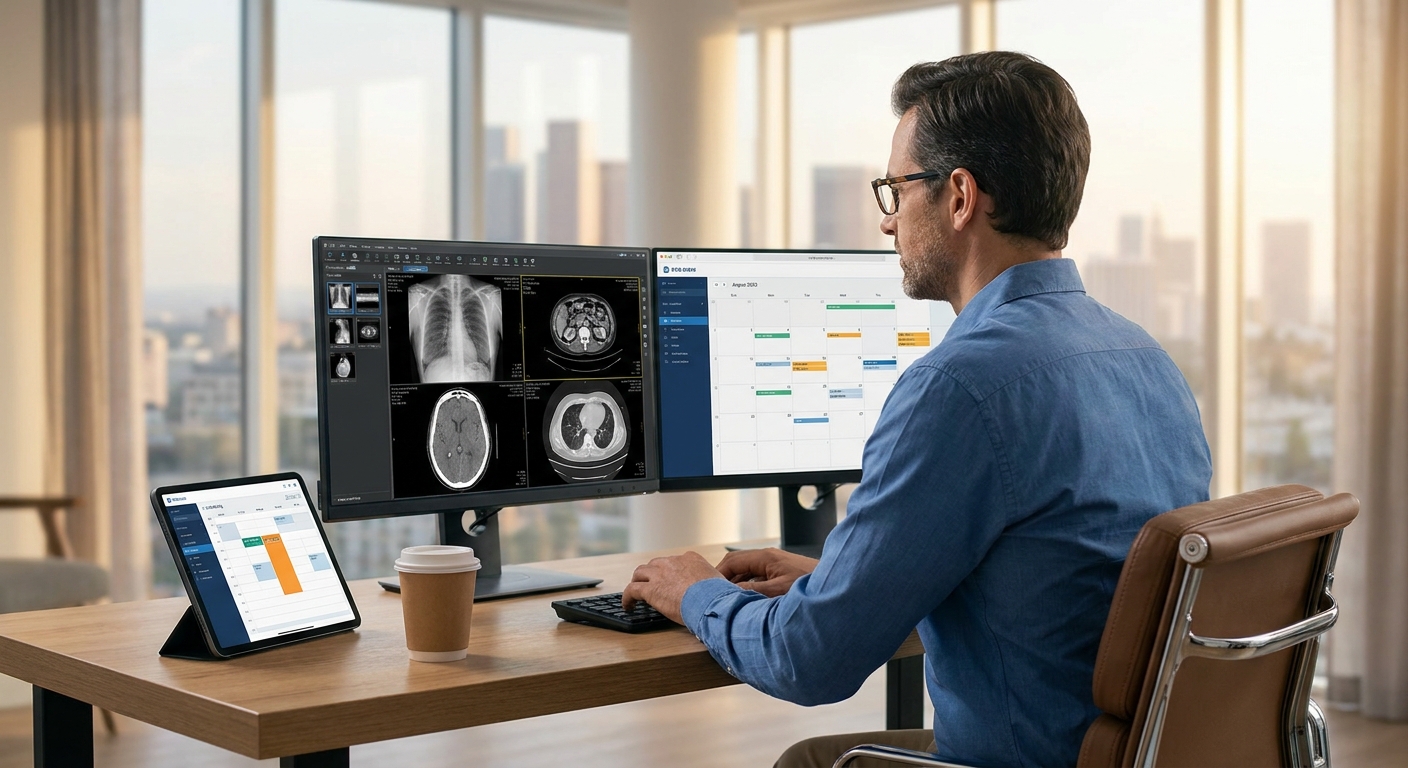
Per diem teleradiology sounds simple until you hit the credentialing paperwork: state licenses, payer enrollment, malpractice tail coverage, and a shift-minimum clause buried in the contract. The platform you pick determines whether "flexible" means real control over your calendar or a euphemism for mandatory weekend coverage.
- Radiology Partners Teleradiology (formerly vRad) is the largest per diem network for overnight and weekend volume in 2026: Buy.
- Real Radiology, the 2021 merger of StatRad and Real Radiology backed by RadNet, gives outpatient-heavy readers steadier per diem blocks: Buy.
- USARAD Holdings works if you want lower shift minimums but a thinner subspecialty menu: Hold.
- In-house hospital telerad pools rarely offer true per diem flexibility — most require FTE status: Skip.
Why this matters
Radiologist demand hasn't slowed. RadBoard's 2026 US Radiology Job Market Report, built from 3,700+ active listings, shows subspecialty demand and remote-reading volume both climbing, and per diem teleradiology is the fastest way to add income or coverage flexibility without a second W2. The catch is that "telehealth radiology platform" covers everything from a national network reading 24/7 emergency volume to a five-person subspecialty group filling gaps between contracts.
RadBoard's radiology job search platform aggregates 5,000+ positions from 20 sources, which is the fastest way to see which teleradiology networks are actively posting per diem roles right now versus which ones only show static career pages. That distinction matters more than brand name recognition.
How the list was built
This ranking weighs four factors: network size and case volume, subspecialty read availability, disclosed shift structure (per diem versus FTE-only), and ownership stability. Teleradiology has consolidated hard since 2010 — mergers and private equity roll-ups changed several brand names on this list at least once. Where a platform's per diem terms aren't publicly disclosed, that's noted rather than guessed at.
Radiologists evaluating any of these should read the actual contract before assuming "per diem" means what it meant at the last one. Shift minimums, RVU floors, and credentialing timelines vary enough between networks that the label alone tells you almost nothing.
The ranked list
1. Radiology Partners Teleradiology (formerly vRad) — the volume leader
vRad launched in 2001 and became one of the largest teleradiology networks in the US before folding into Radiology Partners' teleradiology division in 2021. It still reads for thousands of client facilities across overnight, weekend, and overflow volume, which means per diem radiologists get consistent shift availability without waiting for seasonal demand spikes.
The tradeoff is scale: onboarding and credentialing at a network this size typically takes longer than a boutique group, and subspecialty-only reads are harder to guarantee shift-to-shift. If you want volume and don't mind general-radiology mix, this is the deepest bench available in 2026. Verdict: Buy.
2. Real Radiology — the steadier outpatient pick
StatRad and Real Radiology merged in 2021 under RadNet backing, creating a network with strong outpatient imaging center ties rather than pure overnight emergency volume. That matters for per diem radiologists who want daytime or early-evening blocks instead of nocturnist hours.
The RadNet affiliation gives this network access to a steady outpatient case mix — mammography, MSK, body — which subspecialists can lean into for per diem shifts that don't require overnight availability. Verdict: Buy.
3. USARAD Holdings — the lower-barrier entry
USARAD has run teleradiology services for decades with a smaller footprint than the two networks above. Shift minimums here tend to run lower, which makes it easier to pick up occasional per diem coverage without committing to a recurring block schedule.
The subspecialty menu is thinner, and case volume per shift is generally lower than the larger networks, so this works better as a supplement to a primary job than as a standalone income source. Verdict: Hold.
4. Synergy Radiology Associates — the subspecialist's side door
Synergy is a Houston-based subspecialty teleradiology group covering neuro, body, and MSK reads for hospital and outpatient clients. It's smaller than the national networks, which means fewer open per diem slots at any given time, but it's also one of the few groups built around subspecialty-only reading rather than general call coverage.
If your fellowship training is your differentiator and you don't want general-rad mixed in, this fits better than a volume-first network. Availability is the constraint, not fit. Verdict: Hold.
5. Telerad Tech (DirectRad) — the wait-and-watch
Telerad Tech runs a global remote-reading network used by hospitals for overflow and after-hours coverage. Its per diem structure for US-licensed radiologists is less standardized publicly than the domestic networks above, and shift terms appear to be negotiated more individually than posted as fixed blocks.
That's not disqualifying, but it means more upfront negotiation before you know what "per diem" actually gets you here. Confirm shift minimums and payer credentialing timelines before treating this as a drop-in option. Verdict: Wait.
6. In-house hospital telerad pools — the flexibility trap
A growing number of health systems run their own internal teleradiology pools instead of contracting a national network. The pitch sounds like per diem flexibility, but most of these pools are staffed by FTE radiologists picking up extra internal shifts, not open to true per diem outside hires.
If a health system markets an in-house telerad program as "flexible per diem," ask directly whether external per diem contracts exist at all before applying. Many don't. Verdict: Skip.
“If a teleradiology contract requires more than 120 days of credentialing before your first shift, the per diem flexibility isn't real yet.”
Comparison table
| Platform | Founded / Merged | Best for | Per diem structure | Verdict |
|---|---|---|---|---|
| Radiology Partners Teleradiology (vRad) | 2001, merged 2021 | Overnight/weekend volume | Standing per diem shift pool | Buy |
| Real Radiology | 2021 merger, RadNet-backed | Outpatient-heavy readers | Steadier daytime blocks | Buy |
| USARAD Holdings | Legacy teleradiology provider | Occasional supplemental shifts | Lower shift minimums | Hold |
| Synergy Radiology Associates | Houston-based subspecialty group | Subspecialty-only reads | Slot-based, limited volume | Hold |
| Telerad Tech (DirectRad) | Global remote-reading network | Overflow/after-hours | Negotiated per contract | Wait |
| In-house hospital telerad pools | Varies by health system | Rarely true per diem | Usually FTE-only | Skip |
What to avoid
- "Flexible" job postings with no shift-minimum language. If the posting doesn't state a minimum number of shifts or an RVU floor, assume it's negotiable in the employer's favor, not yours.
- Networks that bundle credentialing costs into your first 90 days of pay. Ask upfront whether licensing and payer credentialing fees come out of early shift earnings.
- In-house telerad pools advertised through general job boards. Confirm the role is open to external per diem hires before applying — see the note above on hospital pools.
Where to find these roles
- Go straight to a network's own per diem career page rather than a generic board — most national networks post standing openings separately from FTE roles.
- Confirm credentialing timelines before signing anything; 60 to 120 days is typical across teleradiology networks in 2026, and that window eats into your first quarter of shifts.
- Use an aggregator like RadBoard to see which platforms are actively posting per diem openings right now versus maintaining a static "careers" page that hasn't changed in a year.
For a deeper walk-through of contract terms before you sign anything, read how to evaluate a teleradiology contract before signing.
Find per diem radiology openings
Search 5,000+ listings from 20 sources on RadBoard.
FAQ
What's the best telehealth radiology platform for per diem work in 2026?
Radiology Partners Teleradiology (formerly vRad) offers the deepest per diem shift pool in 2026 due to its national volume, with Real Radiology a close second for outpatient-heavy readers who want daytime blocks instead of overnight coverage.
Is per diem teleradiology better than a locum tenens contract?
Per diem teleradiology usually means shorter, more frequent shift commitments than locum tenens, which typically runs weeks to months on-site or remote. Choose per diem for supplemental income around an existing job, locum tenens for filling a full staffing gap.
How much credentialing time do telehealth radiology platforms require?
Credentialing for teleradiology per diem roles commonly takes 60 to 120 days once state licensing and payer enrollment are factored in. Networks that skip this disclosure upfront are worth questioning before you sign.
Can subspecialists find per diem-only shifts in teleradiology?
Yes, but availability is limited compared to general-read volume. Groups like Synergy Radiology Associates focus on subspecialty-only reads, though open per diem slots turn over less frequently than at large general networks.
Do telehealth radiology platforms require licensure in every state you read for?
Yes, teleradiology generally requires an active medical license in the state where the patient is located at the time of the read, regardless of where the radiologist sits. This is the single biggest driver of onboarding delays.
Is nighthawk coverage the same as per diem teleradiology?
Nighthawk coverage refers specifically to overnight emergency reads, while per diem describes the shift-payment structure. A per diem contract can include nighthawk shifts, but not all nighthawk work is structured as per diem.
What happened to StatRad and NightHawk Radiology Services?
StatRad merged with Real Radiology in 2021 under RadNet ownership. NightHawk Radiology Services merged into Virtual Radiologic (vRad) back in 2010, and vRad itself became part of Radiology Partners' teleradiology division in 2021.
How do you compare per diem shift pay across platforms?
Compare RVU rate, shift-minimum requirements, and whether credentialing costs are deducted from early pay rather than base rate alone. Two platforms quoting similar per-shift rates can differ significantly once minimums and deductions are accounted for.
One last thing
Most radiologists working per diem teleradiology in 2026 aren't doing it as a standalone career — they're layering it on top of a primary academic or private practice job for supplemental income or subspecialty variety. Treat any platform that pitches per diem telehealth work as a full-time replacement with the same skepticism you'd apply to a base-salary-only job offer: check what's actually guaranteed before you count on it.