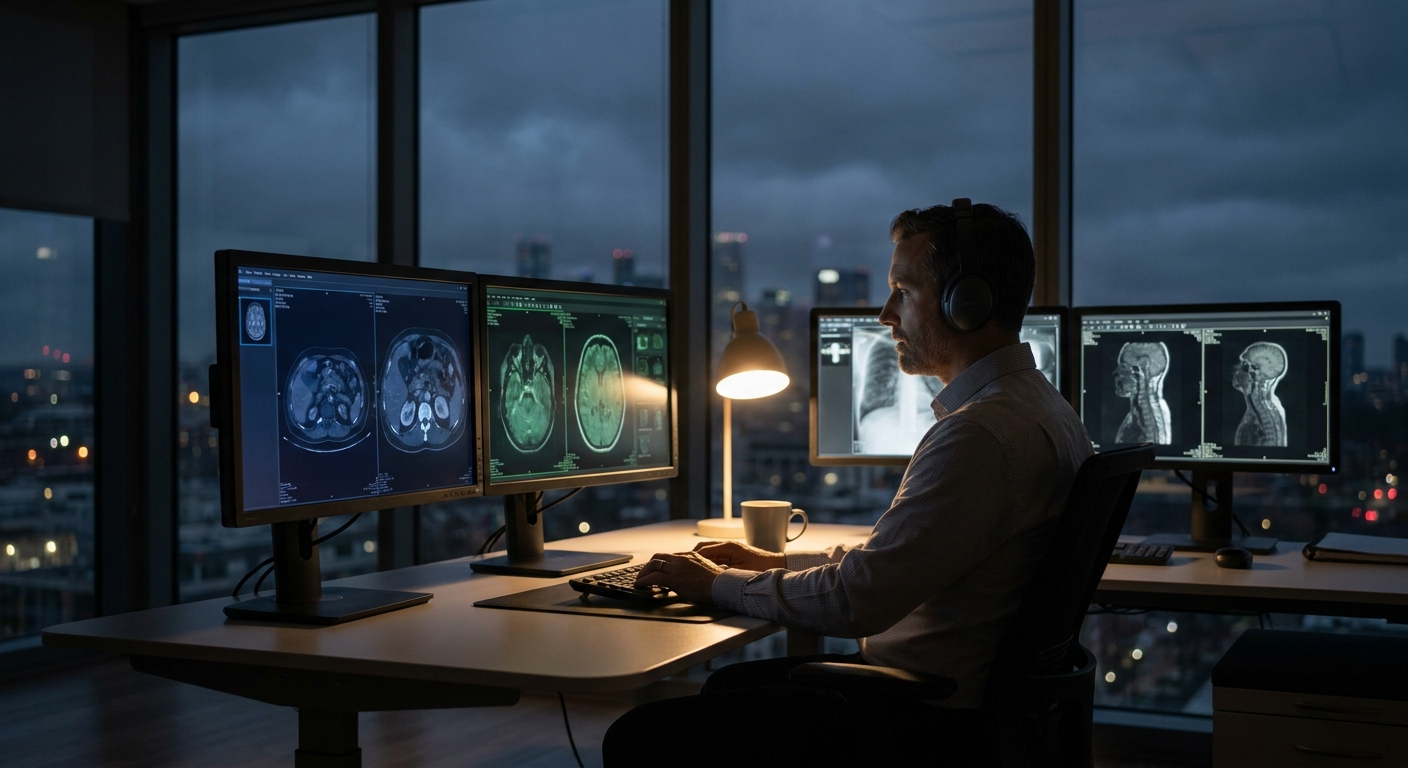
Nighthawk radiology jobs let you build a career entirely around overnight reads instead of squeezing them in as call coverage on top of a day schedule. This guide breaks down what separates a well-structured nighthawk position from a burnout trap, plus which overnight arrangements are worth pursuing in 2026.
- Teleradiology nighthawk coverage is the strongest entry point for physicians targeting nighthawk radiology jobs in 2026 — Buy.
- Neuroradiology overnight coverage pays a premium for stroke and trauma protocol reads — Consider if fellowship-trained.
- Part-time weekend/overnight hybrids suit physicians easing into night work — Consider.
- Avoid contracts with uncapped RVU volume and no defined turnaround-time ceiling — Skip.
Why this matters
Overnight radiology work isn't a niche anymore — teleradiology groups, academic centers, and hospital systems all run dedicated nighthawk lines because daytime radiologist supply can't cover 24/7 stroke and trauma protocols alone. The pay differential for confirmed overnight shifts is real, but so is the variance in contract quality: two postings both labeled nighthawk radiology jobs can mean a stable 7-on/7-off teleradiology schedule or an unpredictable on-call rotation with no volume cap. RadBoard tracks nighthawk and overnight-specific listings alongside the rest of its 5,000+ radiology positions, which makes side-by-side comparison possible instead of guessing from a single job board's phrasing.
Who this is for
This guide is for radiologists who actively want overnight or late-evening shifts — not physicians tolerating occasional call as a condition of a daytime job. That includes teleradiology-focused physicians building a fully remote career, parents and caregivers who need daytime hours free, moonlighters stacking a nighthawk shift onto a primary position, and subspecialists (neuro, body, MSK) who want to work overnight trauma and stroke volume at a premium rate rather than general daytime reads.
What to look for in nighthawk radiology jobs
Shift structure and call coverage model
A dedicated nighthawk line means your entire schedule is built around overnight hours — no daytime clinic, no rotating back to mornings mid-contract. Rotating on-call models that alternate nighthawk weeks with regular daytime duty look flexible on paper but wreck sleep cycles faster than a fixed schedule. Ask whether the position is a standing overnight block (e.g., 7pm-7am, 7-on/7-off) or a variable call rotation before you sign anything.
Compensation differential
Overnight radiology work should carry a clear premium over daytime base pay — either a flat night differential or a higher per-RVU rate for after-hours reads. If a posting doesn't specify the differential, that's a negotiating gap, not a bonus waiting to surprise you. Compare the stated overnight rate against daytime rates for the same subspecialty before assuming competitive means anything.
Reads-per-shift volume and turnaround expectations
Nighthawk coverage exists because stroke and trauma protocols need sub-20-minute turnaround at 3am, so volume and speed expectations are baked into the job. Ask for average studies-per-shift and the contractual turnaround-time (TAT) target — a shift with no stated cap can balloon during a bad night in the ED. A defined cap, even a soft one, signals the group has thought about physician burnout.
Licensing and credentialing footprint
Most nighthawk and teleradiology positions require multi-state licensure, often through the Interstate Medical Licensure Compact (IMLC), because coverage spans facilities in several states. Confirm which states are required now versus which might be added later in the contract term — a group that expands its client base can quietly expand your licensing obligations too.
Employment type
Nighthawk roles come as W-2 hospital employee, W-2 teleradiology group employee, or 1099 independent contractor, and each changes your tax position, malpractice coverage, and benefits access. 1099 nighthawk contracts often pay a higher headline rate but push malpractice tail coverage and self-employment tax onto you. Read the employment classification before comparing dollar figures across postings.
Subspecialty overnight demand
Neuroradiology, trauma/MSK, and general body imaging carry the heaviest overnight volume because stroke and trauma protocols run around the clock; screening mammography and most outpatient breast imaging do not. Matching your subspecialty to actual overnight demand determines whether you're negotiating from strength or taking whatever's posted.
Top picks for overnight-focused radiologists
Teleradiology nighthawk coverage — the safe pick. Fully remote, standing overnight blocks with defined TAT targets are the most common structured nighthawk arrangement in 2026, and licensing is usually handled or subsidized by the group. One spec that matters: confirm the stated turnaround-time ceiling in writing, not just fast reads. Verdict: Buy for physicians who want overnight work without relocating. Browse current listings through teleradiology jobs for radiologists who want remote flexibility.
Remote overnight staff radiologist roles — the flexibility pick. These blend nighthawk-style hours with a fuller remote employment package (benefits, PTO) rather than pure per-read contractor pay. The number that matters here is shift length — most remote overnight postings run 10-12 hour blocks rather than the shorter windows typical of pure nighthawk coverage. Verdict: Consider if you want benefits alongside night hours; check remote radiology jobs for physicians who want flexible schedules for current openings.
Neuroradiology overnight subspecialty coverage — the premium pick. Stroke protocol reads at 2am carry some of the highest per-study rates in radiology because the turnaround window is often under 20 minutes and the stakes are high. Fellowship training is typically required, and the volume is heavier than general nighthawk work. Verdict: Buy if you're fellowship-trained in neuroradiology and want the pay premium; see neuroradiology jobs for fellowship-trained radiologists.
Part-time weekend/overnight hybrid — the low-commitment pick. These combine weekend daytime shifts with occasional overnight blocks, giving you fewer total shifts per month rather than a full nighthawk schedule. The tradeoff is lower total volume and pay compared to a standing nighthawk line. Verdict: Consider as a bridge into full nighthawk work, or as a moonlighting supplement to a daytime job.
What to avoid
- Daytime jobs rebranded as flexible hours that quietly expect occasional overnight call without a stated differential — this is a daytime job with unpaid overnight risk, not a nighthawk position.
- Uncapped RVU nighthawk contracts with no defined volume ceiling or turnaround-time target — a slow night pays fine, a bad night in the ED can double your workload with no additional pay trigger.
- Breast imaging and screening mammography roles marketed as nighthawk — outpatient mammography has essentially no overnight demand, so a posting using that label is either mislabeled or describing something other than true overnight coverage. If mammography is your subspecialty, look at remote options instead through remote breast imaging jobs for mammography-trained radiologists.
Verdict comparison
| Option | Shift structure | Licensing burden | Pay differential | Verdict |
|---|---|---|---|---|
| Teleradiology nighthawk coverage | Standing overnight block | Multi-state, often subsidized | Defined night rate | Buy |
| Remote overnight staff radiologist | 10-12 hr remote block | Multi-state | Base + benefits | Consider |
| Neuroradiology overnight subspecialty | Standing block, high acuity | Multi-state | Premium per-study rate | Buy (fellowship-trained) |
| Part-time weekend/overnight hybrid | Variable, fewer shifts | Single or few states | Lower total volume | Consider |
FAQ
What are nighthawk radiology jobs?
Nighthawk radiology jobs are overnight reading positions, usually teleradiology-based, that cover emergency stroke, trauma, and general imaging for hospitals during off-hours. Shifts typically run standing overnight blocks rather than rotating on-call.
Do nighthawk radiologists get paid more?
Yes, nighthawk radiology positions typically carry a night differential or higher per-RVU rate than equivalent daytime reads in 2026. The exact premium varies by group and should be stated explicitly in the contract, not left as an assumed bonus.
Is nighthawk radiology remote?
Most nighthawk radiology jobs are fully remote through teleradiology groups, since overnight coverage doesn't require on-site presence for image review. Some hospital-employed nighthawk roles still require on-site or hybrid coverage depending on the facility.
What licenses do I need for nighthawk radiology jobs?
Nighthawk positions usually require licensure in every state where covered facilities are located, often streamlined through the Interstate Medical Licensure Compact. Confirm the current state list in the contract, since teleradiology groups can add facilities in new states over time.
How many studies do nighthawk radiologists read per shift?
Read volume varies by subspecialty and facility mix, but nighthawk contracts should state an expected studies-per-shift range and turnaround-time target. A contract with no stated cap is a red flag for uncontrolled overnight workload.
Is neuroradiology in higher demand for nighthawk coverage?
Yes, neuroradiology carries some of the heaviest overnight demand because stroke protocol reads require sub-20-minute turnaround around the clock. Fellowship-trained neuroradiologists typically command a premium rate for nighthawk coverage over general nighthawk positions.
Can I do nighthawk radiology part-time?
Yes, part-time and weekend/overnight hybrid arrangements exist alongside full nighthawk schedules, trading lower total shift volume for more flexibility. These work well as a bridge before committing to a full nighthawk contract or as a moonlighting supplement.
What subspecialties don't fit nighthawk work?
Screening mammography and most outpatient breast imaging have little to no overnight demand, so postings labeling these as nighthawk roles are typically mislabeled. Trauma, neuro, and general body imaging make up the bulk of genuine overnight volume.
One last thing
The biggest overnight pay traps in 2026 aren't low rates — they're missing turnaround-time caps. A posting can advertise a strong per-study rate and still turn into an unsustainable shift if the contract never defines a volume ceiling for a bad night in the ED. Read the TAT clause before the compensation line, not after.