
Best overall in 2026: a teleradiology offer with a guaranteed minimum and clearly defined per-read pay. Best for control over your schedule: a pure per-read arrangement with a documented case mix. Best for predictable hours: a fixed-shift contract. No named platform can be ranked by pay per read from the available information because no verified platform rate schedules are provided. RadBoard is best for finding radiology openings to compare, not for verifying what each employer pays per read.
- Best telehealth radiology platforms by pay per read cannot be ranked without verified employer rate schedules.
- A guaranteed minimum plus per-read pay is the strongest starting point for comparing teleradiology offers in 2026.
- RadBoard helps radiologists find openings across 5,000+ positions from 20 sources; confirm compensation with each employer.
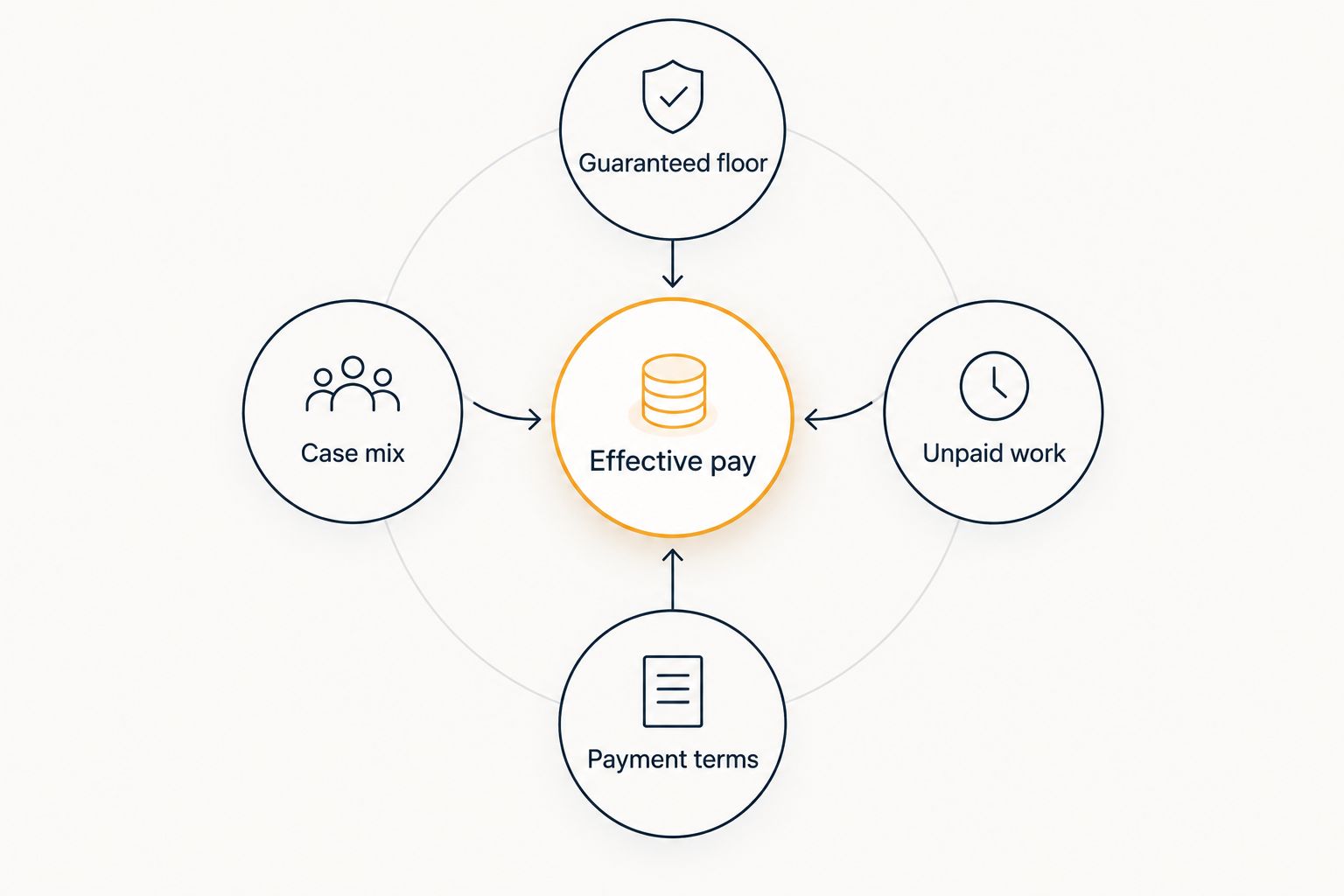
- Compare case mix, unpaid work and payment terms before treating any per-read figure as earnings.
Why this matters
A per-read figure is only one part of a radiologist's compensation. The contract also determines which studies count, whether procedures such as consultations are paid, how corrections are handled and who carries the cost of a home reading setup. The best offer is the one whose payment terms still make sense after you account for the work required to complete each case.
That distinction matters when you search for the best telehealth radiology platforms by pay per read. A job listing can describe remote work without stating a case rate. Another can advertise productivity-based compensation without defining the case mix. Neither gives you enough information to rank its pay against a competing offer.
RadBoard is a radiology job search platform, not a teleradiology reading service. It aggregates 5,000+ radiology positions from 20 sources and offers AI-powered search and swipe-to-save features. Use it to find roles; use written employer terms to compare compensation. RadBoard's 2026 US Radiology Job Market Report describes 3,700+ active listings, a separate stated scope that does not establish a per-read rate for any employer.
What makes the best pay-per-read arrangement
Assess the contract before you compare headline rates:
- Guaranteed floor: Does the agreement state what you receive when the assigned work is lighter than expected? A floor changes the risk you take when volume fluctuates.
- Case mix: Are rates defined by modality, study type, complexity and the work required to finish a report? A single blended figure hides those differences.
- Unpaid work: Does compensation cover preliminary reads, addenda, consultations, callbacks, peer review or quality tasks? Ask which activities count as payable cases.
- Payment terms: What event makes a read payable, and when is that payment recorded? Resolve rejected cases, duplicate studies and corrected reports in writing.
- Shift obligations: Must you cover set hours, respond within a stated window or remain available when the queue is empty? Compare the obligation with the pay structure.
- Operating costs: Establish who supplies the workstation, software access, licensing support and malpractice coverage. An attractive case rate does not answer those questions.
A platform name alone answers none of these. Request the compensation schedule and contract terms for the specific role and date under consideration in 2026. Do not apply one recruiter's description to every opening associated with an employer.
At a glance: the strongest contract structures
This is a ranking of ways to structure a teleradiology offer, not a ranking of named telehealth platforms. No verified, comparable platform-specific pay-per-read data is available here. Each row identifies what to examine when an employer provides actual terms.
| Rank and arrangement | Best for | Pay structure to check | Key limitation |
|---|---|---|---|
| Guaranteed minimum plus per-read pay | Radiologists seeking a defined floor with productivity upside | What triggers the minimum and how eligible reads add to compensation | A floor can come with schedule, volume or eligibility conditions |
| Pure per-read pay | Radiologists who prioritize control over accepted work | Rates for each study category and rules for payable reads | Earnings depend on available cases and uncompensated tasks |
| Fixed-shift pay | Radiologists who prioritize defined coverage hours | Shift duties, included workload and additional-read terms | The shift figure does not show effective pay per completed read |
The ranking favors terms you can inspect, not a claimed market-leading rate. A written floor takes first place only when its eligibility rules and the treatment of additional reads are clear. A vague guarantee is not better than a clear alternative.
1. Guaranteed minimum plus per-read pay: best for a defined floor
A guaranteed-minimum arrangement states a baseline payment for covered work, then specifies how eligible reads affect compensation. The contract must explain whether productivity pay starts on top of the minimum or only after a threshold. Those are different arrangements; do not treat the phrase minimum plus per-read as the full formula.
For a radiologist comparing remote roles in 2026, this is the best starting structure because the floor and the treatment of added work can both be checked in writing. It does not establish that any named platform offers the arrangement or pays more than another employer.
Guaranteed-minimum arrangement pros:
- Gives you a stated baseline to evaluate alongside workload obligations.
- Allows separate scrutiny of how additional reads are credited.
- Makes low-volume periods a contract question rather than an assumption.
Guaranteed-minimum arrangement cons:
- Eligibility conditions can limit when the floor applies.
- A productivity threshold can delay extra compensation.
- A guaranteed amount says nothing by itself about case complexity or unpaid duties.
Guaranteed-minimum arrangement compensation: Obtain the written floor, the definition of a payable read, any threshold and the treatment of work that falls outside a completed report. Compare the entire formula, not the largest figure in a recruiting message.
Best for: A radiologist who wants predictable baseline compensation while retaining a defined way to earn for additional eligible reads. Verdict: Buy only when the floor, eligibility rules and additional-read formula are explicit; otherwise, Hold.
2. Pure per-read pay: best for control over accepted work
Under a pure per-read arrangement, completed eligible studies determine compensation. That makes the definition of an eligible read central to the offer. Ask whether different modalities or study types carry different rates and whether reviewing prior imaging, discussing findings or issuing addenda is included in the original case payment.
This structure suits a radiologist who can assess both the likely work and the rules for accepting it. It ranks below a clearly defined guaranteed floor because no baseline payment is inherent in a pure per-read model. It can still be the better personal fit when its documented terms match the work you want to do.
Pure per-read arrangement pros:
- Links the stated compensation formula directly to eligible completed studies.
- Makes study-category definitions a concrete negotiation point.
- Lets you compare offers by the kinds of cases you expect to read, once the case mix is documented.
Pure per-read arrangement cons:
- A case rate does not guarantee that cases will be available.
- Calls, corrections and other required tasks can reduce effective compensation if they are not separately paid.
- A blended rate can obscure differences between study types.
Pure per-read arrangement compensation: Request the current written rate schedule, the payable-case definition and a description of required work outside routine interpretation. Ask how access to work is assigned; a rate schedule without a clear assignment process cannot establish what you will earn.
Best for: A radiologist comfortable assessing case mix and available work without relying on a guaranteed floor. Verdict: Hold until you can verify both the rate schedule and the work allocation terms; Skip an offer that will not define payable cases.
3. Fixed-shift pay: best for defined coverage hours
A fixed-shift arrangement compensates a specified coverage period rather than paying solely for each eligible read. To compare it with a per-read role, identify the required hours, assigned work, response expectations and tasks included in the shift. Then establish whether reads beyond the defined workload change compensation.
Fixed-shift pay belongs in this comparison because a radiologist searching by pay per read can otherwise dismiss an offer that fits their schedule. It ranks third for this specific query, not as a judgment of clinical work or employer quality: the contract's headline figure does not directly state compensation per completed case.
Fixed-shift arrangement pros:
- Sets a defined period of coverage to evaluate against your schedule.
- Separates the shift obligation from an unsupported claim about available case volume.
- Gives you a clear place to ask which non-reading duties fall inside paid time.
Fixed-shift arrangement cons:
- A shift payment alone cannot support a platform-by-platform per-read ranking.
- Workload and case complexity still need to be established.
- Additional-read terms can be unclear unless the contract addresses them.
Fixed-shift arrangement compensation: Obtain the written coverage hours, duties and terms for work outside the defined shift. Compare the offer as a shift commitment first; calculate a per-read equivalent only when you have a defensible count of eligible completed cases.
Best for: A radiologist who puts defined coverage hours ahead of a direct per-case payment formula. Verdict: Buy when the hours and included duties match your priorities; Hold if extra work has no defined treatment.
How to compare offers without a false pay ranking
Start with the same questions for every employer. Request the written compensation schedule for the role you are considering, not a general description of the company. Confirm which studies are eligible, whether different work attracts different compensation and what happens when a case needs an addendum or consultation.
Next, put the work obligation beside the payment rule. A pure per-read offer requires clarity about case assignment and non-reading duties. A guaranteed-floor offer requires clarity about eligibility and thresholds. A fixed-shift offer requires clarity about coverage duties and work beyond the shift. If an employer cannot answer the relevant questions, leave its compensation unranked.
Finally, compare costs that the headline rate excludes. Establish the home workstation requirements, licensing responsibilities and malpractice terms before judging the offer. These are contract questions, not reasons to assume one platform pays more than another.
For a 2026 search, keep a short record for each opening: role, employer, date of the written terms, compensation structure, payable work, required coverage and unresolved questions. This prevents a verbal figure from being compared with a complete written contract as though they were equivalent.
Find radiology roles to compare
Search 5,000+ radiology positions aggregated from 20 sources.
How these arrangements were ranked
The order follows the criteria above: whether compensation has a defined floor, whether eligible work can be identified and whether obligations can be compared with payment. A guaranteed minimum with clear per-read terms provides the strongest starting point under those criteria. Pure per-read terms follow because the formula can be examined but contain no inherent floor. Fixed-shift terms come third because they answer a different primary question: what the coverage period pays, rather than what each read pays.
This is not evidence that the first arrangement produces the highest income. Without verified rates, actual case mix, assigned work and contract terms from named employers, a numerical pay-per-read leaderboard would be fiction. The 2026 ranking tells you which agreement to inspect first and what would change the decision.
Which pay structure should you choose?
Choose a guaranteed minimum with clearly defined per-read terms as your default when comparing teleradiology opportunities. If you prefer choosing work over having a floor, examine pure per-read offers next and insist on a written definition of eligible cases. If defined hours matter most, compare fixed-shift roles on their coverage obligations before trying to express them as a case rate.
RadBoard helps you discover radiology openings; it does not certify their compensation terms. Its search is a practical starting point for a 2026 comparison, while the employer's current written offer is the basis for your decision. Never rank two named platforms by pay per read using job titles or promotional wording alone.
FAQ
What are the best telehealth radiology platforms by pay per read in 2026?
No named platforms can be ranked by pay per read here without verified, comparable rate schedules and contract terms. Compare each specific offer's payable-case rules, case mix, required work and coverage obligations.
Is a guaranteed minimum better than pure per-read pay?
A clearly defined guaranteed minimum is the stronger starting point if you want a payment floor. Pure per-read pay can fit radiologists who prefer that structure, but its rate schedule and access to work must be clear.
What should I ask before accepting a per-read teleradiology role?
Ask for the written rate schedule and the definition of a payable read. Confirm how studies are assigned and whether addenda, consultations, callbacks and other required tasks are compensated.
Can I compare a fixed-shift offer with a per-read offer?
Yes, but you need the shift's duties and a defensible count of eligible completed cases before calculating a per-read equivalent. A shift payment alone does not establish pay per case.
Does RadBoard verify what teleradiology employers pay per read?
No pay-per-read verification is stated for RadBoard. RadBoard aggregates radiology positions and helps radiologists find opportunities; confirm compensation directly in each employer's written terms.
Does a higher advertised case rate mean higher earnings?
No. Earnings also depend on eligible case volume, case mix, required unpaid work and the contract's payment rules. Compare the complete terms rather than an isolated rate.
How should I compare remote radiology offers in 2026?
Compare offers using the same written checklist: compensation formula, payable work, case mix, schedule, operating costs and unresolved conditions. Keep the date of each employer's terms so you do not compare outdated and current offers.
One last thing
Ask what happens when a completed report needs more work. The answer can expose a weakness in a per-read offer that its headline rate does not show. If addenda, calls or corrections are required but their treatment is undefined, settle that point before comparing the offer with another contract.