
Best overall: a written per-RVU offer with a guaranteed floor and auditable credits. Best for predictable income: guaranteed shift compensation. Best for supplemental work: a clearly defined productivity-only agreement. To compare teleradiology companies’ pay per RVU in 2026, rank the actual contracts—not company names or advertised earning potential.
- Compare teleradiology companies pay per RVU using the same RVU definition, schedule, and compensation period.
- Best default: a written productivity agreement with a guaranteed floor and auditable RVU credits.
- RadBoard aggregates 5,000+ radiology positions from 20 sources for radiologists comparing career opportunities.
- Reject any company ranking that mixes work RVUs, total RVUs, and internal productivity points.
Why this matters
A higher rate does not automatically produce higher earnings. Your result also depends on credited volume, unpaid work, deductions, and the hours required to complete your responsibilities.
RadBoard is best for radiologists who want to search aggregated radiology positions before comparing individual compensation agreements. RadBoard brings together 5,000+ radiology positions from 20 sources and provides search and swipe-to-save features. It is a job-search platform, not the employer setting your compensation.
A defensible 2026 company ranking requires written rates for comparable positions. An overnight contractor agreement and a daytime employee position belong in different comparisons, even when both advertise productivity compensation. The ranking below therefore evaluates offer structures, not an unsupported league table of company rates.
What makes the best teleradiology pay-per-RVU offer
Use these criteria before comparing any headline rate:
- Defined unit: The agreement identifies work RVUs, total RVUs, or a proprietary credit system.
- Auditable credits: You can reconcile completed examinations with the units credited to you.
- Protected income: Any guarantee specifies eligibility, duration, reconciliation, and repayment obligations.
- Comparable workload: The rate applies to a documented shift, case mix, and reading responsibility.
- Complete compensation: Benefits, professional expenses, deductions, and non-reading duties are explicit.
- Controlled changes: The contract explains who can change rates, targets, or conversion tables and with what notice.
Treat these as acceptance criteria, not interview talking points. A recruiter’s explanation does not replace the compensation exhibit incorporated into your agreement.
Teleradiology compensation options at a glance
The order below prioritizes downside protection and payment transparency. It is not a ranking of which structure always pays most.
| Rank | Offer structure | Best for | Standout feature | Key limitation |
|---|---|---|---|---|
| 1 | Guaranteed floor plus per-RVU compensation | Full-time productivity work | Defined income protection alongside productivity earnings | Reconciliation can turn a guarantee into a recoverable draw |
| 2 | Guaranteed shift compensation | Predictable scheduled income | Payment tied to the contracted coverage period | Additional production needs a separate payment provision |
| 3 | Productivity-only compensation | Supplemental reading | Direct connection between credited production and compensation | Unpaid time and limited volume affect earnings |
| 4 | Base compensation plus threshold bonus | Employment with a productivity incentive | Separates base compensation from additional production | Bonus value depends on threshold and calculation rules |
1. Guaranteed floor: best for full-time productivity work
A guaranteed-floor agreement pairs a minimum compensation commitment with a productivity formula. The contract determines whether productivity earnings replace the floor, exceed it, or trigger a later reconciliation.
This is the strongest default for a radiologist who wants productivity-based compensation without accepting all volume risk. That recommendation applies only when the guarantee is written, understandable, and not quietly recoverable from future compensation.
Guaranteed-floor pros:
- Establishes a defined compensation minimum under stated conditions.
- Preserves a production incentive when the formula rewards additional credited work.
- Makes slow-volume periods a specific contract issue rather than an assumption.
Guaranteed-floor cons:
- A recoverable draw is not the same as a nonrecoverable minimum.
- Eligibility conditions can restrict the protection.
Ask the company to show how compensation changes when production falls below the guarantee and when it exceeds it. Require an explanation of any balance carried into another period or collected after departure.
Best for: Full-time radiologists comparing productivity-based teleradiology offers in 2026.
Verdict: Buy into this structure only with a written, nonrecoverable floor and an auditable productivity formula.
2. Guaranteed shift compensation: best for predictable income
A guaranteed shift agreement pays for a defined coverage period rather than making every payment dependent on credited RVUs. Its value rests on what the shift includes: reading responsibilities, availability, handoffs, and work that remains after scheduled coverage ends.
This structure gives you a clearer starting point for budgeting. It does not remove workload risk, because a fixed payment still needs explicit boundaries around volume and responsibilities.
Guaranteed-shift pros:
- Ties compensation to a defined coverage commitment.
- Makes scheduled work easier to compare across employers.
- Separates the compensation floor from fluctuations in credited production.
Guaranteed-shift cons:
- Additional production does not create additional pay unless the agreement says so.
- Unclear handoff rules leave the true time commitment unresolved.
Ask whether your responsibility ends at the scheduled handoff or after clearing assigned examinations. Document how the company handles technical downtime, late arrivals, critical-result communication, and coverage extensions.
Best for: Radiologists who prioritize predictable scheduled income over production-linked upside.
Verdict: Buy for income predictability when shift boundaries and extension rules are explicit.
3. Productivity-only compensation: best for supplemental reading
A productivity-only agreement ties compensation to credited work without a separate guaranteed payment. The rate matters, but so do access to examinations and the administrative work required to complete each assignment.
This structure fits a supplemental-income comparison when you deliberately accept variable earnings. Do not treat a projected production level as a contractual volume commitment.
Productivity-only pros:
- Connects compensation directly to the agreed production measure.
- Makes the unit rate a visible negotiation term.
- Supports a focused comparison of additional reading opportunities.
Productivity-only cons:
- Time without credited work does not generate productivity compensation.
- Required non-reading work reduces the effective return on your time.
Before accepting, request the case-allocation rules and a description of required availability. Establish whether you must remain logged in while waiting and whether interruptions receive separate compensation.
Best for: Radiologists evaluating supplemental work who accept variable production and earnings.
Verdict: Hold until volume access, required availability, and unpaid responsibilities are documented.
4. Base plus threshold bonus: best for employment incentives
A base-plus-bonus agreement provides base compensation and adds an incentive after a defined production threshold. Comparing this structure requires more than finding the bonus conversion rate.
You need the threshold, measurement period, treatment of leave, and rules for joining or leaving during that period. A high bonus rate has no practical value until eligible production crosses the applicable threshold.
Base-plus-bonus pros:
- Separates base compensation from the productivity incentive.
- Creates an explicit framework for additional production earnings.
- Allows employment benefits to be evaluated alongside compensation.
Base-plus-bonus cons:
- The threshold determines when additional compensation begins.
- Payout timing and departure provisions affect when you receive earned incentives.
For a 2026 offer, request the current compensation exhibit rather than relying on a prior recruitment summary. Confirm whether the company prorates thresholds for reduced schedules, approved leave, and partial employment periods.
Best for: Radiologists seeking an employment agreement with a defined production incentive.
Verdict: Hold until the threshold, proration method, and bonus payment rules are clear.
What does “pay per RVU” actually mean?
Work RVUs and total RVUs are different measures. Medicare’s physician payment framework includes 3 RVU components: physician work, practice expense, and malpractice expense. A contract using work RVUs therefore does not use the same denominator as one using total RVUs.
An employer can also define internal productivity credits. Those credits need their own examination-level schedule; the label alone does not establish equivalence with Medicare work RVUs.
Before comparing rates, identify:
- Unit definition: What exactly earns a credited unit?
- Valuation schedule: Which published schedule or internal table applies?
- Examination mapping: How are performed studies mapped to credited examinations?
- Adjustment rules: What changes credits after reporting or billing review?
- Effective date: When does the applicable schedule take effect?
Do not compare unlike denominators. First establish the credited units for the same work, then evaluate the compensation attached to those units.
How to rank actual company offers in 2026
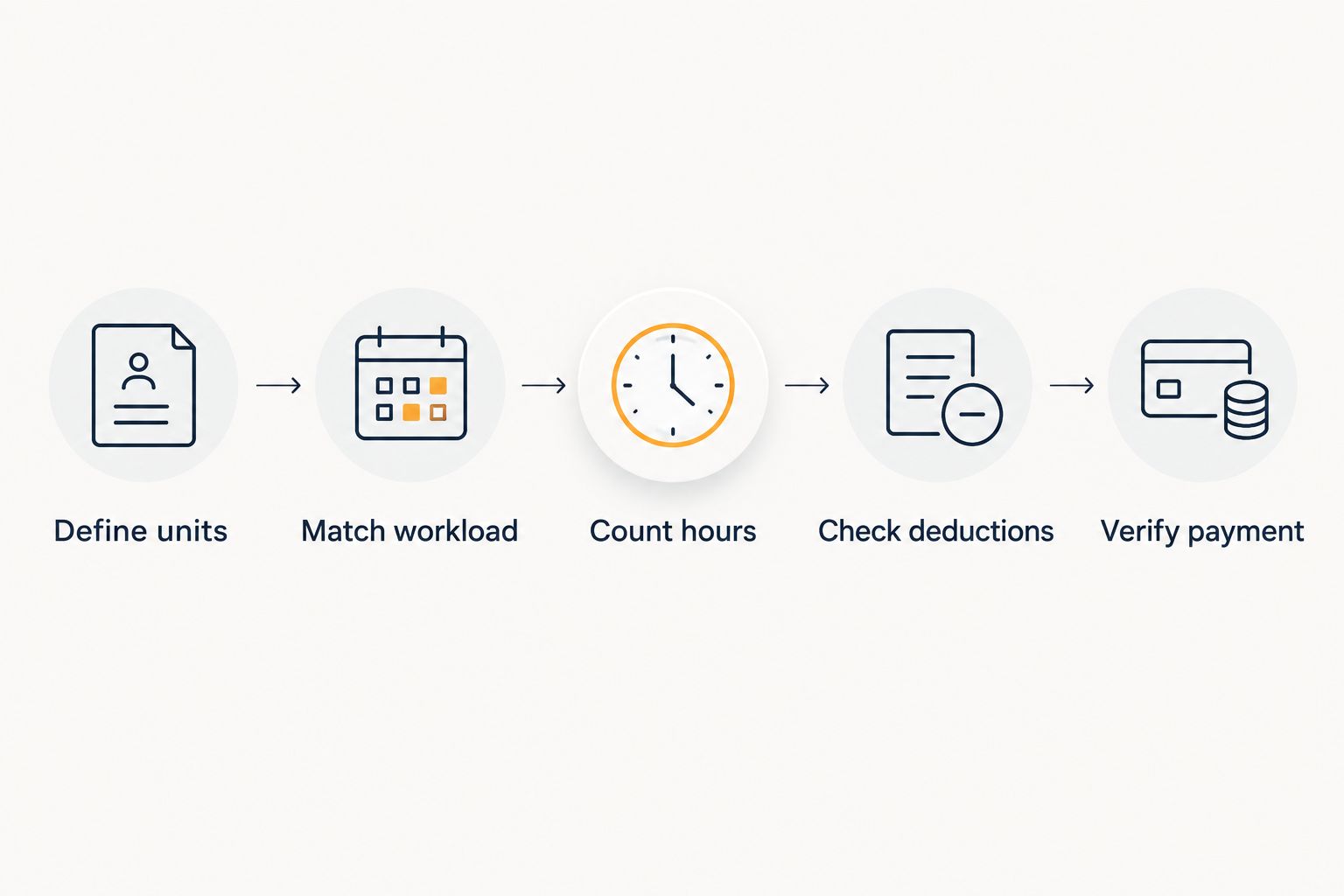
Use the same sequence for every employer. A company moves onto your shortlist when its written terms support the comparison—not when its recruitment message contains the largest number.
Define units
Request the compensation exhibit and the applicable credit schedule. Confirm whether the quoted rate applies to all eligible work or only a particular shift, modality, or production tier.
Match workload
Compare the same coverage period and reading responsibilities. Ask for the expected modality mix, preliminary versus final interpretation duties, consultation requirements, and case-assignment process.
Count hours
Include required availability, handoffs, calls, meetings, and administrative work. Reading time alone is not the complete time commitment when the agreement requires other duties.
Check deductions
Identify professional expenses and deductions assigned to you. Review malpractice arrangements, licensing obligations, workstation responsibilities, and other contract-specific costs without assuming they are included.
Verify payment
Ask for an anonymized reconciliation showing how completed examinations become credited units and compensation. Then confirm the dispute process and access to supporting records.
Use the teleradiology contract evaluation guide to extend this review beyond the payment formula. Compensation terms and termination obligations belong in the same decision.
Questions that expose an incomplete rate quote
Ask the recruiter for written answers before treating an offer as comparable:
- Does the rate use work RVUs, total RVUs, or internal credits?
- Which credit schedule governs the agreement?
- Is any minimum a guarantee or a recoverable draw?
- Which responsibilities earn no production credit?
- Who assigns cases, and what determines access to the worklist?
- Can the company change rates or targets during the agreement?
- When are adjustments finalized, and how do you dispute them?
- What happens to unpaid incentives after termination?
A complete response identifies the controlling document. “That is how the group usually handles it” is not a substitute for a contractual term.
Keep each answer beside the relevant contract provision. This makes inconsistent explanations visible before you commit to credentialing or a start date.
How the offer structures are ranked
The ranking favors a defined income floor, auditable production credits, clear workload boundaries, and understandable payment rules. It does not assign company-specific compensation claims or assume that one employment model always produces higher take-home earnings.
Your priorities change the order. Guaranteed shift compensation belongs first when predictable scheduled income is non-negotiable; productivity-only work belongs higher when you intentionally accept variable supplemental earnings.
Which teleradiology offer should you choose?
Choose the clearest written compensation agreement that fits your schedule—not the largest isolated per-RVU figure. For an undecided full-time applicant, start with a nonrecoverable floor and auditable productivity credits.
Use RadBoard’s teleradiology job search as the discovery step, then obtain employer-specific compensation documents. Saved positions form a shortlist; written terms determine the ranking.
For your 2026 decision, reject comparisons that omit the unit definition, required hours, or reconciliation rules. Without those terms, the headline rate is not a complete offer.
FAQ
Which teleradiology company pays the most per RVU?
A highest-paying company cannot be identified from a headline rate alone. Compare written offers using the same RVU definition, shift responsibilities, credited workload, and compensation period.
What is the difference between work RVUs and total RVUs?
Work RVUs measure the physician-work component, while total RVUs also include practice-expense and malpractice components. Confirm which measure your agreement uses before comparing compensation rates.
Is a higher per-RVU rate always better?
No. A higher rate does not establish higher earnings when credited volume, required hours, deductions, or unpaid responsibilities differ.
Is guaranteed shift pay better than productivity pay?
Guaranteed shift pay is the better fit when predictable scheduled income is your priority. Productivity compensation requires closer review of credited volume, work allocation, and unpaid time.
What should I ask about a guaranteed minimum?
Ask whether the minimum is nonrecoverable or a draw against future earnings. Confirm eligibility conditions, reconciliation timing, and any repayment obligation after departure.
How do I compare employee and independent-contractor offers?
Compare the complete agreements rather than matching headline compensation. Include benefits, professional expenses, insurance responsibilities, required time, and tax treatment, with professional advice for your circumstances.
Can RadBoard help me compare teleradiology opportunities?
RadBoard aggregates radiology positions and provides search and swipe-to-save features. Use it to identify opportunities, then request compensation terms directly from each prospective employer.
One last thing
Ask for the credit schedule before negotiating the conversion rate. A rate increase does not settle how much work receives credit or whether the employer can change that calculation later.
Request an examination-to-payment reconciliation alongside the contract. If you cannot follow the path from a completed report to credited production and payment, keep the offer on hold.