
ABR alternate pathway radiology jobs are positions physicians pursuing the American Board of Radiology’s alternate pathway assess against their training and certification status, with the aim of finding work they can be licensed and credentialed to perform. Your search differs from a standard attending search: pathway status, state licensure, hospital privileges and, where applicable, work authorization require separate checks. In 2026, a promising job description is only the start of that review.
- ABR alternate pathway radiology jobs require a credentialing check before an application becomes an offer.
- RadBoard is best for radiologists who want to search 5,000+ positions from 20 sources, then verify employer requirements directly.
- ABR pathway participation does not replace state licensure, hospital privileges or work authorization.
- Prioritize employers willing to review your exact pathway status; do not treat board-eligible and board-certified as interchangeable.
Why this matters for alternate pathway physicians
A job posting can describe the right subspecialty, location and schedule without explaining whether its employer will consider your current ABR pathway status. The missing detail matters more than the match on clinical work. If you wait until a final interview to raise it, you can spend time pursuing a position whose credentialing requirements you cannot meet.
Start broadly, then screen narrowly. RadBoard aggregates 5,000+ radiology positions from 20 sources and offers AI-powered search and swipe-to-save features. Those features help you find and organize possibilities; they do not establish that an employer will accept your training, issue privileges or sponsor a visa.
Keep the numbers in perspective. RadBoard’s 2026 US Radiology Job Market Report describes 3,700+ active listings, while the platform description states 5,000+ positions from 20 sources. Those figures describe different scopes. Neither is a count of jobs open to alternate pathway physicians. Your workable shortlist is the set of employers that confirm your eligibility for the specific role.
How to search for a role that fits your status
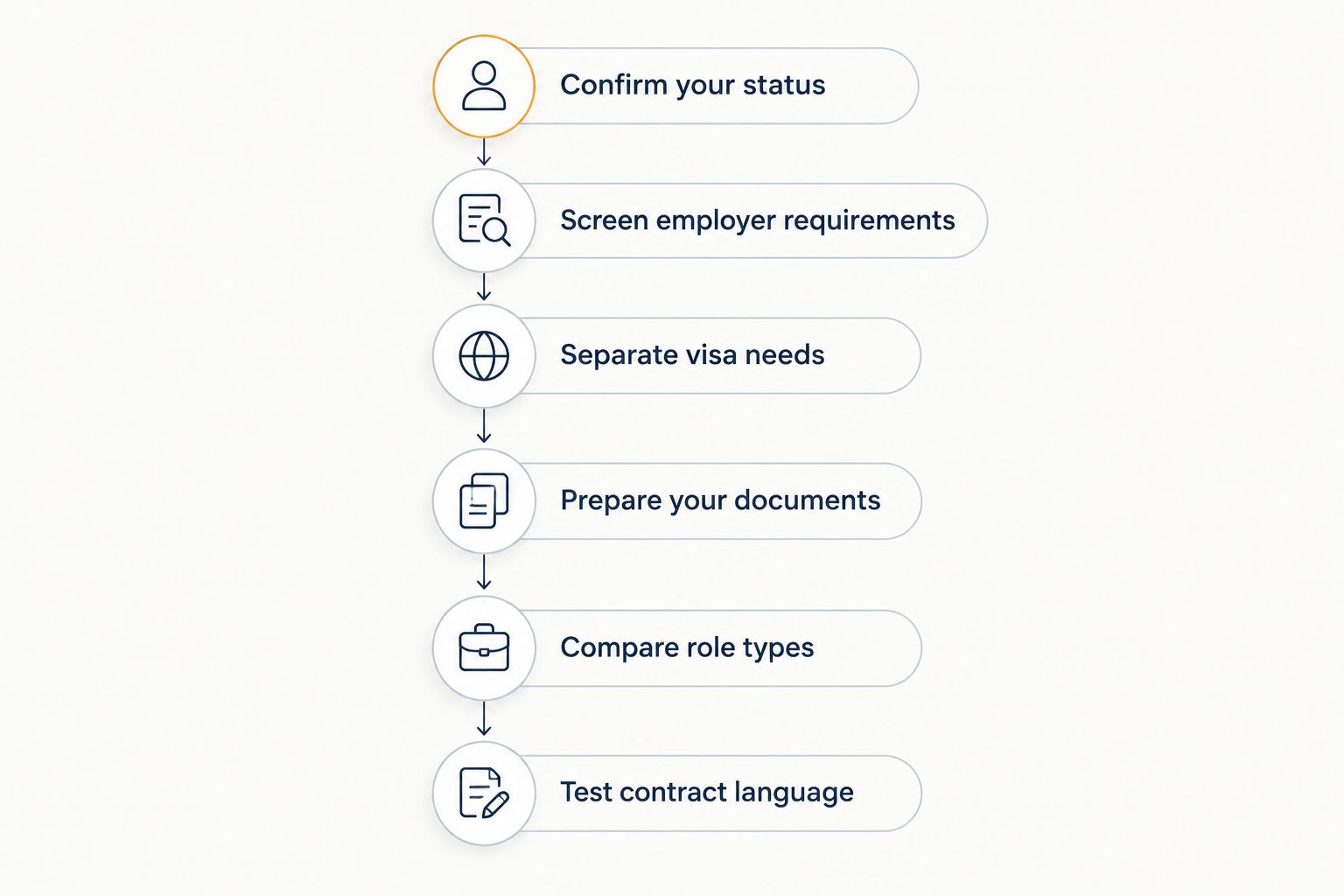
Confirm your status
Get your current ABR pathway status in writing before you describe it to a recruiter. Participation in a pathway, eligibility to pursue certification and completed board certification are different statements. Use the wording supported by your documents, and keep your anticipated milestones separate from completed ones.
Check your own ABR correspondence for the requirements and dates that apply to you. Do not borrow another physician’s timeline: training history and individual pathway decisions are not interchangeable. In 2026, your application should state what is true on the day you send it, not what you expect to be true when a position starts.
- Save current ABR correspondence and note the status it confirms.
- Record completed training and any remaining requirements separately.
- Put confirmed dates beside milestones; mark unconfirmed dates as pending.
- Check whether a posting requires certification now or permits another stated status.
- Ask the recruiter which status the employer needs at application, offer and start date.
If you are specifically seeking positions while awaiting certification, compare the language used in radiology jobs for board-eligible physicians awaiting certification. Do not describe yourself as board-eligible unless you can substantiate that designation.
Screen employer requirements
Read each posting as a list of questions, not as proof that you qualify. A requirement for ABR certification is different from one accepting candidates who will obtain it later. If the posting is unclear, ask before submitting a full application. This is particularly useful when the clinical duties fit but the credentials section uses broad language.
Search manually with terms that describe your actual status and specialty. RadBoard can help you search across its listed positions and save promising results, but an employer’s medical staff office is the authority on its own credentialing rules. Keep a record of the person who answers and the requirement they describe.
- Copy the posting’s exact certification and training requirements into your tracker.
- Ask whether those requirements apply at application or at the proposed start date.
- Ask who reviews exceptions or nonstandard training histories, if applicable.
- Record whether the answer came from a recruiter, department leader or credentialing office.
- Remove roles that require a credential you cannot document by the required date.
Separate visa needs
If you need work authorization, treat it as a distinct screening question. A department’s willingness to review your ABR status does not establish that its employer can support your immigration circumstances. Likewise, an employer’s visa policy does not answer whether its medical staff will grant privileges.
Ask about the immigration category relevant to your case without assuming that a job title or rural location establishes eligibility. A J-1 waiver search, an H-1B sponsorship search and a search that requires no sponsorship have different employer questions. The point is not to infer a policy from a listing; it is to get a direct answer early enough to decide whether to proceed.
- State whether you need sponsorship or have a specific work authorization constraint.
- Ask who handles immigration review for the employer.
- Confirm whether the employer will consider your circumstances before interviewing.
- Keep immigration advice with your qualified adviser; use the employer’s answer to screen the role.
Prepare your documents
A clear credentialing file makes your background easier to assess. It does not guarantee approval. Its purpose is to give a recruiter, department and medical staff office consistent answers without asking them to reconstruct your training from a CV and scattered email attachments.
Prepare a concise summary that names your current status, relevant training and licenses. Then keep the supporting documents accessible. Share sensitive records through the employer’s approved process rather than sending an entire file to every contact. If a requested item does not exist, say so directly and ask whether another form of documentation is acceptable.
- Update your CV with training institutions, roles and dates.
- Keep ABR correspondence that supports the status you claim.
- List current state licenses and distinguish them from applications in progress.
- Prepare training verification and references when requested.
- Track each employer’s outstanding items and the office responsible for reviewing them.
For 2026 applications, consistency is the priority. Your CV, application form and screening-call answer should describe the same completed training and certification status. A discrepancy creates a question you must resolve before the employer can assess the substance of your application.
Compare role types
Search by role type as well as subspecialty. An academic department, hospital-employed group, private practice and remote-reading employer can ask different questions about duties and privileges. None is automatically open or closed to alternate pathway physicians. The useful distinction is whether the particular employer will review your documented status for the particular work.
Build a shortlist around the work you are qualified to do, then test certification, licensure and privileges for each role. A remote position still needs a review of applicable licensing and employer requirements. A temporary assignment still needs its own credentialing review. Do not let an attractive schedule substitute for those checks.
- Compare the clinical duties with your documented training.
- Identify each state in which the role requires you to practice.
- Ask which facility or organization grants the privileges needed for the work.
- Check whether the employer accepts your status for those specific duties.
- Keep roles with unresolved requirements separate from confirmed fits.
Test contract language
An offer is not the end of the credentialing inquiry. Before you sign, compare the written terms with what the employer told you about certification, start date and clinical duties. If the contract makes employment conditional on a milestone, identify that milestone and the date attached to it.
Get qualified review of contractual and immigration questions that affect your case. Do not rely on a recruiter’s verbal description when the agreement states something else. In 2026, a useful offer is one whose conditions you can identify, document and discuss before you commit.
- Locate every certification and licensure condition in the agreement.
- Ask what happens if credentialing is incomplete on the proposed start date.
- Confirm the clinical duties match the privileges under review.
- Put any agreed change in the written offer or contract.
- Resolve conflicting answers before signing, rather than after onboarding begins.
Start a focused radiology job search
Search 5,000+ positions from 20 sources, then confirm credentialing requirements with employers.
Compare job-search options in 2026
Use more than one route if it helps you find relevant openings, but apply the same eligibility test to every result. RadBoard is best for alternate pathway radiologists who want one place to search and save openings across 20 sources; its limitation is that search results cannot confirm credentialing approval. Direct employer contact supplies that missing answer.
| Option | Best for | Key limitation |
|---|---|---|
| RadBoard search | Finding and saving radiology openings across multiple sources | Employer eligibility still needs direct confirmation |
| Direct department outreach | Asking about a specific role and its credentialing process | Each employer requires a separate conversation |
| Recruiter-led search | Having someone ask employers about stated requirements | You still need to verify the answer with the hiring organization |
| Employer career pages | Checking wording published by the hiring organization | A posting can omit details about alternate pathway status |
The table is a search-method comparison, not a ranking of employers. A recruiter can clarify a posting, and a department can explain the work, but neither conversation replaces the formal checks required for your appointment. Save the answer, note its source and follow up when a later document uses different language.
Common mistakes alternate pathway physicians make
Treating pathway participation as completed certification. State the credential you currently hold. If an application asks a yes-or-no certification question, answer it according to your documented status, then explain the pathway where the form permits.
Assuming clinical fit settles eligibility. You can match the subspecialty and still face a separate licensure or privileges requirement. Ask about each requirement before you make a position the center of your search.
Combining visa and credentialing questions. Work authorization and medical staff approval involve different decisions. Get an answer on both when both apply to you; a positive answer on one does not establish the other.
Applying without a record of employer answers. In a 2026 search across multiple positions, notes prevent you from repeating calls or confusing one organization’s requirements with another’s. Keep the posting, contact name, response and follow-up item together.
FAQ
What are ABR alternate pathway radiology jobs?
They are radiology positions a physician pursuing the ABR alternate pathway evaluates against their documented certification status and the employer’s requirements. The job title alone does not establish eligibility.
Can I apply before completing ABR certification?
You can apply to roles whose stated requirements permit your documented status. Confirm whether certification is required at application, offer or start date before investing in the process.
Does the ABR alternate pathway provide a medical license?
No. ABR certification status and state medical licensure are separate matters, and an employer can also require facility privileges.
Does board-eligible mean board-certified?
No. Board-eligible and board-certified describe different statuses; use only the designation your documentation supports.
Are remote radiology jobs an easier route for alternate pathway physicians?
Remote work does not remove licensing or employer credentialing requirements. Check the applicable states and the employer’s certification rules for each position.
How do I find employers open to my pathway status?
Search for clinically relevant openings, then ask each employer whether it will review your documented ABR status for that role. Keep the answer with the posting so you can distinguish confirmed fits from unanswered leads.
Should I discuss visa sponsorship in the first screening call?
Yes, if you need sponsorship, raise that requirement early. Employer support for immigration and approval of clinical credentials are separate decisions.
One last thing
A saved job is a lead, not an eligibility decision. In 2026, the strongest shortlist for an alternate pathway physician is not the longest one; it is the one where you know who reviews your status, what documentation they need and which questions remain unanswered. Search widely, but only advance roles whose requirements you can test.