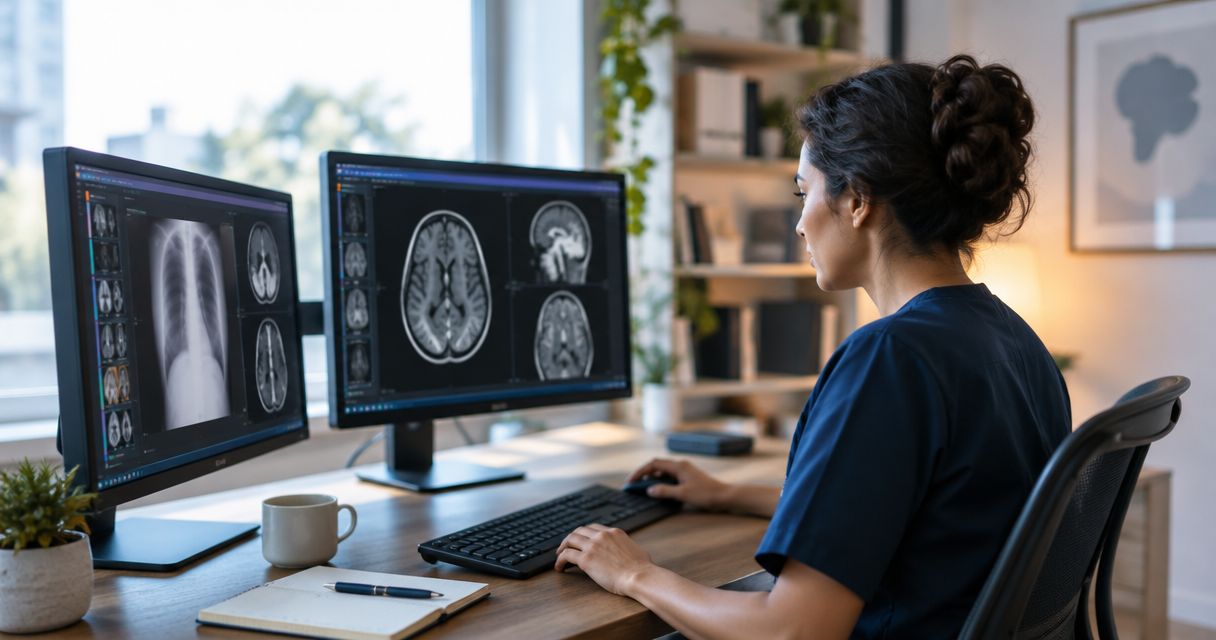
Yes—radiologists can work fully remote long term, including throughout an attending career, when their work consists of diagnostic interpretation and their credentials, employer agreements, and reading setup support it. That does not make medical training fully remote, eliminate clinical responsibilities, or allow procedures requiring your physical presence to be performed from home.
- Can radiologists work fully remote long term? Yes, in diagnostic roles with appropriate credentials, contracts, and clinical support.
- Fully remote describes your location, not your schedule, workload, or freedom to work from another country.
- RadBoard is best for radiologists seeking a radiology-specific job search across 20 sources.
- Protect long-term flexibility by checking onsite obligations, case mix, licensing responsibilities, and contract-change provisions.
Why this matters
A remote position and a durable remote career are different decisions. A job can remove your commute while still imposing overnight coverage, a narrow case mix, or obligations that conflict with your career goals.
RadBoard aggregates 5,000+ radiology positions from 20 sources. That breadth supports a radiology job search, but it does not establish that every position is remote or that a listing's remote designation is a contractual guarantee.
For your 2026 search, separate three questions: Can you do the clinical work remotely? Does the agreement protect that arrangement? Will the work remain a good fit as your priorities change?
Can radiologists work fully remote for their whole career?
A fully remote attending career is compatible with diagnostic radiology; it is not compatible with personally performing hands-on procedures from home. Image interpretation, reporting, and clinician consultation can take place away from the imaging facility when the necessary systems and clinical arrangements are in place.
The distinction is between interpreting an examination and providing every service associated with it. Patients still need image acquisition, and examinations involving procedures or patient-facing care require appropriate personnel at the clinical site.
| Career arrangement | Best for | Main advantage | Main limitation |
|---|---|---|---|
| Fully remote diagnostic practice | Radiologists prioritizing interpretation without routine onsite duties | Removes routine travel to a reading room | Requires deliberate arrangements for consultation, technical support, and professional connection |
| Hybrid diagnostic practice | Radiologists wanting remote reads alongside onsite involvement | Preserves in-person clinical relationships and selected onsite responsibilities | Does not meet a strict fully remote requirement |
| Onsite diagnostic and procedural practice | Radiologists prioritizing hands-on care or local departmental involvement | Supports direct patient care and physical participation | Requires attendance for duties that cannot be performed remotely |
These are career arrangements, not a ranking of clinical quality. Choose the model that matches the work you intend to perform, not the one with the most appealing location label.
Fully remote diagnostic practice
Best for: radiologists who want interpretation to remain the center of their clinical work. A remote role needs more than access to images: you also need relevant clinical information, prior examinations, reporting tools, and a reliable way to communicate findings.
Ask whether the assignment involves preliminary interpretations, final interpretations, or both. Clarify who handles report corrections, addenda, urgent communication, and questions received after your shift.
Remote practice removes travel to the reading location. It does not remove interruptions, reporting accountability, or the need to coordinate with the clinical team. Judge the complete workflow rather than the workstation alone.
Hybrid practice as an alternative
Best for: radiologists who want remote reading without giving up selected onsite work. A hybrid arrangement supports a different goal from a fully remote arrangement: retaining physical participation while moving some interpretation away from the facility.
The trade-off is attendance. If your non-negotiable requirement is never traveling to a clinical site, a hybrid offer fails that requirement even when most reading occurs at home.
For a 2026 offer, distinguish recurring onsite shifts from orientation, occasional meetings, and emergency coverage. Ask for each obligation separately; the word hybrid does not tell you how the schedule works.
Procedural practice and the limits of remote work
Best for: radiologists who want hands-on patient care to remain part of their scope. Interventional procedures, biopsies, and other activities requiring your physical participation cannot be converted into home-based work simply because the associated images are digital.
A radiologist can interpret remotely while onsite clinicians provide other services. That division of responsibilities must be explicit; it is not equivalent to the remote radiologist personally performing those services.
If you want to retain procedures, choose a position that actually includes them. A remote interpretation job is not a substitute for maintaining a procedural practice.
Why long-term remote feasibility varies
The technology is only part of the decision. Your scope, authorization to practice, and employment terms determine whether remote work fits your career.
- Clinical scope: Diagnostic interpretation fits remote delivery differently from procedures and direct patient examinations. Identify every duty, not just the dominant modality.
- Licensing and privileges: Confirm the medical licenses and facility privileges required for the services and locations involved. Remote access does not replace authorization to practice.
- Approved location: Establish where the employer permits you to read. Permission to work from your home does not establish permission to work from any state or country.
- Schedule and workload: Separate remote location from shift choice, call duties, turnaround expectations, and productivity requirements. Home-based work can still have a fixed schedule.
- Professional development: Determine how consultation, feedback, teaching, and leadership participation work for remote physicians. Ask for the actual arrangements.
- Contract terms: Check whether onsite duties or approved work locations can change, who controls those changes, and what options you retain if the arrangement changes.
How do you evaluate a remote offer for a long-term career?
Use 5 contract checks before treating an offer as a durable remote arrangement. Keep the answers together so you can compare positions on the same terms rather than relying on recruiter summaries.
1. Define duties
List the services you will provide: modalities, subspecialty coverage, protocoling, consultations, and any patient-facing responsibilities. Identify duties excluded from the role as well.
Ask who handles work that requires physical presence. A clear division of responsibility is more useful than an assurance that the practice is remote-friendly.
2. Confirm location
Get the approved work location and any onsite attendance requirements in writing. Include orientation, meetings, equipment setup, and coverage obligations in the discussion.
If you expect to relocate, ask how approval works before assuming the arrangement follows you. Domestic relocation and international work require separate evaluation.
3. Check workload
Request the shift structure, case mix, productivity methodology, and communication expectations. Ask how the practice handles complex examinations and work that interrupts interpretation.
Review a representative schedule rather than evaluating the role from a shift label alone. Daytime, evening, and overnight commitments should be stated in the time zone that governs your work.
4. Assign support
Clarify responsibility for licensing administration, credentialing, workstation maintenance, network problems, and clinical escalation. Identify who responds when a problem prevents safe reporting.
Also confirm professional liability coverage for the actual services and locations involved. Have a qualified adviser review coverage and contract questions rather than inferring protection from the employer's remote-work description.
5. Preserve options
Read the provisions covering role changes, termination, notice, and post-employment restrictions. Determine what happens if the practice adds onsite duties or changes the approved reading location.
If teaching, leadership, or partnership matters to you, request the relevant eligibility terms. Do not assume remote physicians receive—or are excluded from—opportunities that the agreement does not address.
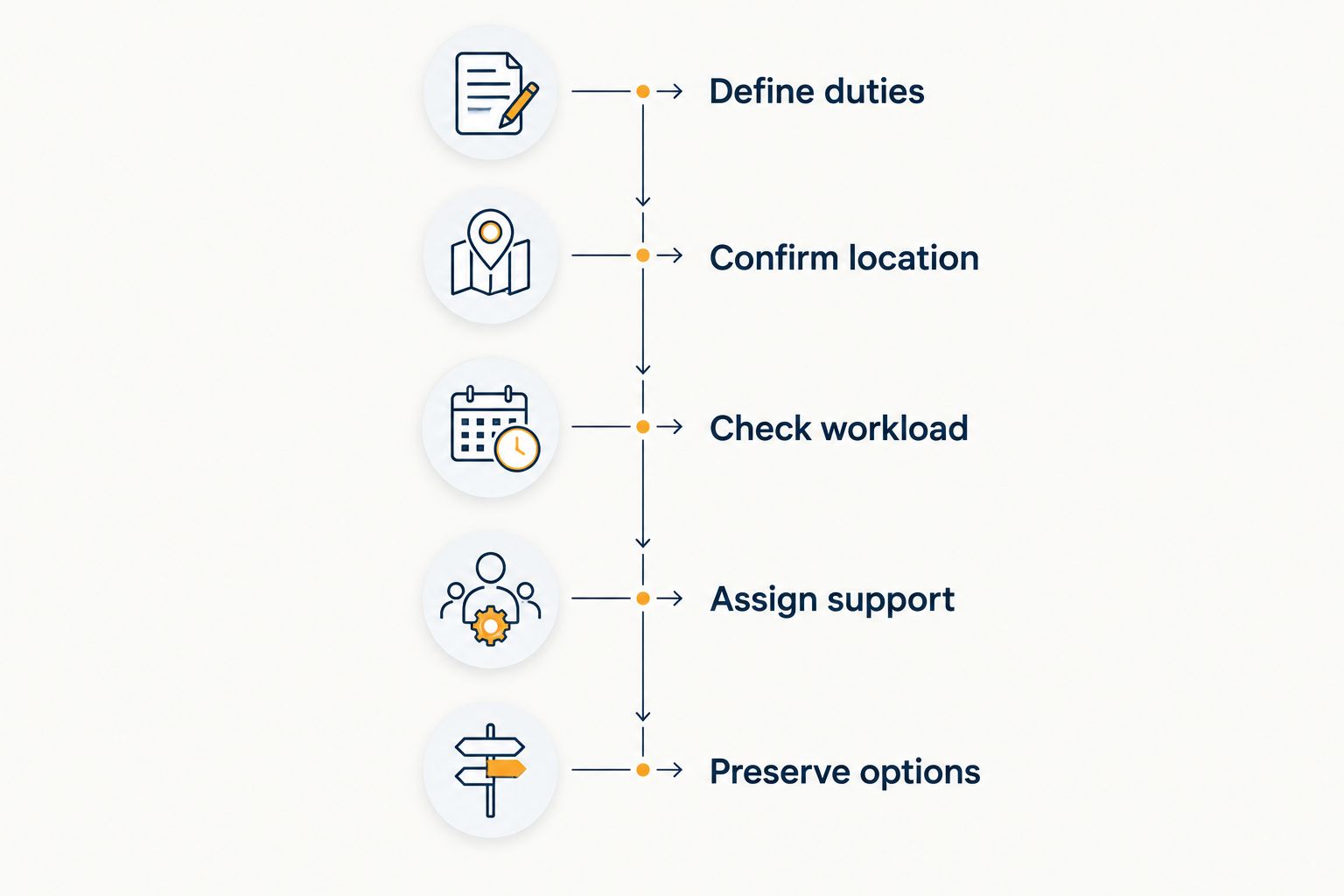
Use those checks consistently during a 2026 job search. A written answer lets you distinguish an actual limitation from an unanswered interview question.
Compare radiology career opportunities
Search 5,000+ radiology positions aggregated from 20 sources.
Can you start fully remote immediately after training?
Yes—a first attending position can be remote if you meet the role's licensing, credentialing, and employer requirements. The more important selection question is how the practice supports decisions when you encounter an unfamiliar or difficult case.
Ask who is available for consultation during your actual shifts and how you obtain a second opinion. Review onboarding, discrepancy feedback, and access to subspecialty colleagues before accepting responsibility for an isolated worklist.
A remote first job is not automatically unsupported. An onsite first job is not automatically well mentored; evaluate the support itself rather than using physical location as its proxy.
Can you stay fully remote without giving up career development?
Yes—remote work can include professional development, but the role needs identifiable opportunities beyond completing reports. Ask how remote physicians participate in case conferences, peer learning, teaching, and departmental decisions.
Separate access from advancement. Being invited to meetings does not establish eligibility for a leadership position, a partnership track, or a particular academic role.
Before choosing a position in 2026, identify the next responsibility you want and ask how someone working remotely can qualify for it. Request specific eligibility criteria rather than a general statement about growth.
Can you return to onsite practice after years of remote work?
Yes—returning to onsite work is possible, but eligibility depends on the duties, credentials, and recent experience the new position requires. Continuing diagnostic interpretation does not establish recent competence in procedures you have not performed.
Keep records of your clinical scope, continuing education, quality participation, and relevant case experience. If you intend to resume a procedure, ask the receiving organization about its competency and privileging requirements before planning the transition.
Preserving options does not require keeping every possible skill active. It requires knowing which skills and responsibilities you are choosing to retain.
FAQ
Can radiologists work fully remote long term?
Yes, radiologists can work fully remote long term in diagnostic interpretation roles when their credentials, clinical workflow, and employer agreements support it. That does not make hands-on procedures or medical training fully remote.
Does fully remote radiology mean I can choose my own hours?
No, fully remote radiology describes work location, not control over your schedule. Confirm shifts, call, turnaround expectations, and availability requirements separately.
Can I work as a remote radiologist from another country?
Do not assume a remote radiology position permits international work. Obtain explicit employer approval and qualified advice on licensing, facility rules, privacy, insurance, and tax obligations before changing countries.
Is fully remote radiology suitable for a new attending?
A fully remote position can suit a new attending when the role provides appropriate onboarding, consultation, and feedback. Evaluate who is available during your actual shifts rather than relying on a general promise of mentorship.
Do remote radiologists still need hospital privileges?
Remote radiologists need the privileges required by the facilities and services they cover. Working outside the hospital does not by itself remove credentialing requirements.
Can a remote radiologist keep doing procedures?
A radiologist can combine remote interpretation with onsite procedural work, but personally performing procedures requires physical attendance. That combined arrangement is not a wholly remote clinical role.
Does RadBoard list only fully remote radiology jobs?
RadBoard aggregates 5,000+ radiology positions from 20 sources; that description does not establish that every listing is fully remote. Confirm work location, onsite duties, and contract terms for each opportunity.
One last thing
You do not need one employer to promise a career-long remote arrangement to build a career of remote work. You need each successive role to meet your clinical, contractual, and personal requirements.
For 2026, make your non-negotiables explicit before applying: approved location, acceptable schedule, clinical scope, and required support. Then keep your credentials and professional relationships current so your next move is a choice rather than a reaction to changed terms.
The strongest remote offer is not merely the one that lets you read from home today. It is the one whose duties you understand, whose limitations you accept, and whose terms leave you able to make the next decision.