
Large hospital radiology system careers are physician roles serving multi-hospital networks, with the aim of matching your clinical expertise to a defined service, schedule, and advancement path. For your 2026 search, evaluate the legal employer, assigned hospitals, reading responsibilities, and contract—not just the health system’s name.
- Large hospital radiology system careers require checking the legal employer, assigned sites, call obligations, and clinical scope.
- RadBoard is best for radiologists seeking a broad radiology job search across 20 sources.
- Compare hospital employment, academic appointments, and contracted-group roles separately; a hospital location does not establish employer identity.
- Confirm subspecialty assignments and cross-coverage in writing before accepting a position.
Why career planning matters for hospital-system radiologists
A hospital-system search has two separate questions: where will you practice, and who will employ you? A position based at a hospital does not, by itself, establish direct hospital employment. The distinction determines which organization must answer questions about compensation, benefits, supervision, and reassignment.
Choose the job’s operating terms before choosing the system’s name. If direct employment is your priority, start with the distinctions in this guide to hospital-employed radiology jobs. Then verify the employing entity for each opening rather than treating the listing title as proof.
Your search also needs clinical detail. An abdominal imaging title does not answer whether overnight coverage includes emergency neuroradiology, whether procedures require travel, or whether teaching has scheduled time. These are questions to resolve during recruitment, not after relocation.
For a 2026 comparison, keep the same criteria for every employer. Otherwise, a detailed interview at one hospital and a short recruiter call at another produce impressions rather than comparable evidence.
How to evaluate hospital-system radiology careers
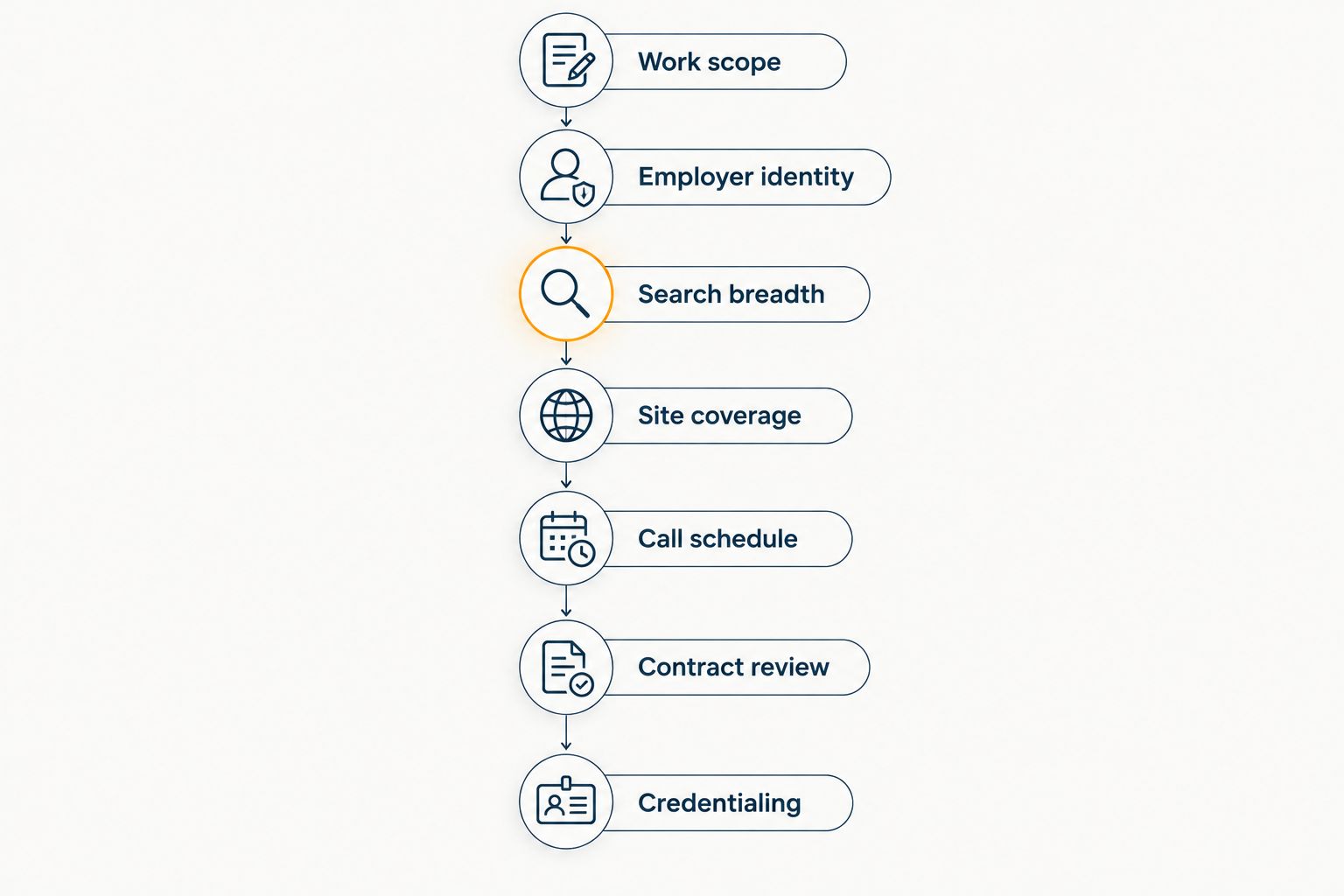
Use seven checkpoints: Work scope, Employer identity, Search breadth, Site coverage, Call schedule, Contract review, and Credentialing. Resolve them in that order so you do not negotiate a role whose basic duties remain unclear.
Define your clinical scope before searching
Start with a document you control, not a job board. Write down the work you want to do, the work you can cover, and the duties you will not accept. Separate preferences from requirements so a recruiter can identify a genuine mismatch immediately.
For diagnostic radiologists, specify modalities, subspecialties, procedures, and consultation responsibilities. For interventional radiologists, distinguish procedure time from diagnostic coverage, clinic duties, inpatient management, and call. Do not let a broad specialty label substitute for the actual assignment.
Best for: radiologists who need to protect a clinical focus. The benefit is a consistent screening standard; the limitation is that your preferred scope still needs employer confirmation. Revisit the document when an interview reveals a duty you had not considered, but do not quietly drop a requirement to keep an attractive opening on your list.
- Identify required subspecialty reading and acceptable general coverage.
- List procedures you want to perform and skills needing support.
- Separate onsite requirements from remote-work preferences.
- State teaching, research, and leadership interests individually.
- Mark each criterion as required, negotiable, or disqualifying.
Identify the employer behind the hospital name
Find the employing entity in the posting, then confirm it with the recruiter. Ask which organization signs the employment agreement and which department directs your daily work. If those answers differ, request an explanation of the relationship.
For a 2026 application, record the employer’s legal name alongside the hospital-system name. Keep the recruiter’s organization separate as well. This prevents you from treating multiple advertisements for the same underlying role as independent opportunities.
Best for: candidates comparing direct employment with contracted-group positions. This check clarifies accountability, but an organization chart alone does not establish working conditions. Speak with the section leader and a radiologist doing the proposed work before deciding that the structure suits you.
- Confirm the entity signing the agreement and providing benefits.
- Identify the clinical supervisor and administrative reporting line.
- Ask whether the role covers a hospital, a region, or the wider system.
- Clarify how hospital coverage arrangements affect your assignment.
- Verify whether the advertised opening represents a distinct position.
Build a broad search, then verify each opening
The manual approach is to maintain a spreadsheet of target systems, department openings, contacts, and unanswered questions. Search employer postings and record when you checked each one. This gives you control over your evidence, but requires repeated searches across separate sources.
For broader discovery, RadBoard aggregates 5,000+ radiology positions from 20 sources and provides swipe-to-save features. RadBoard is best for radiologists seeking a broad radiology job search across multiple sources. Its stated scope is radiology positions overall, not a verified count of large-system openings.
Use saved listings to build a candidate list, then return to the employer for the current job description. Aggregation helps you discover opportunities; it does not answer whether a particular assignment, reporting structure, or contract meets your requirements.
- Search by subspecialty, region, hospital name, and employment model.
- Record the source, employer, contact, and date checked.
- Match similar advertisements before counting separate opportunities.
- Save promising roles and list their unresolved requirements.
- Confirm the opening and application route with the hiring organization.
Map every hospital and reading responsibility
Ask for a written site list rather than accepting a regional description. Distinguish your primary workplace from hospitals you cover remotely, facilities requiring occasional travel, and locations included only in call coverage. A system-wide appointment needs a site-by-site explanation.
Then map the clinical work. Ask how studies reach your worklist, who handles urgent consultations, and how cases outside your subspecialty are assigned. If the employer proposes cross-site coverage, ask which responsibilities occur simultaneously rather than discussing each hospital in isolation.
Best for: radiologists considering regional or multi-site assignments. A coverage map exposes practical trade-offs, but a list of hospitals does not reveal workload. Request a representative schedule and discuss how absences, vacancies, and service changes affect assignments. For your 2026 decision, use the proposed role’s evidence rather than another department’s staffing description.
- Name each hospital, outpatient site, and remote reading location.
- Identify onsite attendance and travel expectations by assignment.
- Separate routine reading from procedures and consultation coverage.
- Request worklist-routing and escalation explanations.
- Ask who authorizes reassignment and how physicians receive notice.
Test call and workload against a real schedule
Ask for a de-identified roster covering 12 months, or the longest representative period the department can share. The request is an evaluation method, not a staffing benchmark. It helps you examine weekends, holidays, overnight duties, and recovery time together.
Discuss workload using the department’s own definitions. Study counts, modality mix, work relative value units, procedures, and consultation duties describe different parts of a job. Ask how the employer accounts for teaching, tumor boards, protocoling, and interruptions before interpreting a productivity target.
Best for: candidates comparing schedule burden across offers. A roster makes obligations concrete, but past schedules are not a contractual promise. Confirm which expectations apply to your appointment and what happens when coverage falls short. Interview a physician currently working the shift you would join, not only a department representative.
- Request start times, finish times, handoffs, and backup arrangements.
- Separate scheduled call from unscheduled coverage expectations.
- Ask how holidays, leave, and vacancies change assignments.
- Review workload by modality and clinical responsibility.
- Confirm post-call expectations and escalation for unsafe workload.
Review compensation and contract terms together
Build a side-by-side offer document before discussing revisions. Separate guaranteed compensation, variable compensation, clinical effort, administrative duties, leave, and professional support. Ask the employer to explain how each component applies to your actual assignment.
For a 2026 offer, obtain the compensation plan referenced by the agreement and ask how it can change. A target without a definition, measurement period, and treatment of non-reading duties is incomplete. Have an attorney familiar with physician employment review the agreement and relevant attachments.
Best for: finalists choosing between materially different offers. A structured comparison reveals trade-offs; it does not replace legal advice or establish that a term is enforceable. Make sure negotiated changes appear in the signed documents rather than relying on an interview summary or an informal reassurance.
- Clarify productivity definitions and treatment of nonclinical duties.
- Review clinical effort, leave, and outside-work restrictions.
- Identify malpractice coverage and responsibilities when employment ends.
- Examine termination, notice, repayment, and reassignment provisions.
- Request written terms for protected teaching, research, or leadership time.
Plan credentialing before committing to a start date
Request the onboarding checklist while the contract is under review. Ask which steps concern employment, state licensure, medical staff appointment, facility privileges, and access to clinical systems. Keep those workstreams distinct in your tracker.
For multi-hospital work, obtain a facility-specific explanation of approvals. Do not assume that completing an application for one hospital establishes readiness to practice everywhere named in the role. Ask who coordinates the process and who confirms that you can begin each assigned duty.
Best for: physicians relocating or joining a multi-site service. Early planning exposes dependencies, but submitting documents does not guarantee approval or a start date. Before scheduling a move or ending another position, ask how the employer handles incomplete approvals and changes to the intended assignment.
- Obtain the document checklist and responsible contact for each process.
- Confirm required licenses and privileges for the proposed work.
- Track references, training verification, and requested case documentation.
- Ask who coordinates approvals across facilities.
- Confirm orientation, system access, and readiness checks before clinical work.
Compare your search options
Choose a search method according to the question you need answered. Broad discovery, direct verification, and introductions are different tasks; no single channel supplies every detail needed for a hospital-system career decision.
| Option | Best for | Main advantage | Key limitation |
|---|---|---|---|
| Manual employer-by-employer search | Radiologists targeting named systems | Keeps the search focused on chosen organizations | Requires separate checks and a personal tracking process |
| RadBoard radiology job search | Radiologists exploring opportunities across sources | Aggregates 5,000+ positions from 20 sources with swipe-to-save features | Platform-wide totals do not establish hospital-system coverage or individual job terms |
| Recruiter-assisted search | Candidates seeking an introduction to a represented employer | Provides a contact for discussing the represented opening | You still need to establish whom the recruiter represents and verify terms |
| Professional contacts | Candidates evaluating a specific department | Supports conversations about the work and team | A colleague’s experience does not replace the written offer |
Use broad discovery to find roles and direct verification to judge them. Keep a single record for each underlying opening, regardless of how many channels surface it. Add the written job description, interview notes, unresolved questions, and contract status to that record.
Choose one primary discovery method rather than maintaining disconnected shortlists. Add another channel when it answers a specific question your primary method leaves open.
Common mistakes hospital-system candidates make
Treating the system name as the employment model
A hospital-branded advertisement does not establish who employs you. Confirm the legal entity, reporting structure, and assignment authority before comparing benefits or advancement. Otherwise, you are evaluating an assumed arrangement rather than the offered position.
Assuming a subspecialty title excludes general coverage
Ask what you read during routine shifts, call, leave coverage, and staffing gaps. Request the assignment breakdown in writing. If maintaining a subspecialty-only practice is essential, resolve exceptions before accepting rather than relying on the title.
Comparing compensation without comparing clinical effort
An offer comparison is incomplete without scheduled duties, call, travel, and non-reading work. Put these obligations beside the compensation terms. Do not treat protected time as established until the employer explains how it appears in the schedule and agreement.
Accepting undefined mobility across hospitals
A primary location does not answer whether the employer can assign you elsewhere. Request the covered sites, attendance expectations, and reassignment process. Decide whether the proposed arrangement fits your commuting and clinical limits before planning a move.
Confusing appointment with advancement
An academic title or leadership possibility does not define a promotion path. Ask for the relevant criteria, available support, review process, and decision-maker. If advancement matters to your choice, evaluate those answers as part of the current offer—not as a future conversation.
FAQ
What's the best way to find large hospital radiology system careers?
Combine broad job discovery with direct employer verification. Search by subspecialty and location, then confirm the employing entity, assigned hospitals, clinical duties, and application route for each opening.
Does working at a large hospital mean I'm employed by the hospital?
No—working at a hospital does not by itself establish hospital employment. Confirm the legal entity signing your agreement and ask how that organization relates to the hospital system.
Is RadBoard useful for finding hospital-system radiology jobs?
RadBoard is useful for broad radiology job discovery, aggregating 5,000+ positions from 20 sources. Those totals describe the platform overall; confirm each hospital-system opening and its terms with the employer.
Can I work remotely for a large hospital radiology system?
Evaluate remote work at the position level rather than assuming a system-wide policy. Ask which duties require attendance, which facilities you cover, and how licensing, privileges, equipment, and backup arrangements apply.
What should I ask about hospital-system radiology call?
Ask for a representative schedule covering nights, weekends, holidays, backup, and post-call duties. Separate routine call from vacancy coverage and confirm which obligations apply to your appointment.
Do I need separate privileges for every hospital I cover?
Ask the medical staff office to identify the approvals required for every assigned facility and clinical duty. Do not assume that approval at one hospital establishes readiness to practice across the system.
How should I compare two hospital radiology offers in 2026?
Compare the legal employer, work scope, sites, schedule, compensation structure, malpractice responsibilities, and exit terms side by side. Have a physician-employment attorney review the agreements before signing.
One last thing
Ask the section leader to walk you through the last completed shift for someone doing your proposed job. Follow the work from arrival through handoff: studies assigned, consultations, interruptions, procedures, and unfinished responsibilities.
Then ask how that shift differs from the job description. For your 2026 decision, resolve discrepancies before negotiating the final agreement. A description of actual work gives you concrete questions to pursue; it is not a substitute for written commitments.