
To get credentialed at multiple hospitals simultaneously in 2026, prepare one verified master record, submit every hospital application in parallel, and track each file against that hospital’s committee calendar. Keep CAQH ProView current, but treat hospital privileges, state licensure, payer enrollment, and malpractice verification as separate workstreams. If speed determines your start date, follow the same document controls used for fast locum tenens radiology credentialing without assuming every hospital offers expedited review.
- The fastest way to get multi-hospital radiology credentials is to run complete applications in parallel.
- CAQH ProView requires re-attestation every 120 days, but it does not replace hospital privileging forms.
- Track each hospital’s application, verification, committee date, privileges, payer enrollment, and start clearance separately.
- Credentialing by proxy can reduce duplicate telemedicine review when the hospitals meet federal requirements.
- RadBoard is best for radiologists identifying multi-hospital opportunities before opening separate credentialing files.
How do you get credentialed at multiple hospitals simultaneously?
Use one controlled source file for your professional history, then open a separate application track for every hospital. Parallel processing prevents one facility’s missing reference, committee schedule, or supplemental form from blocking the others.
-
Create a credentialing master record. Assemble your current CV, medical education, postgraduate training, board status, state licenses, DEA registration, work history, hospital affiliations, malpractice coverage, claims history, peer references, identification, and requested case logs. Use the same dates and descriptions across every application; conflicting dates trigger follow-up questions.
-
Update and re-attest CAQH ProView. CAQH asks providers to re-attest every 120 days. Confirm that hospitals using CAQH can access the profile, then review every entry against your master record. CAQH centralizes information, but hospitals can still require their own disclosures, release forms, privilege requests, and peer references.
-
Submit every application in the same window. Do not wait for one approval before opening the next file. Complete the core application, disclosures, privilege delineation form, and authorization documents for each hospital while your references and verification documents are current.
-
Separate credentialing from privileging. Credentialing verifies qualifications and professional history. Privileging determines which diagnostic interpretations, procedures, modalities, or supervisory duties you can perform at that facility. A complete credentialing file can still stop if the privilege request lacks training evidence or recent experience documentation.
-
Track external verification requests. Hospitals independently verify licenses, education, training, board status, malpractice history, sanctions, exclusions, and other required records. Respond to discrepancies through the medical staff office rather than sending an unrequested replacement packet that creates another document version.
-
Record every committee deadline. Ask each medical staff office for its file-completion cutoff, committee review date, governing-body approval step, and conditions for temporary privileges. The useful date is not when you submitted the application; it is when the hospital declared the file complete for review.
-
Confirm final clearance in writing. Credentialing approval alone does not confirm that you can begin reading. Verify the effective date of privileges, payer or billing readiness where applicable, malpractice activation, system access, onboarding requirements, and the person authorized to release you for clinical work.
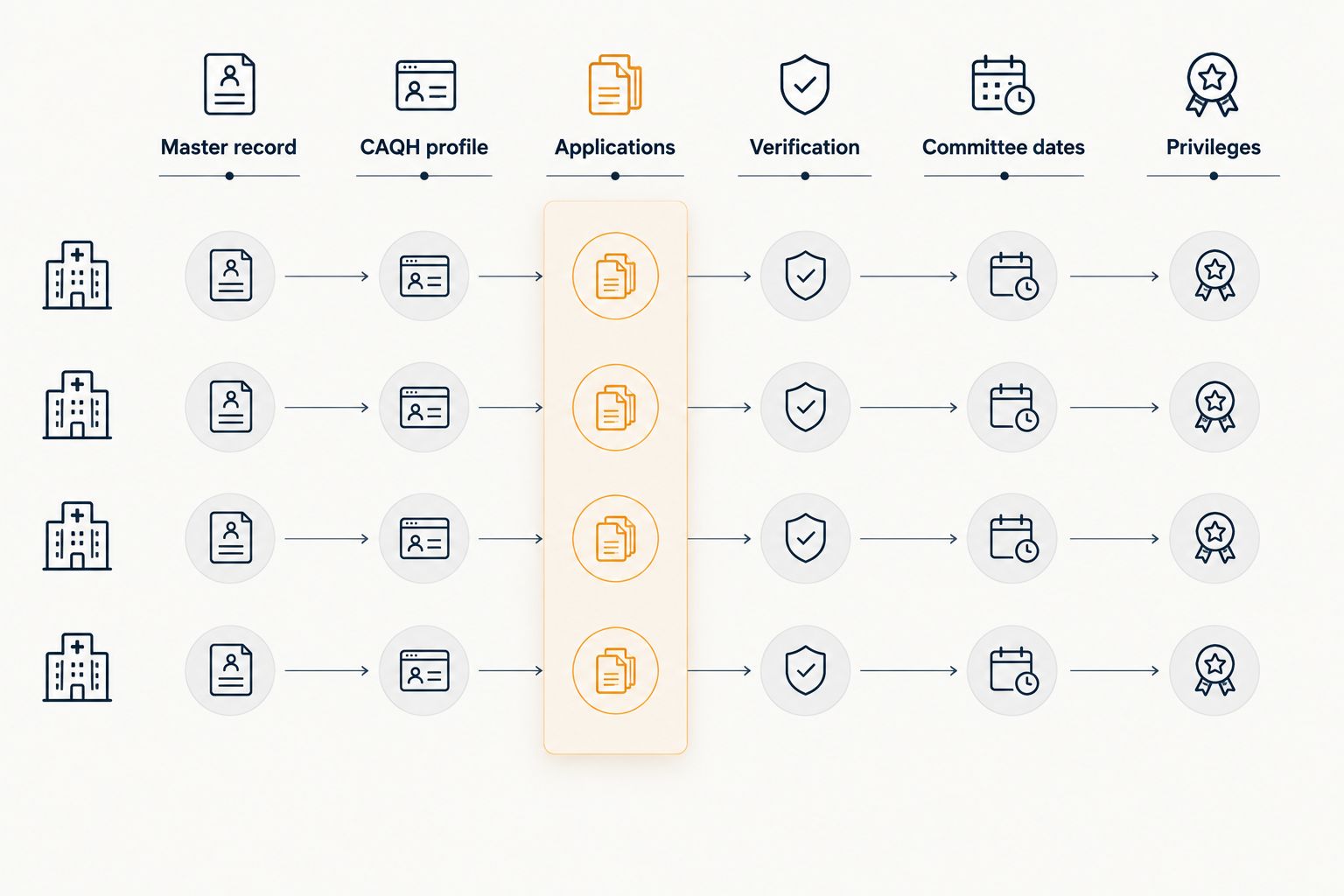
A shared source record reduces duplicate data entry; it does not merge the applications. In 2026, each hospital remains responsible for its own appointment and privileging decision unless an applicable telemedicine arrangement permits credentialing by proxy.
Why this matters
Multi-hospital radiology work creates several dependencies that look similar but are not interchangeable. A state license does not grant hospital privileges, a hospital appointment does not guarantee payer enrollment, and an active CAQH profile does not prove that a medical staff file is complete.
RadBoard is best for radiologists who need to identify multi-hospital roles before starting facility-specific credentialing. The RadBoard radiology job search platform aggregates 5,000+ positions from 20 sources, giving you a defined target list before you authorize references and verification requests for multiple employers.
The practical goal in 2026 is not one universal approval date. It is a controlled set of independent files with visible owners, missing items, deadlines, and clearance conditions.
Build one tracker for every hospital file
Create one row per hospital and one owner per unresolved item. Your tracker should show the application status, CAQH access, verification gaps, requested privileges, reference status, committee cutoff, committee date, final approval, malpractice activation, payer enrollment, system access, and cleared start date.
Use status labels that describe the next action rather than vague progress terms. Good labels include waiting on applicant, waiting on reference, primary source verification, ready for committee, and approved with conditions. A percentage-complete field hides the only fact that matters: what is blocking the file now.
Run a discrepancy check before every submission:
- Match training and employment dates across the CV, CAQH ProView, and hospital application.
- Explain professional gaps using the wording requested by that hospital.
- Use the same legal name and contact details on every authorization.
- Confirm that license and board-status entries reflect the current record.
- Request only privileges supported by your training and documented experience.
- Keep signed releases separate because hospitals can use different forms and expiration rules.
A 2026 credentialing tracker should also distinguish reusable evidence from hospital-specific paperwork. Your CV and training history are reusable; privilege forms, attestations, releases, health requirements, and bylaws acknowledgments usually are not.
Compare the three multi-hospital credentialing pathways
The right pathway depends on the employment arrangement and how the hospitals relate to one another. These routes can reduce duplicate work, but none lets a radiologist bypass required verification or clinical privilege review.
| Pathway | Best for | Main advantage | Main limitation |
|---|---|---|---|
| Direct applications | Permanent or independently contracted hospital work | You control each submission and privilege request | Every hospital maintains a separate file and schedule |
| Agency-coordinated applications | Locum tenens assignments across several facilities | One coordinator can collect reusable documents and chase missing items | The hospital still makes its own appointment and privileging decision |
| Credentialing by proxy | Eligible telemedicine relationships | The originating hospital can rely on a distant-site credentialing decision under defined conditions | The arrangement must satisfy federal rules and hospital bylaws |
Direct hospital applications
Best for: radiologists joining a hospital-employed group, independent practice, or permanent multisite coverage arrangement. The advantage is direct access to the medical staff office and full visibility into requested privileges. The disadvantage is administrative duplication: each facility can use different forms, references, committee cutoffs, and onboarding requirements.
Verdict: Use direct applications when the hospitals are unrelated or the role is permanent.
Agency-coordinated applications
Best for: radiologists pursuing locum tenens assignments at several facilities. An agency can maintain a reusable document packet and coordinate requests, but you still need to review every disclosure and privilege request before signing. Never assume that sending documents to the agency means the hospital file is complete.
Verdict: Use agency coordination for temporary assignments, but keep your own status tracker.
Telemedicine credentialing by proxy
Best for: radiologists reading remotely for hospitals that have a qualifying relationship with a distant-site hospital or telemedicine entity. CMS permits credentialing and privileging by proxy under conditions in 42 C.F.R. § 482.22(a)(3), but the originating hospital retains oversight duties. State licensure and malpractice coverage remain separate requirements.
Verdict: Ask for credentialing by proxy when the arrangement qualifies; otherwise expect a full facility review.
Search multi-hospital radiology roles
Review radiology positions from 20 sources before starting facility-specific applications.
Why multi-hospital credentialing timelines vary
No single national timeline controls hospital appointments. These factors determine whether one file moves while another stalls:
- Application completeness: An unanswered disclosure, unsigned release, unexplained work gap, or missing privilege form keeps the file out of review.
- Primary source verification: Hospitals must verify required credentials with the issuing source rather than relying only on copies you upload.
- Reference response: A reference request can remain open even when every applicant-controlled document is complete.
- Privilege scope: Broad or procedure-specific privilege requests can require extra case logs, training records, or department review.
- Committee calendar: Every hospital sets its own completion cutoff and approval sequence. Missing a cutoff moves that file to a later meeting.
- Adverse-history review: A malpractice claim, disciplinary action, privilege restriction, or application discrepancy requires explanation and facility review; it does not automatically produce the same decision at every hospital.
The fastest controllable move is to answer every hospital request from the same verified source record. Do not alter dates or explanations to match what you think a reviewer wants; inconsistent applications create more verification work.
How should you prioritize hospitals when several files are open?
Prioritize by confirmed clinical need, file readiness, and committee cutoff. Finish the hospital that can place a complete file before its next review deadline, then resolve the oldest external verification request. Do not prioritize based only on the date you started the application.
Use the RadBoard radiology job search platform to narrow the roles first, then open credentialing files only for facilities tied to an accepted offer or documented placement process. RadBoard searches 5,000+ radiology positions, but it is not a credentialing service and does not replace a hospital medical staff office.
Can one CAQH profile cover every hospital application?
One CAQH ProView profile can supply information to participating organizations that you authorize, and CAQH requires re-attestation every 120 days. It does not cover every hospital form or replace facility-specific privilege requests, disclosures, releases, peer references, or committee approval.
Treat CAQH as the controlled source for reusable data. Treat each hospital portal as the authoritative record for that facility’s application status.
Can you hold privileges at multiple hospitals simultaneously?
Yes. Radiologists can hold active privileges at multiple hospitals when each facility approves the appointment and requested clinical privileges. There is no universal numerical cap, but every appointment carries separate renewal, compliance, coverage, and competency obligations.
Before accepting overlapping coverage, compare the schedules and call duties against your employment agreements. Credentialing approval does not override exclusivity, conflict-of-interest, notice, or availability terms.
Does credentialing by proxy eliminate duplicate work?
No. Credentialing by proxy can reduce duplicate review for qualifying telemedicine arrangements, but it does not eliminate state licensure, malpractice coverage, hospital oversight, or scope-of-privilege requirements. Confirm whether the originating hospital’s bylaws and written agreement support the arrangement in 2026.
FAQ
What’s the fastest way to get credentialed at multiple hospitals?
Submit complete hospital applications in parallel from one verified master record. Track each facility’s missing items and committee cutoff separately instead of waiting for one hospital to approve you first.
Does CAQH ProView credential a radiologist for hospital privileges?
No, CAQH ProView does not grant hospital privileges. It supplies reusable professional information to authorized organizations, while each hospital completes its own credentialing and privileging process.
How often must a physician re-attest CAQH ProView?
CAQH ProView requires providers to re-attest every 120 days. Review the profile before re-attesting because inconsistent dates can trigger questions across several hospital applications.
Do I need a separate application for every hospital?
Yes, expect a separate application and privilege request for every hospital unless a qualifying telemedicine credentialing-by-proxy arrangement applies. Shared systems can reuse data, but each hospital remains responsible for its approval decision.
Is hospital credentialing the same as clinical privileging?
No, credentialing verifies your qualifications and professional history, while privileging defines the clinical services you can perform. You need both before practicing under that hospital’s authority.
Can I start reading after the credentialing committee approves me?
Not until the hospital confirms your effective privileges and releases you to begin clinical work. System access, malpractice activation, onboarding, or payer requirements can remain open after committee review.
Can telemedicine hospitals use credentialing by proxy?
Yes, eligible hospitals can use credentialing by proxy when the arrangement meets federal requirements and the participating organizations have the required agreements and oversight. It is not automatic for every remote radiology role.
What belongs in a multi-hospital credentialing tracker?
Track the application, CAQH access, verification gaps, references, requested privileges, committee dates, approval, malpractice activation, payer enrollment, system access, and cleared start date for each hospital.
One last thing
Ask every medical staff office one direct question in 2026: What must be complete for my file to make the next committee agenda? That answer is more useful than a general processing estimate because it identifies the hospital’s actual cutoff and the unresolved item that can still move.
RadBoard helps you identify the multi-hospital radiology opportunities; the medical staff office controls the credentialing decision. Keep those functions separate, and do not treat a job offer, completed CAQH profile, or verbal approval as permission to start clinical work.