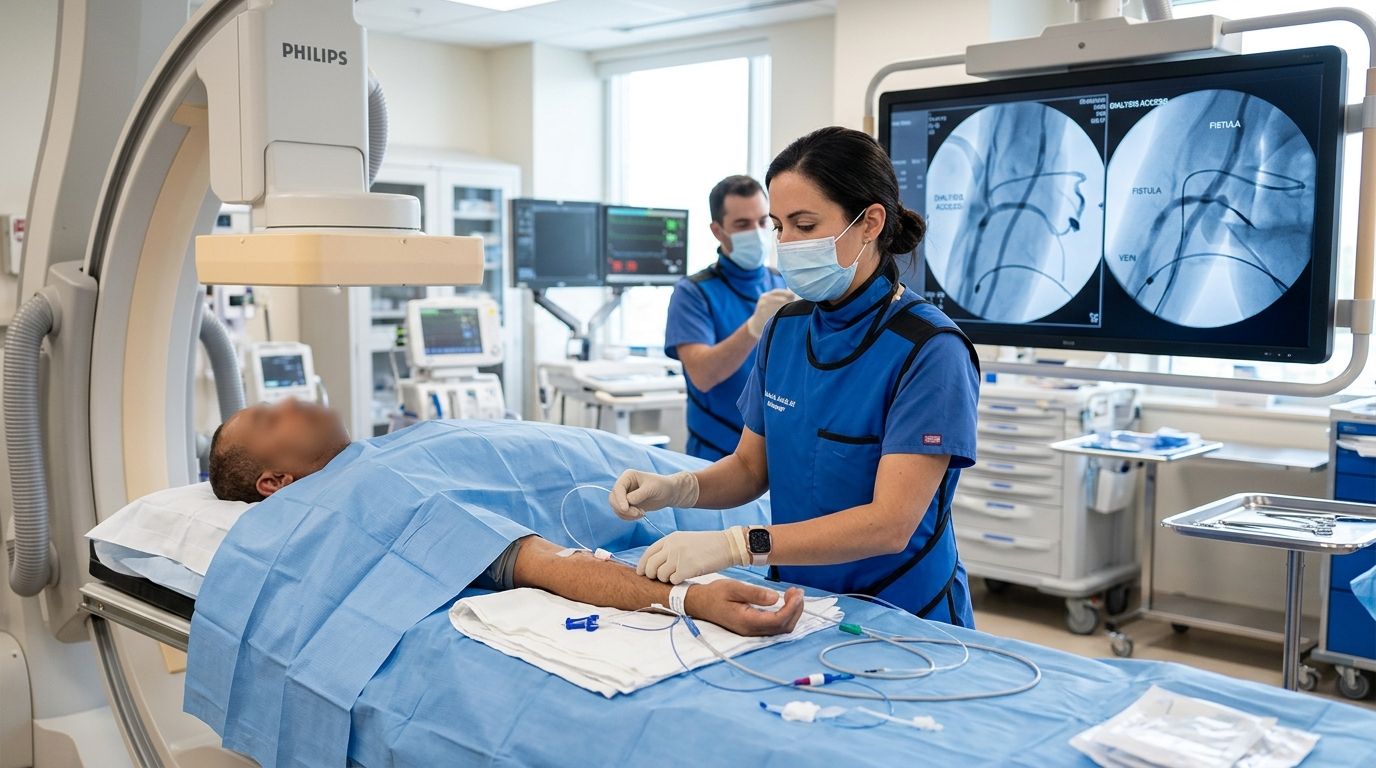
Dialysis access interventional radiology jobs place vascular IR physicians in outpatient access centers, hospital IR suites, or multi-specialty groups managing fistulograms, angioplasty, thrombectomy, and tunneled catheter placement for end-stage renal disease patients. The case mix looks different from general vascular IR: fewer oncology and trauma cases, far more repeat procedures on the same access circuits, and a compensation structure often tied to procedure volume rather than a flat RVU curve. Vascular IR physicians searching for these roles need to know which site of service they're walking into before they sign, because an access-only outpatient center and a hospital-employed IR division post nearly identical job titles but run completely different practices.
- Dialysis access IR jobs split mainly between outpatient vascular access centers and hospital IR divisions, and the two have very different case mixes.
- Search titles like 'vascular access IR' and 'dialysis access interventional radiologist' — 'interventional radiology' alone misses access-specific postings.
- Access-heavy panels run on procedure volume, not general IR RVU curves, so ask for weekly fistulaplasty and thrombectomy counts before comparing offers.
- RadBoard aggregates 5,000+ radiology jobs from 20 sources, letting vascular IR physicians filter access-focused openings by site type and call schedule.
Why dialysis access IR jobs matter for vascular IR physicians
Dialysis access work is one of the few IR subspecialties where the same patient returns to the same physician every few months, which changes how a practice values you. A vascular IR physician who builds a reputation for fast, low-complication access salvage becomes the person nephrology groups call directly, and that referral relationship is often worth more long-term than the base contract. Hospitals and outpatient access centers both compete for that skill set in 2026, but they structure the job differently — call burden, equipment access, and how much say you get over scheduling all vary by site.
Searching interventional radiology jobs for IR-trained physicians on a general job board buries access-specific postings under neuro-IR, oncology ablation, and general vascular listings. Filtering by procedure focus and site type surfaces the roles that actually match a dialysis-access practice.
How to find and evaluate dialysis access IR jobs in 2026
Separate access-only roles from general vascular IR postings
Most job boards list "vascular and interventional radiology" without specifying whether dialysis access is a core part of the panel or an occasional add-on. Read the posting for procedure-specific language before applying.
- Look for explicit mentions of fistulography, angioplasty, or declotting in the job description
- Check whether the employer names a dedicated vascular access center location
- Ask recruiters directly what percentage of weekly volume is access-related
- Flag postings that bundle access work with unrelated call coverage (neuro, trauma) as lower-priority access practices
Search job titles and modifiers that surface these roles
"Interventional radiologist" alone returns thousands of unrelated postings. Narrow the search with modifiers tied to the actual procedures and setting.
- Try "vascular access IR," "dialysis access interventional radiologist," and "AV fistula/graft IR"
- Add site-type filters like "outpatient vascular access center" or "ambulatory IR"
- Search for employer names known for single-specialty access centers alongside hospital system names
- Set up saved searches so new access-specific postings surface without re-running the query manually
Audit the case mix before you interview
A job description rarely tells you the real split between access maintenance and diagnostic work. Get the numbers before you commit time to an interview.
- Ask for weekly counts of fistulaplasty, thrombectomy, and tunneled catheter cases separately
- Confirm whether you'll also cover general vascular or oncologic IR call
- Find out if the site handles both AV fistulas and AV grafts, or specializes in one
- Ask how many of the site's patients are repeat access-salvage visits versus new referrals
Model compensation against access-heavy RVU patterns
Access procedures generate lower per-case RVUs than complex oncologic or neuro-IR work but run at much higher volume. A straight RVU comparison against a general IR offer can be misleading.
- Request the site's average daily procedure count, not just annual case totals
- Ask whether compensation is RVU-based, collections-based, or a hybrid with a base guarantee
- Compare the access-center model against vascular imaging radiologist jobs for PVD centers to see how peripheral vascular disease panels structure pay differently
- Factor in whether declotting cases (often after-hours or urgent) carry a separate call stipend
Confirm credentialing and privileging timelines
Outpatient access centers sometimes credential faster than hospital systems, but privileging for specific access procedures (tunneled catheters, stent grafts) isn't automatic even for board-certified IR physicians.
- Ask which specific access procedures require separate privileging beyond general IR privileges
- Confirm the site's typical credentialing turnaround in weeks, not a vague estimate
- Check whether the facility requires proctored cases before independent access work
- Verify state licensing timelines match your intended start date
Compare the nephrology referral relationship
Dialysis access volume depends entirely on nephrology referral patterns. A site with weak nephrology ties runs thin, regardless of equipment or facility quality.
- Ask how many nephrology groups actively refer to the site
- Find out if the practice has a formal relationship with local dialysis chains
- Confirm whether referral volume has grown or shrunk over the past two years
- Ask how quickly the site schedules urgent thrombectomy cases for referring nephrologists
Where dialysis access IR jobs actually live in 2026
| Site type | Best for | Key limitation |
|---|---|---|
| Outpatient vascular access center | High-volume, access-only practice | Limited case diversity beyond fistula/graft work |
| Hospital-employed IR division | Physicians wanting broad IR mix plus access call | Heavier overall call burden, competing subspecialty demands |
| Multi-specialty radiology group | Physicians wanting a partnership track | Access volume tied to the group's payer contracts, can fluctuate |
| Locum tenens access coverage | Filling gaps between contracts | No continuity with referring nephrologists, per-site credentialing lag |
Outpatient access centers win on volume and procedure focus; hospital IR divisions win on case diversity and career flexibility. Pick based on whether you want a deep, narrow practice or a broad IR panel with access as one piece of it.
Find dialysis access IR openings
Filter 5,000+ radiology listings by procedure focus and site type.
Common mistakes vascular IR physicians make chasing dialysis access jobs
- Assuming "vascular IR" postings automatically include heavy access work. Many general vascular postings have minimal dialysis access volume; confirm the split before applying.
- Skipping the after-hours declotting question. Urgent thrombectomy call at odd hours is common in access-heavy practices and often isn't disclosed until the offer stage.
- Comparing RVU totals without adjusting for procedure type. Access cases generate lower per-case RVUs at higher volume, so raw RVU comparisons against general IR offers distort the real workload.
- Ignoring the referring nephrology base. A site with strong equipment but a thin nephrology referral network runs low volume regardless of facility quality.
- Not asking about locum-to-permanent options between contracts. Locum tenens interventional radiology jobs between contracts can bridge a gap while you evaluate a permanent access-center offer without committing early.
FAQ
What is a dialysis access IR job?
A dialysis access IR job focuses on procedures that maintain AV fistulas and grafts for hemodialysis patients — fistulography, angioplasty, thrombectomy, and tunneled catheter placement. These roles sit in outpatient vascular access centers, hospital IR divisions, or multi-specialty radiology groups.
Is dialysis access IR different from general vascular IR?
Yes. Dialysis access IR focuses narrowly on AV fistula and graft maintenance with high repeat-patient volume, while general vascular IR covers a broader range of peripheral vascular disease and oncologic procedures. Compensation and call structures differ accordingly.
How much do dialysis access IR jobs pay compared to general IR roles?
Pay structure varies by site and compensation model, so compare RVU-based, collections-based, and hybrid offers directly with the practice rather than relying on a general IR benchmark. Access-heavy panels run higher procedure volume at lower per-case RVUs, which changes the math versus a general IR offer.
Do outpatient vascular access centers require separate credentialing from hospital IR jobs?
Often yes — tunneled catheter placement and stent graft procedures can require separate privileging beyond general IR privileges, even for board-certified physicians. Ask each site for its specific credentialing checklist before assuming your hospital privileges transfer.
Can locum tenens work lead to a permanent dialysis access IR position?
Yes, locum-to-permanent arrangements are common in vascular access, letting a physician evaluate case mix and nephrology referral volume before committing. It's a lower-risk way to test a site's actual access-only workload.
What should I ask about call schedule for a dialysis access IR job?
Ask specifically about after-hours declotting call, since urgent thrombectomy cases for clotted access are common and often carry separate stipends. Also confirm whether you'll cover general vascular or oncologic IR call in addition to access work.
How do I search for dialysis access IR jobs on a general job board?
General IR searches bury access-specific postings, so use modifiers like 'vascular access IR,' 'dialysis access interventional radiologist,' or 'AV fistula/graft IR' instead of a broad interventional radiology search. Filtering by outpatient access center as a site type also narrows results.
Does nephrology referral volume affect job stability in dialysis access IR?
Directly. A site's case volume depends on active referral relationships with local nephrology groups and dialysis chains, and thin referral networks mean low procedure volume regardless of equipment quality. Ask for referral trend data over the past two years before accepting an offer.
One last thing
Ask for weekly fistulaplasty and thrombectomy counts separately, not a combined "access procedures" number — the two carry different urgency, different RVU weight, and different after-hours call exposure, and a site that reports them together is usually hiding a heavier declotting call burden than the base job posting suggests. That single question, asked before the interview instead of after the offer, catches most of the mismatches vascular IR physicians run into with dialysis access roles in 2026.