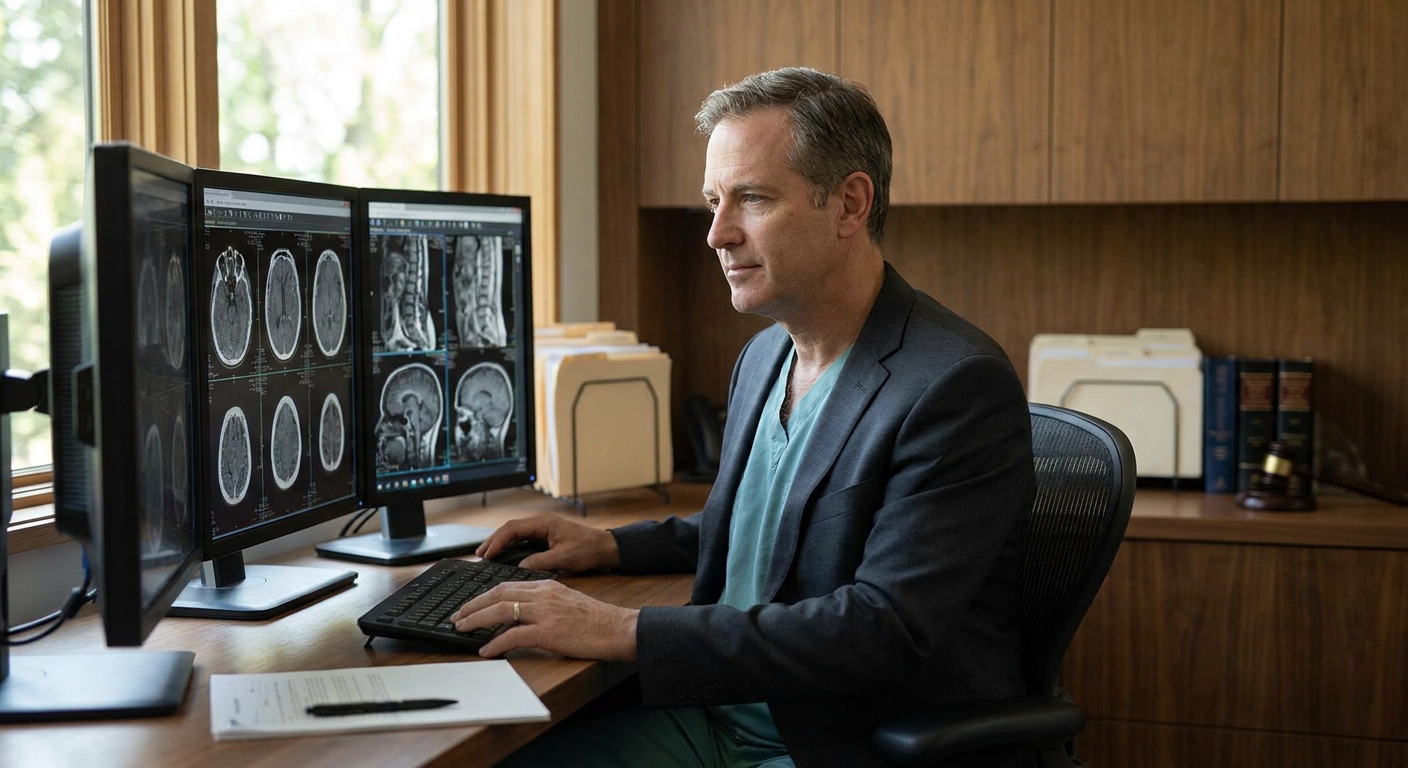
Expert witness radiologist jobs and IME consulting work let you apply subspecialty reads to legal cases and insurance disputes without adding more clinical shifts to your week in 2026.
- Expert witness radiologist jobs reward subspecialty depth over general reads — MSK, neuro, and mammography cases dominate 2026 caseloads.
- IME panel work through national companies is the steady-volume pick; independent expert witness practice pays more per case but takes longer to build.
- Semi-retired and part-time radiologists fit this work best — full clinical schedules leave little room for depositions and record review.
- Malpractice tail coverage and multi-state licensure gaps are the two most common reasons cases fall through before signing.
Why this matters
Radiology is one of the few specialties where a subspecialty read holds up in a deposition the same way it holds up in a tumor board. Attorneys and insurers need radiologists who can defend a finding under cross-examination, not just generate a report.
Demand for this work tracks the same subspecialty trends RadBoard's 2026 US Radiology Job Market Report flags across its 3,700+ active listings: MSK, neuroradiology, and mammography read volume keeps climbing, and legal cases follow the same imaging categories. A radiologist searching radiology jobs on a platform that aggregates 5,000+ postings from 20 sources will notice expert witness and IME listings show up far less often than clinical roles — most of this work comes through referral networks, not job boards.
Who this work is for
This guide is for board-certified radiologists with at least five years of subspecialty reads who want supplemental income without picking up more RVU-based shifts, plus semi-retired radiologists winding down call who still want case volume. It is not a fit for residents, fellows, or anyone without a defensible track record of peer-reviewed reads in the subspecialty they'd testify on.
What to look for in expert witness radiologist jobs for legal and IME consulting
Malpractice tail and professional liability coverage
A courtroom claim triggered years after a read can outlast your original malpractice policy. Confirm any IME company or law firm relationship includes separate coverage for expert testimony, since standard clinical malpractice policies often exclude it.
State licensure and multi-state case exposure
Expert witness work frequently crosses state lines, and testifying on a case tied to a state where you hold no license can get your opinion struck. Check whether the engagement requires full licensure or accepts a limited expert-witness exception before you accept a case.
Referral pipeline: IME companies vs. law firm networks
National IME companies hand you cases; independent expert witness practice means you build your own pipeline through plaintiff and defense attorneys. The first gets you volume faster in 2026; the second pays more per case once the pipeline is running.
Fee structure per case, per hour, or per deposition
Some engagements pay a flat per-case review fee, others bill hourly for record review plus a separate deposition and trial rate. Get the fee schedule in writing before you open the first chart — verbal fee agreements are the top source of billing disputes in this niche.
Subspecialty alignment with common case types
MSK and neuroradiology dominate personal injury and workers' comp cases; mammography and breast imaging dominate delayed-diagnosis claims. Match your subspecialty to the case types with volume, not the ones you find most interesting.
Time flexibility against your clinical schedule
Deposition and trial dates get set by courts, not by you, which means last-minute schedule conflicts with clinical shifts are common. Radiologists on 7-on-7-off or part-time schedules absorb this far better than full-time hospital-employed radiologists with fixed call.
Search radiology jobs on RadBoard
AI search and swipe-to-save across 5,000+ radiology listings from 20 sources.
Top picks for expert witness radiologist jobs and IME consulting
National IME company panel work — the steady volume play. IME companies route independent medical examination cases for workers' comp and disability claims, and joining a panel gets you your first cases within weeks instead of months. The tradeoff is a fixed per-case fee schedule set by the company, not by you. Buy if you want volume fast and don't mind a capped rate.
Semi-retired independent expert witness practice — the wind-down income stream. Radiologists cutting clinical hours in 2026 often keep expert witness work as their only remaining income stream, since record review and depositions can be scheduled around a lighter calendar. Building your own referral pipeline of attorneys takes 12 to 24 months longer than joining an IME panel, but the per-case rate runs higher once it's established. Buy for radiologists past peak clinical hours who still want billable work — the part-time radiology jobs for semi-retired physicians path pairs naturally with this.
Second-opinion and tumor board crossover consulting — the subspecialty crossover. Radiologists already doing second-opinion oncologic reads for tumor boards often get approached for related malpractice or delayed-diagnosis cases in the same subspecialty. It's a natural extension of clinical work you're already credentialed for. Consider if you're already in a second-opinion role and want to test expert witness work without leaving your current position.
Contract forensic radiology consulting for defense firms — the highest fee ceiling. Defense firms retain forensic radiology consultants on a case-by-case contract basis, and per-case fees here run higher than IME panel rates because the work involves deeper record review and more courtroom exposure. Read the engagement contract closely — indemnification and tail coverage terms vary widely between firms, the same way they do in any radiology employment contract. Consider if you have prior deposition experience and a subspecialty with high litigation volume.
Non-clinical AI and imaging-tech litigation consulting — the tech-litigation niche. As AI-assisted reads spread across radiology departments in 2026, litigation tied to algorithm-flagged misses is a new and thin case category. Volume is low right now and the referral networks aren't mature. Skip unless you already have a non-clinical consulting relationship with an imaging tech company.
What to avoid
- High-volume IME mills with flat per-case fees below market — they look like steady income but the hourly math often lands below what a locum shift pays.
- Cases in states where you hold no active license and no expert-witness exception applies — your opinion can be struck before it ever reaches a jury.
- Engagements with no malpractice tail language in the contract — a testimony claim can surface years after the case closes, and a standard clinical policy won't cover it.
Verdict comparison table
| Path | Case volume | Fee ceiling | Licensing burden | Time commitment | Verdict |
|---|---|---|---|---|---|
| IME company panel | High | Fixed, moderate | Low | Predictable | Buy |
| Semi-retired independent practice | Low to start, grows | High once established | Moderate | Flexible | Buy |
| Second-opinion crossover | Moderate | Moderate | Low | Low added | Consider |
| Contract forensic consulting | Moderate | High | Moderate to high | Variable, court-driven | Consider |
| Non-clinical AI litigation | Low | Unproven | Low | Low | Skip |
FAQ
What's the best way to find expert witness radiologist jobs in 2026?
Most expert witness radiologist jobs come through IME company panels and attorney referral networks rather than public job boards. Joining a national IME panel gets you your first cases fastest; building an independent referral pipeline pays more per case over time.
Is expert witness work good supplemental income for radiologists?
Yes, for radiologists with five or more years of subspecialty reads and a schedule flexible enough to absorb court-driven deposition dates. It works best as a supplement to reduced clinical hours, not as a full replacement for RVU-based income early in a career.
Do you need board certification to serve as an expert witness radiologist?
Board certification in radiology and a defensible track record in the relevant subspecialty are standard requirements for expert witness and IME consulting work. Courts and IME companies routinely check certification status before accepting an opinion.
How do IME company panels differ from independent expert witness practice?
IME company panels route cases to you directly and set a fixed per-case fee, which gets you volume fast. Independent expert witness practice means building your own referral pipeline of attorneys, which takes longer to establish but pays more per case once running.
Do expert witness radiologist jobs require malpractice tail coverage?
Standard clinical malpractice policies often exclude testimony-related claims, so separate tail coverage for expert witness work is a standard requirement in most engagement contracts. Confirm this before accepting a case, since claims can surface years after a case closes.
Can teleradiologists do IME and expert witness work remotely?
Record review and report preparation for IME and expert witness cases can be done remotely, but depositions and trial testimony typically require in-person or video appearance tied to the case's jurisdiction. State licensure still applies regardless of where the review happens.
What subspecialties see the most expert witness demand?
MSK and neuroradiology dominate personal injury and workers' comp cases, while mammography and breast imaging dominate delayed-diagnosis claims. Matching your subspecialty to case volume matters more than personal interest when choosing this path.
How much time does expert witness work add to a radiologist's schedule?
Record review runs several hours per case, and depositions or trial testimony add court-scheduled days that can conflict with clinical shifts. Radiologists on part-time or block schedules absorb this more easily than those with fixed full-time call.
One last thing
The radiologists who last longest in expert witness and IME consulting aren't the ones with the flashiest CVs — they're the ones who never take a case outside their actual subspecialty, because a single overreach on cross-examination follows them into every case after it.