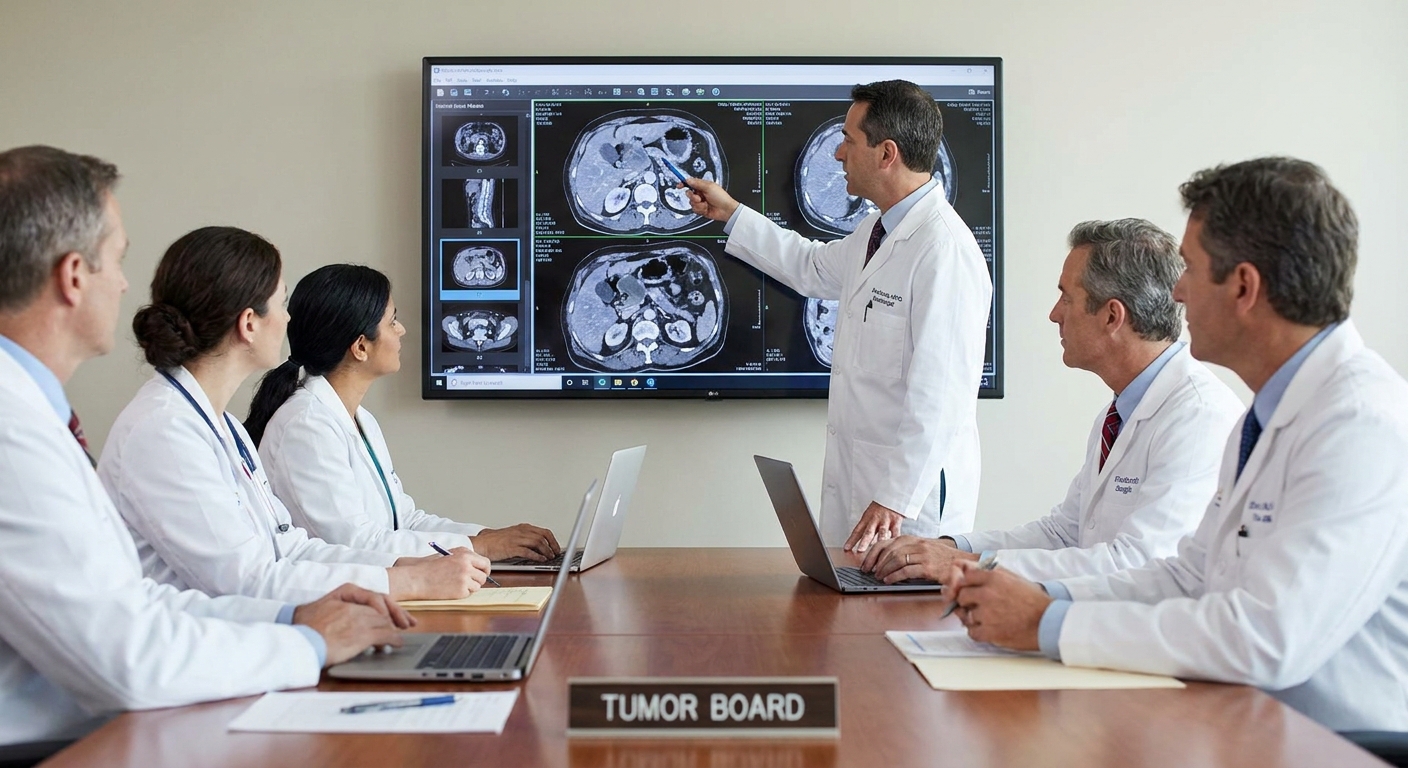
Radiologists who read outside imaging for tumor board discussion need a different job than the one described in a standard diagnostic radiology posting, and the settings that hire for this work vary more than most job seekers expect.
- Academic cancer centers offer the most consistent second opinion radiologist jobs tied to weekly tumor board case conferences.
- Teleradiology consult roles pay per-read but require multi-state licensing before you can take outside-state cases.
- NCI-designated cancer centers run the highest second-opinion volume; expect subspecialty-only reading, not general diagnostic call.
- PE-backed oncology imaging networks look attractive on RVU comp but often skip malpractice tail coverage for discordant overreads - verify before signing.
Why this matters
A second opinion read isn't a routine diagnostic report. You're re-reading a scan from an outside facility, often flagging a discordant finding, and then defending that read in front of an oncologist, surgeon, and pathologist at the same table. The job market for this work sits inside cancer center radiology jobs, but not every cancer center posting involves tumor board participation - some are pure volume reading with no conference time built in.
The distinction matters for pay, schedule, and liability exposure. A second-opinion radiologist carries more risk per read than a routine study, because a missed discrepancy in front of a tumor board has downstream consequences for treatment planning. RadBoard's radiology job search platform surfaces these postings inside its 5,000+ aggregated jobs from 20 sources, but the tumor board detail rarely shows up in the job title - you have to read the fine print.
Who this is for
This guide is for board-certified radiologists with subspecialty training in oncologic imaging - body imaging, neuroradiology, breast imaging, musculoskeletal (sarcoma), or prostate MRI/PI-RADS - who want work built around tumor board case review rather than general diagnostic call. It's also relevant to radiologists finishing fellowship who want their subspecialty niche to translate into consult-style reading instead of a generalist caseload.
What to look for in second opinion radiologist jobs
Subspecialty depth over general reads
Tumor boards expect a radiologist who reads within a defined organ system every day, not someone rotating through general call. A posting that says "oncologic imaging" but lists CT, MRI, ultrasound, and nuclear medicine across all body systems is a general diagnostic job wearing a subspecialty label.
Turnaround time commitments
Most tumor boards meet weekly, and second-opinion reads need to land 24-48 hours before the meeting. Ask directly what the expected turnaround is - a posting that's vague on timing usually means the workload is unpredictable and stacks up before conference day.
Compensation model for consult-style reads
Second-opinion volume runs lower than routine diagnostic imaging, so a pure per-read RVU model can underpay compared to a salaried academic role with built-in conference time. Compare base salary plus academic RVU against per-read teleradiology rates before assuming the per-read number is better.
Multi-site licensing and telehealth infrastructure
Patients bring outside imaging from other states, and a second-opinion read on that file usually requires licensure in the state where the study originated. Confirm whether the employer or the platform supports multi-state license reimbursement before signing.
Direct clinician interaction
Tumor boards expect the radiologist to present findings live, answer questions from oncology and surgery, and sometimes defend a discordant read against the original report. A job posting that never mentions case conference attendance likely doesn't include this responsibility - confirm it in the interview, not after you start.
Malpractice coverage for discrepancy flags
Flagging a missed or discordant finding from an outside facility carries its own liability exposure. Ask whether the group's malpractice policy explicitly covers second-opinion overreads, and whether tail coverage extends to disputes tied to a tumor board recommendation.
“If a second-opinion read takes longer than 24 hours, the tumor board moves on without you.”
Find oncologic imaging roles now
Search 5,000+ radiology jobs from 20 sources with AI-powered filters.
Top picks for second-opinion oncology tumor board work
Academic cancer center second-opinion attending - the traditional path. Weekly tumor board case conference is built into the schedule, and salary plus academic RVU averages more predictable than pure per-read models in 2026. Turnaround expectation runs 24-48 hours before conference day, and subspecialty depth is required at hire. Buy. See academic radiology jobs for teaching and research physicians.
Teleradiology oncologic second-opinion consult - the remote pick. Per-read compensation is common, and the catch is multi-state licensing - you need active licenses in every state where outside imaging originates. Turnaround runs faster than academic settings, often 24 hours or less, because consult platforms route cases by urgency. Consider, if you already hold multi-state licenses. Details at teleradiology jobs for radiologists who want remote flexibility.
NCI-designated cancer center subspecialty reading - the volume play. These centers run the highest second-opinion volume in oncologic imaging, often 10-20 outside-facility reads per week per subspecialist. Case conference attendance is mandatory, not optional, and compensation tends to sit above community hospital averages for 2026. Buy, if you want full-time subspecialty-only reading tied to case discussion.
Subspecialty-only reading niche - the specialist's play. Radiologists who limit their practice to one organ system - prostate MRI and PI-RADS interpretation, or lung cancer screening low-dose CT - can build a second-opinion caseload almost entirely from referrals. The tradeoff is a narrower job market and fewer employer options in 2026. Consider, if your subspecialty is already established.
PE-backed oncology imaging network - the wildcard. RVU-based comp on these networks often beats academic salary on paper, but malpractice tail coverage for discordant overreads is inconsistent across groups. Read the contract before assuming the RVU number holds up after year one. Hold, pending contract review.
What to avoid
- General diagnostic postings labeled "oncologic imaging." If the job description lists every organ system and every modality, it's a routine call job, not a tumor board consult role.
- Per-read teleradiology contracts with no licensing support. A per-read rate that looks strong on paper falls apart once you're paying for five state licenses out of pocket.
- PE-backed groups with no malpractice tail language. A discordant second-opinion read is exactly the kind of case that triggers a dispute - confirm coverage before you sign, not after.
Verdict comparison
| Setting | Turnaround expectation | Comp model | Subspecialty depth required | Verdict |
|---|---|---|---|---|
| Academic cancer center | 24-48 hrs before conference | Salary + academic RVU | High | Buy |
| Teleradiology consult | Under 24 hrs | Per-read | High | Consider |
| NCI-designated center | 24-48 hrs before conference | Salary, above-average | Very high | Buy |
| Subspecialty-only niche | Varies by referral volume | Mixed | Very high | Consider |
| PE-backed network | 24-48 hrs | RVU-based | High | Hold |
FAQ
What is a second opinion radiologist job for oncology tumor boards?
It's a role focused on re-reading outside imaging brought in by cancer patients, then presenting findings at a weekly tumor board alongside oncology and surgery. It differs from routine diagnostic reading because the radiologist often flags discordant results and defends the read in a live case conference.
How much do second-opinion radiologist jobs pay in 2026?
Pay varies by setting: academic cancer centers use salary plus academic RVU, teleradiology consult platforms pay per-read, and PE-backed networks run RVU-based comp that can outpace both on paper. Compensation is usually higher at NCI-designated centers given the volume and subspecialty demand tracked across 2026 postings.
Do second-opinion oncologic reads require board certification in a subspecialty?
Yes, most tumor board-facing roles require fellowship training in the relevant organ system - body imaging, neuroradiology, breast imaging, MSK, or prostate MRI. General diagnostic certification alone rarely qualifies for dedicated second-opinion work.
Is teleradiology a good fit for second-opinion tumor board work?
Teleradiology works well if you already hold multi-state licensing, since second-opinion cases come from outside the treating facility's state. Turnaround on these platforms tends to run under 24 hours, faster than most academic case conference cycles.
What turnaround time do tumor boards expect for second-opinion reads?
Most tumor boards meet weekly and expect the second-opinion read completed 24-48 hours before the meeting. A job posting vague on turnaround usually signals inconsistent scheduling.
Can locum tenens radiologists do second-opinion tumor board reads?
It's uncommon, since tumor board participation typically requires ongoing case conference attendance that locum contracts don't cover. Locum roles are more common in general diagnostic or subspecialty coverage gaps than in dedicated second-opinion positions.
What's the difference between a second opinion read and a routine oncologic imaging read?
A routine oncologic read interprets a new study without prior context, while a second-opinion read re-evaluates an outside facility's imaging and often compares it against the original report for discrepancies. The second-opinion read carries more liability exposure because a missed discrepancy affects tumor board treatment planning.
Do second-opinion radiologist jobs require multi-state licensing?
Yes, if the role involves teleradiology consult work, since outside imaging can originate from any state the patient traveled from. Academic and hospital-based roles typically require only the license for the employing state.
One last thing
RadBoard's 2026 US radiology job market report tracks subspecialty demand across 3,700+ active listings, and oncologic imaging consistently shows tighter turnaround requirements than general diagnostic postings - the fastest-growing segment isn't academic, it's teleradiology consult work built specifically around tumor board deadlines.