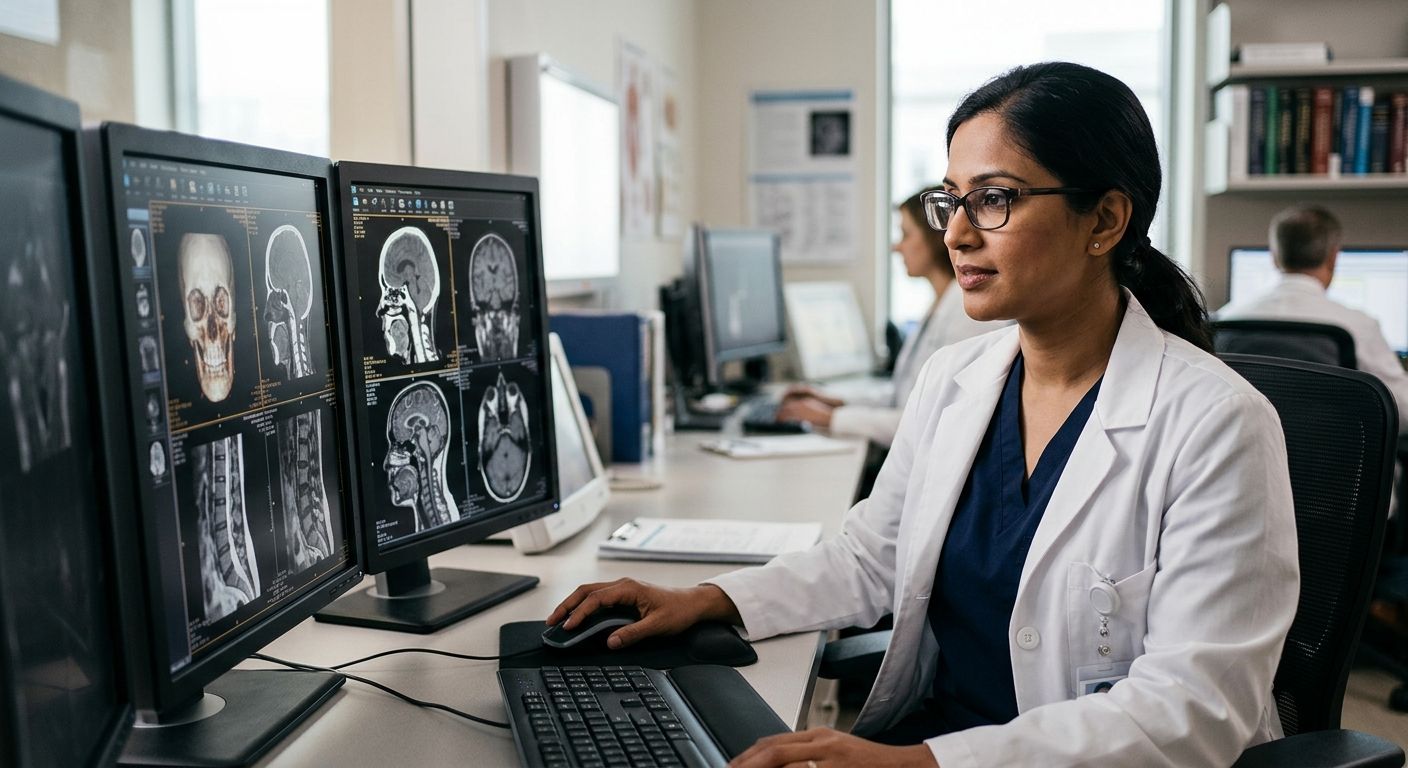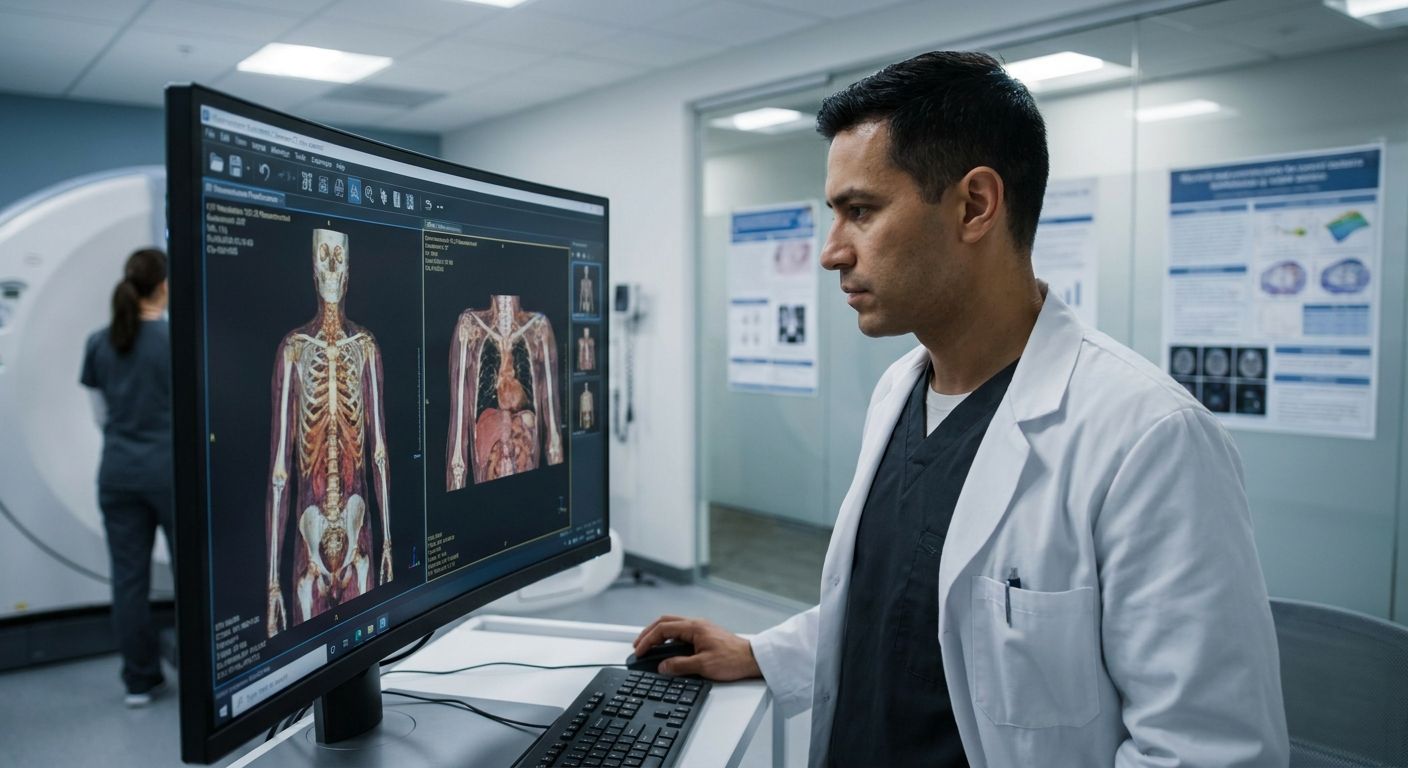
Forensic imaging radiologist jobs for postmortem CT support place a radiologist inside a medical examiner, coroner, or forensic pathology system, reading CT scans that inform a death investigation instead of a treatment plan. The read has to hold up in a courtroom, not just a tumor board, which changes documentation standards, turnaround expectations, and how the role gets staffed in the first place.
- Forensic imaging radiologist jobs for postmortem CT support sit outside standard diagnostic radiology because the read supports a death investigation, not treatment.
- Medical examiner offices, university forensic institutes, and expert-witness practices are the three main hiring paths for this work.
- Most postmortem CT postings do not require a forensic radiology fellowship - cross-sectional CT experience matters more than the credential.
- RadBoard aggregates listings from 20 sources across 5,000+ radiology jobs, useful for catching the sporadic postings this niche produces.
- Expect contract or per-case pay structures more often than a salaried FTE, since single-office caseloads rarely justify one.
Why postmortem CT support matters for forensic imaging radiologists
Postmortem CT (PMCT) is used as a triage and adjunct tool ahead of or alongside autopsy in many medical examiner and coroner systems, flagging trauma, foreign bodies, and internal findings before the pathologist opens the body. That workflow needs a radiologist who can read without a clinical history, describe decomposition and postmortem artifact accurately, and write a report that a prosecutor or defense attorney can put in front of a jury.
Demand for forensic imaging radiologist jobs doesn't behave like demand for general diagnostic radiology jobs. A single county medical examiner's office might handle a caseload that justifies a few hours of imaging review a week, not a full FTE. That's why most postmortem CT roles show up as contract arrangements, part-time consulting agreements, or a forensic imaging component bolted onto an academic or general radiology appointment, rather than as a standalone full-time posting.
Confirm your imaging scope and training fit
Before chasing a posting, check whether your background actually matches what postmortem CT work requires.
- Solid cross-sectional CT reading experience, ideally with body or trauma imaging exposure
- Comfort reading without a clinical history or prior imaging for comparison
- Willingness to describe decomposition changes, gas patterns, and postmortem artifact without treating them as pathology
- No forensic radiology fellowship required for most postmortem CT postings - general or body-trained radiologists fill the majority of these roles
- Some tolerance for irregular case flow instead of a predictable daily volume
Identify where postmortem CT jobs actually get posted
These postings don't cluster on one job board, which is the biggest practical obstacle in this niche.
- County and state medical examiner career pages, often buried under general physician postings
- University-affiliated forensic pathology or forensic institute programs, frequently combined with a teaching appointment
- Expert-witness and medicolegal consulting firms that contract radiologists for case review and testimony
- Academic radiology departments with a forensic imaging division or research arm
- Aggregator platforms that pull listings from multiple sources instead of one institution's career page
Manually checking each medical examiner office's career page one by one is the free route, but it's slow given how thin this niche runs. RadBoard pulls listings from 20 sources into one AI-powered search, which matters more here than in higher-volume subspecialties because a single scattered posting is easy to miss if you're not searching broadly. Swipe-to-save lets you flag the rare forensic listing the moment it surfaces instead of losing it in a general radiology search on RadBoard.
Search forensic imaging openings now
AI-powered search across 5,000+ radiology jobs from 20 sources.
Build a CV that speaks to forensic reviewers
A standard diagnostic radiology CV undersells the parts of your background that matter to a medical examiner's office.
- Lead with cross-sectional CT volume and any trauma or body imaging concentration
- Call out any prior medicolegal, autopsy-correlation, or death-investigation exposure explicitly
- List courtroom testimony or deposition experience if you have it, even informal cases
- Note any joint appointment or collaboration with a pathology department
- Keep your clinical CV base intact, but add a dedicated forensic or medicolegal section instead of burying it in a bullet
A competitive radiology CV built for a general attending job needs this extra layer before it goes to a forensic reviewer - the review committee is looking for legal-context readiness, not just read volume.
Price the role correctly relative to standard diagnostic pay
Forensic imaging pay doesn't map cleanly onto standard RVU-based diagnostic compensation, and treating it like a clinical job during negotiation leaves money on the table.
- Confirm whether the role pays per case, per diem, or on a retainer basis
- Ask about expected report turnaround time for time-sensitive cases tied to active investigations
- Clarify malpractice and liability coverage specific to medicolegal and courtroom exposure
- Ask how testimony and deposition time gets compensated separately from imaging review
- Benchmark the rate against comparable legal-consulting radiology work, not general diagnostic pay, since the liability profile is different
If you're unsure how to push back on an initial offer, the same tactics used to negotiate a higher radiologist salary apply here, with the added leverage point that few radiologists actively pursue this niche.
Vet the employer's caseload and support structure
A thin caseload or a weak informatics setup will make the job harder than the job posting suggests.
- Ask for expected annual PMCT case volume, not just a general estimate
- Confirm whether you'll have access to any available EHR or prior imaging for context
- Ask how the autopsy-correlation workflow works day to day
- Check what PACS or imaging viewer the office actually runs - some medical examiner offices operate on outdated or minimal systems
- Confirm expectations around expert testimony frequency before you sign
Prepare for the expert-witness dimension
Most postmortem CT work eventually intersects with legal proceedings, and that side of the job needs its own vetting.
- Ask how often the role requires courtroom testimony versus deposition-only involvement
- Confirm whether the employer provides testimony prep or you're expected to arrive ready
- Check the malpractice and liability structure for legal-context work specifically
- Ask whether continuing education or professional development covers testimony skills
Radiologists who want more of this work outright, not just as a side effect of a PMCT role, should look directly at expert-witness radiologist jobs built around legal and IME consulting.
Set up peer review and quality assurance expectations
A forensic read that goes uncontested internally is a liability risk for you and the office.
- Ask what peer review process exists for forensic imaging reads specifically
- Confirm accreditation status of the office or institute you're joining
- Clarify documentation standards required for legal admissibility
Comparing your options for forensic imaging radiologist jobs
| Option | Best For | Key Limitation |
|---|---|---|
| County/state ME office direct hire | Radiologists wanting a steady, dedicated PMCT focus | Few standalone FTE openings; most are contract or part-time |
| University forensic institute appointment | Radiologists who want teaching and research alongside PMCT reads | Academic appointment process moves slower than direct hire |
| Expert-witness/legal consulting practice | Radiologists who want testimony work over routine imaging review | Income tied to case volume and court schedule, not a steady salary |
| Aggregator job search (RadBoard) | Radiologists casting a wide net across scattered, hard-to-find postings | Listings for this niche stay sparse even across 20 sources |
Verdict: the county/state ME direct-hire route is the closest thing to a stable job in this niche, but the expert-witness path pays for the legal skill set specifically - pick based on whether you want steady reads or courtroom involvement.
Common mistakes forensic imaging radiologists make
- Assuming a forensic radiology fellowship is a prerequisite, when most postmortem CT roles hire general or body-trained radiologists
- Reading PMCT scans with the same documentation habits used for clinical cases, then getting caught short in deposition
- Benchmarking pay against standard diagnostic RVU rates instead of medicolegal consulting rates
- Signing before confirming testimony and deposition expectations, then getting surprised by court dates
- Ignoring the informatics gap - some medical examiner offices run older PACS or none at all, which slows every read
FAQ
What is a postmortem CT radiologist?
A postmortem CT radiologist reads CT scans performed on deceased individuals to support a medical examiner or coroner's death investigation, often ahead of or alongside a full autopsy. The work focuses on trauma, foreign bodies, and internal findings rather than treatment planning.
Do I need a forensic radiology fellowship for postmortem CT jobs?
No, most postmortem CT postings hire general or body-trained radiologists without a forensic radiology fellowship. Cross-sectional CT experience and comfort reading without clinical history matter more than the specific credential.
Is postmortem CT radiology a full-time job?
Rarely as a standalone role. Most postmortem CT work is structured as contract, per-case, or part-time consulting because a single medical examiner office's caseload seldom justifies a dedicated full-time position.
What's the difference between postmortem CT and a full autopsy?
Postmortem CT is a non-invasive imaging scan used to triage or supplement findings, while an autopsy involves physical dissection by a forensic pathologist. PMCT is typically used as an adjunct tool, not a replacement for autopsy.
Can teleradiologists read postmortem CT scans remotely?
Some forensic institutes and medical examiner systems do use remote imaging review, though access to case context and PACS integration varies widely by office. Confirm the informatics setup before assuming remote reading is supported.
Do postmortem CT radiologists testify in court?
Many do, since forensic imaging findings often become part of legal proceedings. Testimony frequency depends heavily on the employer and case type, so it's worth confirming expectations before accepting a role.
Where do forensic imaging radiologist jobs get posted?
Postings show up on individual medical examiner career pages, university forensic institute sites, expert-witness consulting firms, and aggregator platforms like RadBoard that pull from multiple sources at once.
How is pay structured for postmortem CT work?
Pay is typically per-case, per diem, or retainer-based rather than a standard salary, since caseloads are usually too small to support a full-time position. Rates should be benchmarked against medicolegal consulting work, not standard diagnostic pay.
One last thing
Most postmortem CT positions never appear as a clean, standalone job title - they're bundled into an academic appointment, a part-time consulting agreement, or a general radiology role with a forensic component tacked on. If you're only searching for "forensic radiologist" as an exact job title, you'll miss most of the actual openings; search by imaging setting and employer type instead.