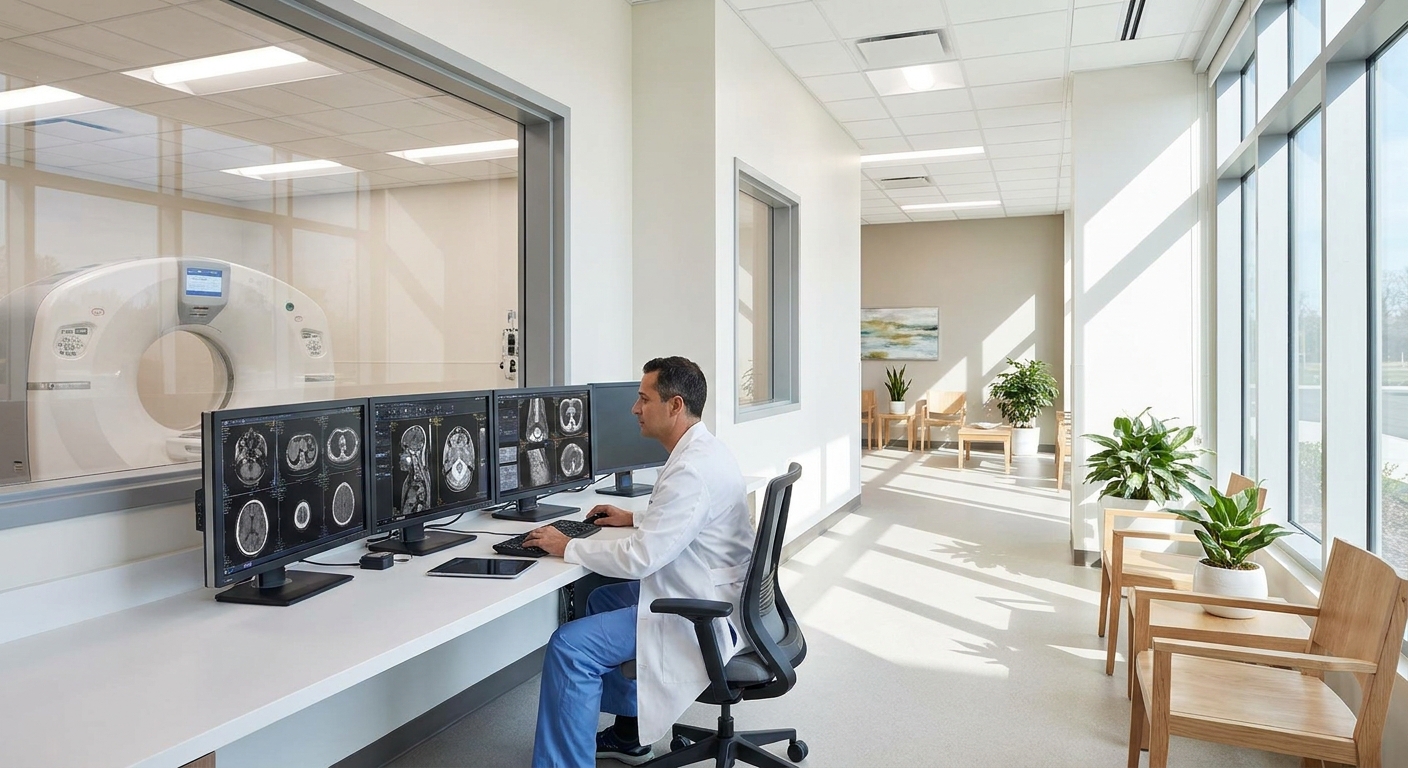
Freestanding ER radiology jobs put you on the hook for trauma and stroke reads at emergency departments that stand entirely apart from a hospital building — same acuity, none of the onsite backup a hospital-campus radiologist takes for granted.
- Freestanding ER radiology jobs run on teleradiology or nighthawk coverage, not onsite staff — buy in if 30-minute STAT turnaround suits you.
- Corporate FSER chains and locum tenens blocks both fill freestanding ER radiology jobs; confirm malpractice tail coverage before signing either.
- Nighthawk-only FSER coverage trades a normal schedule for maximum trauma acuity; outpatient overread trades acuity for zero call.
- RadBoard tracks freestanding ER radiology jobs alongside 5,000+ radiology positions from 20 sources in 2026.
Why this matters
Freestanding emergency departments don't have an imaging department staffed by a radiologist a hallway away from the ED bay. Every scan depends on a contracted teleradiology group, a nighthawk service, or a corporate imaging chain reading remotely, and that structure changes three things for the radiologist taking the job: turnaround expectations, liability exposure, and how much say you get over protocols.
In 2026, freestanding ER radiology jobs sit at the intersection of emergency radiology and teleradiology — you need the read speed of an emergency radiology job and the remote-workflow fluency of a teleradiologist. RadBoard tracks these openings alongside nighthawk, locum, and outpatient imaging listings so you can compare structures side by side.
Who this is for
This fits radiologists who want emergency-level acuity — PE rule-outs, subdural bleeds, appendicitis calls — without a hospital campus commute, and who are already comfortable reading off a home workstation or covering a locum block. It also fits generalists who value fast-turnaround volume over subspecialty depth, and teleradiologists who want to add freestanding sites to an existing rotation.
It's a poor fit for anyone who wants an onsite tumor board, in-person ED attending consults, or a slow, predictable case mix. If that's you, look at outpatient or academic settings instead.
What to look for in freestanding ER radiology jobs
Coverage model: teleradiology, nighthawk, or onsite
Most freestanding EDs run zero onsite radiologists — reads come from a contracted teleradiology group or a nighthawk service covering the overnight block. Confirm whether you're reading live during your shift or picking up nighthawk overflow from multiple sites at once; the second model means unpredictable volume spikes.
STAT turnaround SLA
Freestanding ER contracts typically specify a STAT turnaround window — commonly 20 to 30 minutes for trauma and stroke protocol scans — because the ED physician can't admit or transfer without your read. Get the actual SLA number in writing, not a verbal estimate, and ask what happens contractually if you miss it repeatedly.
Case mix and pediatric volume
Some freestanding EDs skew adult trauma and orthopedic; others carry meaningful pediatric volume without a pediatric radiologist on staff. If pediatric trauma shows up in the case mix, ask whether those studies route to a pediatric-trained colleague or land on your worklist by default.
Ownership and site count
A single independent freestanding ER has different leverage than a corporate chain running dozens of sites under one contract. Chain-owned sites standardize SLAs and pay across locations, which simplifies comparing offers, but your contract can also change when the chain renegotiates with its radiology vendor.
Malpractice and tail coverage
Trauma-read liability is real, and terms vary sharply by whether you're W-2 with a hospital-adjacent group, 1099 with a locum agency, or contracted directly with the FSER chain. Confirm tail coverage in writing before your first shift, not after.
Compare freestanding ER radiology jobs now
Filter 5,000+ radiology jobs by site type and coverage model in 2026.
Top picks
Nighthawk-only FSER coverage — the night owl's pick
Nighthawk contracts typically run 7pm to 7am blocks and cover trauma-heavy overnight volume across multiple freestanding sites at once. Buy if you want maximum acuity per shift and don't mind an inverted schedule — nighthawk radiology jobs list current overnight-block openings.
Corporate chain FSER employment — the volume play
Chains covering a dozen or more freestanding sites standardize STAT SLAs and pay bands, which makes comparing offers easier than negotiating site by site. Consider this route if predictable pay matters more than site independence, but verify who owns the chain and whether your contract survives a vendor change.
Locum tenens FSER staffing — the test-drive
Locum blocks run 1 to 4 weeks and let you sample freestanding ER acuity at two or three sites before committing to a permanent contract. Buy if you're not sure the trauma pace fits your career yet — it's the lowest-commitment way to find out.
Outpatient imaging overread — the no-call fallback
Outpatient center contracts, unlike true freestanding ERs, carry no call and a mostly non-trauma case mix — orthopedic follow-ups, screening mammo, routine CT. Skip this if acuity is the reason you're job hunting; it reads like a freestanding ER job on paper but isn't one in practice.
What to avoid
- Postings that promise "no call" while burying a weekend STAT rotation quota in the fine print
- Corporate chain contracts that don't disclose tail coverage or make it contingent on tenure
- Sites advertising 24/7 pediatric trauma readiness without a pediatric-trained radiologist actually on the coverage rotation
Verdict comparison
| Model | Shift Pattern | Acuity | Call Structure | Verdict |
|---|---|---|---|---|
| Nighthawk-only FSER | 7pm-7am blocks | High trauma/stroke | No daytime call | Buy for night-shift radiologists |
| Corporate chain FSER | Rotating day/night | Mixed, standardized SLA | Site-dependent | Consider, verify ownership |
| Locum tenens FSER | 1-4 week blocks | High, variable | None between contracts | Buy to test-drive |
| Outpatient imaging overread | Daytime only | Low-moderate | No call | Skip if seeking trauma acuity |
FAQ
What's the best coverage model for freestanding ER radiology jobs in 2026?
Nighthawk-only coverage wins for pure acuity since you read trauma and stroke scans back to back during a single overnight block. Corporate chain employment wins for predictable pay and standardized SLAs across sites. Pick nighthawk if acuity matters more than schedule stability, chain employment if the reverse is true.
Is a freestanding ER radiology job better than a hospital-based ER role?
Neither is objectively better - freestanding ER jobs trade the onsite backup and multidisciplinary consults of a hospital campus for a leaner remote-read setup. You get similar or higher trauma volume without hospital politics, but you lose the walk-down-the-hall second opinion on a hard call.
How fast do freestanding ER radiology jobs require STAT turnaround?
Most contracts specify a 20 to 30 minute STAT turnaround window for trauma and stroke protocol scans in 2026. Missing that window repeatedly can trigger contract penalties, so get the exact number in writing before signing.
Are freestanding ER radiology jobs teleradiology-only or onsite?
The vast majority run teleradiology or nighthawk coverage with zero onsite radiologist, since freestanding EDs are built without a full imaging department. A small number of larger freestanding campuses staff an onsite reader during peak daytime hours, but that's the exception, not the rule.
What malpractice coverage should you check before taking a freestanding ER radiology job?
Confirm tail coverage in writing and confirm whether it's occurrence-based or claims-made before you take a single shift. Trauma reads carry real liability exposure, and terms differ sharply between W-2 hospital-adjacent groups, 1099 locum contracts, and direct chain employment.
Can locum tenens radiologists work freestanding ER radiology jobs?
Yes - locum tenens blocks running 1 to 4 weeks are one of the most common ways radiologists enter freestanding ER work without a long-term commitment. It's also the lowest-risk way to test whether the trauma pace and remote workflow fit before signing a permanent contract.
Do freestanding ER radiology jobs cover pediatric trauma cases?
Some do, but not all freestanding EDs staff or contract for a pediatric-trained radiologist, so pediatric trauma volume varies by site. Ask directly whether pediatric studies route to a pediatric specialist or land on your worklist by default.
How many freestanding ER radiology jobs are listed on RadBoard in 2026?
RadBoard aggregates 5,000+ radiology positions from 20 sources in 2026, including freestanding ER, nighthawk, and teleradiology listings updated continuously. Filtering by site type on the platform narrows that list to freestanding and non-hospital imaging roles specifically.
One last thing
The riskiest clause in a freestanding ER radiology contract isn't pay — it's who reads the backlog if the group's contract with the site ends mid-quarter. Ask that question before you ask about salary, and ask it in writing.