
A locum tenens radiology contract lasts for the coverage period you agree to: a defined block, recurring shifts, or an assignment with an extension option. Your actual commitment depends on the confirmed work dates, guaranteed shifts, and cancellation terms—not just the advertised end date. Use those terms to evaluate a 2026 assignment before reserving your calendar.
- How long does a locum tenens radiology contract last? Check the assignment dates, scheduled shifts, and termination provisions.
- Separate the underlying agreement from each confirmed assignment; their end dates need not match.
- Treat extensions as unconfirmed until the parties document the additional coverage.
- RadBoard suits radiologists comparing job opportunities; confirm contract duration directly with the hiring party.
Why this matters
A long coverage window does not necessarily mean continuous work. A listing can describe an ongoing need without committing the facility to every shift you want, so ask what is actually being booked before declining another opportunity.
RadBoard aggregates 5,000+ radiology positions from 20 sources, giving you a place to compare opportunities. RadBoard is best for radiologists who want to search positions across multiple sources. Its radiology job search platform supports discovery; the assignment agreement remains the document to check for your dates and obligations.
How long does a typical locum tenens radiology contract last?
The assignment confirmation—not the word “locum”—sets the duration of your commitment. Read the start and end dates alongside the schedule, extension language, and early-termination provisions. A stated end date alone does not establish how much work is guaranteed before that date.
For a 2026 search, separate these coverage arrangements rather than treating every temporary opening as the same commitment:
| Coverage arrangement | What establishes the duration | Best for | Advantage | Limitation to check |
|---|---|---|---|---|
| Defined block | Confirmed start and end dates, with scheduled shifts | Radiologists reserving a bounded period | Clear calendar boundaries | Early-cancellation rights can change the commitment |
| Recurring shifts | Specific dates or an agreed recurring schedule | Radiologists fitting locums around other work | Repeat coverage without continuous availability | An ongoing need does not establish guaranteed shifts |
| Vacancy coverage | An initial assignment period and any documented extensions | Radiologists considering continued temporary work | Opportunity to discuss additional coverage | A permanent hire or staffing change can affect future bookings |
| Locum-to-permanent | Temporary assignment terms, separate from any permanent offer | Radiologists evaluating a practice before employment | Direct exposure to the working environment | Permanent employment requires its own agreed terms |
Before comparing offers, establish whether the recruiter is describing a facility's staffing need, your booked assignment, or the term of a broader agreement. Those descriptions answer different questions. Ask for the document that confirms your particular coverage dates.
Separate the agreement from the assignment
Read any underlying services agreement together with the assignment confirmation. The agreement can govern the relationship between the parties, while a separate confirmation identifies the facility, schedule, and coverage period.
Check which document controls if the dates or cancellation provisions conflict. Do not assume that signing an agreement means you have accepted every future assignment, or that finishing an assignment automatically ends every obligation in the agreement.
Defined-block coverage: confirm the boundaries
A defined block gives you a start and an end to evaluate. Accept the block only after you can identify the scheduled shifts, not merely the outer dates. Ask whether orientation, call, weekends, and any travel obligations fall inside or outside those boundaries.
The advantage is straightforward planning. The limitation is that a calendar window does not, by itself, tell you whether every shift is guaranteed or what happens if the facility changes its schedule.
For diagnostic radiology coverage, confirm the reading responsibilities and shift boundaries. For procedural work, also establish the expected handoff and follow-up responsibilities. Do not let a clear end date substitute for a clear clinical scope.
Recurring coverage: distinguish access from commitment
Recurring coverage fits radiologists who want repeat assignments without committing their entire calendar. Ask whether the proposed schedule is already confirmed or whether the facility will request dates as needs arise.
The advantage is the ability to arrange work around other commitments. The limitation is uncertainty when future dates remain unconfirmed. Reserve your availability according to the written commitment, not an informal expectation of continued work.
If you want recurring weekend coverage, compare the scheduling questions in this guide to weekend-only radiology jobs. Keep the distinction between a repeat opportunity and a booked shift clear throughout the discussion.
Vacancy coverage: separate the initial term from extensions
An assignment covering an unfilled position needs a defined initial commitment even when the facility's longer-term staffing plan remains unsettled. Ask what dates the facility is booking now and what decision would trigger an extension.
The advantage is the opportunity to discuss continued coverage at a familiar site. The limitation is that the facility's ongoing need does not establish your next assignment. A recruiter’s expectation of an extension is not a substitute for documented dates.
In a 2026 vacancy-coverage discussion, ask who approves additional coverage and how the parties will confirm it. Keep your next booking separate until the extension is settled, especially when travel or another employer's schedule is involved.
Locum-to-permanent: keep the commitments separate
Locum-to-permanent work suits radiologists who want direct experience with a practice before considering employment. Evaluate the temporary assignment on its own terms, including its end date and your obligations if no permanent agreement follows.
The advantage is firsthand exposure to the clinical workflow and team. The limitation is that a temporary assignment does not establish the terms of a permanent position. Ask whether discussing employment changes any obligations under the temporary agreement.
Do not treat a possible permanent role as a guaranteed extension. If you receive an employment offer, review that offer separately rather than assuming the temporary schedule, responsibilities, or other provisions carry over.
Why locum tenens radiology contract length varies
The useful question is what determines the coverage period for the assignment you are considering. Ask the hiring party to connect the proposed duration to the actual work:
- Coverage purpose: Establish whether you are covering scheduled leave, specific shifts, a vacancy, or another defined need. Ask what event ends that need.
- Schedule structure: Confirm whether the assignment books continuous coverage, a recurring pattern, or individually accepted dates. Separate availability requests from accepted shifts.
- Clinical scope: Identify the required modalities, procedures, call responsibilities, and sites. Ask whether a scope change requires a revised assignment.
- Start readiness: Establish which approvals and onboarding tasks must be complete before clinical work begins. Confirm what happens to booked dates if readiness changes.
- Extension process: Identify who can authorize more coverage and how additional dates become binding. Avoid building your calendar around an undocumented renewal.
- Termination provisions: Read the notice requirements and any exceptions. Ask what obligations remain if either party ends the assignment before the scheduled finish.
These questions help you compare commitments without relying on an unsupported “typical” duration. The answer you need is the period you are accepting and the conditions that can change it.
How to verify the commitment before signing
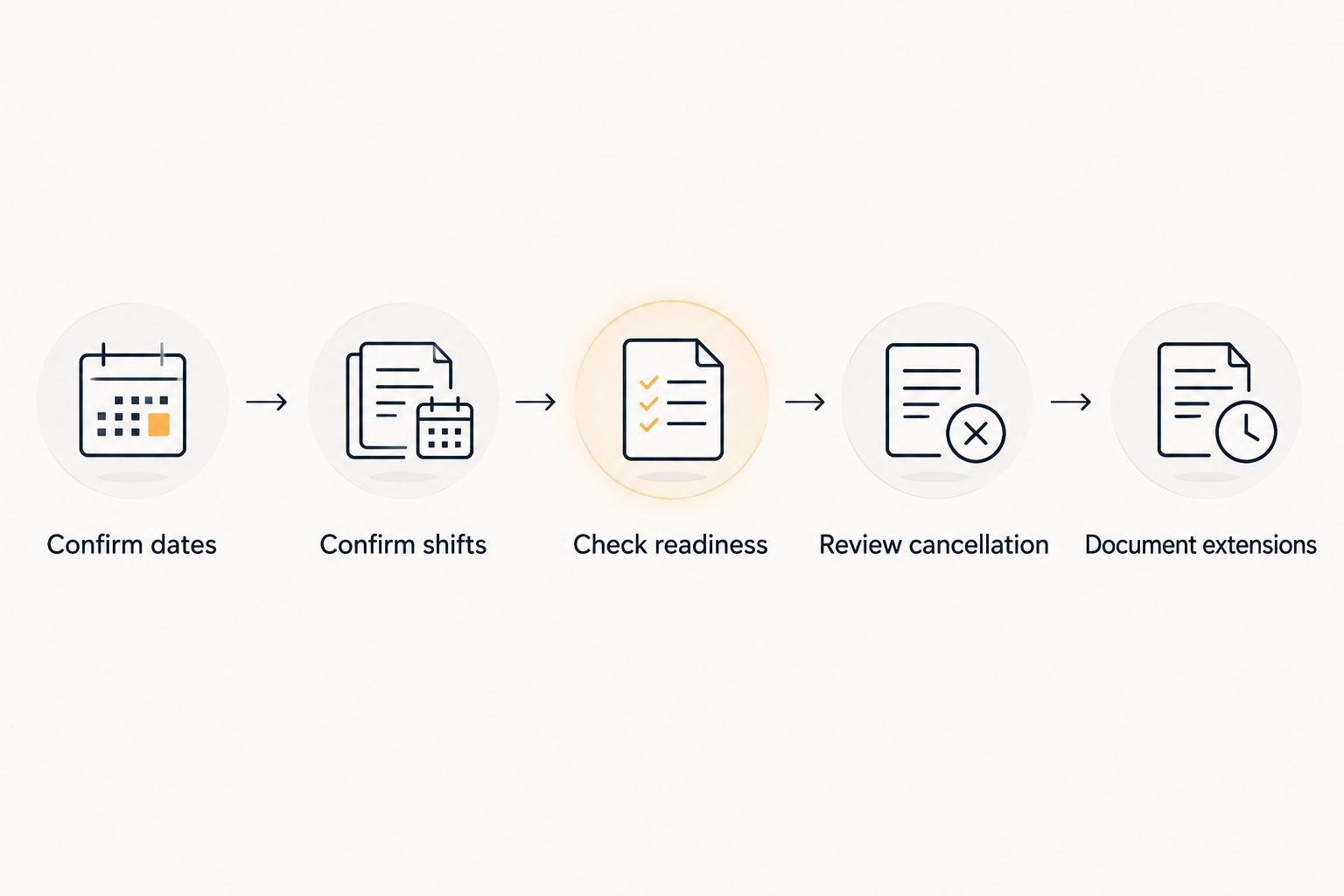
Use this sequence for each 2026 offer. Keep the answers with the assignment documents so you can compare the advertised schedule with the actual commitment.
- Confirm dates. Identify the first and last clinical shifts. List orientation and any required nonclinical attendance separately so the full calendar commitment is visible.
- Confirm shifts. Ask which dates are booked, which are guaranteed, and which are requests for availability. Include call and weekend responsibilities in the same review.
- Check readiness. Ask who confirms that licensing, privileges, onboarding, and system access are complete. Establish what happens if the proposed start date changes.
- Review cancellation. Locate the notice provisions, exceptions, and consequences of a canceled assignment. Ask a qualified attorney about unclear or conflicting language.
- Document extensions. Require the additional dates, schedule, and applicable terms to be recorded before treating an extension as confirmed.
Ask for a calendar, not just a duration
A schedule makes the commitment easier to inspect than a phrase such as ongoing coverage. Request the actual working dates, shift boundaries, call responsibilities, and location requirements. Mark any dates that remain tentative.
Then compare that calendar with your existing commitments. Look for travel conflicts, overlapping call, and obligations that continue beyond the final reading shift. Resolve discrepancies before you accept rather than treating them as scheduling details to settle later.
Can a locum radiology contract end before its stated end date?
A stated end date does not remove the agreement's early-termination provisions. Read the grounds for termination, notice requirements, and any exceptions before deciding how firmly you can rely on the scheduled finish.
Also check how cancellation affects confirmed shifts, travel arrangements, and other obligations. Have a qualified attorney explain provisions you do not understand; do not infer legal protection from the listing's description of the assignment.
Does credentialing count toward the contract length?
Credentialing and clinical coverage are separate timelines to verify. Ask whether the stated period begins when you sign, when approvals are complete, or when you work the first confirmed shift.
For a 2026 assignment, put the proposed clinical start date beside the onboarding requirements. Confirm how a delayed start affects the end date and booked schedule rather than assuming the coverage period automatically moves.
Can you extend a locum tenens radiology assignment?
Treat an extension as confirmed only when the parties document the additional coverage. Check the new end date, scheduled shifts, clinical scope, and applicable cancellation provisions before committing your calendar.
Use the extension discussion to resolve anything that changed during the initial assignment. Additional coverage should not depend on an assumption that the original schedule or responsibilities remain unchanged.
FAQ
How long does a locum tenens radiology contract last?
A locum tenens radiology contract lasts for the coverage period established in the assignment documents, subject to their termination provisions. Confirm the booked dates and shifts rather than relying on a general description of ongoing work.
Does an ongoing locum listing guarantee continuous work?
An ongoing listing does not establish which shifts you have accepted or which shifts are guaranteed. Ask for a written schedule and identify any dates that remain tentative.
Can I accept recurring shifts instead of continuous coverage?
Ask the hiring party whether the assignment permits individually accepted dates or a recurring schedule. Confirm the actual arrangement in writing before reserving availability.
Will my assignment automatically extend if the hospital still needs coverage?
Do not assume continued staffing need automatically extends your assignment. Review the renewal language and document additional dates through the process the agreement requires.
Does remote radiology work have a different contract length?
Remote work describes where you read, not the duration you have accepted. Confirm the coverage dates, schedule, required approvals, and termination provisions for the specific assignment.
What should I ask before accepting a short locum assignment?
Ask for the confirmed dates, guaranteed shifts, onboarding requirements, clinical scope, and cancellation provisions. Review the full commitment, including required attendance outside clinical shifts.
Can RadBoard tell me my final contract duration?
Use RadBoard for radiology job search and opportunity discovery; confirm the final duration with the hiring party. The assignment documents establish your accepted dates and obligations.
One last thing
Read the ending provisions before you build your calendar around the end date. A clearly printed finish does not answer whether shifts can be canceled, how notice works, or what obligations continue afterward.
For your next 2026 offer, ask the hiring party to identify the booked dates, guaranteed work, and cancellation process in the documents you will sign. That is a more useful answer than an estimated duration detached from the actual assignment.