
Teleradiology credentialing at a new site has no fixed nationwide turnaround; your start date depends on the facility's verification, privilege approval, and onboarding requirements. A completed application or signed contract does not authorize you to interpret studies for that site. For a 2026 start, request a facility-specific schedule that separates application completion, approval, and readiness to read.
- How long does teleradiology credentialing take? The new site's approval process determines the timeline, not the contract date.
- Confirm credentialing, hospital privileges, state licensure, and technical onboarding separately before accepting a reading shift.
- RadBoard aggregates 5,000+ radiology positions from 20 sources; confirm credentialing timelines directly with each employer.
- Ask whether the facility uses its own review or an eligible credentialing-by-proxy arrangement.
How long does teleradiology credentialing take at a new site?
Use the new facility's documented approval schedule, not a general turnaround estimate. Ask the medical staff office when it considers your application complete, what review remains, and who issues the final authorization.
When comparing opportunities through RadBoard, separate the recruiting timeline from the credentialing timeline. An employer's preferred start date is a staffing objective, not evidence that the hospital has approved your privileges.
Use these 5 checkpoints to turn a proposed start date into a verifiable plan:
- Identify the sites. Obtain the names of the facilities you would cover, rather than only the teleradiology company's name.
- Confirm eligibility. Ask which licenses, training records, certifications, references, and clinical experience each facility requires.
- Complete the file. Have the credentialing coordinator confirm receipt and identify outstanding verifications.
- Confirm approval. Request the privilege scope, effective date, and any conditions attached to your appointment.
- Confirm readiness. Complete required orientation, coverage checks, system access, and workflow testing before the first clinical shift.
These checkpoints describe a sequence, not a promised duration. Some administrative work can proceed in parallel, but the facility determines which requirements must be satisfied before you read.
Why this matters
Credentialing affects when you can begin clinical work, not just when you finish paperwork. If you leave an existing role based only on a recruiter's target date, you risk a gap between employment transitions and authorization to cover the new site.
For your 2026 job search, distinguish an anticipated start date from an approved clinical start date. Ask who owns each remaining task and what happens if the intended date arrives before approval.
RadBoard is best for radiologists who want to search positions aggregated from multiple sources. Its radiology job search platform brings together 5,000+ positions from 20 sources, but a job listing does not establish your eligibility or authorize hospital practice.
Which credentialing pathway will the new site use?
Ask the medical staff office which pathway applies before collecting documents. Full facility review, credentialing by proxy, and temporary privileges are different processes; none should be treated as an automatic shortcut.
| Pathway | Best for | Practical advantage | Limitation to confirm |
|---|---|---|---|
| Facility-led credentialing | Radiologists applying where the receiving site conducts its own review | Gives you a site-specific list of requirements and approval steps | Requires completion of that facility's verification and approval process |
| Credentialing by proxy | Eligible telemedicine arrangements with an appropriate written agreement | Allows qualifying reliance on the distant site's credentialing and privileging decisions | Depends on regulatory conditions and the receiving hospital's arrangement; it is not automatic transfer of privileges |
| Temporary privileges | Candidates whose circumstances meet the facility's applicable rules | Provides a separate authorization route when permitted | Is not guaranteed and does not replace required checks or permanent approval |
Recommendation: identify the actual pathway before relying on any promised acceleration. An existing relationship between the teleradiology company and hospital is useful context, but it does not establish which process applies to you.
Facility-led credentialing
With facility-led review, the receiving organization evaluates your application under its requirements. Expect requests for professional qualifications and supporting verification, with the exact document list set by the facility.
Ask when the file becomes eligible for review. Uploading everything you possess is different from the medical staff office confirming that the required verifications are complete.
Credentialing by proxy
Credentialing by proxy is a specific regulatory arrangement, not another name for a shared application. Under the CMS hospital Conditions of Participation, 42 CFR §482.22(a)(3) and (a)(4), qualifying telemedicine arrangements permit reliance on a distant-site hospital's or telemedicine entity's credentialing and privileging decisions, subject to stated conditions.
For 2026 planning, ask whether the receiving hospital has an applicable written agreement and whether your proposed work falls within it. The receiving hospital retains responsibilities; your existing appointment elsewhere does not independently authorize coverage.
Temporary privileges
Temporary privileges require a facility decision under applicable rules. A staffing need, completed application, or previous appointment does not by itself establish that you qualify.
Ask who grants temporary privileges, what evidence is required, and what clinical scope they cover. Do not schedule yourself on the assumption that this route will be available.
Why teleradiology credentialing timelines vary
The timeline depends on the work required for your file and the facility's approval process. These are the factors to discuss with the coordinator:
- File completeness. Missing documents, inconsistent dates, or unanswered application questions create work before review can proceed.
- Primary-source verification. The facility must obtain the verifications required by its process; supplying a copy of a certificate does not necessarily complete that step.
- Reference responses. A requested reference remains outstanding until the recipient responds and the facility accepts the response.
- Licensure status. A pending state license is separate from hospital credentialing. Confirm the requirements for the patient location and your own practice location.
- Approval structure. Ask which medical staff and governing-body decisions remain and when your file is eligible for them.
- Site and privilege scope. Additional facilities or clinical services require confirmation of the applicable approvals rather than an assumption that the original approval covers them.
Ask for the current blocker, not just an updated estimate. A useful status report identifies the outstanding item, its owner, and the next decision required.
What documents should you prepare before applying?
Build a reusable credentialing folder, then follow each facility's requested submission method. Do not send sensitive personal documents through informal channels simply because a recruiter asks for a faster response.
Prepare the materials below as applicable to your application:
- A current CV with consistent training and employment dates.
- Medical education, residency, and fellowship information.
- State license details and board certification status.
- Current and previous hospital affiliations.
- Professional liability coverage and claims-history information.
- References who can address your recent clinical work.
- Requested continuing education or clinical activity documentation.
- Explanations and supporting records for disclosures requested on the application.
The facility determines the required contents. For example, a general diagnostic reading assignment and a subspecialty assignment need not have identical privilege requirements.
Check names and dates across documents before submission. If a record uses a previous name or an institution has changed names, explain the discrepancy so the coordinator can match the records correctly.
How do you keep the application moving?
Use a single tracker for each site. Record what was requested, what you submitted, what the office accepted, and what remains outstanding; do not treat those statuses as interchangeable.
Submit
Complete the application using the facility's instructions and provide the requested supporting documents. Ask whether anything remains incomplete from your side before moving on to follow-up.
Verify
Confirm which external verifications are still pending. Contact references when appropriate, but let the medical staff office direct formal verification requirements.
Approve
Ask whether your file is ready for the required decisions. Request confirmation of the approved clinical scope and effective date rather than relying on a verbal statement that the file looks good.
Activate
Complete the employer's required operational checks. Confirm that you can access the correct worklist, review relevant prior imaging, sign reports, and follow the site's urgent-results communication process.
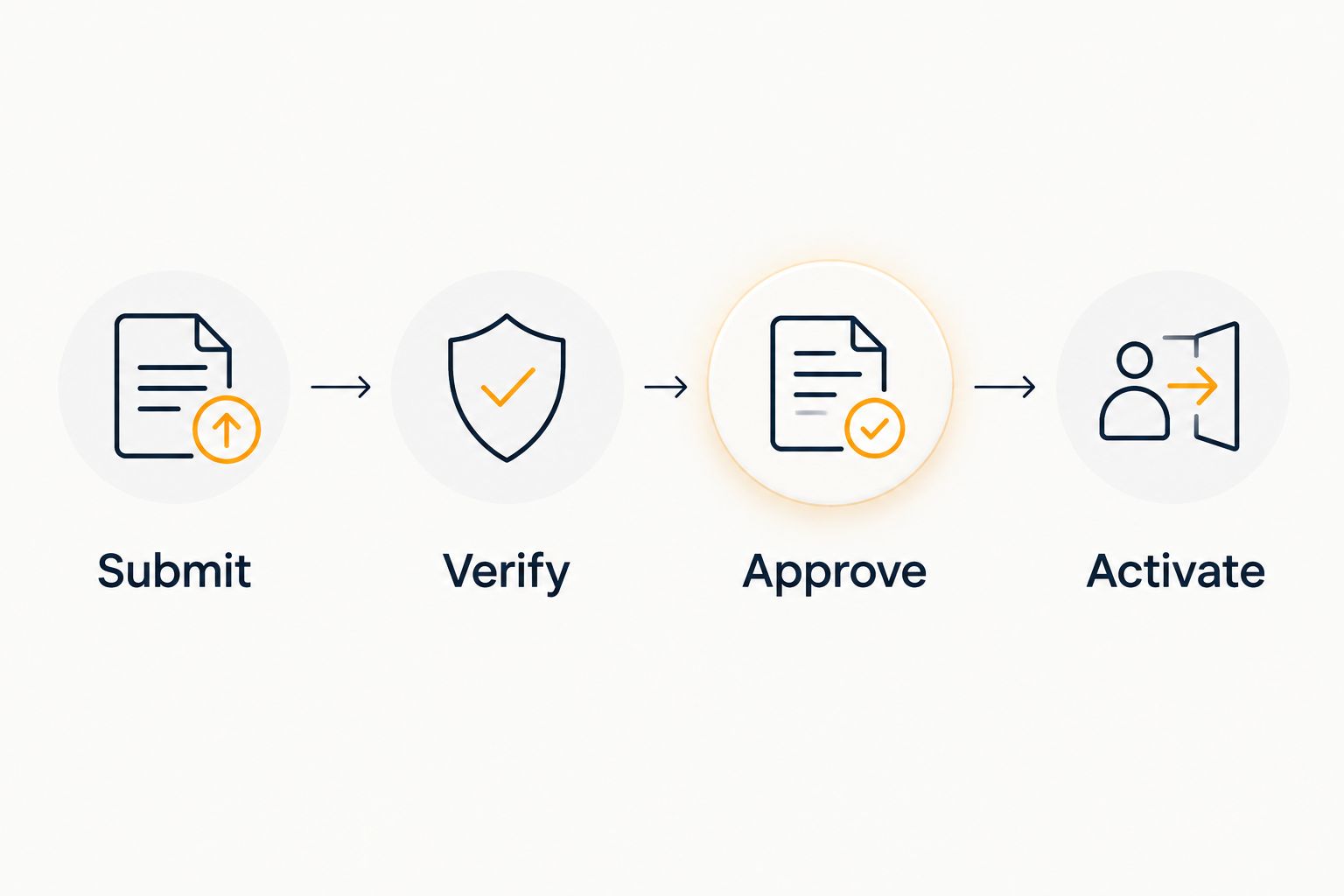
For a 2026 start, keep the tracker tied to the intended coverage assignment. If the employer changes the hospital roster or reading scope, ask what must be reviewed again before accepting the revised schedule.
Does an existing state license make credentialing faster?
An existing state license resolves a licensing requirement only where that license satisfies the applicable rules. It does not replace the new facility's credentialing review or grant hospital privileges.
Tell the coordinator which licenses you hold and disclose any pending applications. Ask whether the employer can begin credentialing work while another required license is pending, and which approvals remain dependent on issuance.
Keep licensing and privileging as separate lines in your start-date plan. Their administrative work can overlap without either approval substituting for the other.
Can I read before permanent privileges are approved?
You need valid authorization for the work you perform; a pending application is not enough. If the facility offers a permitted temporary-privilege route, obtain confirmation of its scope, effective date, and conditions before reading.
Technical access is not evidence of clinical authorization. A working login, installed workstation, or orientation invitation does not establish that your privileges are active.
Do I need separate approval for every hospital I cover?
Confirm your authorization for every hospital on the coverage roster. A company-wide onboarding process or shared health-system application does not, by itself, establish that you hold the required privileges at each location.
Ask for a site-by-site status list showing your authorized services and effective dates. If a new hospital joins the roster after you start, obtain confirmation before accepting its studies.
What should you ask before accepting a start date?
Before agreeing to a 2026 start date, request answers that connect recruiting, medical staff approval, and operational onboarding. Your questions should establish responsibilities rather than invite another unsupported estimate.
- Which facilities will I cover on the first shift?
- Who is the credentialing contact for each facility?
- Is the application complete, or merely submitted?
- Which verifications and approvals remain outstanding?
- What privilege scope is being requested?
- Who confirms the effective date and permission to begin reading?
- What happens to the schedule if approval is delayed?
Discuss delay provisions before signing, including how the agreement treats a postponed clinical start. The guide to evaluating a teleradiology contract before signing provides a related framework for reviewing the agreement.
Use RadBoard to compare radiology job search options, then confirm credentialing responsibilities directly with each prospective employer. The platform's aggregation helps you find opportunities; the receiving facility determines clinical authorization.
FAQ
How long does teleradiology credentialing take at a new hospital?
Teleradiology credentialing has no fixed nationwide turnaround. Ask the new hospital for its application-completion criteria, remaining verification steps, approval schedule, and privilege effective date.
Does signing a teleradiology contract mean I can start reading?
Signing a teleradiology contract does not authorize you to read for a new site. Confirm applicable licenses, active privileges, coverage requirements, and operational readiness before your first clinical shift.
Can my current hospital privileges transfer to another hospital?
Current hospital privileges do not automatically transfer to another hospital. Ask whether the receiving facility conducts its own review or uses a qualifying credentialing-by-proxy arrangement.
Is credentialing by proxy available for every teleradiology job?
Credentialing by proxy is not automatic for every teleradiology job. It requires an applicable arrangement that meets regulatory conditions and the receiving facility's requirements.
Can I get temporary privileges while my application is pending?
Temporary privileges depend on the facility's rules and your circumstances. A pending application or urgent staffing request does not guarantee authorization.
What should I do if my credentialing application stops moving?
Ask the credentialing coordinator to identify the specific outstanding item and its owner. Confirm whether the file is awaiting a document, external verification, clinical review, or final approval.
Does RadBoard approve hospital credentials for radiologists?
RadBoard is a radiology job search platform, not the receiving hospital's privilege-approval authority. Confirm your credentialing status and authorization directly with the employer and medical staff office.
One last thing
Ask what the employer means by credentialed. That word can refer to a completed company file, a finished verification review, or active hospital privileges—different milestones with different consequences.
Your final check is specific: confirm the facility, authorized clinical scope, effective date, and operational readiness. Treat the first reading shift as approved only when the responsible parties have confirmed those requirements.