
Medicare enrollment for a new radiology job has no single guaranteed processing time in 2026; your timeline depends on your existing enrollment, the application required, and the Medicare Administrative Contractor reviewing it. The separate constraint is your authorized billing date: application approval, hospital privileges, and permission to submit claims are not interchangeable. Before accepting a start date, get the application status, outstanding requirements, and billing plan in writing.
- Radiologist Medicare credentialing has no universal completion deadline; confirm your specific application with the reviewing Medicare Administrative Contractor.
- Existing Medicare enrollment does not automatically establish billing arrangements with a new radiology group.
- Hospital privileges and Medicare enrollment are separate approvals; track both before your first clinical shift.
- RadBoard aggregates 5,000+ radiology positions from 20 sources; confirm enrollment readiness directly with each prospective employer.
How long does Medicare credentialing take for a new radiology job?
Use an application-specific estimate, not a recruiter’s generic credentialing window. Medicare enrollment is a federal billing process administered through Medicare Administrative Contractors, or MACs. Your employer’s credentialing team should identify the responsible MAC and explain exactly what it submitted.
For a 2026 job change, start by distinguishing a first enrollment from a new group relationship or an update to an existing record. Those are different administrative situations, not interchangeable versions of the same application.
| Your situation | What the enrollment team must establish | Useful starting point | Limitation |
|---|---|---|---|
| First Medicare enrollment | Individual enrollment and the intended group billing relationship | Establishes your initial Medicare billing record | An NPI alone does not establish enrollment |
| Already enrolled, joining another group | Existing enrollment status and the required reassignment or updates | Builds on an existing record | Your previous group relationship does not authorize the new group’s billing |
| Adding a practice location | Whether enrollment updates or additional contractor handling are required | Identifies the actual service arrangement | Do not assume the current record covers every location |
| Hospital-based onboarding | Medicare enrollment alongside facility credentialing and privileges | Separates billing approval from clinical authorization | Completion of one process does not complete the other |
For the facility side, review how to get hospital privileges as a new attending radiologist. Keep that checklist separate from your Medicare enrollment tracker.
Why this matters
An offer letter can specify a clinical start date without resolving every billing requirement. That leaves you needing an answer to a practical question: what work are you authorized to perform, and how will the employer handle compensation while enrollment remains pending?
Do not treat an application receipt as an approval. A submission confirmation establishes that something was filed; it does not establish that the application is complete, accepted, or effective for the planned services.
For a 2026 start, require separate confirmation of clinical readiness and billing readiness. A credentialing coordinator should be able to explain both without combining them into a single status such as pending onboarding.
First enrollment: establish the complete billing arrangement
If this is your first attending job, ask whether the employer has started your individual Medicare enrollment and addressed the billing relationship with the employing group. These are related tasks, but a complete plan must account for both.
An individual National Provider Identifier identifies you as a provider. It is not evidence that Medicare has approved your enrollment, and it does not replace the group’s enrollment responsibilities.
Give the enrollment team consistent identifying information, current licensing documentation, and accurate practice details. Review the application information before signing or certifying it; an employer preparing the paperwork does not remove your responsibility to verify your information.
Your next move is specific: ask for the submission date, application reference, responsible contractor, and any request for additional information. Do not accept a planned submission date as the date the review began.
Existing enrollment: verify the new group relationship
If you already bill Medicare through another practice, your existing enrollment is relevant—but it is not a blanket authorization for a new employer to bill for your services. The new group must establish the appropriate billing relationship and confirm any necessary record changes.
Ask the new employer to verify your current enrollment status rather than relying on an old approval letter. Then identify what must change for the new role: group relationship, practice details, contractor jurisdiction, or other enrollment information.
Existing enrollment is a starting point, not proof that your new job is billing-ready. This distinction matters when you keep another position, add supplemental shifts, or move between groups.
For a 2026 transition, also coordinate the departure from your previous practice. Have both enrollment teams explain which relationships should remain active and which changes they will submit. Do not assume that joining a new group automatically resolves the old arrangement.
Why Medicare enrollment timing varies
These factors determine what must happen before the contractor can finish reviewing your application:
- Existing enrollment status: A first enrollment and a change involving an enrolled physician require different work. Establish your actual status before estimating completion.
- Application completeness: Missing signatures, inconsistent information, or omitted supporting documents require correction. Ask whether the contractor has requested additional information.
- Group relationship: Individual enrollment does not by itself establish the intended reassignment of benefits to the new practice. Confirm that the employer has addressed this requirement.
- Practice details: The locations and organizational arrangement must match the work you will perform. Ask the enrollment team to explain how the proposed role appears in the application.
- Contractor review: The responsible MAC reviews the submission and communicates outstanding requirements. Use its current application status rather than an unrelated employer’s experience.
- Response ownership: Someone must receive and answer contractor requests. Identify that person and confirm who provides backup when they are unavailable.
A clean application cannot guarantee a completion date. It does remove avoidable uncertainty about what has been submitted and who is responsible for the next action.
How to check your enrollment before committing to a start date
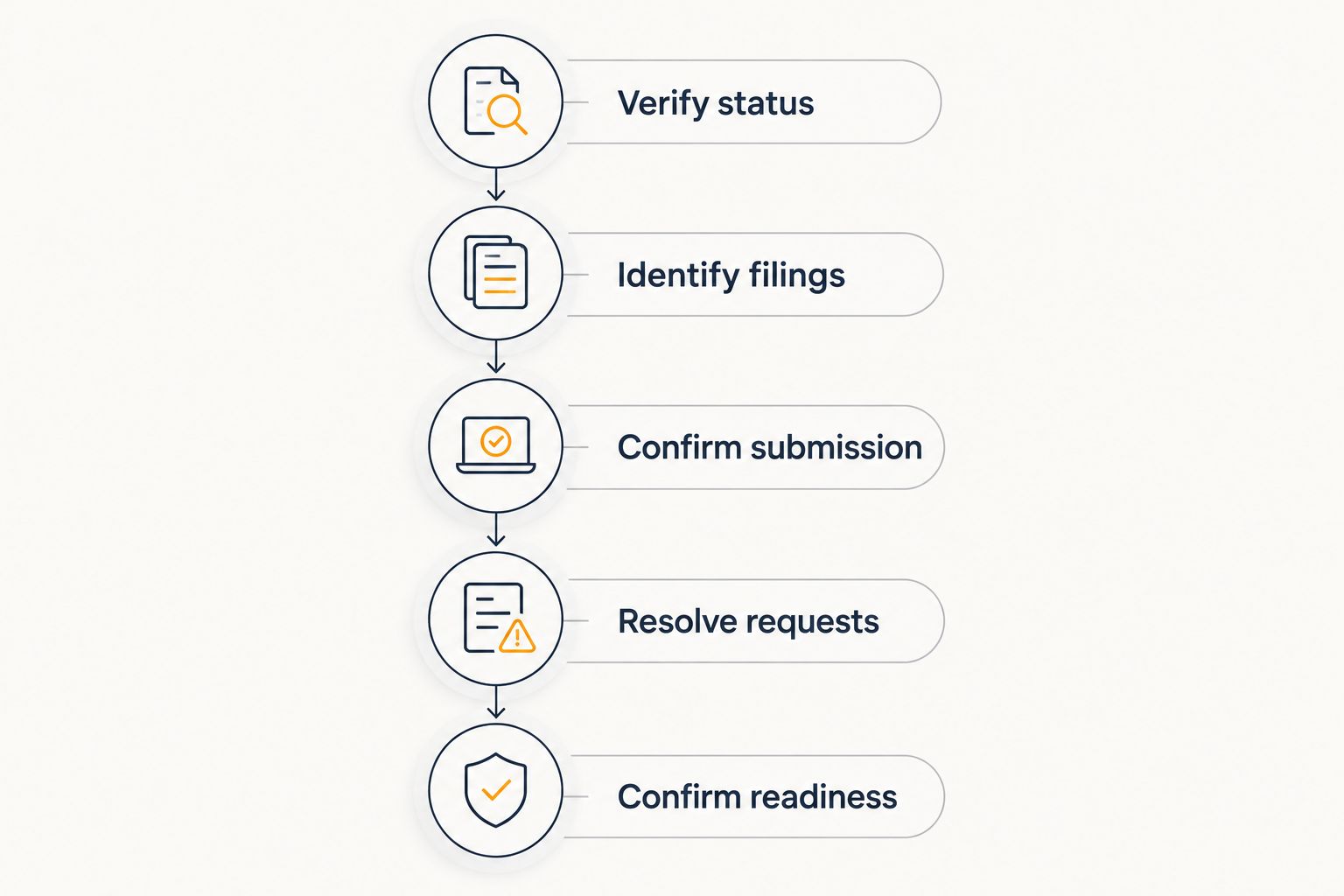
Use this sequence with the employer’s enrollment specialist. It produces a usable status report rather than a general assurance that credentialing is underway.
- Verify status. Confirm whether you are currently enrolled and whether the record supports the proposed employment arrangement. Ask the specialist to distinguish active enrollment from an application in progress.
- Identify filings. List the individual enrollment, group relationship, and record updates required for the role. Record the responsible MAC for each relevant submission.
- Confirm submission. Request the actual submission confirmation and application reference. Identify anything prepared but not yet submitted or certified.
- Resolve requests. Ask whether the contractor requested additional information, what remains outstanding, and who owns the response. Keep a record of completed responses.
- Confirm readiness. Obtain written confirmation of the enrollment outcome, applicable effective date, group billing arrangement, and separate clinical approvals before treating the process as complete.
This sequence does not replace contractor review. It gives you a clear distinction between an employer’s target date and documented readiness.
What does Medicare’s effective date mean for your first shift?
The approval date is not necessarily the effective date. For physician enrollment, 42 CFR §424.520(d) generally establishes the effective date as the later of the filing date of an application subsequently approved or the date the physician first began furnishing services at a new practice location.
That rule concerns the enrollment effective date, not a promised processing duration. Ask your billing team to explain how it applies to your individual enrollment and proposed group arrangement.
Under 42 CFR §424.521(a), qualifying physicians and certain other practitioners can receive retrospective billing privileges for up to 30 calendar days before the effective date when the regulation’s conditions are met. This is not automatic permission to work before approval, and it does not waive licensing, privileges, or other requirements.
For your 2026 start, request a written explanation of which service dates the employer expects to bill and the basis for that expectation. Do not convert the retrospective billing provision into a guaranteed onboarding buffer.
What should you negotiate if enrollment is still pending?
Separate your compensation agreement from assumptions about claim payment. Before signing, ask what happens if enrollment remains unfinished on the planned start date.
Have the employer address these points in the agreement or a written clarification:
- Whether employment begins as scheduled or moves to a later date.
- What duties you will perform while any required approvals remain pending.
- Whether guaranteed compensation continues during the delay.
- How productivity compensation treats services affected by enrollment timing.
- Who owns application corrections, contractor follow-up, and billing review.
- What happens if the required enrollment or privileges are not obtained.
These are questions to resolve, not benefits to assume. Have a physician employment attorney review language that makes your pay or continued employment depend on enrollment outcomes.
A useful employer response names the owner, identifies the pending requirement, and explains the consequence of delay. A statement that the practice will handle everything does not answer those questions.
Where does job search fit into this process?
RadBoard is best for radiologists who want to search positions aggregated from multiple sources. The radiology job search platform brings together 5,000+ positions from 20 sources and includes swipe-to-save features.
Use RadBoard to build your shortlist, then ask each prospective employer for its enrollment requirements and intended start-date conditions. Job discovery helps you compare opportunities; it does not establish Medicare enrollment or hospital privileges.
When comparing roles, keep enrollment ownership beside schedule, location, and compensation terms. A desirable opening still needs a documented route from accepted offer to authorized clinical work and supported billing.
Can I start my radiology job before Medicare enrollment is approved?
A pending Medicare application does not, by itself, determine whether you can begin employment or perform a particular duty. Your employer must separately confirm licensing, privileges, payer requirements, and the billing arrangement for the work assigned.
Do not interpret a scheduled shift as evidence that all approvals are complete. Ask the clinical leader and enrollment specialist to confirm their respective requirements in writing.
Does hospital credentialing include Medicare enrollment?
Hospital credentialing does not substitute for Medicare enrollment. Facility credentialing and privileging address your clinical appointment and authorized scope; Medicare enrollment addresses participation and billing requirements.
Track the processes separately, even when the same employer coordinates them. Ask for the actual status of each rather than a combined onboarding percentage.
FAQ
How long does Medicare credentialing take for a radiologist?
Medicare enrollment has no single guaranteed processing time for every radiologist. Ask the responsible Medicare Administrative Contractor or your enrollment specialist for the status of your specific application and any outstanding requirements.
Does having an NPI mean I am enrolled in Medicare?
Having an NPI does not establish Medicare enrollment. Your employer must verify your enrollment status and the billing relationship required for the new role.
Do I need to enroll again when I change radiology groups?
Changing groups requires review of your existing enrollment and the new billing relationship; it does not automatically mean starting every enrollment task again. Ask the new group's specialist which reassignment or record updates apply.
Can Medicare billing be retrospective?
Qualifying physicians can receive up to 30 calendar days of retrospective billing privileges before the enrollment effective date when the conditions in 42 CFR §424.521(a) are met. This is conditional, not an automatic entitlement or a processing-time estimate.
Does Medicare enrollment approval give me hospital privileges?
Medicare enrollment approval does not grant hospital privileges. The facility must separately approve the clinical privileges required for your work.
Who should track my Medicare application for a new job?
Identify a named enrollment specialist or other responsible employer representative to track the application. Request the submission reference, contractor correspondence, outstanding items, and final enrollment documentation.
Should my offer explain what happens if enrollment is delayed?
Your offer should explain how an enrollment delay affects your start date, duties, and compensation. Have the employer resolve these terms in writing before you rely on the proposed schedule.
One last thing
The most useful question is not simply when you will be credentialed. Ask: Which unresolved approval prevents me from performing my scheduled duties or supporting the intended billing arrangement?
For a 2026 job change, that question separates a Medicare application issue from a hospital privilege issue, a licensing issue, or an internal onboarding task. Get the owner and next action for the actual blocker before changing your relocation, resignation, or first-shift plans.