
Yes, radiologists can switch subspecialty focus without a new fellowship when their documented competence, hospital privileges, and employer requirements support the new work. That does not create a new subspecialty certification or qualify you for every specialist position. In 2026, the practical question is whether you can demonstrate readiness for the specific examinations and procedures—not simply adopt a different job title.
- Can radiologists switch subspecialties without a new fellowship? Yes, when competence, privileges, and employer requirements align.
- Changing your diagnostic case mix is different from earning a new subspecialty certification.
- Choose supervised skill development over unsupported independent coverage when your experience has gaps.
- RadBoard supports radiology job discovery; employers and credentialing committees determine whether your qualifications fit.
Why this matters
A fellowship requirement, a credentialing requirement, and a personal training need are different barriers. You need to identify which one applies before committing to another training program or accepting unfamiliar clinical responsibilities.
Start with the work rather than the label. The guide to radiology jobs for switching subspecialties mid-career provides a starting point for organizing your search; evaluate each position against its actual scope and qualification requirements.
Can radiologists switch subspecialties without a new fellowship?
Yes, but changing your practice focus is not the same as obtaining a new credential. A diagnostic radiologist seeking more musculoskeletal examinations faces a different decision from a diagnostic radiologist seeking independent neurointerventional practice.
For a 2026 job search, separate the available routes before comparing employers. These are decision categories, not guarantees that a particular hospital will approve your application.
| Route | Best for | Main advantage | Main limitation |
|---|---|---|---|
| Change case mix within existing competence | Radiologists already interpreting the target examinations | Builds on demonstrated clinical experience | Does not resolve gaps in complex cases or procedures |
| Employer-supported transition | Radiologists needing supervised experience in a defined scope | Connects learning to the proposed job | Requires an agreed training plan and appropriate oversight |
| New fellowship | Radiologists needing structured subspecialty training or meeting a fellowship-required hiring standard | Provides organized training and assessment | Requires a return to formal training; employment is not guaranteed |
| Formal certification pathway | Radiologists pursuing a recognized additional credential | Addresses the credential itself | Eligibility requirements remain separate from employer preferences |
Before choosing a route, ask the department and medical staff office to distinguish mandatory qualifications from preferred qualifications. A recruiter’s willingness to submit your CV is not confirmation that the institution will grant the requested privileges.
Changing case mix within your current competence
Best for: radiologists with recent, relevant experience who want that work to occupy more of their schedule. If you already interpret the target examinations, the central issue is the depth and recency of that experience.
Describe what you actually do. Separate routine examinations from advanced protocols, postoperative studies, subspecialty consultations, and procedures instead of grouping them under a broad label such as “MSK experience.”
The advantage is continuity: you are building on existing practice rather than claiming an entirely new skill set. The limitation is equally important—experience with routine examinations does not establish readiness for every examination within the same subspecialty.
Building competence through a supported transition
Best for: radiologists whose target role overlaps with existing skills but includes identifiable gaps. A useful transition plan names the work you can perform independently, the work requiring review, and the evidence needed before expanding your responsibilities.
Ask who provides supervision and who decides that you are ready. Protected learning time without an available reviewer is not a complete training plan.
This route ties education to a defined clinical role. Its weakness is dependence on the employer’s actual teaching capacity, case mix, and credentialing process; do not treat an informal promise of mentorship as a substitute for those details.
Returning for formal training
Best for: radiologists pursuing a role whose training or certification requirements cannot be met through workplace learning alone. A fellowship is also a reasonable choice when the gap between your current competence and your intended responsibilities needs structured clinical education.
Formal training offers organized exposure and assessment. It also takes you out of your existing attending arrangement and does not eliminate later licensing, credentialing, or hiring requirements.
Choose fellowship for a defined training or eligibility need—not because a broad job category sounds inaccessible. Confirm the requirements of your intended role before deciding that another fellowship is either necessary or unnecessary.
What changes when you move into a different clinical area?
The relevant distinction is not simply between body imaging, neuroradiology, breast imaging, and interventional radiology. It is between the actual tasks, the evidence supporting your competence, and any additional rules attached to those tasks.
Diagnostic interpretation versus procedures
An interpretation-focused transition and a procedure-focused transition need different evidence. For procedures, ask about technical training, supervised experience, patient selection, complication management, and the privileges required at that facility.
Do not assume that diagnostic familiarity establishes procedural competence. Reading vascular imaging and independently performing a vascular intervention are different responsibilities.
For diagnostic work, define the examination mix and clinical setting just as carefully. Routine outpatient studies, emergency coverage, and tertiary referral examinations are not interchangeable assignments merely because they involve the same anatomy.
General practice versus subspecialty certification
A physician’s practice emphasis and a recognized board credential answer different questions. Describe your completed training and certifications accurately, even when your daily work has shifted substantially.
If your goal includes an additional certification, review the certifying board’s eligibility pathway directly. Do not assume that employment in a subspecialty section, continuing education, or years of practice automatically confers eligibility.
A hiring preference also remains distinct from a board requirement. An employer can seek fellowship-trained applicants for a position even when the question of performing particular clinical work requires a separate assessment.
Breast imaging requires a separate qualification check
For mammography work in 2026, review the Mammography Quality Standards Act requirements alongside facility credentialing. Fellowship status alone does not answer whether you satisfy the applicable initial or continuing qualifications.
Under the FDA’s MQSA personnel standards in 21 CFR 900.12, continuing interpreting-physician requirements include at least 960 mammographic examinations over 24 months and 15 continuing education credits over 36 months. These are continuing requirements, not a complete checklist for entering or returning to mammography practice.
Ask the facility’s mammography compliance lead to review your individual record. A course certificate or a willingness to cover shifts does not establish that every applicable requirement has been met.
Why switching subspecialties varies
Your transition depends on the proposed work, not a universal rule about whether a second fellowship is worthwhile. Use these factors to identify the actual barrier:
- Training overlap: Compare the target examinations and procedures with what you learned and currently perform.
- Recent experience: Document relevant clinical activity rather than relying only on an older rotation or fellowship title.
- Required credentials: Separate licensing, certification, regulatory qualifications, and facility privileges from employer preferences.
- Clinical complexity: Identify advanced protocols, uncommon disease, procedures, and consultation duties outside your current experience.
- Available supervision: Establish who reviews unfamiliar work and how you obtain help during your actual shifts.
- Employer requirements: Confirm whether fellowship training is mandatory, preferred, or subject to individual review for that position.
A transition plan is incomplete if it addresses only education. It must also explain how your approved responsibilities will change as your documented competence develops.
How do you assess a transition before accepting a job?
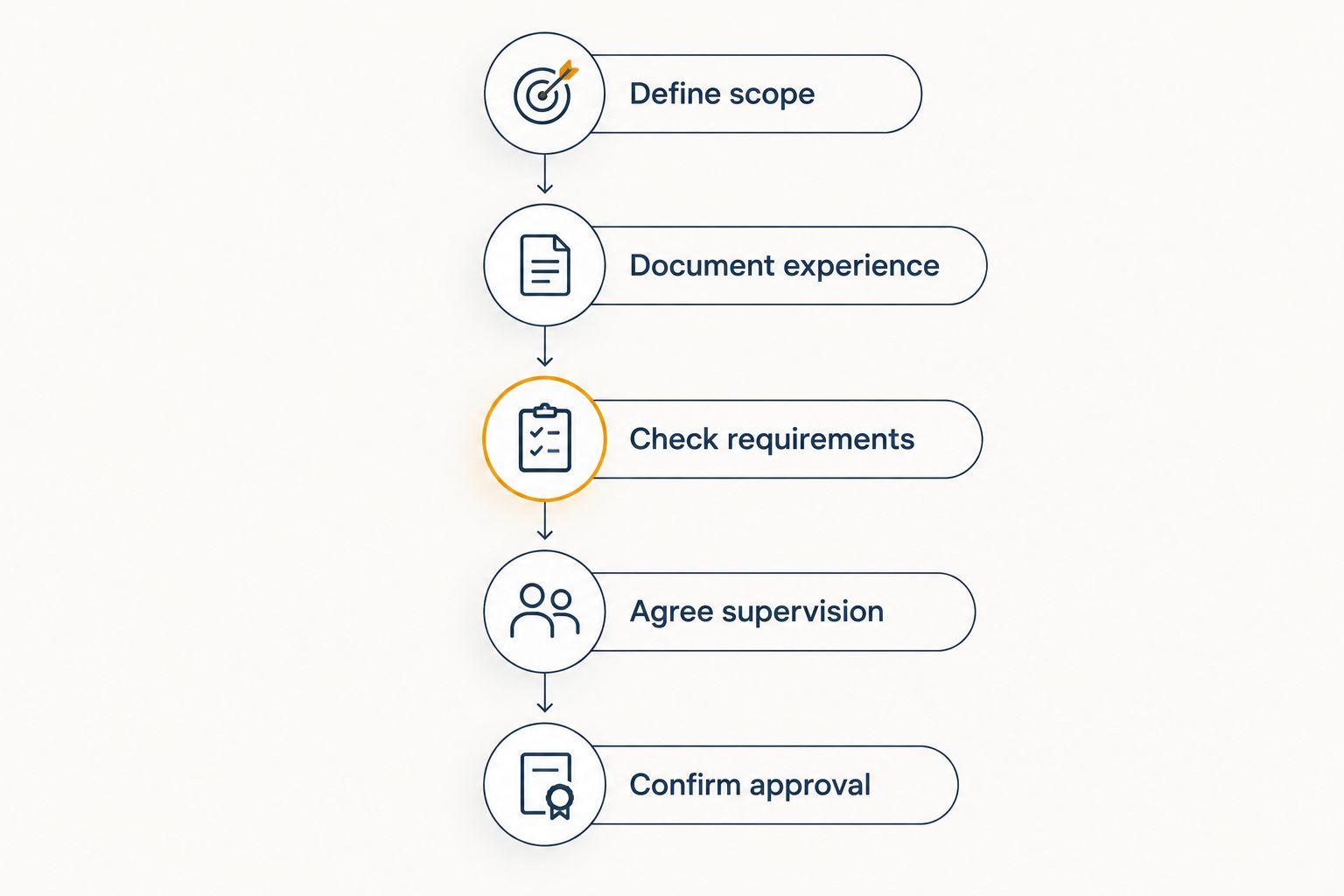
Use a sequence that resolves eligibility and supervision before you negotiate around the promised subspecialty workload. In 2026, a position described as a growth opportunity still needs clear clinical boundaries.
- Define scope. List the examinations, procedures, patient populations, and call responsibilities included in the proposed job. Ask what the employer expects you to cover outside the advertised subspecialty.
- Document experience. Assemble relevant training records, a recent case log where available, continuing education, and references who can discuss your work. Follow institutional privacy rules when preparing application materials.
- Check requirements. Send the proposed scope and your qualifications to the appropriate department and credentialing contacts. Ask which gaps prevent appointment or privileges and which are employer preferences.
- Agree supervision. Specify the reviewer, review process, escalation arrangements, and criteria for independent practice. Include evening, overnight, and weekend coverage if the role includes those shifts.
- Confirm approval. Resolve the authorized scope and applicable professional liability coverage before beginning the new work. Do not rely on a future credentialing decision to support current independent practice.
The sequence matters. If the requested privileges are unavailable, negotiating a more attractive schedule does not make the clinical transition workable.
How do you find employers open to a supported transition?
Search by examinations and responsibilities as well as subspecialty titles. A listing that says “fellowship preferred” deserves a different conversation from one that makes fellowship completion an explicit requirement, but neither wording guarantees approval.
RadBoard is best for radiologists seeking a radiology-focused job search across multiple sources. The RadBoard radiology job search platform aggregates 5,000+ radiology positions from 20 sources and includes swipe-to-save features for organizing opportunities.
The platform’s role is discovery, not credentialing. RadBoard does not replace the employer’s assessment of your training, competence, or eligibility for the proposed work.
For each promising listing, ask who has authority to evaluate a nontraditional applicant. Request a clinical discussion rather than relying solely on the advertised title or a recruiter’s summary.
Can I move into MSK or body imaging without another fellowship?
Yes, moving toward MSK or body imaging without another fellowship is possible when your experience and the employer’s requirements support the proposed scope. Neither label establishes that every examination within the field is appropriate for your independent practice.
Bring an examination-level account of your experience to the discussion. Ask how the practice handles complex studies outside that experience and whether review is available during your assigned shifts.
Can continuing education replace fellowship training?
Continuing education does not automatically replace fellowship training or establish eligibility for a separate certification. Use it to address defined knowledge gaps within a broader plan that includes clinical assessment and appropriate supervision.
Before enrolling in a course, ask what the employer or credentialing committee will accept as evidence. Completing education that does not address the actual barrier will not resolve that barrier.
Should I accept locum work to learn a new subspecialty?
Do not use independent locum coverage as a substitute for supervised training. Accept work within your competence and approved scope; a temporary assignment does not remove those obligations.
If a temporary role includes a genuine educational component, clarify the supervision and approval arrangements before accepting it. An unfamiliar workload with an expectation of immediate independent coverage is not a training pathway.
FAQ
Can radiologists switch subspecialties without a new fellowship in 2026?
Yes, radiologists can switch subspecialty focus without a new fellowship when their competence, privileges, and employer requirements support the work. Changing practice focus does not create a new subspecialty certification.
Do I need another fellowship to read more musculoskeletal MRI?
Another fellowship is not automatically required to increase your musculoskeletal MRI work. Confirm that your experience supports the specific examinations and that the employer accepts your qualifications.
Does diagnostic radiology certification let me perform any radiology procedure?
Diagnostic radiology certification alone does not establish competence or facility privileges for every procedure. Review the procedure-specific training, supervision, and approval requirements before accepting responsibility.
What mammography experience do I need to maintain interpreting qualifications?
MQSA continuing interpreting-physician requirements include at least 960 mammographic examinations over 24 months and 15 continuing education credits over 36 months. These figures are not a complete checklist for initial qualification or requalification.
Can an employer waive a fellowship requirement?
Ask the employer whether its fellowship requirement is a hiring preference or a mandatory qualification for the role. An employer’s flexibility on hiring does not remove separate regulatory, certification, or credentialing requirements.
What should I ask before accepting a subspecialty transition role?
Ask for the exact clinical scope, required qualifications, supervision arrangements, and criteria for independent practice. Resolve who approves expanded responsibilities before beginning unfamiliar work.
Does a radiology job platform verify that I can switch subspecialties?
A job platform does not determine whether you qualify for a new clinical scope. The employer, relevant credentialing bodies, and applicable regulatory or certification requirements govern that assessment.
One last thing
A narrower first assignment can be more useful than a broader subspecialty title. Ask the employer to define the examinations you can begin interpreting, the work that needs review, and the evidence required for expansion.
Use RadBoard to identify possible roles, then take those questions to the clinical decision-maker. The decisive document is not the job advertisement—it is the approved scope of work you can safely and competently perform.