
Radiology residency plus a standard fellowship takes 6 years after medical school in the United States: 1 clinical year, 4 years of diagnostic radiology residency, and a 1-year fellowship. That excludes medical school, and longer fellowships, additional subspecialty training, or interruptions extend the timeline. For 2026 planning, count the clinical year explicitly rather than treating a 4-year radiology residency as the entire postgraduate pathway.
- How long does radiology residency and fellowship take? Usually 6 years after medical school, including the clinical year.
- Diagnostic radiology residency itself lasts 4 years; a standard subspecialty fellowship adds 1 year.
- Interventional radiology follows a different pathway; do not automatically add a fellowship to an integrated residency.
- RadBoard aggregates 5,000+ radiology positions from 20 sources for physicians comparing career opportunities.
How long does radiology residency plus fellowship take?
The standard diagnostic radiology pathway takes 6 postgraduate years when you include a 1-year fellowship. The confusion comes from where people start counting: radiology-specific residency begins after the initial clinical year.
| Training stage | Duration | What the stage covers |
|---|---|---|
| Initial clinical year | 1 year | Required clinical training before diagnostic radiology residency |
| Diagnostic radiology residency | 4 years | Broad diagnostic imaging training and supervised clinical practice |
| Standard subspecialty fellowship | 1 year | Focused training in a selected area of radiology |
| Total after medical school | 6 years | Clinical year, diagnostic residency, and standard fellowship |
The American Board of Radiology's diagnostic radiology training requirements distinguish the clinical year from the 4 years of diagnostic radiology training. ACGME specialty and subspecialty requirements provide the corresponding program framework; use the requirements applicable to your entering class when confirming a 2026 training plan.
The arithmetic answers the duration question, not whether additional training fits your career. For that decision, consider whether a radiology fellowship is worth it against the work you want to perform.
Why this matters
A missing clinical year shifts your expected attending start date by a full year. Counting fellowship twice creates the opposite mistake, especially when comparing diagnostic and interventional radiology pathways.
Your timeline also affects relocation, family planning, and job applications. Build your plan around the exact completion date of your final required program, then separately track licensing, certification, and hospital credentialing.
For 2026 applicants, distinguish the program's advertised duration from the total time after medical school. A fellowship described as 1 year does not include the residency required to enter it.
Diagnostic residency without fellowship: 5 years after medical school
The standard diagnostic radiology pathway without fellowship takes 5 years after medical school: 1 clinical year followed by 4 diagnostic radiology years. Fellowship is additional subspecialty training, not a universal requirement for completing diagnostic radiology residency.
Best for: physicians targeting positions whose duties and hiring criteria match their residency training. The advantage is an earlier transition out of formal training; the limitation is that employers seeking specific fellowship preparation impose a narrower qualification requirement.
Do not confuse completing residency with qualifying for every available position. A general diagnostic opening and a dedicated subspecialty opening can ask for different experience, even when both use the title radiologist.
Before deciding against fellowship, read actual job requirements. Identify whether fellowship is required, preferred, or absent from the posting, and ask the employer to clarify the expected case mix rather than assuming the title answers that question.
Diagnostic residency plus standard fellowship: 6 years
The standard fellowship-trained diagnostic radiologist completes 6 years after medical school. The sequence is 1 clinical year, 4 diagnostic radiology years, and 1 fellowship year.
Best for: physicians seeking focused subspecialty preparation before entering a position aligned with that training. The benefit is concentrated clinical experience; the trade-off is another year before transitioning from trainee to attending responsibilities.
A 1-year fellowship is a common structure in areas such as musculoskeletal imaging, breast imaging, abdominal imaging, pediatric radiology, and neuroradiology. Individual programs can offer additional research or advanced clinical training, so the specialty name alone does not establish the full commitment.
For your 2026 shortlist, record the actual appointment length and whether an additional year is optional or required. Use the program's written curriculum and appointment terms, not a general description of the subspecialty.
A fellowship also does not guarantee that your eventual job will consist entirely of that subspecialty. Ask prospective employers how they divide focused reads, general coverage, procedures, and call.
Integrated interventional radiology: 6 years after medical school
The integrated interventional radiology pathway takes 6 years after medical school, including the initial clinical year. The integrated residency itself contains 5 years of diagnostic and interventional radiology training after that clinical year.
Best for: physicians pursuing an integrated route to interventional radiology training. Its advantage is a combined diagnostic and interventional curriculum; its limitation is that it is a distinct training choice, not simply diagnostic residency with a standard imaging fellowship attached.
Do not add a routine fellowship year to the integrated pathway just because diagnostic radiology discussions commonly include one. Additional training depends on the physician's goals and the specific program, rather than being an automatic extension of integrated residency.
The American Board of Radiology and ACGME describe integrated and independent interventional radiology pathways separately. Compare the correct pathway requirements before estimating your completion date.
Independent interventional radiology: 6 or 7 years total
Independent interventional radiology training generally adds 2 years after diagnostic radiology residency, producing a 7-year total after medical school. Eligible graduates who complete Early Specialization in Interventional Radiology, or ESIR, can enter an abbreviated 1-year independent pathway, producing a 6-year total.
Best for: diagnostic radiology trainees pursuing interventional radiology through the independent route. The advantage is a route from diagnostic residency into dedicated interventional training; the limitation is that abbreviated entry depends on meeting the applicable ESIR requirements.
Do not assume that performing interventional rotations during diagnostic residency automatically establishes ESIR eligibility. Confirm your program's status, your documented training, and the receiving program's entry requirements.
| Pathway | Total after medical school | Best for | Main benefit | Main limitation |
|---|---|---|---|---|
| Diagnostic radiology without fellowship | 5 years | General diagnostic career plans | Earlier completion of formal training | Does not provide fellowship-specific preparation |
| Diagnostic radiology plus standard fellowship | 6 years | Focused diagnostic subspecialty plans | Dedicated subspecialty training | Adds a training year |
| Integrated interventional radiology | 6 years | Integrated IR career plans | Combined diagnostic and interventional training | Requires the integrated pathway |
| Diagnostic radiology plus independent IR | 7 years | Independent IR applicants without abbreviated entry | Dedicated IR training after diagnostic residency | Longer standard sequence |
| Diagnostic radiology with ESIR plus abbreviated independent IR | 6 years | Eligible ESIR graduates | Shorter independent IR sequence | Requires documented eligibility |
Why radiology training length varies
The standard 6-year diagnostic residency-plus-fellowship estimate assumes uninterrupted training and a 1-year fellowship. These factors change the total:
- Counting convention: Some descriptions list only the 4 diagnostic residency years and omit the preceding clinical year.
- Fellowship duration: A program with an additional clinical or research year extends the standard sequence.
- Training pathway: Integrated IR and independent IR organize diagnostic and procedural training differently.
- Additional fellowship: A second fellowship adds the duration of that appointment rather than replacing the first.
- Training interruptions: Leave, remediation, or a transfer changes the completion date when required training remains unfinished.
- Separate research time: Research outside the required clinical sequence adds calendar time when it does not count toward completion.
Ask your program director which activities count toward required training. Do not assume every research appointment, elective, or period of leave carries the same credit.
How do you calculate your own completion date?
Start with your actual appointments, not a generic age estimate. Your education before residency and any gaps between appointments make age an unreliable way to calculate readiness for practice.
- Clinical year: Record the start and completion dates of your qualifying initial clinical training.
- Residency: Add the full diagnostic or integrated residency sequence that applies to your pathway.
- Fellowship: Add the exact duration of each fellowship you intend to complete.
- Employment clearance: Track licensing, credentialing, and employer requirements separately from training completion.
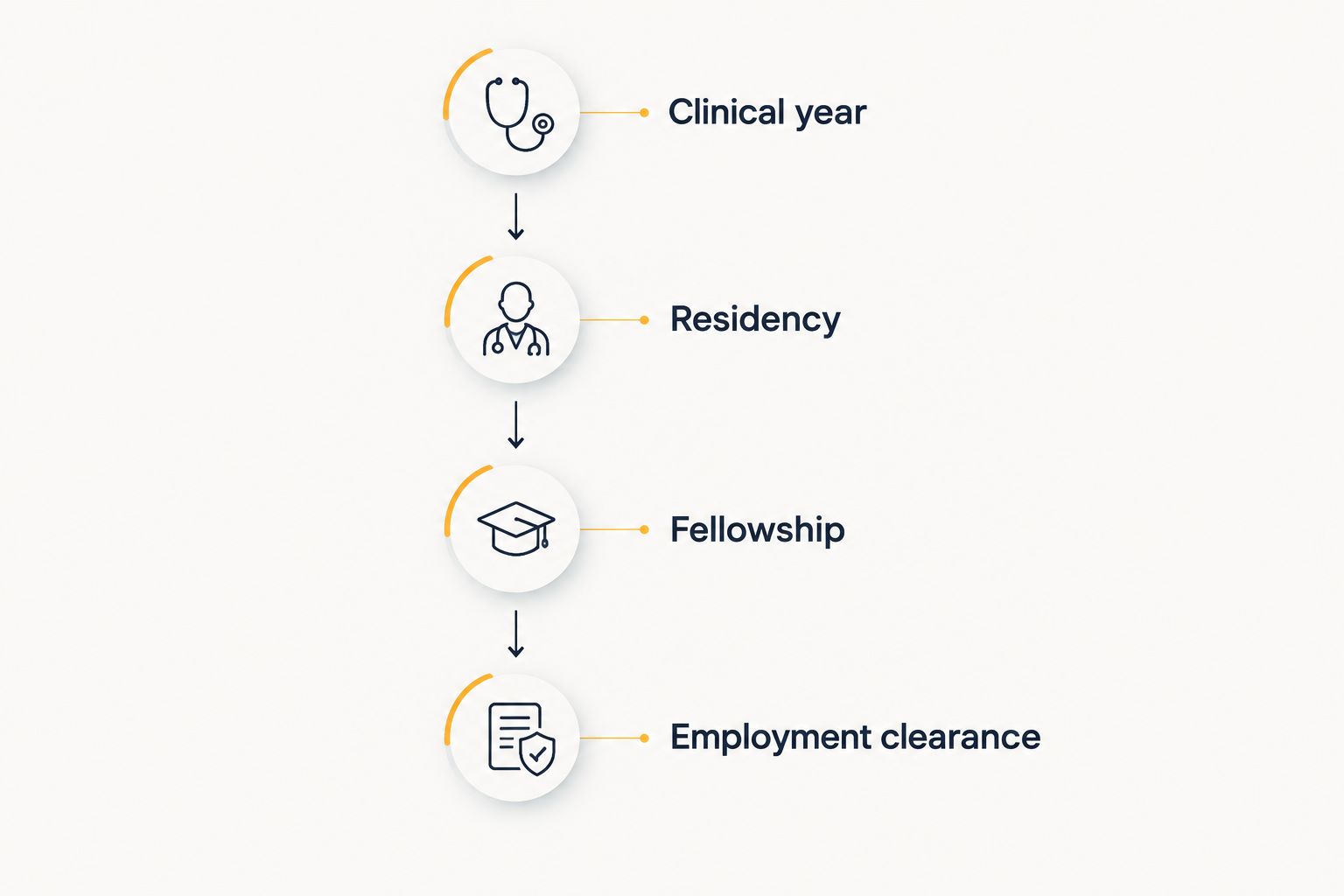
For a 2026 career plan, maintain separate dates for completing training and starting employment. A signed contract does not replace the approvals required to practice at the hiring institution.
Ask the employer which approvals must be complete before your first shift. That keeps an administrative dependency from being mistaken for an additional required training year.
Does the clinical year count toward radiology residency?
1 clinical year belongs in the total postgraduate timeline, even though diagnostic radiology residency itself lasts 4 years. That is why both a 4-year residency description and a 5-year residency-pathway description can appear in discussions of the same specialty.
When comparing programs, ask whether the advertised position includes the clinical year or requires a separate appointment. Count that year once, not zero times or twice.
Does board certification add another year of residency?
4 years of diagnostic radiology residency remains the training requirement; certification is a separate process. Exam eligibility and certification requirements do not automatically create another residency year.
Check the American Board of Radiology's rules for your examination cohort. Also confirm whether a prospective employer requires board eligibility or completed certification at the intended start date.
Can you start an attending job without fellowship?
5 years after medical school completes the standard diagnostic residency pathway without fellowship, but eligibility for a particular attending role depends on more than training duration. Licensing, employer criteria, credentialing, and the proposed clinical duties still apply.
Review positions against your actual qualifications. An opening that requires fellowship training is not equivalent to one that accepts residency-trained general diagnostic radiologists.
Connect the training timeline to your job search
RadBoard is best for radiologists comparing career opportunities across multiple job sources. The radiology job search platform aggregates 5,000+ positions from 20 sources and includes swipe-to-save features.
Use RadBoard to compare the qualifications attached to roles that interest you. Record the requested fellowship, certification status, clinical scope, and proposed start date before deciding whether an opening fits your training plan.
RadBoard's radiology job search platform supports opportunity discovery; it does not establish your eligibility for a hospital appointment. Confirm requirements directly with the employer and the relevant licensing or credentialing body.
Compare radiology career opportunities
Search 5,000+ radiology positions aggregated from 20 sources.
FAQ
How long does radiology residency and fellowship take in the US?
The standard diagnostic radiology pathway with a 1-year fellowship takes 6 years after medical school. That includes 1 clinical year, 4 diagnostic radiology residency years, and 1 fellowship year.
Is radiology residency four years or five years?
Diagnostic radiology residency itself lasts 4 years; the standard postgraduate pathway includes a preceding 1-year clinical appointment. Count 5 years after medical school before adding fellowship.
How long is a typical diagnostic radiology fellowship?
A standard diagnostic radiology subspecialty fellowship commonly lasts 1 year. Confirm the individual program's duration because additional clinical or research training extends some appointments.
Is a fellowship required after diagnostic radiology residency?
Fellowship is not a universal requirement for completing diagnostic radiology residency. Individual employers and subspecialty positions set their own training and experience requirements.
How long does integrated interventional radiology training take?
Integrated interventional radiology takes 6 years after medical school, including the initial clinical year. Do not automatically add a separate standard imaging fellowship to that pathway.
Does ESIR shorten independent interventional radiology training?
Eligible ESIR graduates can complete an abbreviated 1-year independent interventional radiology pathway rather than the standard 2-year pathway. Confirm that your documented training satisfies the applicable entry requirements.
Does finishing fellowship mean I can start work immediately?
Completing fellowship does not by itself clear you to start every attending position. Your license, employer requirements, hospital privileges, and credentialing must also support the intended start date.
One last thing
The easiest year to miss is the clinical year before diagnostic radiology residency. Write your plan as separate appointments, then add them together; a specialty label is not a complete timeline.
Before accepting a fellowship, compare its curriculum with the work you want afterward. Additional training should answer a specific clinical or career need, not simply extend the sequence because fellowship is common.