
The cost of maintaining multiple state medical licenses in 2026 is the combined renewal expense for your states, plus required education and administration, minus any employer reimbursement. Initial applications, licensing-pathway charges, credentialing, and malpractice coverage belong in separate budget lines—not inside a recurring renewal estimate.
- Cost of maintaining multiple state medical licenses: radiologist budgets should separate renewals, CME, and employer reimbursement.
- RadBoard suits radiologists comparing job opportunities before deciding which state licenses to maintain.
- Annualize renewal expenses, but track actual payment deadlines separately.
- Get licensing reimbursement terms in writing before accepting multi-state teleradiology work.
How much does it cost to hold licenses in multiple states?
Your actual cost depends on which licenses you hold, when each renews, and what your employer pays. A useful estimate separates the expense of keeping existing licenses from the expense of adding new ones. A national average cannot substitute for your state-by-state renewal schedule.
Start with a license inventory. The guide to maintaining multi-state licenses as a teleradiologist addresses the ongoing management side; the budget below separates the financial categories.
| Budget category | What belongs here | How to treat it |
|---|---|---|
| Recurring license maintenance | State renewal charges and applicable recurring assessments | Annualize each state's renewal cycle |
| New-state entry | Applications, required verifications, and background checks | Keep separate from maintenance |
| Required education | Education needed to satisfy applicable renewal requirements | Count incremental spending, not duplicate course totals |
| Administration | Paid assistance and your own tracking time | Separate cash spending from hours |
| Employment-related requirements | Facility credentialing and applicable registrations | Track separately from the medical license |
| Reimbursement | Expenses an employer agrees to cover | Subtract only documented, eligible amounts |
For a 2026 budget, record both the annualized expense and the payments actually due during the year. Those totals answer different questions: what the licenses cost to carry, and what cash you need available.
Why this matters
An additional license is useful when it supports an actual assignment, a credible job prospect, or a deliberate backup plan. It also creates another renewal obligation. Do not treat a larger license portfolio as a career benefit without checking how you will use it.
For radiologists comparing remote, locum, and multi-site work, licensing support belongs beside compensation and scheduling in the offer review. An employer's promise to help with paperwork is not the same as an agreement to pay renewal expenses.
The practical decision is whether each state's expected work justifies its recurring expense and administrative burden. Make that decision before renewal, not after a deadline forces it.
Existing licenses: build the recurring budget
For every active license, record the issuing board, license status, expiration date, renewal cycle, renewal requirements, and current renewal charge. Use the medical board's current instructions rather than a remembered amount from your last application.
Annualize the renewal component by dividing the renewal charge by the number of years it covers. Then add education or administrative expenses that are genuinely attributable to maintaining that license. Keep a separate cash calendar showing the full payment due on the actual renewal date.
This distinction matters when renewal dates cluster. An annualized budget smooths expenses for comparison, but it does not change the amount due when you submit a renewal.
Use a 12-month cash calendar alongside the annualized view. Record payment confirmation after each renewal and verify that the board shows the expected status; submitting payment and confirming completion are separate tasks.
Keep maintenance separate from professional overhead
Do not assign your entire professional education budget to state licensing. Some education supports clinical practice, certification, employer requirements, and license renewal simultaneously. Count the actual expense once, then identify which requirements the activity satisfies.
Likewise, distinguish medical licensure from board certification, hospital privileges, and insurance. They serve different purposes. Combining them into one licensing total makes it harder to compare jobs or negotiate a specific reimbursement request.
Adding another state: separate entry from upkeep
A new-state application is not a recurring renewal expense. Create an entry-cost category for the application itself and any required verification, background-check, or application-assistance expenses. Confirm the requirements with the relevant board before submitting documents.
Ask when the first renewal will occur. Do not assume that a newly issued license gives you the same remaining term as a license renewed at the beginning of a standard cycle; check the board's rules and the expiration date on the issued license.
If you use the Interstate Medical Licensure Compact, distinguish the expedited application process from the individual licenses issued through it. The compact facilitates obtaining licenses in participating jurisdictions; it does not replace them with a single nationwide medical license. Review the compact's current eligibility and state-specific instructions before choosing that route.
Budget entry and upkeep separately. That makes an employer's offer to cover initial licensing easier to evaluate without assuming it includes future renewals.
Why multi-state license maintenance costs vary
The number of states is only the starting point. The mix of renewal obligations and reimbursement terms determines your own expense.
- State renewal rules: Each issuing board sets its requirements and renewal process. Confirm the current instructions for every license.
- Renewal timing: The annualized expense and the payment due in a particular year are different measures. Track both.
- Education requirements: Review required topics and eligible activities state by state. Do not assume that meeting one state's requirements satisfies every other state's rules.
- License status: Active, inactive, and other statuses have different conditions. Check both the maintenance obligations and the process for returning to practice.
- Administrative support: An employer or paid service can assist with tracking and submissions. Confirm exactly what the assistance includes.
- Employer reimbursement: Written eligibility rules, submission deadlines, and employment conditions determine which expenses the employer actually covers.
For your 2026 review, attach the current requirement or policy to each budget line. That turns a rough estimate into a record you can update without rebuilding it from memory.
Which licensing approach fits your work?
Maintain licenses to support a work plan, not a collection. Compare the following approaches against your assignments, job search, and tolerance for administrative work.
| Approach | Best for | Main advantage | Main limitation |
|---|---|---|---|
| Current-work licenses | Radiologists with a stable, defined practice footprint | Keeps the portfolio tied to work you already perform | Offers less readiness for work elsewhere |
| Targeted additional licenses | Radiologists pursuing specific assignments or employers | Connects each application to a concrete opportunity | Requires entry work before that opportunity starts |
| Broader active portfolio | Radiologists pursuing work across several jurisdictions | Preserves licensing readiness across more locations | Adds renewal tracking and ongoing obligations |
| Employer-supported portfolio | Radiologists whose contracts specify licensing support | Clarifies who handles eligible expenses and administration | Support depends on the agreement's scope and conditions |
These approaches are not mutually exclusive. You can maintain current-work licenses and add a targeted state after receiving an offer. Employer support can apply to either arrangement, but it should not replace your own record of license status and deadlines.
Before letting an unused license lapse or changing its status, check the board's requirements and discuss any employment implications with your credentialing contact. Do not equate stopping renewal with an approved inactive status.
How do you calculate your own annual licensing budget?
Build the calculation around documents you can verify. A spreadsheet is sufficient; the important part is separating recurring obligations, new applications, and employer payments.
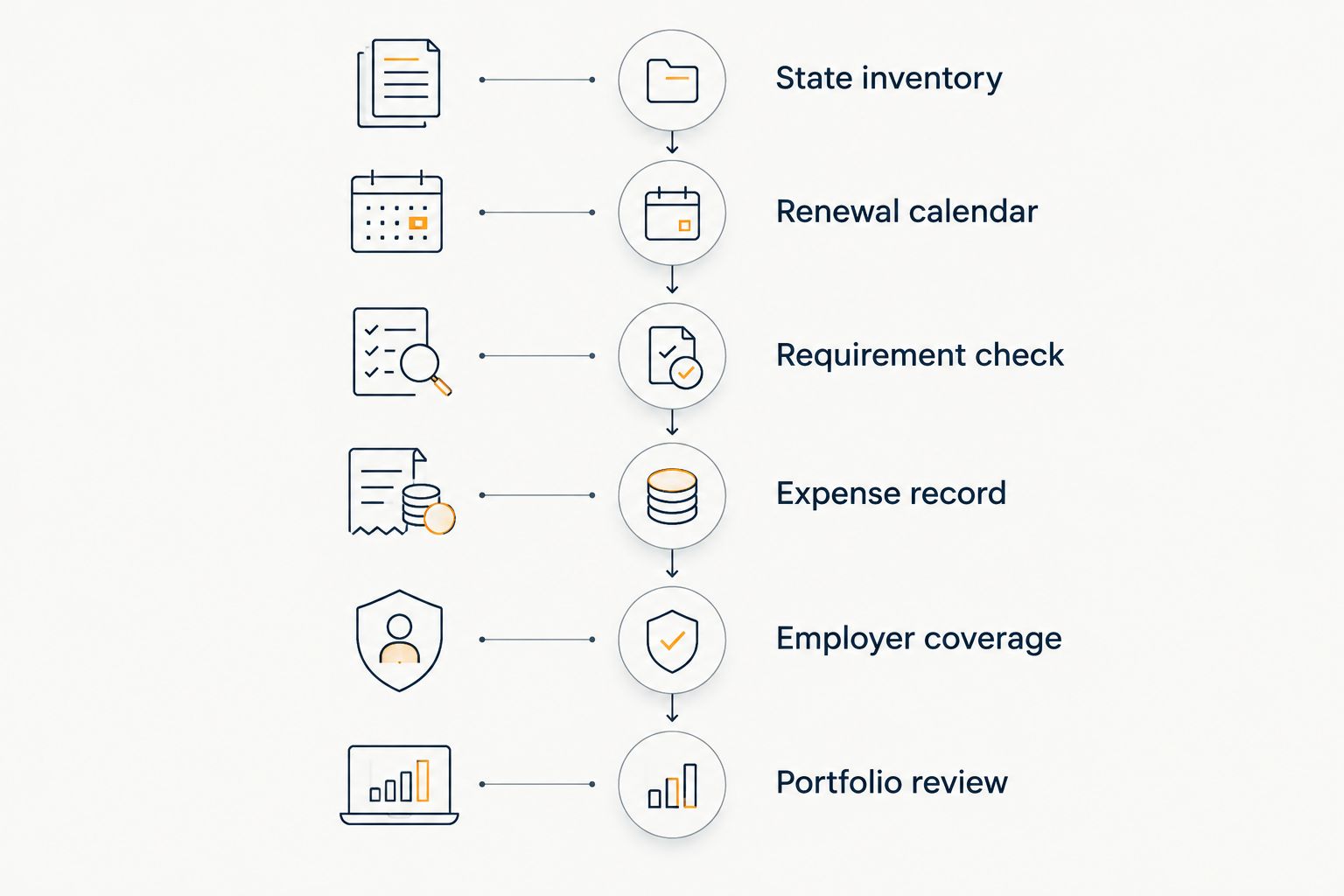
- State inventory: List every license, its status, expiration date, and the work it supports. Include pending applications separately.
- Renewal calendar: Record each renewal cycle and actual payment deadline. Flag obligations due during your planning period.
- Requirement check: Review education, attestations, and other renewal instructions directly with the issuing board.
- Expense record: Enter verified renewal expenses and incremental education or administrative spending. Keep entry expenses outside the maintenance subtotal.
- Employer coverage: Match each expense to written reimbursement terms. Record whether payment is direct or requires you to submit a claim.
- Portfolio review: Decide which licenses support ongoing work or a specific next move. Investigate status changes before making them.
Use this calculation: annualized renewal expenses + incremental compliance spending + paid administration − documented reimbursement = annual out-of-pocket maintenance expense. Keep unpaid personal administrative hours beside the total rather than assigning an unsupported monetary value to them.
For a 2026 offer comparison, also prepare a cash-due total. Include only payments due during that period, and show reimbursement timing separately. Employer repayment after submission does not eliminate the need to make the initial payment yourself.
What should you ask an employer to cover?
Ask the employer to distinguish initial applications, renewals, required checks, and administrative assistance. A general licensing-support statement leaves too much unresolved. Request the relevant policy or contract language before relying on it in your budget.
Your questions should cover:
- Which states are required for this role, and who approves adding another?
- Does support include both initial applications and later renewals?
- Are required verification and background-check expenses eligible?
- Does licensing support draw from the same allowance as continuing education?
- Who pays first, and what documentation is required?
- What happens to reimbursement if an assignment ends or employment terminates?
Do not assume a recruiter, staffing firm, facility, and employing group share the same obligations. Identify the party responsible for payment and the person responsible for submissions. Keep those responsibilities visible in your offer comparison.
A useful reimbursement term names the expense, the covered states, and the payment process. Administrative help is valuable, but it is a separate benefit from reimbursement.
How do you connect licensing decisions to a job search?
RadBoard is best for radiologists comparing career opportunities before deciding which state licenses to maintain. The radiology job search platform aggregates 5,000+ positions from 20 sources and includes swipe-to-save features. Use the opportunity search to identify relevant employers, then ask those employers about required states and licensing support.
The limitation is straightforward: a job search does not establish a board's renewal requirements or an employer's reimbursement obligations. Verify both directly. Do not infer a licensing benefit from the presence of a job listing.
When you review RadBoard, save roles that match your subspecialty and preferred work arrangement. Compare the actual state requirements before adding a license solely to broaden your search.
Compare roles before adding licenses
RadBoard aggregates 5,000+ radiology positions from 20 sources.
Can the same CME satisfy several state renewals?
The same educational activity can satisfy requirements in more than one state when it meets each board's rules. Check eligible credit, required topics, reporting periods, and documentation separately; do not assume acceptance is identical everywhere.
Keep completion certificates in a central record and map them to each renewal. This helps you identify a genuine education gap without budgeting repeatedly for an activity you have already completed.
Does remote radiology work remove state licensing requirements?
Remote work does not create a general exemption from state medical licensing requirements. Confirm the applicable rules for the jurisdictions involved in your work, including where patients receive care and where you practice.
For a 2026 teleradiology offer, request the required-state list from the employer before finalizing your budget. Keep facility credentialing and malpractice territory checks separate from that license inventory.
Should you keep a license you are not using?
Keep an unused license only after weighing a specific future use against its renewal obligations and the rules for changing or restoring status. An identified assignment or relocation plan is a clearer reason than an undefined possibility.
Before acting, confirm the board's status options and any contractual obligations. An inactive or expired license is not permission to resume clinical work without satisfying the applicable requirements.
FAQ
How much should I budget for multiple state medical licenses as a radiologist?
Budget the verified renewal expenses for each state, plus incremental education and administration, minus documented employer reimbursement. Keep new applications and other professional overhead separate from recurring maintenance.
Does a teleradiology employer pay for every state license?
Employer payment depends on the written agreement or reimbursement policy. Ask which states and expense categories qualify, who pays first, and whether employment conditions affect reimbursement.
Is the Interstate Medical Licensure Compact a single medical license?
The Interstate Medical Licensure Compact is an expedited pathway to individual licenses in participating jurisdictions, not a single nationwide license. Check current eligibility and the requirements of the states where you intend to practice.
Can I count the same CME toward several medical license renewals?
You can use the same activity for several renewals when it satisfies each board's applicable requirements. Verify credit eligibility, required subjects, reporting periods, and documentation for every state.
Should I annualize renewal expenses or budget the full payment?
Use annualized expenses to compare ongoing maintenance, and use the full payment due for cash planning. Keeping both views prevents a renewal calendar from being mistaken for an annual expense estimate.
Does RadBoard manage medical license renewals?
RadBoard is a radiology job search platform, not a substitute for checking medical board requirements. Use it to compare opportunities, then confirm licensing obligations and reimbursement with the relevant board and employer.
One last thing
The next license you add should have a reason attached to it. Record the employer, assignment, or relocation plan it supports, then review that reason before renewal. If the opportunity disappears, reassess the license instead of renewing automatically.
For your final 2026 check, reconcile the renewal calendar with the employer's covered-state list. A license can remain your responsibility even when the assignment that originally required it has ended.