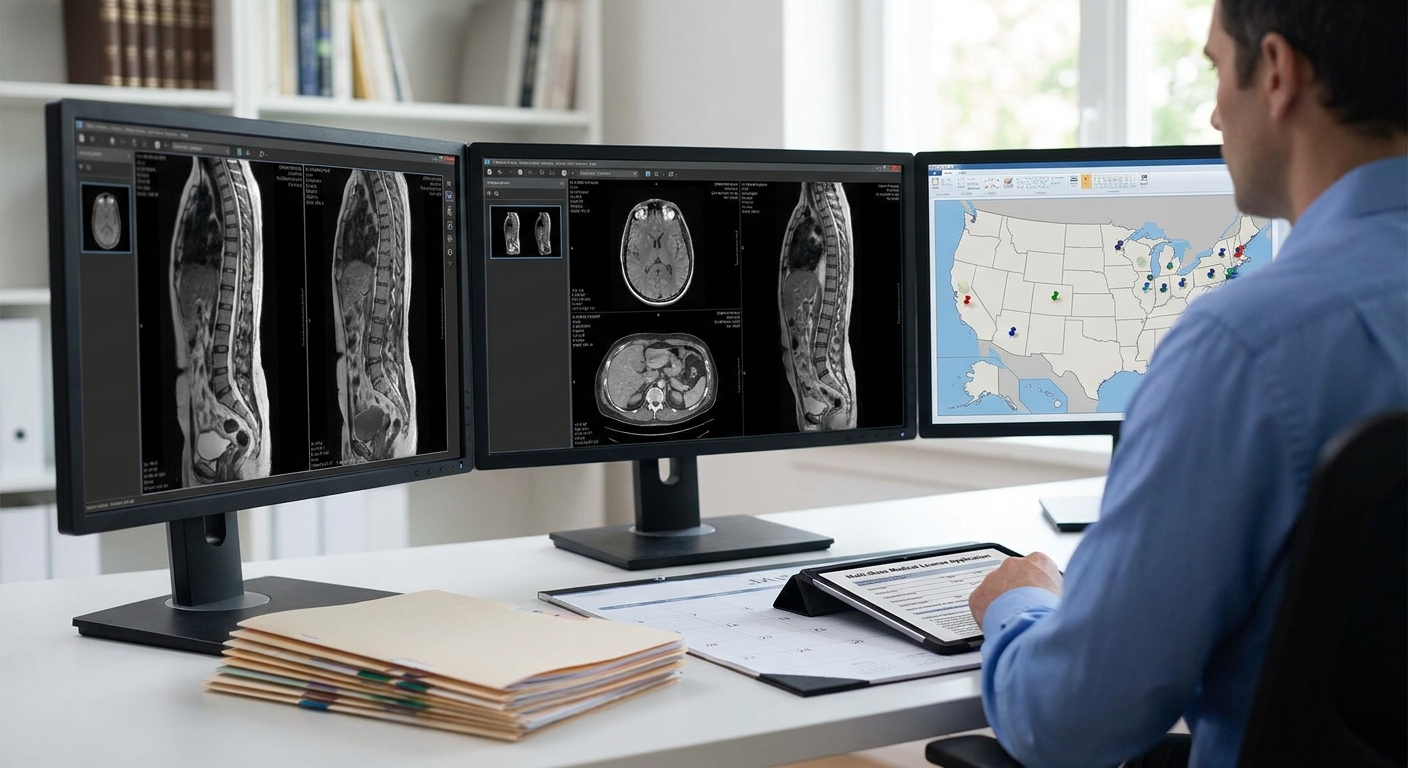
Teleradiology jobs that offer multi-state license support solve one problem: reading for hospitals in six states without paying for six licenses out of pocket and chasing six sets of paperwork on your own time.
- National teleradiology networks with reimbursed multi-state licensing are the safe pick for 2026 job seekers.
- IMLC-participating employers cut credentialing time from months to roughly 4-8 weeks per added state.
- Skip contracts that reimburse initial licenses but not renewals — that cost resurfaces every 1-3 years.
- AI-augmented telehealth radiology platforms are the wildcard: faster onboarding, thinner malpractice tail coverage.
- Locum-to-permanent teleradiology contracts work best if you already hold 3+ active state licenses.
Why this matters
Teleradiology pay is tied to volume, and volume is tied to how many states you can legally read for. A radiologist licensed in three states caps out faster than one licensed in eight, and the license itself — application fees, fingerprinting, board certification verification, malpractice history pulls — runs $300 to $800 per state depending on the board. Multiply that across a dozen states and the math stops making sense unless someone else is paying and processing it.
RadBoard aggregates more than 5,000 radiology jobs from 20 sources, and a growing share of the teleradiology listings in that pool now specify license reimbursement or IMLC facilitation directly in the posting. That's a 2026 shift worth noticing: employers used to bury this detail in the offer letter. Now it's a recruiting hook because radiologists are asking for it upfront.
Who this is for
This guide is for board-certified or board-eligible radiologists who already read remotely, or want to, and who see license count as the ceiling on their earning potential. It's for someone weighing a national teleradiology group against a smaller regional practice and trying to figure out which one actually pays for the paperwork instead of just promising to. If you hold one or two state licenses and plan to stay that way, most of this won't move the needle — skip to the radiology job search platform and filter by state instead.
What to look for in teleradiology jobs with multi-state license support
License reimbursement and renewal support
Initial licensing reimbursement is table stakes in 2026 — almost every serious teleradiology employer covers it. The real differentiator is renewal. State licenses expire every 1 to 3 years depending on the board, and if the contract only covers year one, you're back to paying $300-$800 per state on your own dime starting year two. Ask for renewal language in writing before you sign anything.
IMLC facilitation and expedited credentialing
The Interstate Medical Licensure Compact now covers more than 40 states, and employers that actively facilitate IMLC applications cut new-state credentialing from a 3-4 month DIY process down to roughly 4-8 weeks. Not every teleradiology group does this well — some just hand you a checklist and call it support. Ask specifically whether they have in-house credentialing staff or outsource to a third party, because that answer predicts how fast you actually get added to a new state's reading roster.
State coverage matched to caseload, not padded
Some contracts advertise "licensed in 15+ states" as a selling point, but if the actual reading volume only justifies 6-8 active states, the extra licenses are dead weight you paid renewal fees on for nothing. Ask what percentage of your monthly RVUs would come from each state tier before agreeing to hold licenses you'll rarely use.
Malpractice tail coverage across every licensed state
Malpractice coverage that follows you across state lines matters more than the license itself. A tail policy gap in even one state you're licensed in exposes you to claims filed years after you stop reading there. Confirm the group's malpractice carrier explicitly names tail coverage per state, not just a blanket national policy that assumes uniform coverage.
Compliance tracking across multiple medical boards
Eight states means eight CME requirements, eight renewal calendars, and eight sets of continuing education rules that don't always overlap. Employers with dedicated compliance software or staff flag renewal deadlines 60-90 days out; employers without it leave that tracking to you, and a missed renewal can suspend your ability to read for that state's cases mid-contract.
Filter teleradiology roles by state coverage
Search AI-matched radiology jobs and swipe to save the ones with license support.
Top picks for multi-state license support
National teleradiology networks — the safe pick. These groups typically hold active contracts across 15-30+ states and run in-house credentialing teams whose entire job is processing new-state applications. The number that matters: turnaround on a new state license averages 4-8 weeks when the employer manages the IMLC filing versus 3-4 months solo. Full details live in the roundup of best teleradiology companies to work for. Buy.
AI-augmented telehealth radiology platforms — the wildcard. Faster onboarding, often 2-3 weeks to first shift, because triage software pre-sorts studies and reduces the credentialing burden per state. The tradeoff: malpractice tail coverage on these platforms is newer and less standardized, so read the policy language line by line before you sign. Compare specifics in the best telehealth radiology platforms for per diem shift flexibility guide. Consider.
Regional or state-based teleradiology groups — the specialist play. Smaller footprint, usually 3-8 states, but often faster relationship-building with hospital clients and less bureaucracy per license added. Good fit if your subspecialty demand is concentrated in a specific region rather than spread nationally. Consider.
Locum-to-permanent teleradiology contracts — the flexible pick. Works best if you already hold 3 or more active state licenses, since these contracts rarely fund licensing from zero — they're built for radiologists who can plug into existing coverage fast. The tradeoff is you're financing your own license base while testing the fit. Consider if you're already multi-licensed, Skip if you're starting from one state.
What to avoid
- "Unlimited state licensing" language with no renewal clause. It sounds generous until year two, when the reimbursement quietly stops and you're covering $300-$800 renewals per state alone.
- Contracts that count license count instead of usable volume. A dozen licenses mean nothing if 80% of your RVUs come from three states — you paid for nine licenses you barely touch.
- Malpractice policies with vague "multi-state coverage" wording. Ask for the carrier name and confirm tail coverage per state in writing; a generic mention in the offer letter isn't a policy.
Verdict comparison
| Employer type | States typically covered | Renewal support | Credentialing speed | Verdict |
|---|---|---|---|---|
| National teleradiology network | 15-30+ | Usually included | 4-8 weeks per state | Buy |
| AI-augmented telehealth platform | 8-15 | Varies by contract | 2-3 weeks to first shift | Consider |
| Regional teleradiology group | 3-8 | Often included | 6-10 weeks per state | Consider |
| Locum-to-permanent contract | Depends on your base | Rarely funded from zero | Fast if pre-licensed | Consider/Skip |
FAQ
What is multi-state license support in teleradiology jobs?
Multi-state license support means the employer reimburses licensing fees, files paperwork through IMLC where possible, and tracks renewals across every state you read for. In 2026, most national teleradiology groups cover the first license; fewer cover renewals, so check that specifically.
How many states should a teleradiology radiologist be licensed in?
It depends on caseload, not a fixed number. Radiologists reading for national groups often hold 8-15 active licenses, but only pursue new states where the contract shows real reading volume, not just theoretical coverage.
Does the IMLC speed up teleradiology credentialing?
Yes. The Interstate Medical Licensure Compact now covers more than 40 states and can cut new-state licensing from 3-4 months down to 4-8 weeks when an employer's credentialing team files on your behalf.
Are teleradiology multi-state licensing costs tax deductible?
License fees, board applications, and related travel can often be deducted as business expenses for independent contractor radiologists, but confirm specifics with a tax professional familiar with physician contracts, not a general guide.
Is a national teleradiology network better than a regional group for licensing support?
National networks generally have dedicated credentialing staff and cover more states, which suits radiologists chasing broad coverage. Regional groups move faster per license and fit radiologists concentrated in one area's demand.
How much does it cost to get licensed in a new state as a radiologist?
Individual state medical license applications typically run $300 to $800 in fees before factoring in fingerprinting, verification services, and renewal cycles every 1-3 years, which is why employer reimbursement matters.
Do teleradiology jobs cover malpractice tail insurance across states?
Coverage varies by employer and contract. Ask explicitly whether tail coverage applies per licensed state, since a gap in even one state can leave you exposed to claims filed after you stop reading there.
Should I take a teleradiology job before I have multiple state licenses?
Yes, if the employer funds initial licensing and renewals — that's the entire point of multi-state license support. Starting from one license with a group that reimburses is often cheaper than self-funding licenses first.
One last thing
The detail most radiologists miss isn't the license fee — it's the renewal clock. A license that expires in year two with no reimbursement clause quietly turns a "free" multi-state setup into a $2,000-$4,000 annual bill once you're spread across six or eight states. Read the renewal section of any teleradiology contract before you read the base salary.