
Radiologist malpractice insurance has no single national rate you can apply to your next job; your cost depends on the insurer’s quote and what your employment contract requires you to pay. For a 2026 offer, compare the annual premium, deductible obligations, and responsibility for claims reported after you leave—not just whether the posting says malpractice is included.
- How much does malpractice insurance cost for radiologists? Get a quote matched to your practice and coverage requirements.
- Employer-paid premiums do not establish who pays for tail coverage when employment ends.
- RadBoard helps radiologists find job opportunities; confirm malpractice terms directly with each employer.
- Compare claims-made and occurrence coverage before comparing annual premiums.
How much does malpractice insurance cost for radiologists?
Your useful number is the written quote for your actual work, not a specialty-wide average. A diagnostic reading position, a procedural role, and a multistate teleradiology assignment do not describe identical insurance exposures. Your quote must reflect the services, locations, coverage limits, and policy terms attached to the position.
Separate the insurer’s premium from your personal payment obligation. An employer can purchase the policy while assigning you a deductible or an obligation to arrange extended reporting coverage after departure. Those terms belong in your offer comparison alongside compensation and benefits.
Use this breakdown when reviewing W-2 versus independent-contractor radiology offers:
| Component | What to establish | Why it matters |
|---|---|---|
| Annual premium | Who purchases the policy and pays renewals | Identifies your ongoing obligation |
| Deductible or retention | Who pays and when payment is required | Identifies expenses beyond the premium |
| Extended reporting coverage | Whether it is needed and who arranges it | Addresses later reporting of earlier work |
| Prior-acts coverage | Whether a replacement insurer accepts earlier work | Determines whether coverage continues across a move |
| Required coverage limits | What the employer and facilities require | Keeps competing quotes comparable |
| Covered practice | Which services, entities, and locations are included | Tests whether the policy fits the job |
Do not add these components mechanically. Tail coverage and accepted prior-acts coverage can be alternative ways to address continuity when changing claims-made insurers. Ask the insurer to explain the proposed arrangement before treating either as a separate obligation.
Why this matters
A salary comparison is incomplete until you know which malpractice obligations follow you. Employer-paid coverage during employment does not settle what happens after resignation, termination, retirement, or a change in the practice’s insurer.
For your 2026 job search, request the insurance documents before signing. A benefits summary describes an offer; the policy and employment agreement establish different parts of the coverage and payment arrangement. Read both, and resolve conflicting language in writing.
The practical goal is straightforward: identify what protects your work, what you must pay, and what remains your responsibility when the relationship ends.
Claims-made coverage: check continuity before the premium
Claims-made coverage generally depends on when a claim is made and, under the policy’s terms, reported. The underlying professional service must also fall within the covered period, including any applicable retroactive date. Exact reporting requirements come from the policy, not the job posting.
Best for: radiologists whose employer or practice maintains claims-made coverage and documents how coverage continues through an insurer change or departure. The advantage is a defined arrangement that can include accepted prior acts. The limitation is that leaving the policy requires attention to reporting continuity.
Ask for the retroactive date, reporting conditions, and written departure provisions. A statement that the employer pays malpractice does not answer those questions. Neither does a certificate showing that coverage exists today.
If you receive an introductory premium, ask how renewal terms change as the policy matures. Compare the expected coverage arrangement across your employment, rather than treating the opening quote as a permanent annual obligation.
Occurrence coverage: check when the work happened
Occurrence coverage generally responds to covered professional services performed during the policy period, even when a claim arrives later, subject to the policy’s terms. That timing distinction separates it from claims-made coverage. It does not remove exclusions, limits, or the need to confirm which work is insured.
Best for: radiologists who want coverage tied to when the professional service occurred. Its advantage is that ending the policy does not ordinarily create the same extended-reporting issue for covered occurrences. Its limitation is that you still need to assess the full policy, not just its label.
For a 2026 comparison, keep coverage limits, practice details, and deductible terms consistent across quotes. Otherwise, a premium difference tells you little about the value of the protection.
| Coverage arrangement | Best for | Main advantage | Main limitation |
|---|---|---|---|
| Claims-made | Physicians with documented reporting continuity | Can incorporate accepted prior acts | Departure requires attention to reporting provisions |
| Occurrence | Physicians prioritizing service-date coverage | Covered occurrences remain tied to their policy period | Exclusions and limits still require review |
Neither policy type is automatically the better choice for every radiologist. Match the policy to the work and the contract’s allocation of responsibility.
Tail coverage: establish who owns the departure obligation
Tail coverage is an extended reporting arrangement for a claims-made policy. It allows qualifying claims involving earlier covered work to be reported after the underlying policy ends, subject to the endorsement’s terms. It does not insure new clinical work performed after termination.
The central employment question is who must arrange and pay for it. Request an answer for voluntary resignation, termination without cause, termination for cause, retirement, and a practice sale. Do not assume the same obligation applies to every departure.
Also ask whether the arrangement provides an alternative through accepted prior-acts coverage. A new insurer’s willingness to cover earlier services must be confirmed; changing employers alone does not establish continuity.
Recommendation: settle the departure language before accepting the position. An undefined obligation is not a completed benefits negotiation, even when current premiums are employer-paid.
Why radiologist malpractice insurance costs vary
These are the details to reconcile before requesting or comparing quotes. They describe the risk and the protection being purchased; they do not support a universal premium estimate.
- Clinical scope: Describe diagnostic interpretation, procedures, supervision, and other professional services accurately. Do not assume a general radiology description covers every duty.
- Practice geography: Identify the states and facilities involved, including patient locations relevant to remote interpretation. Confirm the insurer accepts the full arrangement.
- Coverage limits: Match the required per-claim and aggregate limits. A quote for different limits is not a like-for-like comparison.
- Policy structure: Identify claims-made or occurrence coverage, deductible provisions, reporting requirements, and applicable retroactive dates.
- Claims history: Disclose the history requested by the insurer accurately. Ask how the underwriting decision affects the offered terms.
- Work arrangement: Explain employed work, independent contracting, locum assignments, and outside shifts. Establish which policy covers each activity.
For your 2026 renewal or job change, update the description when your duties change. Adding procedures, a new facility, or another state is a reason to request confirmation—not to assume the existing arrangement follows automatically.
How do I get a useful malpractice insurance quote?
Use a consistent submission so each insurer or broker evaluates the same practice. Compare coverage first and your payment obligation second. A quote is useful only when it matches the work you will actually perform.
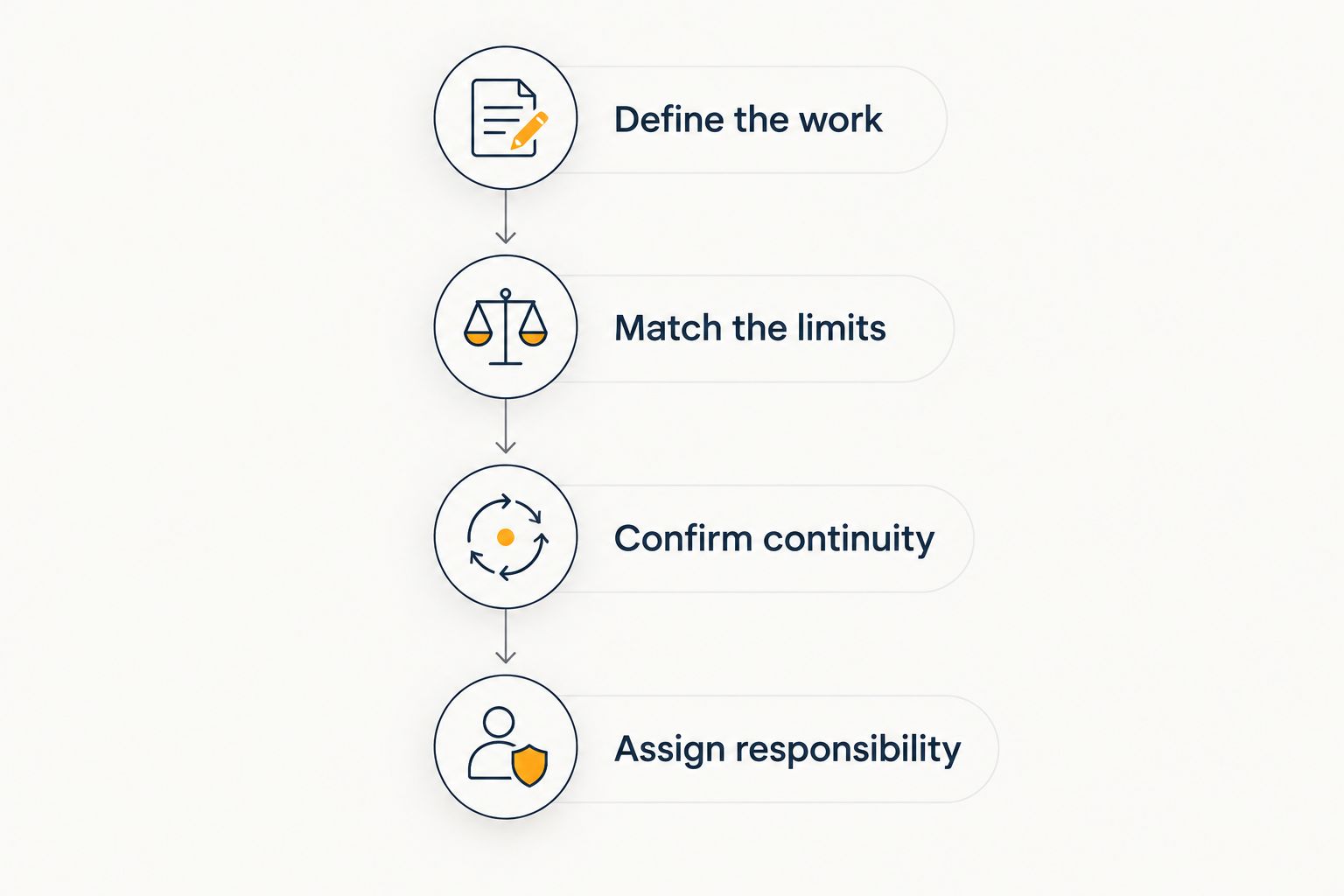
- Define the work. List your clinical duties, practice entities, locations, and outside professional activities. Include remote work and procedural responsibilities explicitly.
- Match the limits. Obtain the employer’s and facilities’ requirements. Ask about deductibles, defense expenses, exclusions, and whether limits are shared.
- Confirm continuity. Identify your existing policy type and retroactive date. Request written confirmation of any proposed prior-acts or extended reporting arrangement.
- Assign responsibility. Establish who purchases coverage, handles renewals, and pays departure-related obligations. Reconcile the answer with the employment agreement.
Keep the final quote, policy documents, endorsements, and relevant contract language together. Ask a qualified insurance professional to explain coverage questions and an attorney to review contractual obligations. Those are related decisions, but they are not interchangeable.
How should I compare malpractice benefits across job offers?
Build a separate insurance line in your offer comparison. Record the policy type, payer, limits, deductible responsibility, outside-work provisions, and departure arrangement. Mark an unanswered item as unresolved rather than treating it as included.
RadBoard is a radiology job search platform for physicians seeking positions across multiple sources. It aggregates 5,000+ radiology positions from 20 sources and offers swipe-to-save features. Use RadBoard to find opportunities, then verify each employer’s malpractice provisions directly.
The platform’s role is job discovery, not establishing your insurance coverage. A saved posting is a starting point for questions; the employer’s documents and insurer’s terms determine the arrangement you are evaluating.
Compare radiology opportunities
Search 5,000+ radiology positions from 20 sources, then verify coverage terms with employers.
Does employer-paid malpractice include tail coverage?
Employer-paid malpractice does not establish that tail coverage is included. The employment agreement must address the departure obligation, and the insurance documents must establish how reporting coverage works.
Ask for specific language rather than a verbal assurance. If payment depends on length of service or the reason for departure, identify the condition before you sign.
Is malpractice coverage included in locum tenens work?
Locum tenens coverage depends on the assignment agreement and policy; the job label alone establishes nothing. Ask the agency or contracting entity to identify the insurer, covered services, applicable locations, and reporting arrangement after the assignment ends.
Check outside shifts separately. Coverage arranged for an assignment does not establish protection for unrelated work you accept elsewhere.
Does remote radiology work need different coverage checks?
Remote radiology work requires confirmation that the policy covers the relevant professional services and jurisdictions. Working from home does not replace the need to identify where patients receive care and which entities engage you.
For a 2026 multistate assignment, provide the insurer with the full proposed practice arrangement. Obtain confirmation before adding work, rather than relying on a general statement that teleradiology is covered.
FAQ
How much does malpractice insurance cost for radiologists in 2026?
Radiologists need an individualized quote based on their practice, coverage requirements, and underwriting details. Compare the annual premium with deductible obligations and any responsibility for coverage after departure.
What's the best way to compare radiologist malpractice quotes?
Compare quotes using the same clinical duties, locations, policy type, limits, and deductible terms. Then establish who pays each obligation under your employment or contractor agreement.
Is occurrence coverage better than claims-made coverage?
Neither policy type is automatically better for every radiologist. Occurrence coverage centers on when covered services occurred; claims-made coverage requires attention to claim timing, reporting terms, and continuity.
Do I need tail coverage when I leave a radiology job?
Your need for tail coverage depends on the existing policy and the replacement coverage arrangement. Confirm whether accepted prior-acts coverage or another applicable provision addresses later claims involving your earlier work.
Does my employer's malpractice policy cover moonlighting?
Employer coverage does not establish that unrelated moonlighting is insured. Ask the insurer to confirm the specific outside duties, entities, and locations in writing.
What should I ask before accepting a teleradiology contract?
Ask which services, entities, and jurisdictions the malpractice policy covers. Also confirm limits, reporting requirements, and responsibility for coverage when the contract ends.
Can RadBoard confirm whether a job includes malpractice coverage?
RadBoard is a radiology job search platform, not confirmation of an employer's insurance terms. Verify coverage through the employer's agreement and the applicable insurance documents before accepting a position.
One last thing
Ask what happens if the practice changes insurers while you remain employed. Coverage continuity is not only a resignation issue: a switch between claims-made arrangements also requires attention to earlier services and reporting terms.
Before signing, resolve both transitions: joining the practice and eventually leaving it. Keep the written answers with your contract so your next career decision starts with established obligations rather than assumptions.