
The cost of a radiology partnership buy-in depends on the group’s written ownership agreement, what you acquire, and how you pay—not the partnership title alone. For a 2026 offer, assess the capital contribution alongside any deferred compensation, financing obligations, and exit restrictions. Ask for the valuation and payment schedule before treating partnership as a financial benefit.
- Assess the cost of partnership buy-in radiology group offers through capital contributions, deferred compensation, financing, and exit terms.
- A partnership-track job does not establish what ownership you will receive; request the governing documents.
- Compare ownership rights and total compensation, not just the payment due at admission.
- RadBoard aggregates 5,000+ radiology positions from 20 sources; use job discovery to build your comparison set.
How much does radiology partnership buy-in cost?
Your actionable number is the amount calculated under the specific group’s agreement. Request a written breakdown that separates the ownership purchase from compensation arrangements, working capital, financing, and contingent obligations. A verbal estimate does not explain what you own or what you owe.
Use this worksheet to identify the components of the proposal. These are items to investigate, not charges that every radiology group imposes.
| Component to check | What to request | How to evaluate it |
|---|---|---|
| Ownership purchase | Entity name, interest acquired, and valuation method | Match the payment to identifiable ownership rights |
| Working capital | Required contribution and capital-account treatment | Establish whether this is separate from the ownership purchase |
| Deferred compensation | Associate and partner compensation formulas | Separate an explicit contribution from an earnings difference |
| Financing | Loan agreement and repayment schedule | Identify interest, security, and personal obligations |
| Additional contributions | Capital-call provisions and approval rules | Determine what future funding obligations you accept |
| Departure settlement | Redemption formula, deductions, and payment timing | Compare entry terms with the terms for leaving |
Start with the employment structure in the guide to careers at small private radiology practices. Then examine the ownership documents separately: an employment agreement and an ownership agreement answer different questions.
Why this matters
A partnership decision combines a job decision with an investment decision. You need to assess the reading workload, compensation, governance rights, and capital exposure together, without treating any one of them as a substitute for the others.
For your 2026 comparison, distinguish what is promised now from what requires later approval. An offer describing a partnership track needs an admission date or process, eligibility criteria, and a clear explanation of who makes the decision.
Do not assign ownership value to an undefined future opportunity. Ask the practice to put the admission terms in writing before you use them to justify accepting different employment terms.
Compare the payment structures, not just the headline amount
The payment structure determines when you need cash and which obligations remain after you leave. Identify the arrangement described in the actual proposal rather than assuming that all partnership offers work alike.
| Structure to investigate | Best for | Potential advantage | Limitation to examine |
|---|---|---|---|
| Upfront contribution | Physicians able to fund admission immediately | Makes the initial payment obligation explicit | Requires cash before future investment returns are known |
| Installment purchase | Physicians seeking scheduled payments | Spreads the payment obligation across the agreed schedule | Requires review of interest and unpaid balances at departure |
| Compensation withholding | Physicians evaluating payroll-funded contributions | Connects contributions to compensation payments | Makes take-home compensation harder to compare without a reconciliation |
| Earn-in arrangement | Physicians offered ownership through defined service conditions | Connects admission to specified milestones | Requires clear vesting, approval, and forfeiture provisions |
These labels do not establish the legal or tax treatment. Ask counsel and your accountant to review the documents that implement the arrangement, including whether payments purchase equity, fund a capital account, or serve another purpose.
An installment schedule also does not resolve valuation. A manageable payment schedule and a justified ownership valuation are separate requirements.
Why radiology partnership buy-in obligations vary
Use these factors to question the proposal. Confirm which ones apply rather than importing assumptions from another practice’s offer.
- Ownership scope: Identify whether you acquire an interest in the professional practice, an imaging business, real estate, or another entity. Request separate documentation for each interest.
- Valuation method: Ask how the agreement treats assets, liabilities, receivables, and goodwill. Request the calculation rather than accepting a valuation label.
- Interest acquired: Establish the economic interest, voting rights, and distribution rights. Do not assume these rights are identical.
- Capital requirements: Review the initial contribution, reserve requirements, and rules for later capital calls. Identify who approves additional funding.
- Payment terms: Separate payment timing from total obligations. Review financing, compensation withholding, and what happens to unpaid balances after departure.
- Redemption rules: Examine how ownership is valued when you leave, when payment occurs, and which deductions or conditions apply.
The relevant comparison is what you pay, what you receive, and what remains at risk. A payment figure without those details is incomplete.
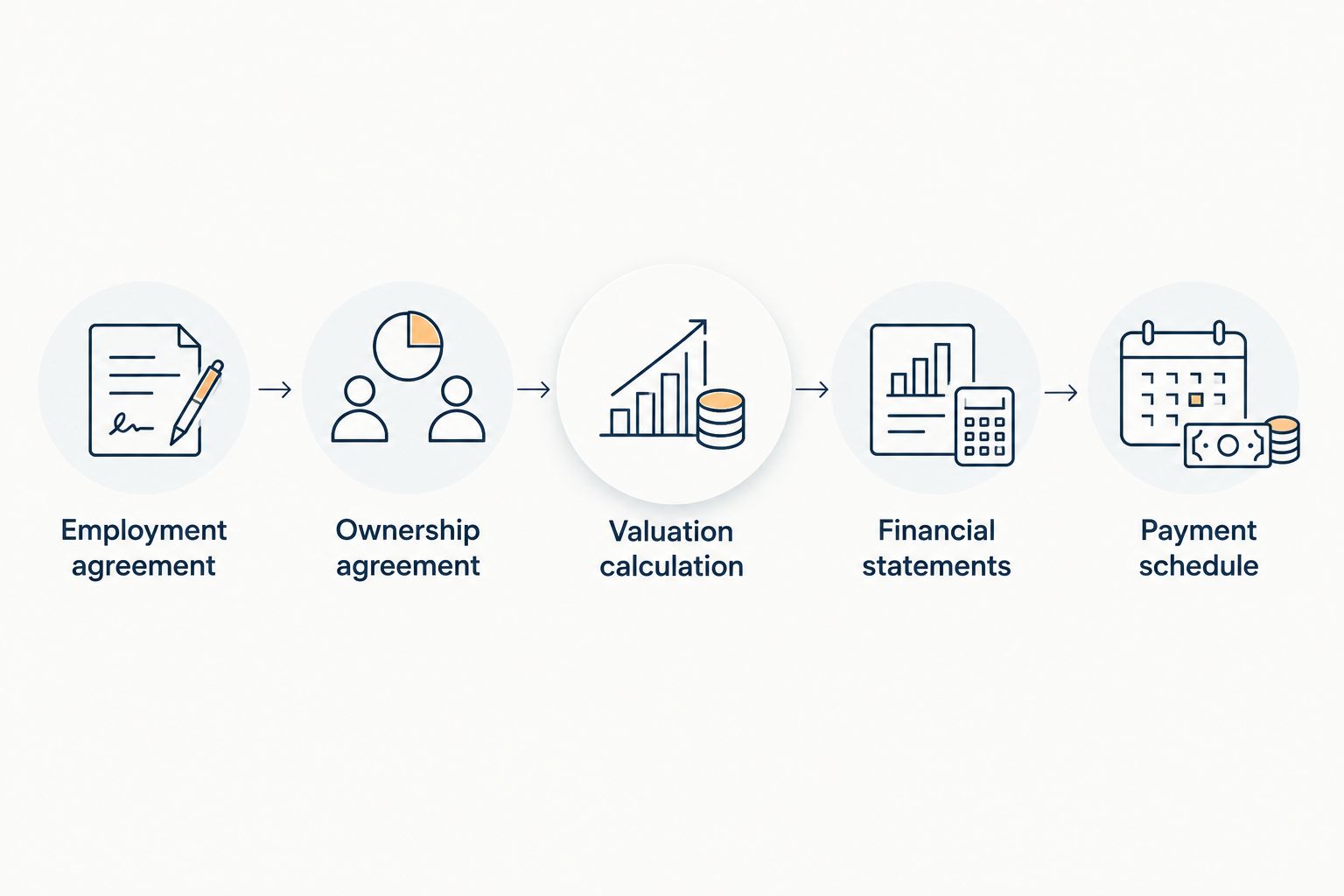
Request 5 documents before evaluating the buy-in
For a 2026 partnership review, assemble these 5 documents or document sets before comparing the offer with another position. Have a healthcare attorney review the legal terms and an accountant assess the financial and tax implications.
- Employment agreement. Confirm compensation, duties, termination provisions, and the language describing partnership eligibility. Identify any separate agreement incorporated by reference.
- Ownership agreement. Request the shareholder, operating, or partnership agreement applicable to the entity. Read admission, voting, transfer, amendment, and redemption provisions together.
- Valuation calculation. Obtain the calculation supporting your proposed contribution and identify the financial information used. Ask how that calculation relates to the ownership interest you receive.
- Financial statements. Request current financial statements and supporting information appropriate to the proposed investment. Ask your accountant to identify additional records needed to evaluate debt, cash flow, and distributions.
- Payment schedule. Obtain the contribution schedule, financing documents, and any compensation-withholding arrangement. Require an explanation of what happens to each obligation if admission is delayed or employment ends.
The documents need to agree with one another. If the offer letter describes ownership rights that the governing agreement does not establish, request clarification in the signed documents—not another verbal assurance.
Calculate cash exposure without double-counting
Build separate views of cash required, compensation differences, and contingent obligations. Combining them into one unexplained total obscures when you pay and which assumptions drive the comparison.
Cash required
List the ownership payment, separate capital contributions, professional review expenses, and scheduled financing payments. Reconcile financed amounts with the purchase obligation so you do not count both the borrowed principal and the same purchase payment twice.
Show the dates cash leaves your account. A schedule makes it easier to evaluate affordability alongside household obligations and other debt payments.
Compensation differences
Compare the proposed associate compensation with a documented alternative offer under comparable duties. Adjust your comparison for workload, call, vacation, benefits, and productivity expectations before treating the difference as an economic sacrifice.
Do not automatically label every associate-to-partner compensation difference a buy-in. Ask whether the agreement expressly allocates withheld earnings toward ownership and how those amounts are recorded.
Contingent obligations
List capital calls, guarantees, unpaid purchase balances, and other contractual exposures separately. Do not treat a possible obligation as a payment already made, but do not omit it from your decision.
Keep cash paid, compensation forgone, and contingent exposure in separate columns. That separation gives your advisers a clearer basis for checking the analysis.
Test 3 scenarios before accepting
For a 2026 offer, ask the practice and your advisers to work through 3 scenarios using the proposed agreements. Request written explanations of the applicable clauses rather than assurances about what the group usually does.
Admission as planned
Confirm the admission process, contribution calculation, ownership effective date, and start of distribution eligibility. Ask whether any additional approval remains outstanding after you satisfy the stated criteria.
Document your initial voting and economic rights. If those rights change over time, identify the conditions for each change.
Departure before admission
Determine what happens to withheld compensation, accumulated contributions, and any financing balance. Read the employment termination provisions alongside the partnership-track language.
Ask whether the outcome differs depending on who ends employment and why. Have counsel explain any forfeiture or repayment provisions before you rely on amounts being returned.
Departure after admission
Apply the redemption provisions to your proposed ownership interest. Establish how the agreement determines value, when payment becomes due, and which outstanding obligations affect the settlement.
Ask what happens to personal guarantees and unpaid purchase financing. Leaving employment and being released from a separate obligation are different contractual events.
How do you compare partnership with an employed position?
Compare the job on its employment terms and the ownership on its investment terms. Put compensation, benefits, workload, call, and vacation beside the capital contribution, governance rights, distribution rules, and exit provisions.
Neither structure earns an automatic preference. A partnership proposal needs a defensible investment case; an employed offer needs acceptable compensation and working conditions. Use the same documented assumptions when comparing both.
RadBoard is best for radiologists who want to search positions aggregated from multiple sources. The radiology job search platform brings together 5,000+ positions from 20 sources and offers swipe-to-save features for building a shortlist. Use that discovery step to identify alternatives; obtain ownership and financial documents directly from each prospective practice.
That is the platform’s role in this decision: expanding your comparison set. A saved job is a lead to investigate, not evidence that a partnership valuation or admission promise is acceptable.
Is a partnership track a guarantee of ownership?
A partnership-track label does not establish your ownership rights. Read the admission criteria, approval process, and governing documents to determine what the practice has actually committed to provide.
Ask who can change the admission terms before you become an owner. Treat unresolved approval conditions as unresolved—not as an ownership interest you already hold.
Can you negotiate a radiology partnership buy-in?
Ask which terms the group is willing to discuss, including payment timing, valuation documentation, ownership rights, and departure treatment. A practice’s willingness to change those terms is specific to that proposal.
Request a written response to each proposed change. Do not evaluate a revised payment schedule without checking whether it also changes financing obligations, compensation, or redemption rights.
FAQ
What determines the cost of partnership buy-in radiology group offers?
The cost depends on the specific ownership agreement, valuation, interest acquired, and payment structure. Review separate capital contributions, financing, compensation withholding, and departure obligations alongside the ownership purchase.
Is there a standard buy-in amount I should use for a 2026 radiology offer?
Use the proposed group’s documented valuation and contribution calculation to evaluate your 2026 offer. A comparison amount does not establish what that particular agreement requires or what rights you receive.
Does lower associate compensation count toward my partnership buy-in?
Lower associate compensation counts toward an ownership contribution only if the arrangement establishes that treatment. Request the written allocation and accounting rather than assuming the compensation difference purchases equity.
What documents should I request before agreeing to partnership?
Request the employment agreement, ownership agreement, valuation calculation, financial statements, and payment schedule. Ask a healthcare attorney and accountant to review the provisions relevant to your proposed investment.
Will I get my contribution back if I leave the radiology group?
Your agreement determines the treatment of your contribution when you leave. Review the redemption formula, payment timing, deductions, unpaid obligations, and any applicable forfeiture provisions.
Is profit sharing the same as owning part of a radiology practice?
Profit sharing alone does not establish an ownership interest. Request the documents that identify any equity interest, voting rights, distribution rights, and transfer restrictions.
Can RadBoard verify a radiology group’s partnership valuation?
RadBoard is a radiology job search platform, not a substitute for transaction-specific financial and legal review. Obtain the valuation and ownership documents from the practice and review them with qualified advisers.
One last thing
Read the exit formula before accepting the entry formula. For your 2026 decision, ask the practice to explain how the proposed ownership interest would be redeemed under the same agreement you are being asked to sign.
If the entry calculation and departure calculation use different methods, ask your accountant to explain the financial effect. Knowing how you leave is part of understanding what you are buying.