
Private practice does not pay a fixed amount more than academic radiology; the difference depends on the specific contracts, workload, and ownership terms you compare in 2026. A higher advertised salary is not the same as higher compensation for equivalent work, especially when bonuses are conditional or partnership requires a financial commitment. Compare guaranteed annual compensation first, then benefits, required hours, and ownership income separately.
- The academic vs private practice radiology pay difference requires matched contracts, not a universal percentage.
- Separate guaranteed salary, conditional bonuses, and partnership distributions before comparing radiology compensation.
- Include call, teaching, research, and administrative duties when comparing required work.
- RadBoard suits radiologists comparing job opportunities across multiple sources; confirm compensation terms with each employer.
How much more does private practice pay versus academic radiology?
The meaningful pay difference is the gap between comparable offers—not the gap between an academic starting salary and a private practice partner's projected income. For your 2026 search, match career stage, location, subspecialty, employment status, and workload before calculating a premium.
Start with this framework to compare radiology job offers beyond base salary. Keep guaranteed compensation separate from income that requires additional production, shifts, or ownership.
| Compensation component | Academic radiology offer | Private practice offer | Comparison rule |
|---|---|---|---|
| Guaranteed salary | Record the contractual guarantee and its duration | Record the contractual guarantee and its duration | Compare equivalent employment periods |
| Incentive compensation | Identify clinical, leadership, or other incentive terms | Identify productivity, collections, or other incentive terms | Separate eligibility from guaranteed payment |
| Ownership income | Include only an explicitly offered ownership arrangement | Include only documented eligibility and distribution terms | Do not treat projected distributions as salary |
| Required work | Include clinical, teaching, research, and administrative duties | Include clinical, call, management, and administrative duties | Count all required work |
| Benefits and expenses | Verify employer contributions and covered expenses | Verify employer contributions and covered expenses | Value only documented provisions |
| Exit obligations | Review repayment and insurance responsibilities | Review repayment and insurance responsibilities | Keep departure costs visible |
A private practice premium is meaningful only when you identify what additional work or risk accompanies it. A larger annual guarantee deserves a different interpretation if it also requires more evenings, fewer days off, or broader coverage.
Why this matters
You are choosing an employment arrangement, not purchasing a salary number. Teaching time, research expectations, ownership eligibility, and call obligations determine what you must deliver for the compensation.
For a 2026 decision, establish your nonnegotiables before interviewing: required location, acceptable call, desired clinical scope, and whether teaching or research belongs in your working week. Otherwise, you risk comparing jobs you would not accept under equivalent terms.
A strong comparison also separates financial value from personal preference. You can prefer an academic role with lower guaranteed cash, or prefer private practice without ownership, without claiming either arrangement pays better on every measure.
Academic radiology: compare compensation with assigned duties
Best for: radiologists seeking a role with explicitly defined teaching or research responsibilities. Evaluate the actual appointment rather than assuming an academic title guarantees protected time.
Ask how the employer divides clinical service, trainee supervision, scholarship, meetings, and administration. If research time is described as protected, request the written allocation and ask how clinical coverage affects it.
The potential advantage is access to the academic work you want within your employment arrangement. The trade-off is that those responsibilities still consume working time, including preparation, assessment, manuscript revisions, and committee work when required.
Before accepting, establish:
- Which duties are required for your appointment and promotion.
- Whether teaching and research occur within scheduled work or outside clinical sessions.
- How clinical productivity affects incentive eligibility.
- Whether leadership duties receive separate compensation or workload adjustment.
- Who decides when protected time changes.
Do not value an academic benefit you will not use. Conversely, do not treat a defined research allocation as equivalent to a job that requires full clinical coverage throughout the same period.
Private practice employment: compare the guarantee before the upside
Best for: radiologists prioritizing a clinical role with clearly documented compensation and workload expectations. An employed private practice position must stand on its current terms, not on an assumed future partnership.
Request the guaranteed salary, guarantee period, incentive formula, expected schedule, and coverage responsibilities. Ask what happens when the guarantee ends and whether compensation changes automatically or requires a new agreement.
The potential advantage is a compensation arrangement aligned with the clinical work you want to perform. The trade-off is exposure to additional production requirements or variable income when the contract makes payment contingent on those conditions.
For a 2026 offer, have the employer distinguish expected earnings from contractual obligations. Ask which components require extra shifts, particular productivity levels, collections, or continued employment through a payment date.
Evaluate the employed offer as though partnership never occurs. If the current job does not meet your needs, an undocumented future opportunity does not fix it.
Partnership-track radiology: separate employment from ownership
Best for: radiologists who want ownership and are prepared to evaluate the business terms. Partnership eligibility, purchase requirements, voting rights, and distributions are separate questions from your employed salary.
Ask for the documents governing admission and ownership before assigning financial value to the opportunity. Establish whether admission follows objective conditions, a discretionary vote, or another approval process.
Ownership offers participation in the practice under its governing terms. It also introduces obligations and business exposure that a salary-only comparison misses, including any required capital contribution or responsibility specified in the agreement.
Request clarity on distributions, retained earnings, ownership restrictions, departure provisions, and what happens if the practice changes ownership. A verbal description of partner earnings is not a contractual promise that your income will match it.
Keep projected partnership income outside your guaranteed-pay comparison. Evaluate ownership separately with legal and financial advisers who can review the actual documents.
Why the academic versus private practice pay difference varies
The same practice label can cover different jobs. These contract-level factors determine whether you are comparing equivalent compensation:
- Workload and schedule: Compare required hours, evening coverage, weekends, call, and leave. More annual cash does not establish better compensation for equivalent work.
- Clinical scope: Match subspecialty work, general coverage, procedures, and responsibility across sites. Ask which duties are mandatory rather than occasional.
- Nonclinical responsibilities: Include required teaching, research, quality work, meetings, and administration. Identify whether these duties replace clinical sessions or extend the workday.
- Payment conditions: Distinguish salary guarantees from productivity incentives, collections-based payments, retention conditions, and extra-shift compensation.
- Ownership terms: Separate employed earnings from distributions and account for any documented financial commitment required to become an owner.
- Benefits and exit terms: Compare employer contributions, covered professional expenses, repayment clauses, and malpractice responsibilities using the written agreements.
Location also needs to match before you interpret an offer gap as a practice-setting difference. A comparison that changes both employment model and geography cannot isolate the effect of either.
How do I calculate the pay difference between my offers?
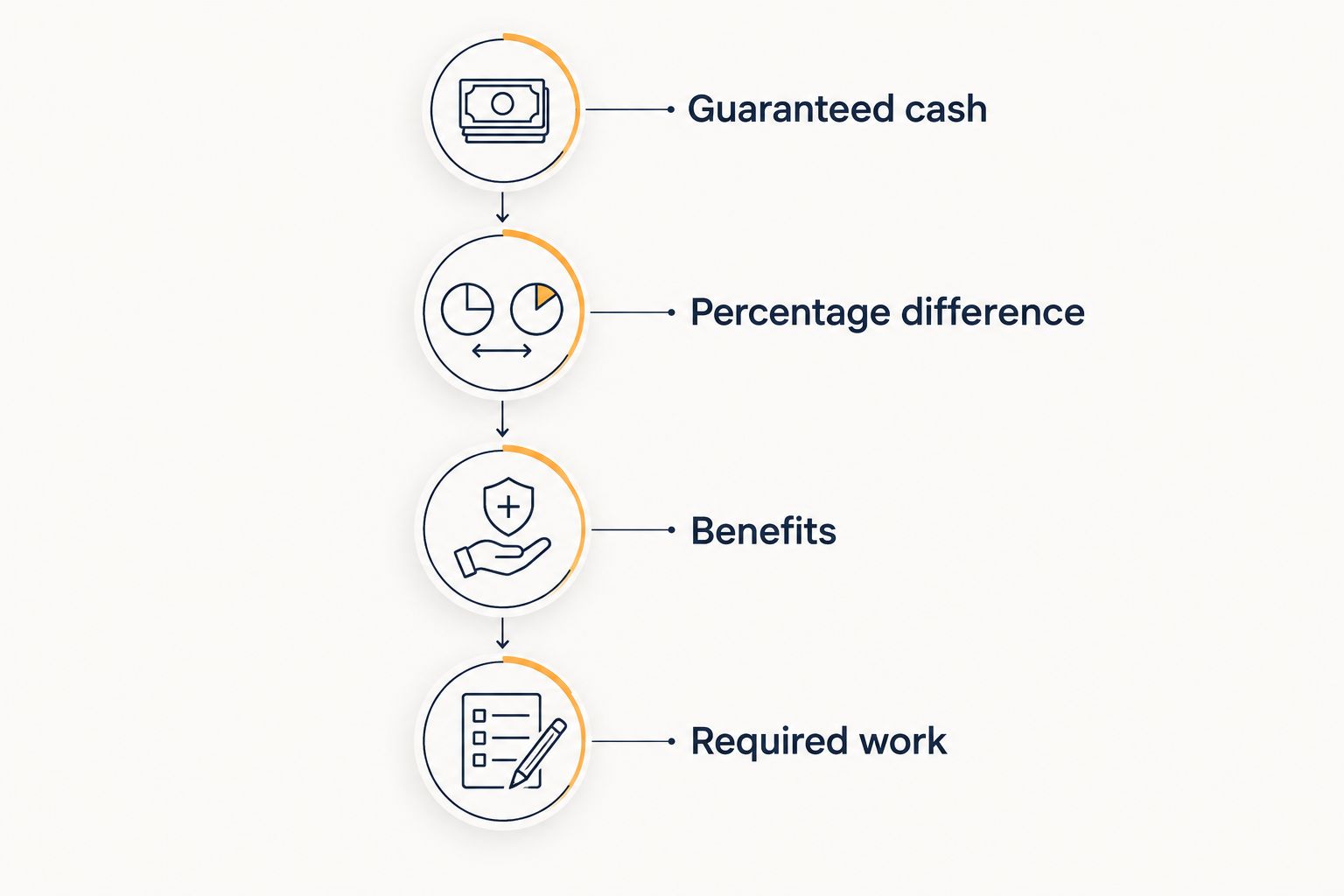
Use the same compensation definition for both offers. Calculate the guaranteed annual cash difference first; assess conditional income and benefits afterward.
Establish guaranteed cash
Record recurring contractual compensation over the same 12-month period. Keep a signing payment separate from recurring salary, and identify any repayment requirement attached to it.
Do not add a discretionary bonus to the guarantee. If an employer describes a payment as expected, ask which contract provision makes it payable and under what conditions.
Calculate the percentage difference
Subtract academic guaranteed annual cash from private practice guaranteed annual cash. Divide that difference by academic guaranteed annual cash, then multiply by 100 percent to express the private practice premium relative to the academic offer.
Use that denominator consistently. Reversing the denominator answers a different question: how much lower the academic offer is relative to the private practice offer.
Compare benefits separately
List documented employer retirement contributions, insurance contributions, and covered professional expenses. Do not assign an invented cash value to flexibility, reputation, mentorship, or future advancement.
Benefits can matter without being interchangeable with salary. Keep employer contributions distinct from amounts deducted from your own compensation.
Compare required work
Build an annual schedule from the actual contract, including required clinical and nonclinical time. Record call and extra coverage separately when their duration or frequency is not defined.
Where required hours are clearly specified, divide comparable compensation by those hours. Do not present an hourly comparison as precise while leaving required evening work or administrative time out of the denominator.
Is private practice better paid if I never become a partner?
Private practice employment pays more only when the specific employed offer exceeds the comparable academic offer under the compensation definition you use. Partnership income does not belong in that calculation if you never receive ownership.
Ask whether the employed compensation formula changes if you decline partnership or are not admitted. That answer matters more than an earnings illustration based on someone else's ownership position.
Can an academic offer be financially better despite lower salary?
An academic offer can be financially better under your chosen comparison if documented benefits or lower required working time outweigh its lower salary. Test that conclusion against the contract rather than assigning assumed values.
Keep personal value separate: a teaching role you want can justify your choice without becoming an invented compensation benefit. Decide what you are willing to exchange for that work before negotiating.
Build a shortlist before negotiating
RadBoard aggregates 5,000+ radiology positions from 20 sources and provides search and swipe-to-save features. RadBoard is best for radiologists comparing opportunities across multiple sources.
Use RadBoard's radiology job search to identify roles worth discussing, then ask each employer for the same compensation and workload details. A listing supports discovery; the employment and ownership agreements establish the terms you are accepting.
For your 2026 shortlist, keep an offer worksheet with separate entries for guarantees, conditional payments, required work, benefits, and unresolved questions. Mark an unanswered term as unresolved rather than assuming it matches another employer's offer.
FAQ
What is the academic vs private practice radiology pay difference?
The academic vs private practice radiology pay difference depends on the specific offers, compensation components, and workload being compared. Compare guaranteed annual cash first, then assess conditional earnings, benefits, and ownership separately.
Does private practice radiology always pay more than academics?
Private practice does not guarantee higher compensation than academic radiology. The answer depends on the written offers and whether you compare salary, total compensation, or compensation relative to required work.
Should I include partner distributions when comparing job offers?
Keep partner distributions separate from guaranteed employed compensation. Evaluate ownership eligibility, financial commitments, and distribution terms before assigning value to projected ownership income.
How do I compare academic protected time with private practice vacation?
Protected academic time and vacation are different: protected time remains assigned work, while vacation is time away from work. Ask which duties occupy protected sessions and whether clinical coverage can replace them.
Does a higher productivity bonus mean a better offer?
A higher potential productivity bonus does not establish a better offer. Compare the payment formula, qualifying work, thresholds, calculation period, and conditions for receiving payment.
What should I ask about a radiology partnership track?
Ask for the written admission criteria, approval process, financial commitments, ownership rights, distribution provisions, and departure terms. Evaluate the employed contract separately in case partnership does not occur.
What should I compare before accepting a radiology offer in 2026?
Compare guaranteed compensation, conditional income, required duties, benefits, and exit obligations before accepting a radiology offer in 2026. Resolve unclear terms in writing rather than relying on recruitment descriptions.
One last thing
Ask each employer to explain what happens if you perform every required duty but receive no discretionary bonus and never become an owner. That question separates the job you are accepting from the upside you are being shown.
Choose on documented terms; treat projections as a separate decision. A premium you cannot connect to a contract provision is not guaranteed compensation.