
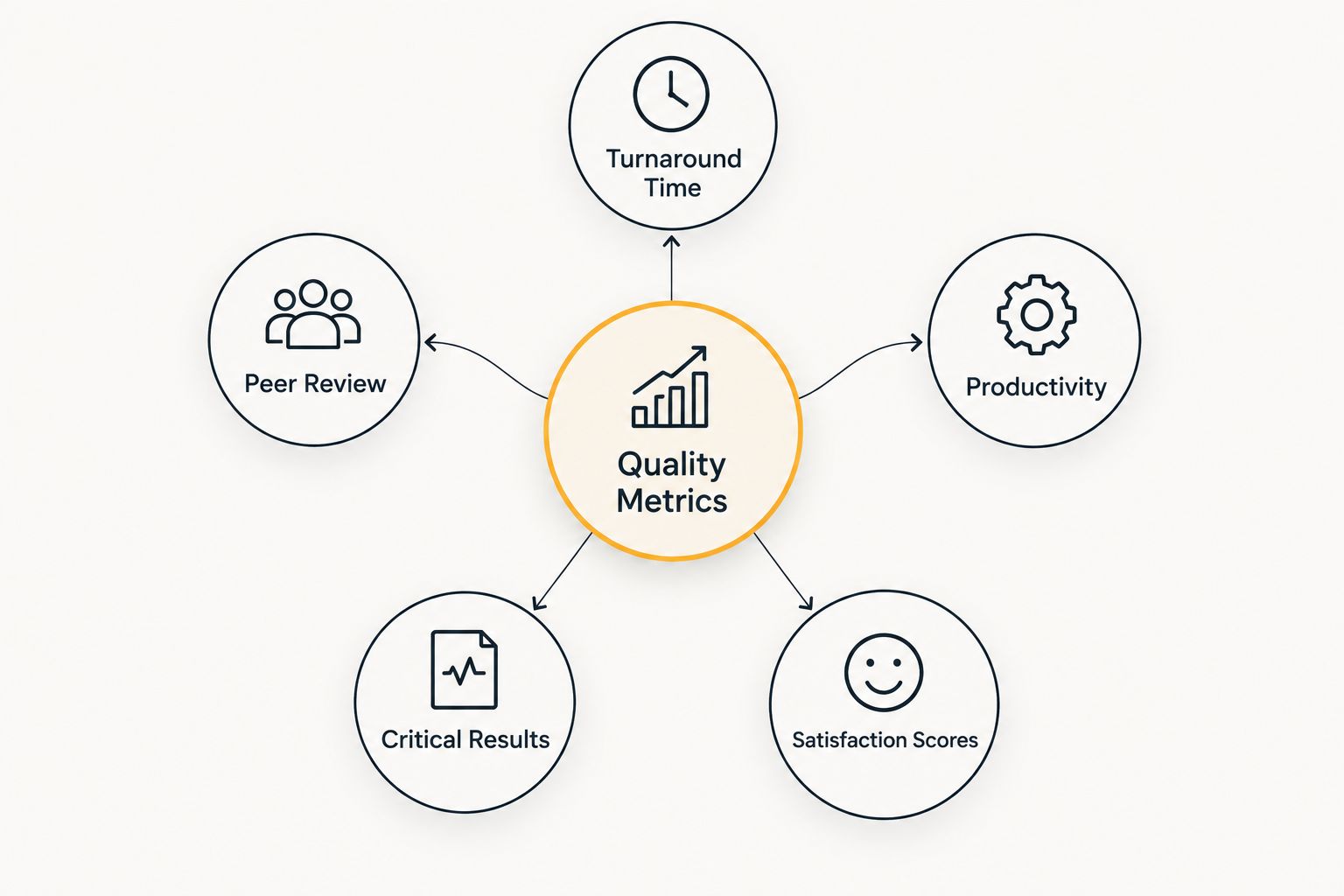
Radiology employers want proof, not adjectives — document turnaround time, RADPEER or equivalent peer-review scores, wRVU productivity, critical-results communication compliance, and satisfaction data from referring physicians, then translate each into a one-line CV bullet with a specific number and a comparison point. The hidden cost of skipping this: candidates who only list job titles and read volumes get filtered out before a recruiter ever asks about culture fit, because volume alone doesn't separate a strong reader from an average one.
- Document five metric categories: turnaround time, peer review score, wRVU productivity, critical-results compliance, and satisfaction data.
- Pull peer review numbers from your PACS quality module or RADPEER report before you resign, not after.
- RadBoard job listings increasingly name quality expectations directly in the posting for 2026 hires.
- A CV bullet needs a number and a comparator: '98% same-day STAT turnaround vs. department average' beats 'fast turnaround.'
- Teleradiology and hospital-employed groups weight these metrics differently — match the metric to the employer type.
Why this matters
A radiologist with 40,000 annual reads and no documented quality data looks identical on paper to one with 25,000 reads and a top-decile discrepancy rate. Employers evaluating radiology jobs in 2026 increasingly ask for quality data during interviews, especially at academic centers and ACR-accredited facilities where peer review is baked into credentialing. Bring the numbers first and you skip a round of follow-up questions that weaker applicants get stuck answering cold.
The RadBoard job platform surfaces postings that name quality or compliance expectations directly, which means candidates who show up with documentation already in hand move faster through screening.
How to document radiology quality metrics for job applications
The fastest way to build this is a single-page metrics sheet, separate from your CV, that you can hand to a recruiter or reference during an interview. Structure it as a table:
| Metric | What it shows | Where to pull it |
|---|---|---|
| Turnaround time (TAT) | Speed on STAT and routine reads | PACS/RIS dashboard, radiology admin |
| Peer review score (RADPEER or equivalent) | Diagnostic accuracy relative to peers | Quality assurance department log |
| wRVU productivity | Case volume adjusted for complexity | Billing/compensation reports |
| Critical results communication | Compliance with notification timelines | QA or compliance office |
| Referring physician satisfaction | Clinical relationship quality | Survey data if the practice runs one |
Request these numbers in writing from your current or most recent employer before you give notice — access to quality dashboards often ends the day you leave.
Turnaround time: document the split, not just the average
Don't report one blended TAT number. Break it into STAT versus routine, and modality if your group tracks it separately (CT versus MRI versus plain film). A hospital-employed job listing frequently asks about STAT turnaround specifically because it maps to ED throughput, so a single average buries the number that matters most to that employer.
Peer review score: use the system your employer actually runs
Most U.S. radiology groups run some version of RADPEER, the ACR's standardized peer review scoring system, or an internal equivalent. Pull your individual score trend over the most recent 12 months rather than a single snapshot — a stable or improving trend reads better than one strong quarter. If your group doesn't formally track this, note that explicitly rather than guessing at a number.
Productivity: pair wRVUs with case complexity, not just volume
A raw read count means little without context. Pairing wRVU totals with subspecialty mix (say, a body imaging-heavy caseload versus general diagnostic) gives an employer a faster read on whether your throughput will transfer to their case mix. Groups evaluating case log documentation for attending applications look for this pairing specifically, not volume alone.
Critical results communication: compliance rate over anecdote
Employers care whether you consistently notify referring physicians within your institution's required window for critical findings. Document your compliance rate if your QA system tracks it. If it doesn't, describe your process (direct call, documented in report, escalation path) instead of inventing a percentage you can't verify.
Satisfaction data: only if it exists
Not every practice surveys referring physicians. If yours does, a documented satisfaction score or a specific note from a department chief carries weight. If it doesn't exist, skip this category rather than fabricating a number — an unverifiable claim damages credibility faster than a missing data point.
Why the metrics you document vary by job type
- Practice setting — hospital-employed groups weight critical-results compliance and TAT heavily; academic centers weight peer review and teaching contributions.
- Subspecialty — a neuroradiologist's discrepancy benchmarks and case mix look different from a musculoskeletal radiologist's, so context matters more than the raw score.
- PACS/RIS reporting tools — some systems auto-generate quality dashboards; others require manual pulls from a QA office, which changes how fast you can assemble documentation.
- Peer review program maturity — a group running a formal RADPEER program for years gives you a longer trend line than a group that started tracking last year.
- Employer type — private equity-backed groups and hospital systems often ask for productivity data upfront; smaller independent groups may ask about peer relationships and satisfaction instead.
- ACR accreditation status — facilities holding ACR accreditation run more structured quality programs, which typically means more documented metrics are already available to you.
Find radiology jobs that value your metrics
Search 5,000+ radiology positions from 20 sources on RadBoard.
Where quality metrics belong on your CV
Quality data doesn't belong in your work history bullets — it belongs in a dedicated "Quality & Performance" section near your CV's close, right before references. This keeps your work history readable while giving reviewers a fast reference point. Anyone assembling a competitive radiology CV for a first attending job should treat this section as non-negotiable for 2026 applications, since more job postings now explicitly request quality data during screening.
If your current or past employer runs a documented peer-review or quality assurance program, note the program name and your tenure in it — specificity reads as more credible than a vague "strong peer feedback" line.
Related questions
What quality metrics should radiologists track for job applications in 2026?
Track turnaround time (split by STAT and routine), peer review score trend, wRVU productivity paired with case complexity, critical-results communication compliance, and referring physician satisfaction data if it exists. Skip any category your current employer doesn't formally measure rather than estimating a number.
Is turnaround time or peer review score more important to employers?
Turnaround time matters most for hospital-employed and ED-adjacent roles in 2026, while peer review score carries more weight at academic centers and ACR-accredited facilities with formal credentialing processes. Bring both when you can — most employers ask about at least one during a first-round interview.
How do I get discrepancy rate data from my current employer?
Request your individual RADPEER or equivalent peer-review report directly from your quality assurance department, ideally 12 months of trend data rather than one snapshot. Do this before you give notice, since dashboard access frequently ends on your last day.
Do teleradiology employers weight quality metrics differently than hospital employers?
Teleradiology groups typically weight turnaround time and case volume most heavily since throughput drives their staffing model, while critical-results communication protocols matter less directly since the on-site facility often owns that step. Hospital employers weight communication compliance and peer review more because both tie to institutional credentialing.
How many quality metrics should I include on a CV?
Four to five metrics is enough — turnaround time, peer review trend, productivity, and critical-results compliance covers what most 2026 employers ask about. Adding more than that dilutes the section and makes each number look less deliberate.
FAQ
What quality metrics should radiologists document for job applications?
Document turnaround time split by STAT and routine, peer review score trend (RADPEER or equivalent), wRVU productivity paired with case mix, critical-results communication compliance, and referring physician satisfaction data if your practice tracks it.
Is a RADPEER score required for radiology job applications?
No employer legally requires a RADPEER score, but academic centers and ACR-accredited facilities frequently ask for it during 2026 credentialing and interview screening. Bringing it unprompted signals you understand what the review process expects.
Where do I find my turnaround time data?
Your PACS or RIS dashboard typically logs turnaround time automatically, and your radiology administrator can export STAT versus routine splits on request. Pull this before you give notice at your current job.
How do I document quality metrics if my employer doesn't track them formally?
Note explicitly that formal tracking wasn't part of your prior role rather than inventing a number, and describe your process for critical-results notification or peer consultation instead. A described process still demonstrates quality awareness without a fabricated figure.
Should productivity metrics include RVUs or raw case counts?
Use wRVUs paired with subspecialty case mix rather than raw case counts, since raw volume without complexity context tells an employer little about your actual workload. This pairing is what most 2026 hiring managers ask about directly.
Do quality metrics matter more for locum or permanent radiology jobs?
Permanent roles weight quality metrics more heavily during initial screening since employers are evaluating long-term fit, while locum assignments tend to prioritize licensure, credentialing speed, and availability first. Quality data still helps locum candidates stand out for repeat assignments.
Can I use quality metrics from a fellowship instead of an attending role?
Yes, fellowship-level peer review feedback and case log data are acceptable for early-career applications, and most employers expect fellows to lack a long attending-level trend line. Frame the section as fellowship-based data explicitly so reviewers set the right expectations.
One last thing
The candidates who get fast callbacks in 2026 aren't the ones with the highest read volume — they're the ones who can answer a quality question with a specific number in under ten seconds. Build the metrics sheet once, update it every time you change jobs, and you'll never scramble to reconstruct a discrepancy rate from memory during a screening call.