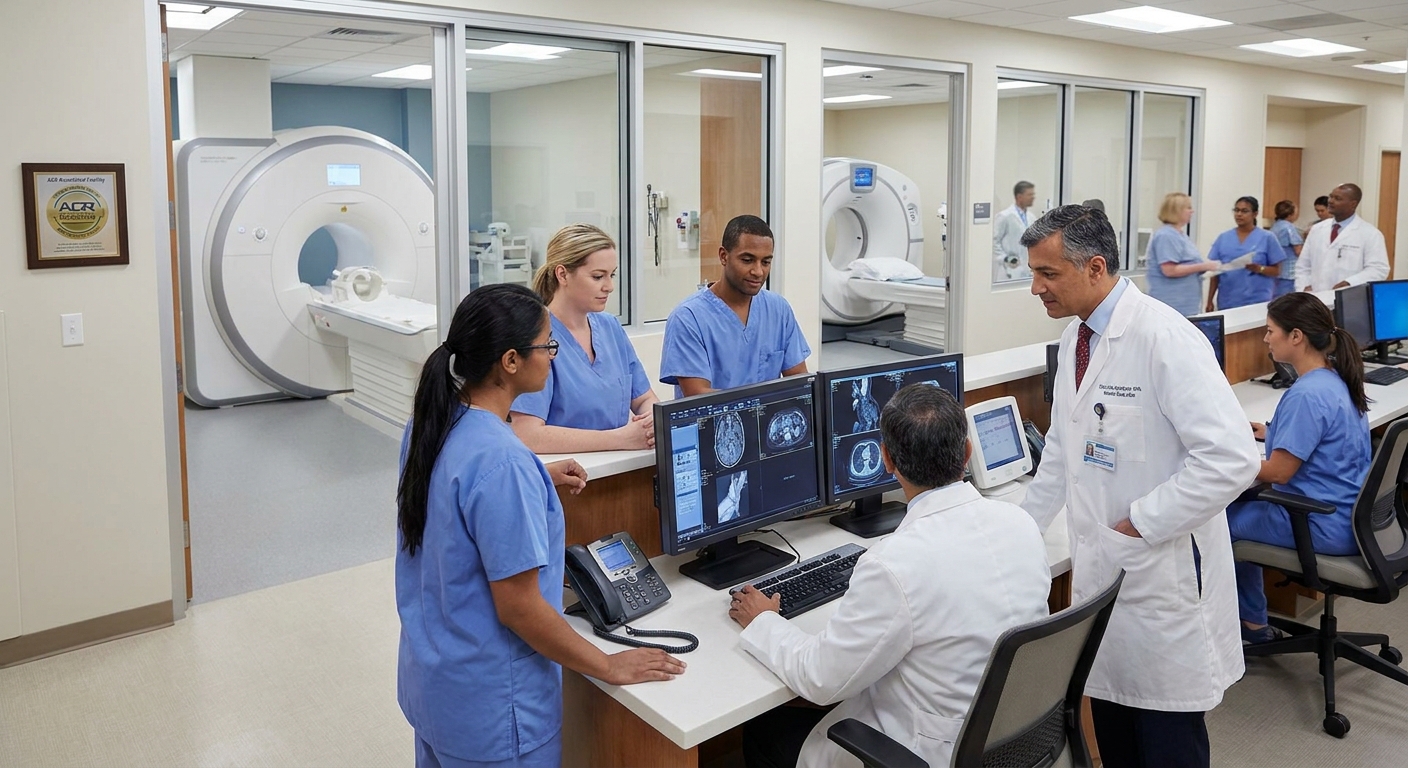
ACR-accredited imaging facilities employ the majority of hospital and outpatient radiologists in 2026, and the accreditation module list on a job posting tells you more about call burden, equipment, and peer-review workload than the salary line does.
- National imaging chains hold CT, MRI and breast Gold Seal accreditation across 50+ sites at once — Buy for subspecialty variety.
- Hospital-employed acr accredited radiology jobs typically carry 8-10 accredited modules under one Gold Seal in 2026 — Buy for stability.
- Academic medical centers run full-spectrum accreditation but trade salary for research access — Consider only for teaching tracks.
- Freestanding outpatient centers often hold mammography-only MQSA accreditation, not full ACR Gold Seal — Skip if you need multi-modality reads.
- Any facility citing 'state licensed' instead of ACR Gold Seal is not offering acr accredited radiology jobs — verify before signing.
Why this matters
Under the 2008 Medicare Improvements for Patients and Providers Act (MIPPA), any facility billing Medicare for CT, MRI, PET or nuclear medicine has to hold accreditation from a body like the ACR — no accreditation, no reimbursement for advanced imaging. That single rule is why "ACR-accredited" shows up on job postings at all: it's not a marketing line, it's the difference between a facility that can bill for the studies you'll read and one that can't.
Accreditation scope also predicts your actual workday. A site with full Gold Seal coverage across CT, MRI, ultrasound, nuclear medicine and mammography runs a heavier peer-review and QA load than a single-modality outpatient center — more physicist sign-offs, more case audits, more documentation. In 2026, that workload difference is the real variable behind two jobs with identical base salaries.
Who this is for
This guide is for board-certified and board-eligible radiologists comparing job postings that mention ACR accreditation without explaining what it covers — attendings weighing hospital, academic, and national-chain offers, and residents or fellows who want to confirm a site's accreditation scope before signing anything. If you're choosing between acr accredited radiology jobs at a 400-bed hospital and a freestanding outpatient center, the accreditation module list should factor into the decision as much as call schedule.
What to look for in ACR-accredited radiology jobs
Modality-specific accreditation scope
Ask which modules the facility actually holds — CT, MRI, breast imaging under MQSA, nuclear medicine, ultrasound — because "ACR-accredited" on a job posting can mean one module or eight. A site with CT and MRI accreditation but no breast accreditation won't route mammography reads to you regardless of your fellowship training.
Peer review and QA staffing
Gold Seal accreditation requires documented peer review and a staffed medical physicist for equipment QC. Facilities that understaff this function push more manual review work onto radiologists, which shows up as unpaid administrative time you won't see in the offer letter.
MIPPA compliance for Medicare billing
Confirm the facility's accreditation covers every modality it bills Medicare for. A lapse in CT or MRI accreditation means the facility can't collect Medicare reimbursement for those studies — and hiring freezes or sudden layoffs often trace back to exactly this.
Accreditation renewal timeline
Every ACR Gold Seal certification runs on a 3-year renewal cycle. Ask for the current certificate date. A facility mid-renewal in 2026 with a lapsed certificate is a red flag worth raising in the interview, not after you've signed.
Subspecialty case volume tied to accreditation
Some accreditation modules set minimum case-volume thresholds to maintain certification. That translates directly into your read volume for that subspecialty — high-volume mammography accreditation means more breast imaging shifts, not fewer.
Search ACR-accredited radiology openings
Filter 5,000+ radiology jobs from 20 sources by facility type and modality.
Top picks by facility type
National imaging center chains — the volume play. Chains often hold CT, MRI and breast Gold Seal accreditation across 50+ sites under a single corporate accreditation program, meaning you get subspecialty variety without changing employers. Case mix skews toward outpatient volume rather than trauma. Verdict: Buy for radiologists who want modality breadth. See national imaging center chains for how these roles structure call and RVU targets in 2026.
Hospital-employed positions — the stability pick. Hospitals typically carry 8-10 accredited modules under one Gold Seal — CT, MRI, mammography, nuclear medicine, ultrasound and interventional coverage in most 300+ bed systems. That breadth means heavier peer-review documentation but the widest case exposure of any employer type. Verdict: Buy for radiologists prioritizing job security over flexibility. Details on structure and benefits are in hospital-employed radiology jobs.
Academic medical centers — the teaching pick. Full-spectrum ACR accreditation plus research imaging protocols, often with reduced clinical RVU expectations in exchange for lower base pay than private practice or chains. Peer review here doubles as teaching material for residents. Verdict: Consider only if research or resident supervision is part of your career plan — check academic radiology jobs before comparing offers.
VA hospitals — the federal pick. VA facilities follow ACR-equivalent imaging standards alongside Joint Commission requirements, on the same roughly 3-year cycle, with federal benefits and loan repayment options not tied to accreditation scope at all. Call burden is lower than most hospital systems, but scheduling runs through federal HR timelines. Verdict: Consider for radiologists prioritizing benefits stability over compensation ceiling.
Freestanding outpatient centers — the no-call pick. Most standalone imaging centers hold MQSA mammography accreditation and maybe CT, but rarely the full multi-modality Gold Seal a hospital carries. That's fine if you want a mammography-heavy, no-call schedule; it's a problem if the posting implies broader subspecialty exposure than the accreditation supports. Verdict: Skip if you need multi-modality variety, Consider if mammography or general outpatient reads are your target.
What to avoid
- "State licensed" marketed as accreditation. State licensing is a legal requirement to operate, not the same standard as ACR Gold Seal — a facility can be state licensed with zero ACR accreditation.
- Facilities mid-renewal with no certificate date. If HR can't produce a current accreditation date within the 3-year cycle, treat that as an open question, not a formality.
- Single-module accreditation sold as full coverage. A posting that says "ACR-accredited" but only covers mammography under MQSA isn't offering the multi-modality volume the job title implies.
Verdict comparison
| Facility type | Accreditation scope | Call burden | Verdict |
|---|---|---|---|
| National imaging chains | CT, MRI, breast across 50+ sites | Moderate | Buy |
| Hospital-employed | 8-10 modules, full Gold Seal | High | Buy |
| Academic medical centers | Full-spectrum + research protocols | Moderate-high | Consider |
| VA hospitals | ACR-equivalent + Joint Commission | Low | Consider |
| Freestanding outpatient | Often mammography-only (MQSA) | Low | Skip for multi-modality seekers |
FAQ
What does ACR accredited mean for a radiology job?
It means the facility has passed American College of Radiology review for specific imaging modalities like CT, MRI, or mammography, on a 3-year renewal cycle. The accreditation determines both Medicare billing eligibility and your actual case mix.
Is ACR accreditation required for radiologist employment in 2026?
It's not legally required to hire a radiologist, but it is required for a facility to bill Medicare for advanced imaging like CT, MRI, PET, and nuclear medicine under the 2008 MIPPA law. Most employers pursue it for reimbursement reasons.
How long does ACR accreditation last?
ACR Gold Seal accreditation runs on a 3-year cycle before facilities must undergo renewal review. Ask for the current certificate date during your interview, especially at smaller outpatient centers.
What's the difference between ACR Gold Seal and MQSA accreditation?
MQSA is a federal law requiring mammography-specific accreditation for any facility performing breast imaging. ACR Gold Seal covers a broader set of modalities including CT, MRI, ultrasound, and nuclear medicine, and MQSA compliance is often bundled into it.
Does ACR accreditation affect radiologist salary?
Indirectly, yes — facilities with broader accreditation scope tend to have higher case volume and RVU opportunity, which affects RVU-based compensation. Accreditation itself doesn't set salary, but it shapes the read volume behind it.
How do I verify a facility's ACR accreditation before accepting a job?
Ask HR or the medical director for the current accreditation certificate and its expiration date within the 3-year cycle. You can also ask which specific modules are covered rather than accepting a general 'we're accredited' answer.
Do teleradiology jobs need to read for ACR accredited sites?
Yes, if the studies are billed to Medicare for CT, MRI, PET or nuclear medicine, the originating site still needs MIPPA-compliant accreditation regardless of where the radiologist reads from.
What happens if a facility loses ACR accreditation?
It loses Medicare reimbursement eligibility for the affected modality immediately under MIPPA rules. That's frequently the real reason a facility suddenly posts multiple radiologist openings after a renovation or ownership change.
One last thing
The accreditation lapse itself is often the hidden hiring trigger in 2026 postings: a facility that loses Medicare billing eligibility for CT or MRI under MIPPA has to fix it fast, and fixing it fast sometimes means hiring radiologists to help clear the backlog created during the gap. If a job posting mentions a "recent renovation" or "new equipment" alongside urgent hiring language, ask directly whether that ties to an accreditation renewal — it usually does.