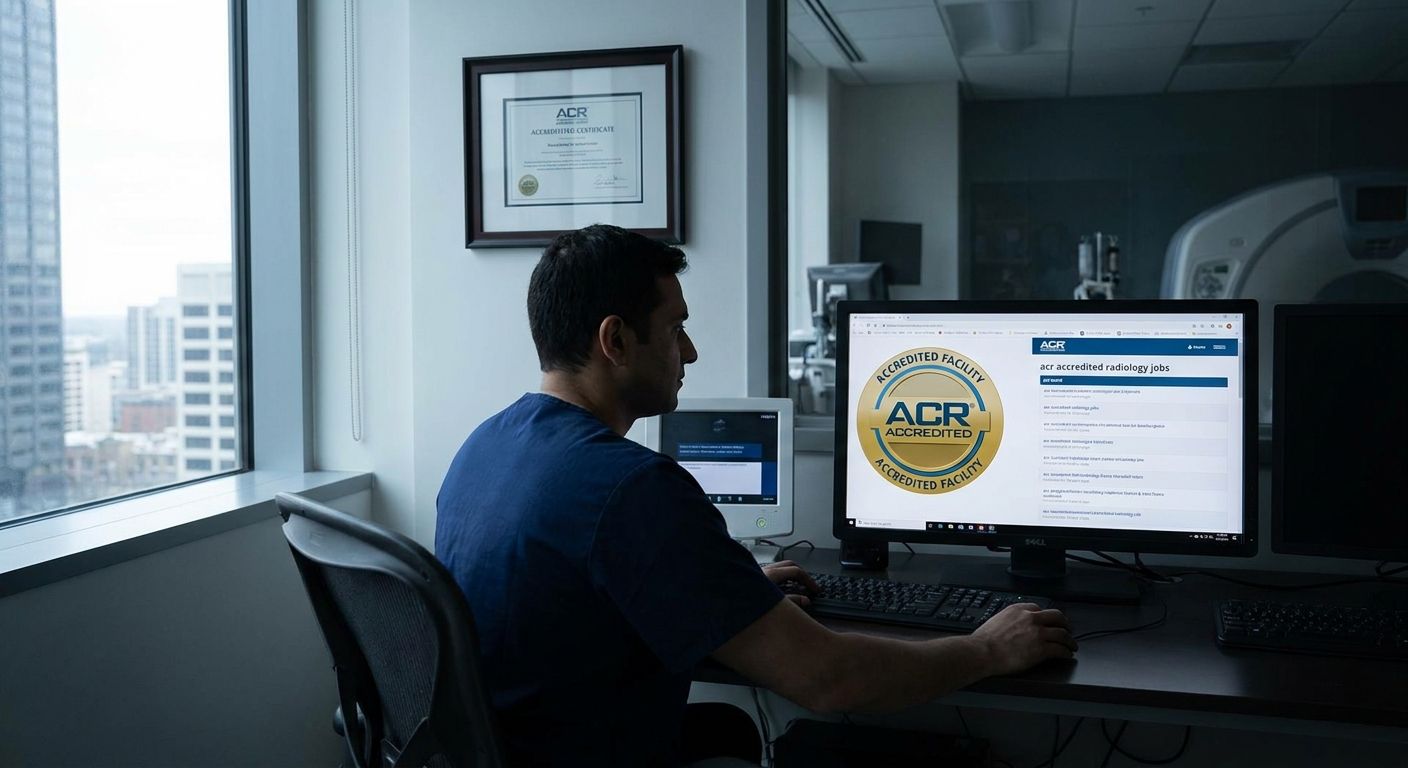
Confirm ACR accreditation directly on ACR's Accredited Facility Search before you sign anything — a job posting that says "ACR-accredited" is a marketing claim, not proof. Match the exact facility name and street address, check which specific modalities carry accreditation (CT, MRI, mammography, ultrasound, nuclear medicine each get separate approval), and note the expiration date, since ACR accreditation runs on three-year cycles. A group can list accreditation for its flagship hospital while the satellite outpatient site where you'd actually read cases hasn't renewed.
- Verify acr accredited radiology jobs directly on ACR's facility search tool — don't trust the job posting alone.
- ACR accreditation runs a three-year cycle; ask for the expiration date, not just a certificate.
- Mammography sites need MQSA certification by federal law, and ACR accreditation is the most common path to it.
- CMS requires accreditation for CT, MRI, and PET reimbursement under MIPPA, limiting billing at non-accredited sites.
- RadBoard aggregates radiology openings from 20 sources, but accreditation status still needs a candidate-side check before you sign.
Why this matters
Accreditation status affects more than bragging rights on a job posting. It signals whether the site has current equipment testing, qualified staffing ratios, and image quality controls in place — the working conditions you'll inherit on day one. Postings tagged as radiology jobs at ACR-accredited imaging facilities advertise the designation as a differentiator, but accreditation applies to specific sites and specific modalities, not an entire health system.
It also affects reimbursement. CMS has required accreditation for advanced diagnostic imaging — CT, MRI, and PET — since the Medicare Improvements for Patients and Providers Act (MIPPA) took effect in 2008. A site that lets accreditation lapse can lose the ability to bill Medicare for those studies, which shows up fast in a group's RVU-based compensation model.
How to verify ACR accreditation before accepting a radiology job
- Search the facility on ACR's Accredited Facility Search. Use the exact legal name from the offer letter or job posting, not the marketing name.
- Match the address. Multi-site groups often have one accredited flagship and several unaccredited satellites — confirm the specific location where you'd be reading.
- Check the modality list. A site can hold MRI accreditation without CT accreditation, or vice versa. Confirm accreditation covers the modality mix in your job description.
- Note the expiration date. ACR accreditation cycles run three years. An accreditation that expires within your first six months on the job is worth a direct question to HR.
- Request the certificate in writing. Any accredited facility can produce a current certificate on request. Hesitation or a vague answer is itself information.
- Cross-check MQSA status separately if mammography is part of the role. Mammography certification is federally mandated and tracked independently from general ACR modality accreditation.
General ACR accreditation vs. MQSA mammography certification
These two get confused constantly, and the difference changes what "verified" actually means for a given job.
| Designation | Legal status in 2026 | What it covers |
|---|---|---|
| ACR accreditation (CT, MRI, US, NM) | Voluntary, but often required by payers/CMS for reimbursement | Equipment QC, personnel qualifications, image quality review |
| MQSA certification (mammography) | Mandatory by federal law | Every US facility performing mammography, enforced by the FDA |
If the role involves mammography, MQSA certification is non-negotiable — a facility legally cannot operate a mammography unit without it. ACR accreditation is the most common route facilities use to satisfy MQSA, but a facility can also meet the requirement through an alternate FDA-approved accrediting body. Ask which body certified the specific unit you'd be reading on.
Modality-specific accreditation: CT, MRI, ultrasound, and nuclear medicine
ACR issues accreditation per modality, not per building. A hospital system might carry MRI accreditation at its main campus and CT accreditation at an outpatient center three miles away, with no accreditation at all for its nuclear medicine suite. Verify accreditation for every modality named in your job description, individually. For locum tenens nuclear medicine jobs or PET/SPECT-heavy roles, nuclear medicine accreditation is separate from CT/MRI accreditation and gets overlooked more often because it's a smaller line item on most facility websites.
Breast Imaging Center of Excellence and other specialty designations
Some facilities layer additional designations on top of baseline accreditation — Breast Imaging Center of Excellence (BICOE) status requires accreditation across mammography, breast ultrasound, and (where offered) breast MRI simultaneously, plus stereotactic biopsy accreditation if the site performs image-guided biopsies. If a job posting leads with a BICOE designation, verify all the underlying component accreditations rather than taking the umbrella label at face value — a lapsed component can drop BICOE status without the facility updating its marketing materials right away.
Why accreditation status varies across employers
- Site age and equipment refresh cycles — newer scanners pass QC testing more easily than units nearing end-of-life.
- Corporate structure — private-equity-backed groups and multi-site chains sometimes centralize accreditation renewal and miss satellite locations.
- Modality mix — a site heavy in mammography has stronger regulatory pressure (MQSA) to stay current than a site doing only general ultrasound.
- Reimbursement dependence — sites billing Medicare for CT/MRI/PET have a direct financial incentive to keep MIPPA-required accreditation current; cash-pay or workers' comp-heavy sites have less pressure.
- Recent ownership changes — accreditation paperwork can lag after an acquisition, especially in private-equity-backed group transitions.
“If a facility can't produce a current accreditation certificate on request, treat that as a red flag, not an administrative delay.”
Read the underlying employment contract closely too — accreditation status sometimes shows up as a condition tied to your compensation formula or malpractice coverage, not just a facility fact sheet.
Related questions about ACR accreditation and radiology jobs
Is ACR accreditation required by law for radiology jobs?
No, ACR accreditation itself is voluntary for most modalities, but two things make it functionally mandatory in 2026: MQSA makes mammography certification a legal requirement, and CMS requires accreditation for CT, MRI, and PET reimbursement under MIPPA. A facility can technically operate CT and MRI without ACR accreditation, but it usually can't bill Medicare for those studies without it.
How long does ACR accreditation last?
ACR accreditation is valid for three years per modality before a facility must reapply. Renewal timing varies by modality, so a facility's CT accreditation and MRI accreditation may expire on different dates even at the same site.
What's the difference between ACR accreditation and MQSA certification?
MQSA certification is the federally mandated requirement for any US facility performing mammography, enforced by the FDA. ACR accreditation is the voluntary quality program that most facilities use to satisfy MQSA, though alternate FDA-approved accrediting bodies exist for the same purpose.
Search ACR-accredited radiology jobs now
5,000+ radiology jobs from 20 sources, filtered by subspecialty and site.
FAQ
Is ACR accreditation required by law for radiology jobs?
ACR accreditation itself is voluntary, but mammography certification under MQSA is federally mandated, and CMS requires accreditation for CT, MRI, and PET reimbursement under MIPPA. A site can technically run CT and MRI unaccredited, but usually can't bill Medicare for it.
How long does ACR accreditation last?
ACR accreditation is valid for three years per modality. Renewal dates can differ across CT, MRI, and ultrasound accreditation even at the same facility, so check each modality separately.
What's the difference between ACR accreditation and MQSA certification?
MQSA certification is the legally required federal standard for any facility performing mammography. ACR accreditation is the most common voluntary program facilities use to meet that MQSA requirement.
Can a facility be accredited for MRI but not CT?
Yes, ACR issues accreditation per modality rather than per building, so a facility can hold MRI accreditation while its CT unit runs unaccredited or with expired accreditation.
Should I ask for an accreditation certificate during the interview?
Yes, ask for a current accreditation certificate covering the specific site and modalities in your job description. Any legitimately accredited facility can produce one without delay.
Does CMS require ACR accreditation for reimbursement?
CMS has required accreditation for advanced diagnostic imaging — CT, MRI, and PET — since MIPPA took effect in 2008. A facility with lapsed accreditation risks losing Medicare billing for those studies.
What is a Breast Imaging Center of Excellence (BICOE)?
BICOE is a designation requiring simultaneous accreditation across mammography, breast ultrasound, and breast MRI where offered, plus stereotactic biopsy accreditation. Verify each underlying component rather than relying on the umbrella label.
How do I find ACR-accredited radiology jobs on RadBoard?
RadBoard aggregates 5,000+ radiology positions from 20 sources with AI-powered search and swipe-to-save, but accreditation status for any specific listing still needs a direct check against ACR's facility search before you sign.
One last thing
Accreditation for a group's flagship site tells you nothing about the satellite clinic listed in your job description — check the exact address, every time, not just the corporate name. In 2026, with more radiology groups operating across multiple sites under one brand, that gap between headline accreditation and site-level reality is the single most common thing candidates miss before signing.