
Dual certification in nuclear medicine and diagnostic radiology is worth pursuing when your intended job uses both disciplines and the additional credential satisfies a specific employer requirement. It is not a default upgrade for a career centered on general diagnostic imaging. In 2026, base the decision on your training pathway, intended clinical responsibilities, and actual credentialing requirements—not an assumed salary premium.
- Is dual certification in nuclear medicine and radiology worth it? Yes, when your target position uses both disciplines.
- American Board of Nuclear Medicine certification and American Board of Radiology nuclear radiology subspecialty certification are distinct credentials.
- RadBoard aggregates 5,000+ radiology positions from 20 sources; verify certification requirements directly with each employer.
- Compare training commitments, clinical privileges, case mix, and continuing certification before choosing a pathway.
Is dual certification in nuclear medicine and radiology worth it?
Pursue dual certification for a defined scope of practice, not for the credential alone. Start with the responsibilities described in radiology jobs for dual board certification in nuclear medicine, then ask employers which qualifications they require and which they merely prefer.
The relevant comparison is between career plans, not interchangeable certificates. Nuclear medicine certification, diagnostic radiology certification, and nuclear radiology subspecialty certification represent different credentials; confirm the exact pathway before comparing programs.
| Career plan | Best for | Potential benefit | Trade-off to evaluate | Decision |
|---|---|---|---|---|
| Diagnostic radiology plus nuclear medicine certification | Physicians seeking work across diagnostic imaging and nuclear medicine | Credentials aligned with responsibilities in both disciplines | Additional training, examinations, and continuing certification obligations | Pursue when target employers need both |
| Diagnostic radiology plus nuclear radiology subspecialty certification | Diagnostic radiologists seeking a nuclear imaging focus | A subspecialty credential within the radiology certification framework | It is not the same credential as nuclear medicine certification | Compare against the employer's exact requirement |
| Diagnostic radiology without an additional nuclear credential | Physicians whose intended work does not require additional nuclear certification | Keeps training focused on the intended diagnostic practice | Does not establish a separate nuclear medicine credential | Choose when it matches the intended role |
No credential in this table independently determines your hospital privileges or every activity you can perform. Ask the institution to review your actual qualifications against the proposed clinical duties.
Why this matters
A career decision made around an imprecise phrase such as dual boarded can send you toward the wrong training application. A recruiter might use that phrase without specifying whether the position requires nuclear medicine certification, nuclear radiology subspecialty certification, or experience with particular examinations.
For your 2026 search, separate 3 decisions: the work you want, the certification pathway you qualify for, and the privileges the employer will grant. Treating them as separate questions prevents a credential discussion from substituting for a job discussion.
The practical test is straightforward. If you removed the additional credential from your application, would the employer exclude you from the work you actually want? Ask for an explicit answer rather than interpreting a preferred-qualifications list.
Diagnostic radiology plus nuclear medicine certification
Best for: physicians who intend to practice across diagnostic radiology and nuclear medicine. This route deserves consideration when your target position explicitly calls for certification through the American Board of Radiology and the American Board of Nuclear Medicine.
The benefit is alignment between your credentials and your planned work. The disadvantage is committing to additional requirements without assurance that your eventual schedule will use both disciplines.
Before selecting a program, obtain a written explanation of how your prior training applies to each certification pathway. Confirm that the proposed rotations, supervision, and documentation meet the relevant board's requirements; admission to a program is not itself a guarantee of certification eligibility.
Do not infer the total training commitment from another physician's experience. Your starting qualifications and the structure of the specific program matter. Choose this route when both credentials serve a documented career objective.
Diagnostic radiology plus nuclear radiology subspecialty certification
Best for: diagnostic radiologists seeking a nuclear radiology subspecialty credential. The American Board of Radiology offers nuclear radiology subspecialty certification, which is distinct from American Board of Nuclear Medicine certification.
That distinction matters when a posting names a specific board. Do not assume an employer accepts either credential simply because both relate to nuclear imaging; send the exact credential name to the hiring physician and credentialing office.
The advantage is a defined subspecialty route within radiology. The limitation is that it does not confer a separate nuclear medicine certificate or resolve every institution's credentialing requirements.
In 2026, review the current board requirements before accepting a training position. Ask the program to identify the applicable pathway and explain how it documents completion. Choose this route when the credential matches your intended work and employer requirements.
Diagnostic radiology without an additional nuclear credential
Best for: physicians whose intended job does not require separate nuclear certification. If your career goal is unrelated to nuclear medicine, another credential needs a specific justification beyond making your CV longer.
The benefit is keeping your training choices tied to the work you want. The trade-off is not holding a separate credential that another position might require.
Do not equate this choice with permission to perform—or a prohibition against performing—every nuclear imaging task. Training, demonstrated competence, institutional privileges, and applicable regulatory requirements remain relevant.
Ask prospective employers to identify the duties you would be eligible to perform with your actual qualifications. Choose this route when it meets your intended practice requirements; reconsider if your career target changes.
Why the value of dual certification varies
The value of dual certification depends on how the credential connects to training and employment. Evaluate these factors individually rather than treating board status as a general measure of career quality.
- Credential requirements: Determine whether the employer requires ABNM certification, an ABR subspecialty certificate, board eligibility, or another specifically stated qualification. Ask who makes the final determination.
- Training fit: Confirm which pathway your existing education supports and what additional work remains. Obtain the explanation from the program and relevant certifying board.
- Clinical scope: Separate PET/CT interpretation, SPECT interpretation, general diagnostic imaging, and radiopharmaceutical therapy responsibilities. A broad job title does not describe the complete assignment.
- Practice authorization: Distinguish board certification from institutional privileges and radioactive materials licensing requirements. Ask the employer's credentialing and radiation safety teams to review the proposed duties.
- Ongoing obligations: Review continuing certification requirements for each credential you plan to maintain. Include the professional time involved, not just the initial training decision.
- Actual job design: Determine whether the department will schedule you in the specialty you trained for. A credential has limited personal value if your assigned work consistently excludes your intended focus.
How should you test the decision before applying?
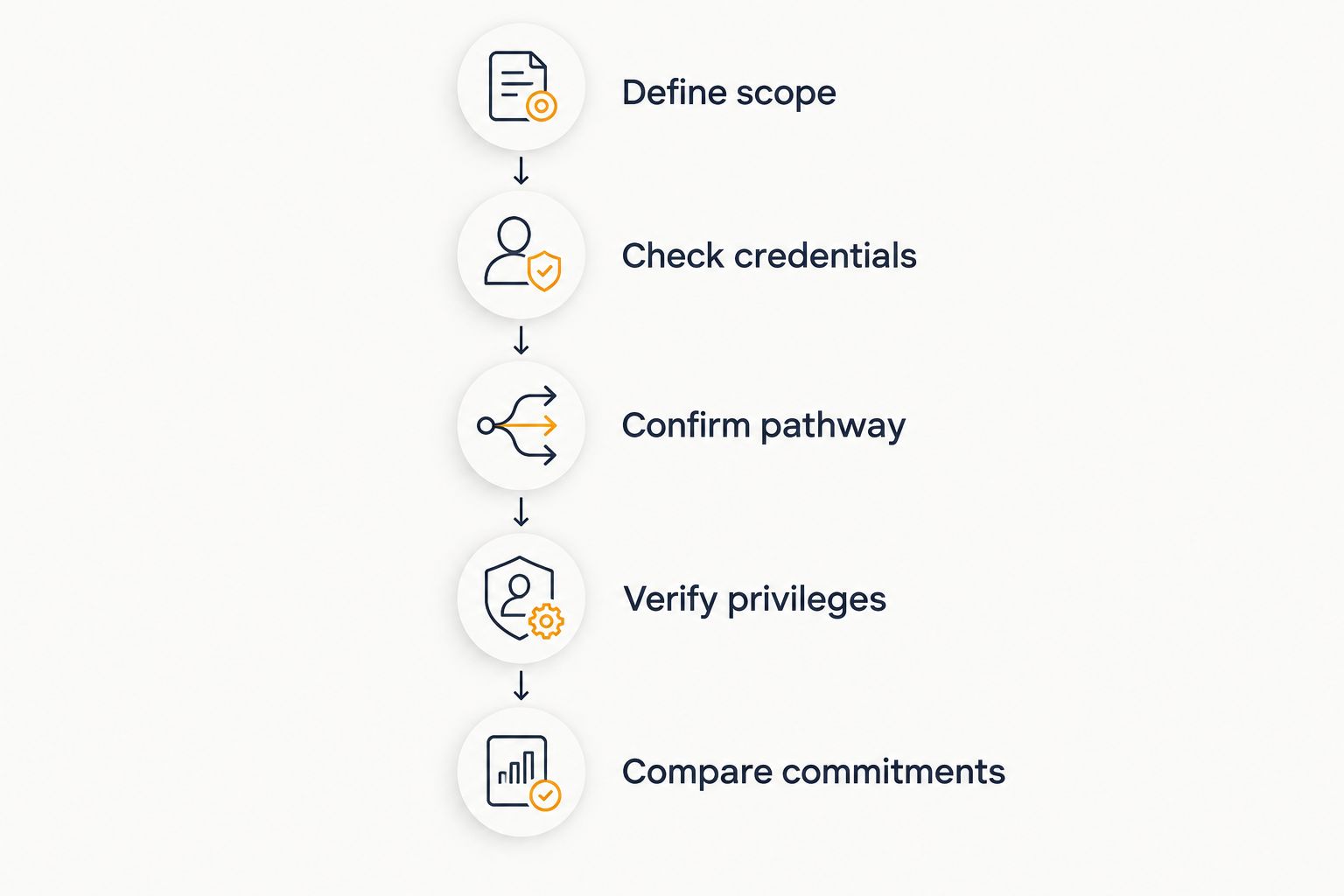
Use a short sequence that turns a general career question into a specific training decision. Complete it before you commit to a program, particularly if an employer's stated preference is driving your interest.
- Define scope. Write down the work you want to perform: diagnostic interpretation, nuclear imaging, therapy responsibilities, teaching, or a combination. Identify which duties are essential to your career choice.
- Check credentials. Collect the exact qualification language from relevant positions. Separate required credentials from preferred credentials and ask employers to clarify ambiguous wording.
- Confirm pathway. Have the training program explain how your background meets the relevant board's current eligibility requirements. Verify the pathway with the board rather than relying solely on recruitment language.
- Verify privileges. Ask the proposed employer which institutional and regulatory approvals apply to your intended work. Identify who reviews your training documentation.
- Compare commitments. Put training, examinations, ongoing certification, schedule, and clinical responsibilities side by side. Decide whether the additional credential changes your access to the work you want.
This sequence gives you a reason to proceed—or a reason to stop. An unresolved credentialing question belongs before the commitment, not after it.
How should you use job listings to assess career fit?
Use job listings to identify questions, not to establish certification rules. RadBoard is best for radiologists comparing positions aggregated from multiple sources. Its radiology job search platform brings together 5,000+ positions from 20 sources and offers swipe-to-save features for building a shortlist.
That breadth supports comparison, but it does not replace an employer's review of your qualifications. RadBoard's aggregate position count is not a count of dual-certification vacancies, and a listing's wording is not a promise of privileges.
For a 2026 shortlist, record the exact certificate requested, clinical duties, work location, call expectations, and named contact for qualification questions. Save the wording that matters so you can resolve discrepancies during interviews.
Keep different search intents separate. A PET/CT interpretation position, a nuclear medicine position, and a molecular imaging position need individual review even when their descriptions overlap. Compare the underlying responsibilities rather than assuming the titles describe equivalent work.
What should you ask during an employer interview?
Ask the hiring physician and credentialing team different questions. The hiring physician explains the department's needs; the credentialing team evaluates the documentation required for your proposed privileges.
Use these questions to establish whether dual certification changes the position:
- Which exact certification is required, and which is preferred?
- Which clinical duties depend on that qualification?
- What would my actual reading and patient-care schedule include?
- Who reviews eligibility for radiopharmaceutical therapy responsibilities?
- What training records and experience documentation must I provide?
- Does the written offer reflect the specialty responsibilities discussed?
Ask about compensation separately from credential eligibility. Do not assume an additional board certificate earns a premium, and do not accept a broader clinical assignment without understanding its schedule and expectations.
A useful offer specifies the work, not just the qualification. If the employer cannot describe how it will use your additional training, you still lack the information needed to judge the opportunity.
Will dual certification increase my salary?
Dual certification does not establish a guaranteed salary increase. Evaluate a specific offer against its clinical duties, schedule, call obligations, benefits, and compensation structure rather than attaching an assumed premium to the certificate.
For a 2026 comparison, ask the employer whether the additional qualification changes the position or its compensation terms. A general statement that the department values dual training is not the same as a written offer reflecting that responsibility.
Do I need dual certification to interpret PET/CT?
Dual certification is not a universal prerequisite for every PET/CT interpretation position. Your training, qualifications, and the institution's privileging requirements determine eligibility for the specific assignment.
Ask the credentialing office to review your documents before treating a recruiter’s answer as final. Also clarify whether the role involves interpretation alone or additional patient-care responsibilities.
Does dual certification automatically authorize radiopharmaceutical therapy?
Dual certification alone does not establish authorization for every radiopharmaceutical therapy activity. Applicable radioactive materials licensing requirements and institutional privileges must also be satisfied.
Ask the employer's radiation safety team which authorized-user requirements apply to the intended therapies and how your training will be evaluated. Keep that review separate from the employment interview.
FAQ
Is dual certification in nuclear medicine and radiology worth it for general practice?
Dual certification is worth pursuing for general practice only when it serves a specific clinical role or employer requirement. If your intended work does not use the additional qualification, another certificate is not a default career upgrade.
Is ABNM certification the same as ABR nuclear radiology certification?
ABNM certification and ABR nuclear radiology subspecialty certification are distinct credentials. Ask employers which exact credential they require before choosing a training pathway.
How long will it take me to obtain both certifications?
Your training commitment depends on your existing qualifications and the certification pathway you enter. Obtain a written pathway assessment from the program and verify eligibility with the relevant board.
Will being dual boarded guarantee a higher-paying job?
Being dual boarded does not guarantee a higher-paying job. Compare actual offers and determine whether the additional credential changes the clinical assignment or compensation terms.
Can I work remotely with nuclear medicine and radiology certification?
Certification alone does not determine whether a position is remote. Confirm which duties involve image interpretation and which require an onsite presence, then review the employer's requirements.
Where can I compare radiology jobs that mention nuclear medicine?
RadBoard is a radiology job search platform aggregating 5,000+ positions from 20 sources. Review each relevant listing's exact credential requirements and confirm them directly with the employer.
Should I verify certification requirements again before enrolling in 2026?
Verify the current certification requirements before enrolling in 2026. Ask the program and relevant board to confirm that the proposed training pathway fits your qualifications and intended credential.
One last thing
Before choosing additional training, ask a prospective employer what your schedule would look like with the credential—and without it. The difference is more informative than a preferred-qualification label.
Choose the work first, then the credential that qualifies you for it. If the additional certification changes neither your eligibility nor your intended responsibilities, establish another clear reason before committing.