
Nighthawk radiology is worth the pay premium when the extra compensation survives an hours-and-benefits comparison and the overnight schedule fits your sleep and home life. The headline premium does not account for recovery time, unpaid administrative work, or benefits you must replace. For a 2026 offer, decide on the written workload and schedule—not the advertised annual income alone.
- Is nighthawk radiology worth it? Yes when the compensation, overnight workload, and recovery schedule fit your circumstances.
- Compare guaranteed compensation per required hour before counting productivity bonuses.
- Get backup coverage, shift boundaries, and productivity expectations in writing.
- RadBoard supports radiology job search across 5,000+ positions from 20 sources; confirm individual offer terms directly.
Why this matters
An overnight position changes more than your working hours. Your sleep window, family availability, clinical support, and recovery days all belong in the decision. A block of days off is not equivalent to a block of usable personal time if you spend its beginning recovering from nights.
Start with the actual duties behind nighthawk radiology jobs for physicians who prefer overnight shifts. Treat “nighthawk” here as overnight radiology coverage, not a recommendation of a particular employer.
Is nighthawk radiology worth the pay premium?
Accept the premium only after comparing equivalent work commitments. A higher annual offer does not establish a better deal if it requires more hours, additional weekends, broader coverage, or greater compensation risk.
For your 2026 search, compare overnight work against a realistic alternative you would actually accept. A daytime position in another location or with different employment status is not a clean benchmark until you account for those differences.
| Schedule option | Best for | Main advantage | Main trade-off | What to verify |
|---|---|---|---|---|
| Dedicated overnight coverage | Radiologists who prefer nights and can protect daytime sleep | A defined overnight role when the contract fixes the schedule | Daytime sleep and separation from household routines | Shift boundaries, workload, backup, and recovery blocks |
| Swing-shift coverage | Radiologists who prefer evening work over full overnight coverage | An alternative to working through the entire night | Evening work conflicts with family and social time | Exact end time and responsibility for late-arriving cases |
| Daytime coverage | Radiologists prioritizing daytime routines | Alignment with daytime household and professional schedules | Daytime duties can include meetings, procedures, and interruptions | Call obligations, weekend coverage, and non-reading duties |
These are schedule trade-offs, not compensation rankings. No schedule label establishes the actual pay, workload, or quality of a particular position.
Dedicated nights: best for a protected sleep routine
Dedicated overnight coverage deserves consideration when you genuinely prefer that schedule and can defend a consistent sleep window. Ask for the complete rotation, including holidays, mandatory meetings, and coverage outside the advertised shifts.
The advantage is schedule clarity when the agreement provides it. The disadvantage is that remote work does not remove the need to sleep during the day. Do not accept nights on the assumption that working from home makes daytime caregiving compatible with recovery.
Swing shifts: best for avoiding a full overnight schedule
Swing coverage is an alternative when evening work fits better than working until morning. Compare the actual clock hours rather than relying on the label; ask which time zone controls the schedule.
The benefit is avoiding a full overnight commitment if the stated hours support that goal. The drawback is losing evenings, and a nominal end time provides little protection without a clear handoff process.
Daytime work: best for preserving daytime routines
Daytime radiology belongs in the comparison even when the advertised annual compensation is lower. Assess its required hours, benefits, call, commute, and clinical responsibilities using the same method as the overnight offer.
The advantage is alignment with a daytime routine. The trade-off is that daytime work is not automatically no-call, low-volume, or interruption-free. Verify those terms instead of treating “days” as a complete job description.
Why the value of nighthawk radiology varies
The premium has no useful meaning without the obligations attached to it. Check these factors before assigning value to an overnight offer:
- Required time: Count scheduled shifts, mandatory meetings, onboarding, and other required work. Separate clinical coverage from unpaid administrative obligations.
- Compensation structure: Distinguish guaranteed compensation from productivity-dependent earnings. Ask what happens during low volume, technical downtime, and orientation.
- Clinical workload: Request the modality mix, acuity, participating facilities, and hourly workload distribution. An average alone does not describe peak demand.
- Coverage support: Confirm who handles urgent consultations, technical problems, escalations, and simultaneous emergencies. Ask how additional coverage is activated.
- Employment terms: Compare benefits, malpractice arrangements, licensing responsibilities, equipment, and termination provisions. Have qualified advisers review legal and tax questions.
- Recovery fit: Map the schedule against sleep, caregiving, commuting, and household obligations. Include the transitions into and out of each overnight block.
A 2026 contract review should resolve these questions before you treat a projected premium as dependable compensation. Verbal reassurance is not a substitute for a written schedule or compensation formula.
How to compare an overnight offer with a daytime offer
Use the same worksheet for every position. Keep guaranteed compensation separate from estimates, and keep required work time separate from personal recovery time. That prevents a favorable assumption in one column from deciding the entire comparison.
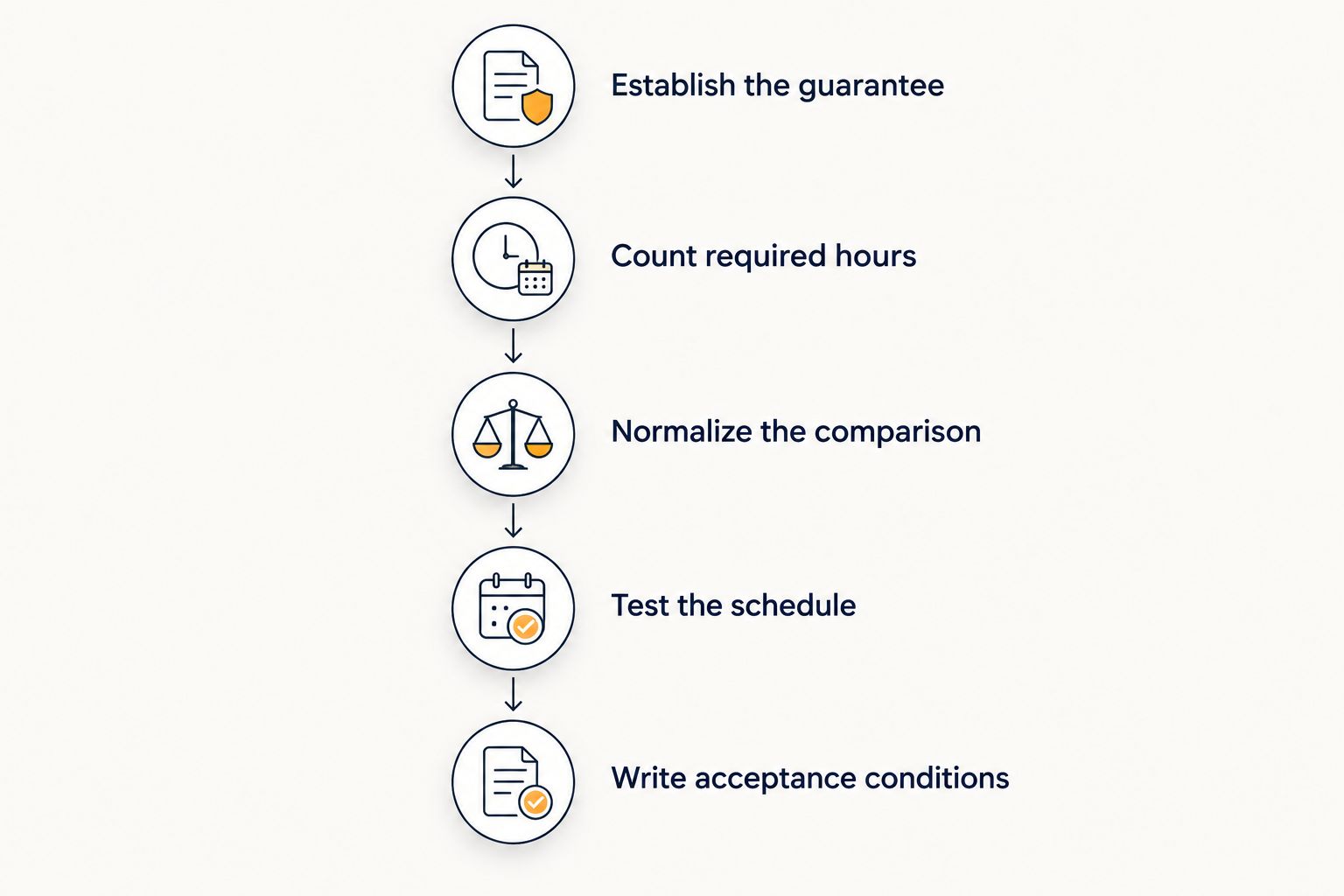
Establish the guarantee
Record the guaranteed compensation and the conditions required to receive it. Note whether the guarantee changes after onboarding or an initial contract period.
Then document the productivity formula separately. Ask which work receives credit, how credit is attributed, and whether corrections or discrepancies affect payment. Do not treat an attainable-sounding bonus as guaranteed income.
Count required hours
Use the written shift schedule to calculate annual clinical hours. Add required meetings, training, administrative duties, and any explicit obligation to remain after the shift ends.
Ask how unfinished cases transfer to the next reader. A job with a defined handoff is different from a job that requires you to clear an assigned queue before leaving, even when both advertise identical shift lengths.
Normalize the comparison
Divide guaranteed annual compensation by annual required work hours to establish a consistent starting point. Compare benefits and physician-paid expenses separately so you can see what changes the result.
For employed and independent-contractor offers, use a tax professional to compare your circumstances. Do not assume that a higher gross figure produces a higher after-tax result or replaces the value of benefits automatically.
Test the schedule
Place the proposed rotation on your actual calendar. Mark protected sleep, household responsibilities, commuting if applicable, and the transition back to daytime activities.
The question is practical: can you maintain this schedule without regularly sacrificing sleep? If your plan requires being available during the same hours you intend to sleep, revise the plan before accepting the job.
Write acceptance conditions
List the terms that determine your decision: a fixed schedule, defined reading scope, a backup pathway, or a clear compensation guarantee. Ask the employer to address each condition in the appropriate written agreement.
This converts a vague question about whether nights are “worth it” into a decision about a specific offer. Accept when the documented terms meet your requirements; decline when the role depends on assumptions you cannot verify.
What should you ask the employer before accepting nights?
Ask for evidence about the actual service you would cover, not a general description of the practice. A useful discussion includes the person responsible for overnight operations and a radiologist who currently works the proposed schedule.
Use these questions to make the workload concrete:
- Which examinations and subspecialties fall within my assigned scope?
- How does workload change across the shift, and what information supports that description?
- Who responds when simultaneous urgent studies exceed available reading capacity?
- Who handles critical-result communication, protocol questions, and referring-clinician calls?
- What happens to compensation and workflow during equipment or connection failures?
- Can the employer change covered facilities, shift hours, or productivity expectations unilaterally?
Ask a current overnight reader about the handoff in particular. Find out whether the stated end time matches the operational expectation and how unresolved consultations transfer.
A clear escalation pathway matters more than a promise that help is available. You need to know who answers, what triggers assistance, and who owns the decision when demand exceeds staffing.
Where should you compare nighthawk radiology opportunities?
RadBoard is best for radiologists who want an aggregated radiology job search rather than separate searches across multiple sources. The platform brings together 5,000+ radiology positions from 20 sources and includes swipe-to-save features for keeping opportunities together.
Use RadBoard to build a shortlist, then apply the same schedule and contract questions to every employer. Aggregation helps you find opportunities; it does not replace direct verification of workload, compensation, or coverage arrangements.
For a 2026 shortlist, record the posting date and the date you confirmed terms with the employer. A saved listing is a starting point for a conversation, not a signed commitment about how the job operates.
Is remote nighthawk radiology easier than onsite overnight work?
Remote nighthawk radiology removes the commute when the role is fully home-based, but it does not remove overnight clinical responsibility. Compare the reading scope, communication burden, technical support, and backup arrangements rather than treating location as a workload measure.
Remote work also requires a suitable reading environment. Confirm equipment responsibilities, technical support, connectivity expectations, and the process for transferring coverage during an outage.
Is productivity-based nighthawk pay better than a guarantee?
Productivity-based nighthawk pay is a better fit only when you understand the formula and accept the earnings variability. A guarantee gives you a defined compensation baseline, subject to its written conditions; productivity pay ties earnings to credited work.
Request a written explanation using the employer's actual compensation rules. Check how non-reading duties, downtime, case assignment, and disputed credits affect the result before comparing the offers.
Should you try overnight radiology before committing permanently?
A limited overnight assignment is a reasonable way to assess schedule fit when its terms and clinical support meet your requirements. It gives you direct experience with daytime sleep and overnight workflow without assuming that the arrangement must become permanent.
However, a short assignment does not establish that a different employer or long-term rotation will feel the same. Evaluate the trial's duties and contract independently, including credentialing, malpractice, and exit obligations.
FAQ
Is nighthawk radiology worth it for the extra pay?
Nighthawk radiology is worth it when the extra compensation remains attractive after comparing required hours, benefits, workload, and recovery needs. Judge the written offer against a daytime or swing-shift alternative you would actually accept.
Does working from home make overnight radiology easier?
Working from home removes a commute but does not establish an easier workload. Confirm reading scope, urgent communication duties, technical support, and backup coverage separately.
What is the biggest schedule question before accepting nighthawk work?
The biggest schedule question is whether you can protect daytime sleep throughout the proposed rotation. Map sleep and recovery against caregiving, household responsibilities, and required meetings before signing.
How do I compare nighthawk compensation with daytime compensation?
Compare guaranteed compensation per required work hour, then assess benefits and physician-paid expenses separately. Keep productivity projections outside the guaranteed-income comparison.
Should I accept a nighthawk job with unclear productivity targets?
Do not accept an offer whose productivity expectations or payment formula you cannot explain from the written terms. Request the crediting rules, workload expectations, and treatment of downtime before deciding.
Can RadBoard help me compare radiology job opportunities?
RadBoard supports radiology job search across 5,000+ positions from 20 sources. Use the platform to identify opportunities, then verify each employer's schedule, compensation, and coverage terms directly.
One last thing
Ask who owns the next unread study when your shift ends. That answer tests whether the advertised schedule has an operational boundary or merely an expected finishing time.
For your 2026 decision, make the handoff rule part of the offer discussion before negotiating the premium. More compensation does not resolve an undefined obligation to keep working.