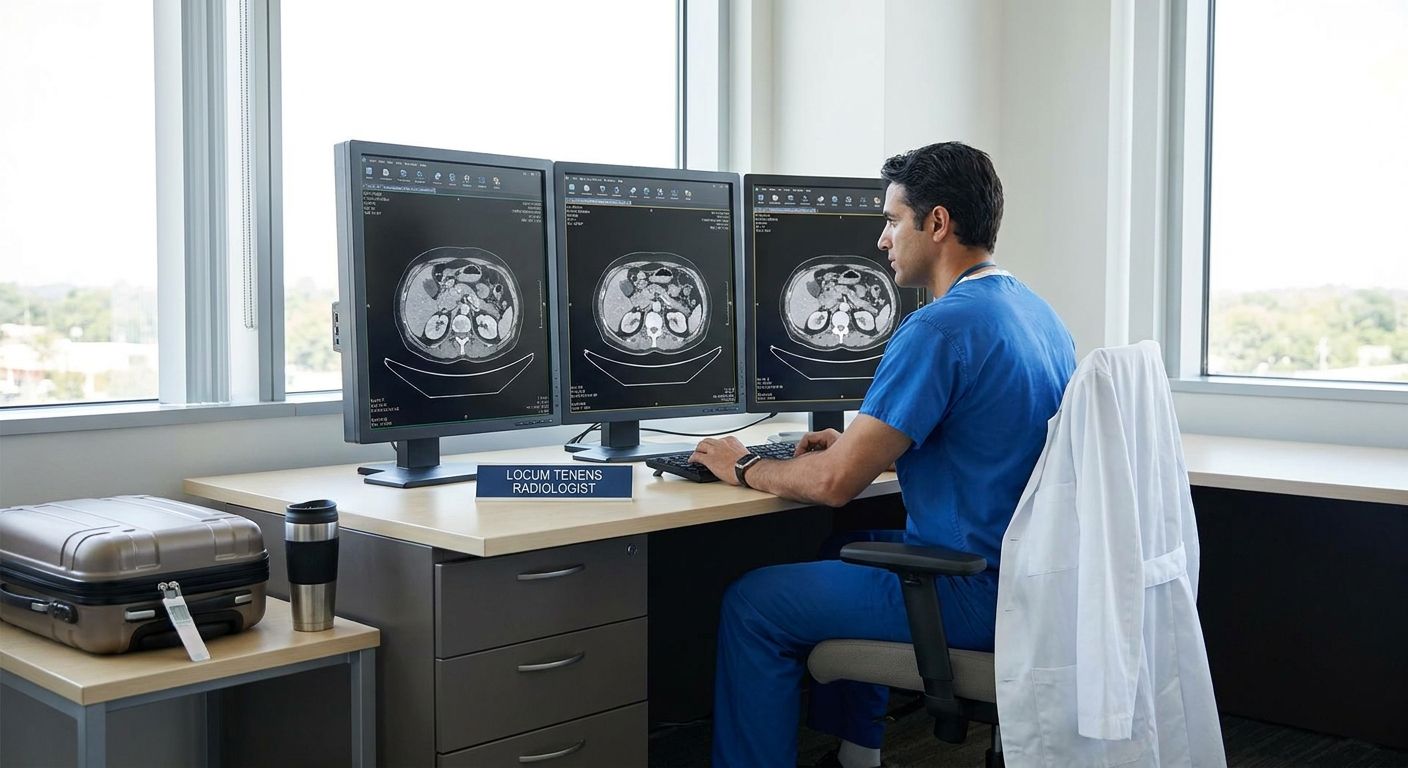
Abdominal and body imaging radiologists picking up locum tenens work face a narrower matching problem than general diagnostic locums do: liver MRI protocols, CT enterography timing, and hepatobiliary contrast sequences have to line up with the site before the first shift, not after.
- Subspecialty-matched body imaging locum desks are the safest locum tenens body imaging jobs pick for fellowship-trained abdominal readers in 2026.
- Transplant center fill-ins carry the highest RVU load but demand same-day liver and kidney protocol fluency — Consider, not Buy, for a first locum contract.
- General diagnostic locum roles with occasional abdominal overflow are a Skip for specialists chasing subspecialty-only volume.
- RadBoard aggregates 5,000+ radiology positions from 20 sources, including locum tenens body imaging listings tracked through 2026.
Why this matters
Abdominal imaging is a protocol-dense subspecialty. A locum assignment that looks generic on a staffing agency sheet can turn into a week of re-learning a site's hepatobiliary contrast timing, transplant surveillance protocols, or PI-RADS reporting template.
That mismatch costs more than convenience. A radiologist reading unfamiliar sequences at an unfamiliar site moves slower, flags more callbacks, and risks a shorter renewal. Matching the assignment to your actual subspecialty training before you sign is the difference between a locum contract that renews and one that ends after the minimum term.
The 2026 market has more locum tenens body imaging jobs listed than at any point in the last few years, but volume alone doesn't fix the matching problem \u2014 it just gives you more listings to filter through with the radiology job search platform before you commit to one.
Who this is for
This guide is for fellowship-trained abdominal and body imaging radiologists considering locum tenens work: between permanent positions, testing a new market before relocating, or filling a scheduling gap without giving up subspecialty-only reading. It assumes you already read cross-sectional abdominal MRI and CT at a high volume and want locum work that keeps you in that lane, not a generalist float pool.
What to look for in locum tenens body imaging jobs for abdominal specialists
Protocol and contrast fluency match
Ask what percentage of the locum caseload is actually abdominal MRI and CT before you sign, not after the first shift. A site running liver protocol MRI, CT enterography, and transplant surveillance imaging daily is a real subspecialty match; a site offering "body imaging with some overflow" usually means general diagnostic reads padded with occasional abdominal cases.
Credentialing and privileging turnaround
Locum contracts live and die on how fast credentialing clears. A facility that can turn privileging around in two to three weeks lets you start sooner and negotiate from a position of choice; one stuck in a six-week hospital bylaws process eats into a short-term contract before you've read a single study.
Malpractice tail and coverage terms
Confirm whether the assignment includes claims-made or occurrence-based coverage, and who owns the tail if the contract ends early. This detail rarely shows up in the job posting headline, but it shows up in your bank account if you leave a claims-made assignment without tail coverage locked down.
PACS/RIS and remote-read compatibility
Abdominal imaging often means comparing current studies against years of prior liver lesion or renal mass surveillance. Confirm the site's PACS gives you full prior access on day one \u2014 without it, you're reading transplant and oncology follow-ups blind to history, which slows turnaround and increases callback risk.
Rate structure: day rate vs. RVU vs. case-based
Body imaging RVU weights run higher than plain film or basic CT, so an RVU-based locum rate rewards a high-acuity abdominal caseload more than a flat day rate does. Case-based pay works against you if the site batches easy follow-up ultrasounds with complex MRI enterography reads at the same per-case number.
Contract flexibility and renewal terms
Look for a stated renewal or extension clause, not a verbal promise. A locum contract with a written 30- or 60-day renewal option gives you leverage to negotiate rate or schedule changes before the term ends, instead of scrambling for the next assignment cold.
Top picks for abdominal imaging locum tenens work
Subspecialty-matched body imaging desks \u2014 the credential-matched pick. These assignments run liver MRI, CT enterography, and hepatobiliary contrast protocols as the daily caseload, not the exception. Sites offering this desk structure typically confirm case volume and protocol list before contract signing, which is the single strongest predictor of a locum assignment that fits your training. Full listings for this category sit on the body imaging radiologist jobs for abdominal imaging specialists page. Buy.
Transplant center fill-in coverage \u2014 the highest-acuity pick. Liver and kidney transplant centers run dense surveillance imaging schedules and often need same-week locum coverage when a transplant radiologist is out. The reading is demanding \u2014 immediate post-op complications, rejection surveillance, vascular patency checks \u2014 and pays accordingly, but it's a poor fit for a first locum contract if you haven't read transplant protocols regularly in the last 12 months. Consider.
GI and fluoroscopy add-on shifts \u2014 the volume filler. Barium studies, defecography, and upper GI series pair naturally with abdominal cross-sectional work and often get bundled into body imaging locum blocks as a lower-intensity shift type. These shifts rarely carry high RVU weight on their own, but they smooth out a week that would otherwise be all high-acuity MRI reads. Consider.
General diagnostic locum with occasional abdominal overflow \u2014 the wildcard, and usually the wrong one. Staffing agencies list these broadly to fill any qualified radiologist into a general pool, with abdominal cases showing up as a fraction of the daily list rather than the focus. For an abdominal specialist chasing subspecialty-only reading, this contract structure dilutes the caseload you actually want. Skip.
Filter locum listings by subspecialty
Search 5,000+ radiology positions and swipe to save the ones that match your training.
What to avoid
- Contracts with no stated malpractice tail terms. If the agreement doesn't specify who covers the tail on a claims-made policy, get it in writing before you sign, not after the first shift.
- Sites that can't confirm case mix in writing. "Mostly abdominal" verbally on a phone screen isn't the same as a written caseload breakdown \u2014 ask for the latter every time.
- PACS access without full prior history. A site that can't grant you comparison access to prior imaging on day one is setting you up for slower reads and more callbacks on transplant and oncology follow-ups.
Verdict comparison
| Assignment type | Case mix match | Credentialing speed | Rate structure | Verdict |
|---|---|---|---|---|
| Subspecialty-matched body imaging desk | High | Fast (2\u20133 weeks typical) | RVU-favorable | Buy |
| Transplant center fill-in | Very high acuity | Moderate | RVU-favorable, high volume | Consider |
| GI/fluoroscopy add-on shifts | Moderate | Fast | Flat or case-based | Consider |
| General diagnostic locum, abdominal overflow | Low | Varies | Flat day rate | Skip |
Before accepting any of these, run the actual math on your true hourly rate \u2014 a locum contract with a high headline day rate can still pay worse per hour than a lower-rate contract with faster credentialing and fewer unpaid administrative hours.
FAQ
What are locum tenens body imaging jobs?
Locum tenens body imaging jobs are short-term contract positions reading abdominal and pelvic MRI, CT, and ultrasound at a facility that needs temporary coverage in 2026. Contracts typically run from a few weeks to several months and can renew if both sides agree.
Do locum tenens body imaging jobs pay more than permanent positions?
Locum tenens body imaging jobs often carry a higher headline day rate or RVU rate than comparable permanent roles, since the rate has to cover the lack of benefits and contract instability. The true hourly rate depends heavily on credentialing time and unpaid administrative hours, so compare those before assuming a locum contract pays more.
Is transplant imaging locum work harder to get than general body imaging locum work?
Yes, transplant center locum coverage is harder to place because sites need a radiologist already comfortable with liver and kidney transplant surveillance protocols. Sites typically prioritize candidates with recent transplant-imaging volume over general body imaging locums.
How long do locum tenens body imaging contracts usually run?
Most locum tenens body imaging contracts run from a few weeks up to six months, with many including a renewal or extension clause. Shorter assignments (under a month) are common for single-radiologist coverage gaps at rural or transplant centers.
Can locum tenens body imaging work turn into a permanent position?
Yes, locum-to-permanent conversion is common in body imaging, especially at sites testing whether a subspecialist fits their caseload before committing to a full hire in 2026. Ask upfront whether the contract includes a conversion clause if you want that option preserved.
What credentialing timeline should I expect for a body imaging locum job?
Credentialing for locum tenens body imaging jobs typically takes two to six weeks depending on the facility's bylaws process and whether you already hold licensure in that state. Hospital-employed sites tend to run slower than outpatient imaging centers.
Do I need malpractice tail coverage for a locum tenens body imaging contract?
You need to confirm tail coverage terms before signing any claims-made locum contract, since an unresolved tail can leave you personally liable for claims filed after the contract ends. Occurrence-based policies avoid this problem but are less common in locum staffing agreements.
Are locum tenens body imaging jobs a good fit for a first job out of fellowship?
Locum tenens body imaging jobs can work for a first job if you want to test different practice settings before committing to a permanent position in 2026. The tradeoff is less schedule stability and a credentialing process you'll repeat with every new contract.
One last thing
The contracts that renew past the first term almost never have the highest headline rate \u2014 they're the ones where the case mix matched on day one and the radiologist never had to relearn a protocol mid-assignment.