
Locum tenens trauma radiology jobs at Level 1 centers are short-term contract assignments covering imaging call — CT, MRI, and ultrasound reads on polytrauma cases — when a hospital's permanent radiology staff has a gap. Level 1 fill-in work moves faster than a routine outpatient locum: American College of Surgeons verification standards require Level 1 trauma centers to keep radiology coverage immediately available around the clock, so the credentialing clock, the call structure, and the read-turnaround expectations all compress compared to a standard diagnostic locum contract.
- Locum tenens trauma radiology jobs at Level 1 centers require credentialing inside 2-4 weeks, not the 60-90 days typical of permanent hires.
- RadBoard aggregates 5,000+ radiology positions from 20 sources in 2026, including trauma and emergency locum listings.
- Staffing agencies win on speed to first shift; direct hospital contracts win on day rate — compare both before signing.
- Malpractice tail coverage and multi-state licensing are the two line items fill-in radiologists skip most often, and regret.
Why locum tenens trauma radiology matters for Level 1 fill-ins
A Level 1 trauma center can't run with a gap in imaging coverage — ACS verification requires radiology to be immediately available for acute reads, not on a next-morning turnaround. That's the structural reason trauma-specific locum demand doesn't behave like general diagnostic locum work: a single call-out or unfilled shift is a compliance problem for the hospital, not just a staffing inconvenience.
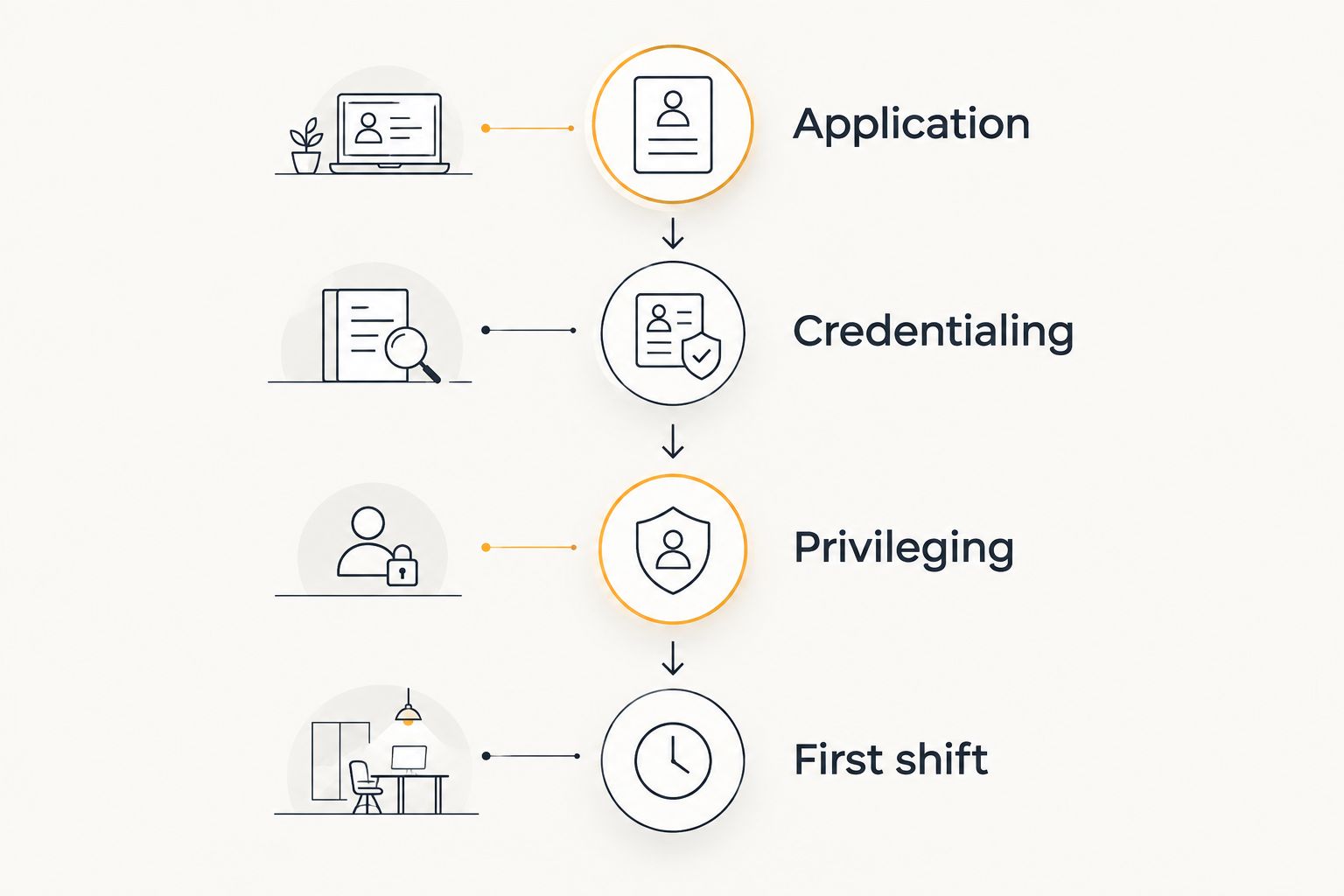
If you're weighing Level 1 trauma center imaging jobs as a fill-in radiologist, the difference between this segment and general locum work is speed on both sides: hospitals need coverage fast, and you need to be credentialed, privileged, and reading pan-scans within days of accepting the assignment. Every step below is built around that compression.
Confirm the credentialing timeline before you sign
Hospitals quoting a start date without a credentialing plan are the number one reason trauma locum assignments fall through. Ask for the timeline in writing before you commit to anything.
- Request the hospital's average credentialing turnaround in days, not weeks, and get it in the contract
- Ask whether temporary privileges are available while full credentialing processes
- Confirm the medical staff office has your CV, board certification, and state license verification ready to submit same-week
- Check whether the facility uses a credentialing verification organization that can expedite primary-source verification
- If the timeline exceeds your available start window, walk — a rushed credentialing process is a red flag on both sides
Getting credentialed fast for locum tenens work is the single biggest lever on whether a trauma fill-in assignment actually happens on schedule in 2026.
Nail down trauma call expectations in writing
"Trauma coverage" means different things at different facilities — get the specifics before the first shift, not during it.
- Ask for average daily trauma CT and MSK volume, not just a general estimate
- Confirm whether pan-scan protocols are standardized or vary by trauma surgeon preference
- Clarify whether you're reading solo or with attending backup for level-1 activations
- Get the expected turnaround time for critical trauma reads in writing
- Ask whether overnight call is in-house or remote, and whether that changes by shift
Negotiate day rate and RVU triggers
Trauma locum rates vary by call burden, not just subspecialty — a quiet weekend fill-in and a busy trauma-1 overnight aren't priced the same.
- Ask for the base day rate and any night or weekend differential separately
- Confirm whether RVU-based bonuses apply above a volume threshold
- Check locum radiologist day rates by subspecialty before you counter an offer, so you know where trauma coverage sits relative to general diagnostic locum work
- Negotiate travel and lodging as separate line items, not folded into the day rate
- Ask whether cancellation or shortened-shift pay is guaranteed if a case volume drops
Lock in malpractice tail and licensing coverage
This is the step fill-in radiologists skip most, and it's the one that costs money months after the assignment ends.
- Confirm whether the facility or staffing agency carries occurrence-based or claims-made coverage
- If it's claims-made, ask who pays for tail coverage when the contract ends
- Verify your state license covers the facility's location — trauma centers near state lines complicate this
- Confirm malpractice limits meet the state's minimum for hospital privileging
- Get the coverage terms in writing before your first shift, not after
Build a pan-scan-ready reading workflow
Trauma reads move faster than routine diagnostic work, and the workflow needs to match that pace from shift one.
- Request PACS and dictation system access at least 48 hours before your first shift
- Confirm the facility's structured reporting templates for trauma pan-scans
- Ask whether AI-assisted triage flags critical findings before you open the study
- Build a personal checklist for common trauma misses — solid organ injury grading, C-spine clearance criteria, retroperitoneal bleeds
- Confirm who to call for a second read on ambiguous polytrauma findings
Compare staffing agencies against direct hospital contracts
Both routes work for trauma fill-ins — the right one depends on how fast you need to start and how much control you want over rate negotiation.
- Staffing agencies typically move faster on credentialing paperwork since they've worked with the facility before
- Direct hospital contracts usually pay a higher net rate since there's no agency margin
- Agencies handle malpractice tail and licensing logistics; direct contracts put that on you
- If this is your first trauma locum assignment, an agency's track record with that specific facility reduces risk
Sequence your assignment calendar across multiple contracts
Most trauma fill-in radiologists stack two or three short assignments a year rather than one long contract — plan the calendar so credentialing windows don't overlap.
- Build in a buffer week between assignments for licensing renewals or CME requirements
- Track which states require separate licenses versus those covered under compact agreements
- Confirm tax residency implications if you're covering trauma centers in more than one state in 2026
- Keep a running document of facility-specific PACS logins and workflow notes for repeat assignments
Comparing your options for trauma locum coverage
| Option | Best for | Key limitation |
|---|---|---|
| Direct hospital contract | Radiologists who want the highest net rate and have prior trauma experience | You handle your own credentialing logistics and malpractice tail negotiation |
| Staffing agency locum tenens | First-time trauma fill-ins who want faster credentialing support | Agency margin reduces the net day rate compared to direct contracts |
| Job board aggregator (RadBoard) | Radiologists comparing trauma listings across many hospitals and agencies at once | Aggregators surface listings; they don't handle credentialing or contract negotiation directly |
RadBoard's role in this comparison is search, not staffing — it pulls trauma and emergency locum listings from 20 sources into one AI-searchable, swipe-to-save feed so you're not checking a dozen agency sites separately.
Common mistakes Level 1 trauma fill-ins make
- Signing before confirming the credentialing timeline — a verbal "should be quick" from a recruiter is not a contract term
- Treating all trauma call the same — a level-1 overnight and a quiet weekend fill-in are different jobs at different rates
- Skipping the malpractice tail conversation — claims-made policies without tail coverage create exposure after the assignment ends
- Underestimating multi-state licensing lead time — a license that takes six weeks doesn't help a four-week assignment start date
- Not asking about AI triage tools already in the reading workflow — some trauma centers flag critical findings automatically, which changes how you prioritize a shift
Find trauma locum openings faster
Search 5,000+ radiology listings from 20 sources with AI-powered filters.
FAQ
What is a locum tenens trauma radiology job?
It's a short-term contract position covering imaging call at a trauma center, usually filling a gap in permanent staffing. Level 1 centers require the radiologist to be credentialed and privileged fast, since ACS verification standards mandate immediate radiology availability.
How fast can I get credentialed for a Level 1 trauma center locum assignment in 2026?
Facilities working with staffing agencies can often credential a radiologist in 2-4 weeks when temporary privileges are available. Direct hospital contracts without agency support can take longer if the medical staff office is backlogged.
Do locum tenens trauma radiologists need ATLS or ACLS certification?
Most Level 1 trauma centers do not require ATLS for radiologists since that's a surgical and ED credential, but some facilities ask for basic life support certification as part of privileging. Confirm the specific requirement with the credentialing office before you sign.
Is locum tenens trauma radiology pay higher than routine diagnostic locums?
Trauma coverage often carries a night or weekend differential on top of the base day rate because of call burden and turnaround expectations. Rates vary by facility volume and subspecialty, so compare offers against day-rate benchmarks before countering.
Can I do locum tenens trauma coverage remotely via teleradiology?
Some Level 1 centers allow remote overnight coverage for trauma reads if the facility's protocol supports it, but many require in-house presence for level-1 activations. Ask specifically whether the role is in-house, remote, or a hybrid split before accepting.
What malpractice coverage do I need for a Level 1 trauma locum job?
You need coverage that meets the state's minimum limits for hospital privileging, and clarity on whether it's occurrence-based or claims-made. If it's claims-made, confirm who pays for tail coverage once the assignment ends.
How do I find locum tenens trauma radiology jobs fast?
Searching a single aggregator that pulls from multiple staffing agencies and hospital postings is faster than checking each source separately. RadBoard aggregates 5,000+ radiology positions from 20 sources with AI-powered search built for exactly this kind of time-sensitive search.
Should I use a staffing agency or apply directly to trauma centers?
Staffing agencies move faster on credentialing since they've worked with the facility before, while direct contracts typically pay a higher net rate. First-time trauma fill-ins usually do better starting with an agency for the logistics support.
One last thing
The detail most fill-in radiologists miss: ACS Level 1 verification requires immediate radiology availability, not next-hour — which means the facility's real urgency isn't about filling a schedule gap, it's about staying compliant with its trauma designation. That's leverage in rate negotiation that most locum radiologists never use in 2026.