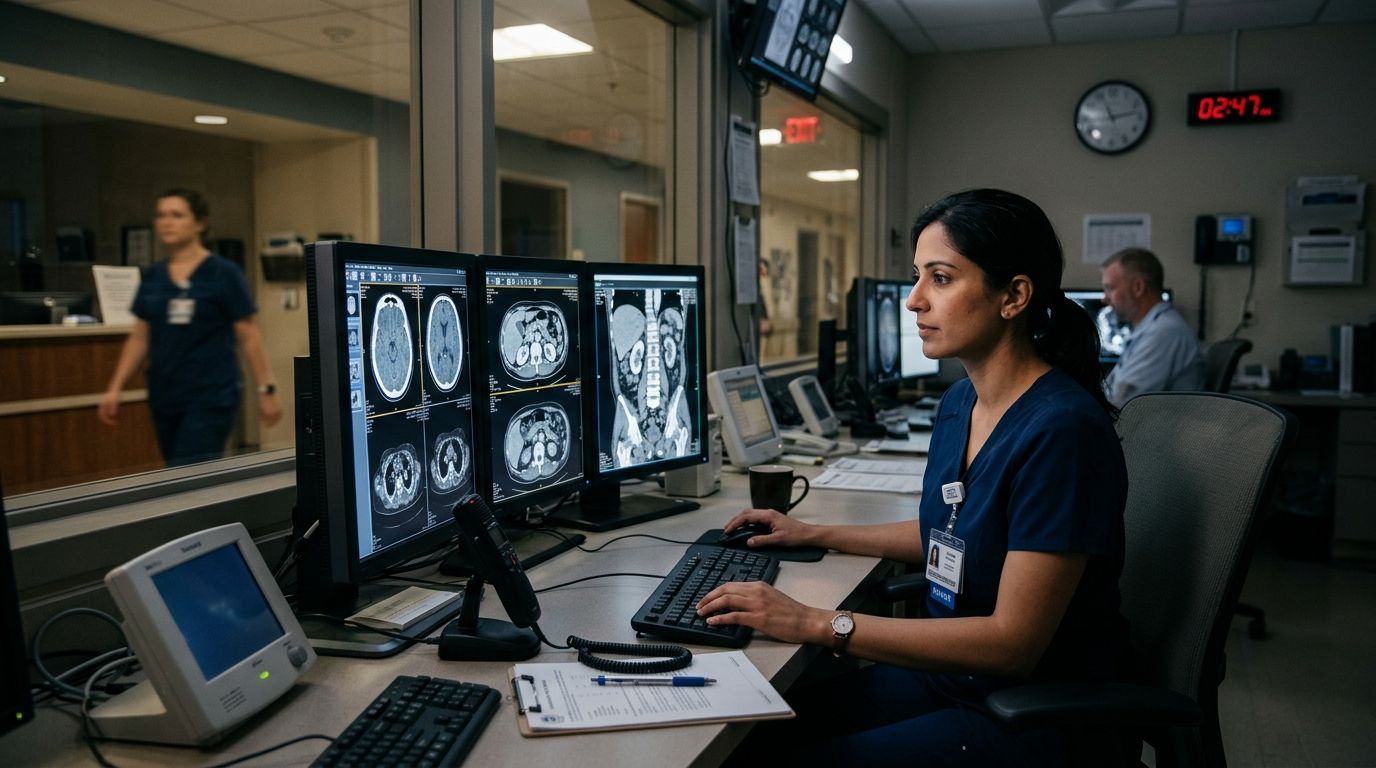
Night float radiology jobs place a rotating physician on overnight hospital coverage, reading STAT trauma, stroke, and ED studies while the day team is off the schedule. Unlike a fixed nighthawk contract, the night float model rotates the overnight block among a group of radiologists so no single person carries every night indefinitely.
- Night float radiology jobs rotate overnight hospital coverage among a group instead of assigning one radiologist to permanent nights.
- RadBoard lists night float and nighthawk openings among 5,000+ radiology positions pulled from 20 sources.
- Rotation length (3-7 nights) and the differential pay structure matter more than the base salary line in 2026 offers.
- Night float differs from nighthawk teleradiology: night float radiologists are typically in-house or hybrid, not a standalone remote overnight contract.
- Verify STAT read turnaround expectations and tech/PACS support before signing; these vary widely by hospital size.
Why night float coverage matters for overnight radiologists
Hospitals need continuous STAT coverage for trauma activations, code strokes, and ED reads at 2 a.m. as much as at 2 p.m. Night float is how many hospital-employed and academic groups solve this without burning out one radiologist on a permanent night contract. The nighthawk radiology jobs model handles the same clinical problem differently — a dedicated overnight reader, often remote, rather than a rotating in-house group.
Radiologists searching for this arrangement in 2026 are usually not looking for a permanent nights career. They want overnight differential pay, a defined rotation length, and a return to day shifts on a predictable cycle. That distinction changes what to ask in an interview and what red flags to watch for in a contract.
Confirm what "night float" means at this hospital
The term isn't standardized across health systems, so the first step is pinning down the actual structure before comparing offers.
- Ask whether night float is in-house, remote, or hybrid (physically on campus for part of the shift, remote for reads)
- Get the exact rotation length in writing: 3 nights, 5 nights, or a full week block
- Confirm how frequently the rotation recurs — every 4 weeks, every 6 weeks, or on an as-needed basis
- Check whether night float radiologists also carry weekend or holiday overnight blocks
- Clarify whether the role is a standalone position or a rotating duty layered on top of a full-time day schedule
Evaluate the shift structure and hand-off protocol
A night float shift that starts at 7 p.m. and ends at 7 a.m. reads very differently than one that starts at 11 p.m. Hand-off quality determines whether you're finishing prior-shift backlog or starting clean.
- Get the exact start and end time, not just "overnight"
- Ask how unread studies are handled at shift change — carried over or absorbed by the day team
- Confirm whether night float covers a single hospital or multiple sites in a health system
- Check whether there's a designated overlap window with the outgoing or incoming radiologist
- Ask what happens on a night when call volume spikes past a normal shift
Negotiate the differential and compensation structure
Overnight shifts almost always carry a pay differential over day-shift base rate, but the size and structure of that differential varies by employer type — academic, community hospital, or hospital-employed group.
- Ask whether the differential is a flat per-shift bonus or a percentage add-on to base RVU pay
- Confirm whether night float shifts count toward annual RVU targets or sit outside them
- Check whether holiday and weekend nights carry an additional stacked differential
- Ask how PTO and sick coverage work for a rotating night schedule — a missed night float shift is harder to backfill than a missed day shift
- Compare the total night float compensation structure against a 7-on-7-off block scheduling arrangement, which packages overnight and daytime blocks differently
Measure the expected call volume and study mix
Night float coverage at a level 1 trauma center looks nothing like night float at a 150-bed community hospital. Volume and case mix should shape what you're willing to accept for pay and rotation length.
- Ask for average overnight study counts, broken out by modality (CT, MRI, plain film, ultrasound)
- Confirm what percentage of overnight reads are trauma or stroke activations requiring immediate turnaround
- Check whether pediatric or OB overnight studies are included or routed elsewhere
- Ask whether a second radiologist or a teleradiology backup covers overflow during a surge
- Find out whether night float radiologists also handle preliminary reads that day teams finalize later
Check credentialing, licensing, and malpractice terms
Overnight solo coverage means fewer people around if a credentialing gap or licensing lapse surfaces mid-shift. This is worth confirming before you sign, not after your first rotation.
- Confirm the hospital covers credentialing costs and timeline for night float privileges
- Ask whether malpractice coverage extends to any remote-read component of a hybrid night float role
- Check state licensing requirements if the hospital pulls overnight reads from an affiliated site in another state
- Confirm whether tail coverage applies if you leave the group after a defined night float term
Assess overnight technology and support staff
A night float radiologist reading solo without a technologist on the phone or an IT contact for PACS issues is a different job than one with full overnight support.
- Ask who staffs the reading room overnight — technologists, PACS support, or radiologist alone
- Confirm whether AI triage tools flag stroke and PE cases before they hit your worklist
- Check average PACS uptime and what the backup protocol is during an outage
- Ask whether a phone consult line to the ED or ICU is staffed for the full shift
Search night float openings efficiently
Manually checking hospital career pages for night float postings is slow because the term isn't used consistently — some systems call it "night rotation," others "overnight coverage block." Filtering by shift type and reading the job description for rotation length is the faster way to sort real night float roles from standalone nighthawk contracts. RadBoard's AI-powered search surfaces overnight and rotating-shift radiology jobs across 5,000+ listings from 20 sources, and swipe-to-save lets you shortlist night float postings without re-searching each site individually.
Night float coverage options compared
| Option | Best for | Key limitation |
|---|---|---|
| In-house night float (hospital-employed) | Radiologists who want overnight differential without leaving employment | Rotation frequency can compress if the group is short-staffed |
| Nighthawk teleradiology contract | Radiologists who prefer permanent, predictable overnight remote work | No daytime rotation break; overnight-only long term |
| Locum tenens night coverage | Radiologists testing overnight work before committing | Assignment length and renewal are not guaranteed |
| Hybrid rotating model (on-campus plus remote) | Groups needing flexible overnight staffing across sites | Requires licensing and credentialing at every covered site |
Verdict: in-house night float rotation is the better fit for radiologists who want overnight pay without a permanent nights career; nighthawk contracts fit radiologists who prefer the schedule to stay fixed year-round.
Common mistakes radiologists make with night float roles
- Assuming "night float" means the same schedule everywhere. Rotation length and frequency vary enough between hospitals that two "night float" postings can be very different jobs.
- Not confirming whether unread studies carry over at shift change. A vague hand-off protocol turns one bad night into a pattern of backlog.
- Underestimating credentialing lead time for hybrid roles. Multi-site night float coverage can require licensing in more than one state before the first shift.
- Treating the differential as fixed income without checking RVU interaction. Some contracts count night float shifts toward the same RVU target as day shifts, effectively reducing the real bonus.
- Ignoring recovery time between rotations. A 5-night block every 4 weeks reads differently on a body than the same block every 6 weeks — ask before signing.
Find night float radiology jobs faster
Search 5,000+ radiology listings from 20 sources with AI-powered filters.
FAQ
What is a night float radiology job?
A night float radiology job rotates a physician through overnight hospital shifts as part of a group schedule, rather than assigning one radiologist to permanent nights. Rotations commonly run 3 to 7 nights before cycling back to day coverage.
Is night float the same as nighthawk radiology?
No. Nighthawk radiology typically means a standalone, often remote, overnight-only contract, while night float rotates among a group and usually returns to daytime duties. Both cover the same overnight STAT read need but with different schedule structures.
How much does night float pay compared to day shifts?
Night float shifts typically carry a pay differential over base day-shift compensation, either as a flat per-shift bonus or a percentage add-on to RVU pay. The structure varies by employer type, so confirm whether night float shifts also count toward annual RVU targets.
How long does a typical night float rotation last?
Rotation length ranges from 3 nights to a full week, cycling back to day shifts every 4 to 6 weeks in most hospital-employed groups. Academic programs and community hospitals structure this differently, so confirm the exact cycle before accepting an offer.
Do night float radiologists need a subspecialty?
Most night float roles call for general diagnostic radiology coverage across CT, MRI, plain film, and ultrasound rather than a single subspecialty focus. Board certification in diagnostic radiology is the baseline requirement at nearly every hospital posting these roles.
What support should a night float radiologist expect overnight?
Expect at minimum a technologist on call, a PACS support contact, and a phone line to the ED or ICU for consults. Ask specifically whether AI triage tools flag stroke and PE cases before they reach your worklist, since this varies by hospital in 2026.
Does night float coverage affect malpractice terms?
Malpractice coverage should extend to any remote-read component of a hybrid night float role, and tail coverage terms should be confirmed if you leave the group after a defined rotation term. Ask for this in writing before signing.
Where can I find night float radiology job listings?
RadBoard aggregates night float and overnight rotation postings among 5,000+ radiology jobs pulled from 20 sources, filterable by shift type. AI-powered search and swipe-to-save make it faster to shortlist these roles than checking individual hospital career pages.
One last thing
The biggest variable in a night float contract isn't the pay differential, it's the recovery cadence between rotations. Two postings with identical hourly pay can produce very different burnout curves depending on whether the night block cycles back every 4 weeks or every 6 — ask for the actual rotation calendar, not just the rotation length, before you sign anything in 2026.