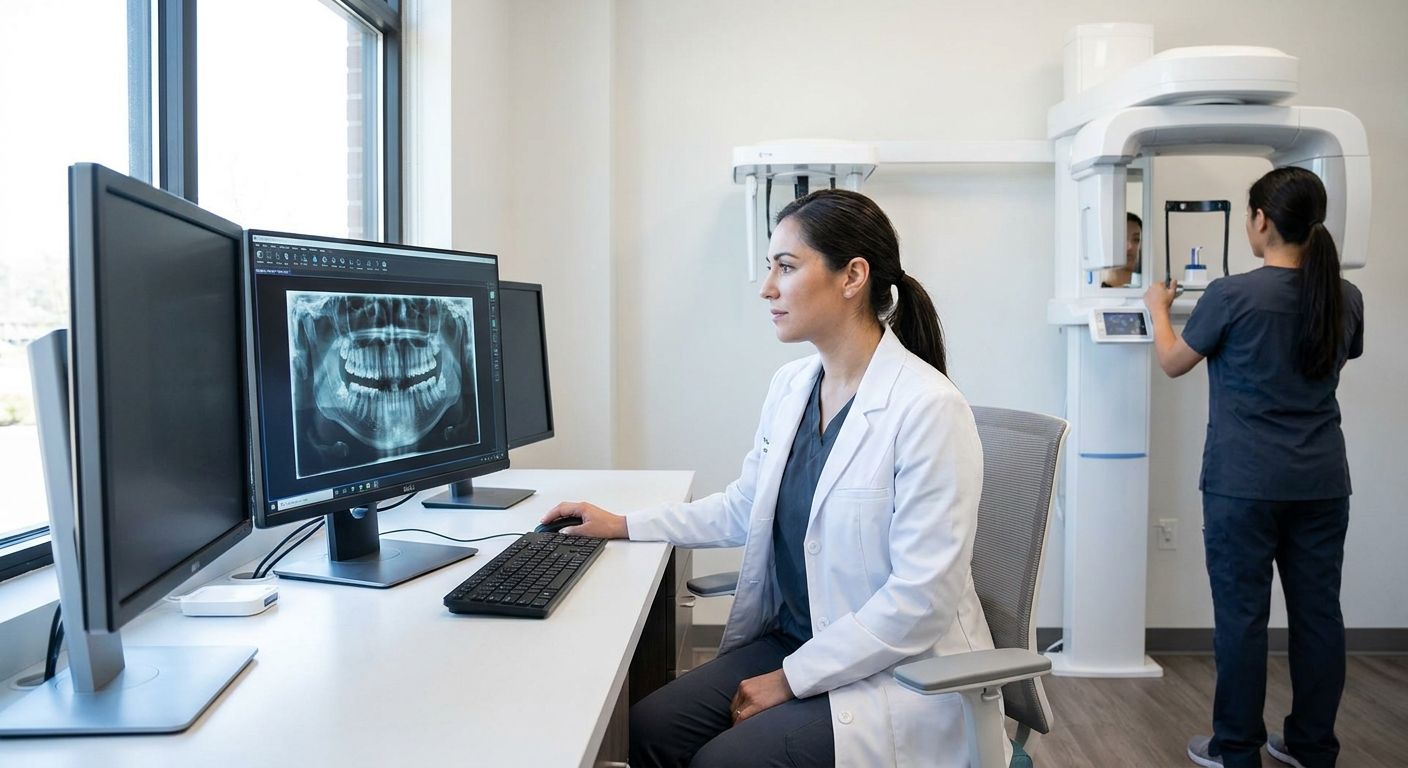
Oral and maxillofacial radiology (OMFR) openings sit at the narrow overlap between dentistry and diagnostic imaging, and most general radiology job boards don't sort for them. This guide breaks down where oral radiology jobs actually post in 2026, what separates a real dental-imaging opening from a mislabeled dental hygienist listing, and which employer type fits which career stage.
- Dental school faculty roles carry the heaviest CBCT teaching caseload -- Buy for academic-track OMFR physicians.
- OMFS private practice imaging roles skip overnight call and pay per-scan -- Consider for high-volume readers.
- DSO imaging director roles are the fastest-growing oral radiology jobs in 2026 but require multi-site travel -- Consider with a mileage clause.
- General boards bury oral radiology jobs inside ENT and head-neck categories; RadBoard filters 5,000+ listings from 20 sources by subspecialty.
- Hospital maxillofacial imaging posts pair well with trauma coverage -- Buy for radiologists who want variety over pure dental reads.
Why this matters
Oral and maxillofacial radiology is a small subspecialty, and small subspecialties get lost on generic job boards. A search for "radiology jobs" on a hospital career site rarely distinguishes a CBCT-heavy dental school faculty post from a chest CT role at the same institution.
That matters in 2026 because dental service organizations (DSOs) are consolidating imaging under centralized directors, and demand for physicians who can read cone-beam CT accurately is rising faster than the pool of dentomaxillofacial radiologists trained to fill those seats. If you search generic terms, you'll miss postings that never use the word "radiologist" at all -- some list under "imaging director" or "oral pathology consultant."
RadBoard pulls oral radiology jobs from 20 sources into one filtered feed, which matters when the category itself is scattered across dental school HR pages, OMFS practice sites, and DSO corporate careers pages that rarely cross-post to mainstream radiology boards.
Who this is for
This guide is for two overlapping groups: MD/DO radiologists with head-and-neck or dentomaxillofacial fellowship training who read CBCT and panoramic studies, and dentists with advanced training (DDS/DMD plus a radiology residency) who hold ABOMR certification rather than ABR. If you're deciding between a dental school faculty track, an oral and maxillofacial surgery (OMFS) practice imaging role, or a DSO director seat, the criteria below apply regardless of which credential path you hold.
What to look for in oral radiology jobs for dental imaging
CBCT and panoramic volume
The single biggest variable across oral radiology jobs is scan mix. A role reading 40 CBCT studies a week for implant planning looks nothing like one reading 5 CBCTs alongside a full panoramic and bitewing caseload for a multi-chair DSO. Ask for the actual weekly scan count before you sign -- volume determines whether the role sharpens your subspecialty skill or dilutes it into general dental reads.
Credential pathway required
Some postings specify ABOMR (American Board of Oral and Maxillofacial Radiology) certification; others accept ABR-certified radiologists with head-and-neck fellowship training. This distinction gates who can even apply, so confirm it early rather than assuming your training covers the listing.
Surgical planning involvement
OMFR readers increasingly support pre-surgical workups for implant placement, orthognathic surgery, and third-molar extraction near the inferior alveolar nerve. Practices doing complex bone-grafting or sinus-adjacent implant cases lean on precise CBCT measurements the same way general surgical teams rely on imaging before sinus lift procedures -- the read has to flag sinus floor proximity and bone density before the surgeon books the case. If your target role touches OMFS surgical planning, ask how many cases per month require that level of pre-op detail.
Call burden and site coverage
Most oral radiology jobs skip overnight call entirely -- dental imaging is scheduled, not emergent. But DSO director roles often require covering multiple locations, which can mean 60+ mile drives between sites on a single day. Confirm whether the role is single-site or multi-site before you compare compensation.
Employer type and growth trajectory
Dental schools, OMFS group practices, DSOs, and hospital maxillofacial departments each hire differently. Academic roles move slowly and value teaching output; DSO roles move fast and value scan throughput. Know which trajectory you're signing up for.
Filter oral radiology jobs by employer type
Search 5,000+ radiology listings from 20 sources and swipe to save the ones that fit.
Top picks: where oral radiology jobs actually sit
Dental school academic faculty -- the teaching track
Academic OMFR faculty positions carry the heaviest CBCT teaching caseload of any employer type, since faculty read alongside dental residents and often direct the imaging curriculum. One spec that matters: protected non-clinical time, typically 20-30% of a full-time appointment, for research or curriculum development. Verdict: Buy for physicians who want a long academic career and don't mind slower promotion timelines. Building toward this track works best with a defined subspecialty niche rather than a general dental imaging background.
OMFS private practice imaging -- the safe pick
Surgical practices hiring an in-house or contracted radiologist to read implant and third-molar CBCTs skip overnight call almost entirely. The concrete number: most of these roles run a 4- to 5-day clinic schedule with zero weekend reads. Verdict: Buy for radiologists who want predictable hours and direct surgeon collaboration over teaching load.
DSO imaging director -- the wildcard
Dental service organizations centralizing imaging across 10+ locations are hiring directors to standardize CBCT protocols and read overflow volume. This is the fastest-growing category of oral radiology jobs in 2026, but multi-site travel and corporate reporting structures aren't for everyone. Verdict: Consider if you negotiate travel reimbursement and a cap on site count upfront.
Hospital maxillofacial imaging -- the underrated middle ground
Hospital-employed roles reading trauma-related facial fracture CT alongside routine dental imaging give you case variety a pure dental-practice role won't. One spec: these roles often pair with a broader head-and-neck or neuroradiology call pool, which keeps your general skills sharp. Verdict: Consider for radiologists who don't want to specialize exclusively in dental reads. Pairing this with a subspecialty fellowship year strengthens your application for these hybrid postings.
Locum or per-diem dental imaging coverage -- the flexible pick
Small OMFS practices and dental schools occasionally post short-term coverage for faculty sabbaticals or maternity leave. The number that matters: most run 3-6 month contracts, shorter than typical locum radiology assignments elsewhere. Verdict: Consider as a way to test academic versus private practice before committing long-term.
What to avoid
- Listings titled "dental radiographer" or "dental imaging technician" -- these are technologist roles, not physician or ABOMR-credentialed positions, and they'll waste an application cycle.
- DSO postings that don't specify scan volume -- a vague "imaging support" listing often means you'll read general dental films with no CBCT specialization, undercutting the subspecialty value of your training.
- Academic postings without stated non-clinical time -- if the job description doesn't mention protected research or teaching hours, assume it's a clinical-heavy role dressed up as academic.
Verdict comparison
| Employer type | Call burden | Credential gate | Best for | Verdict |
|---|---|---|---|---|
| Dental school faculty | None | Often ABOMR preferred | Teaching-focused careers | Buy |
| OMFS private practice | None | ABOMR or ABR + fellowship | Predictable hours | Buy |
| DSO imaging director | Multi-site travel | ABR or ABOMR | Fast-growing, corporate-track | Consider |
| Hospital maxillofacial | Shared call pool | ABR + head-neck fellowship | Case variety | Consider |
| Locum/per-diem dental | None | Varies by contract | Testing the field | Consider |
FAQ
What's the best type of oral radiology job for a new graduate?
OMFS private practice imaging roles suit new graduates best in 2026 because they skip overnight call and offer a defined, repeatable scan protocol to build speed on. Academic faculty tracks work too, but they move slower on promotion and pay.
Is ABOMR certification required for oral radiology jobs?
Not always -- many postings accept ABR-certified radiologists with head-and-neck or dentomaxillofacial fellowship training. Dental school faculty roles are more likely to specify ABOMR than private practice or DSO postings.
How much CBCT volume should I expect in a dental imaging job?
Volume varies widely: OMFS practice roles often run 20-40 CBCT studies weekly for implant and third-molar planning, while general DSO roles may mix in far fewer CBCTs alongside panoramic and bitewing reads. Confirm the actual weekly count before accepting an offer.
Do oral radiology jobs require overnight call?
Most don't. Dental imaging is scheduled rather than emergent, so OMFS practice, dental school, and DSO roles typically run daytime hours with no weekend call. Hospital-employed maxillofacial roles are the exception if they share a broader head-and-neck call pool.
Are DSO imaging director jobs a good career move in 2026?
DSO director roles are the fastest-growing segment of oral radiology jobs in 2026 as dental service organizations centralize imaging across multiple locations. The tradeoff is multi-site travel, so negotiate reimbursement and a site-count cap before signing.
Can a general diagnostic radiologist take an oral radiology job?
Yes, if you hold head-and-neck fellowship training and demonstrate CBCT reading competency, many private practice and hospital maxillofacial roles will consider you without ABOMR certification. Academic faculty tracks are the exception, where ABOMR is more commonly preferred.
Where do most oral radiology jobs get posted?
They're scattered across dental school HR pages, OMFS practice career sites, and DSO corporate portals that rarely cross-post to mainstream radiology boards. Aggregated platforms filtering across 20 sources catch listings that a single-site search would miss.
One last thing
Oral and maxillofacial radiology is one of the smallest subspecialty categories tracked across the 3,700+ active radiology listings analyzed for 2026, which means a single new DSO contract or dental school hire can shift the entire job count for the category in a given month. Set an alert rather than relying on a one-time search -- this niche moves in bursts, not a steady drip.