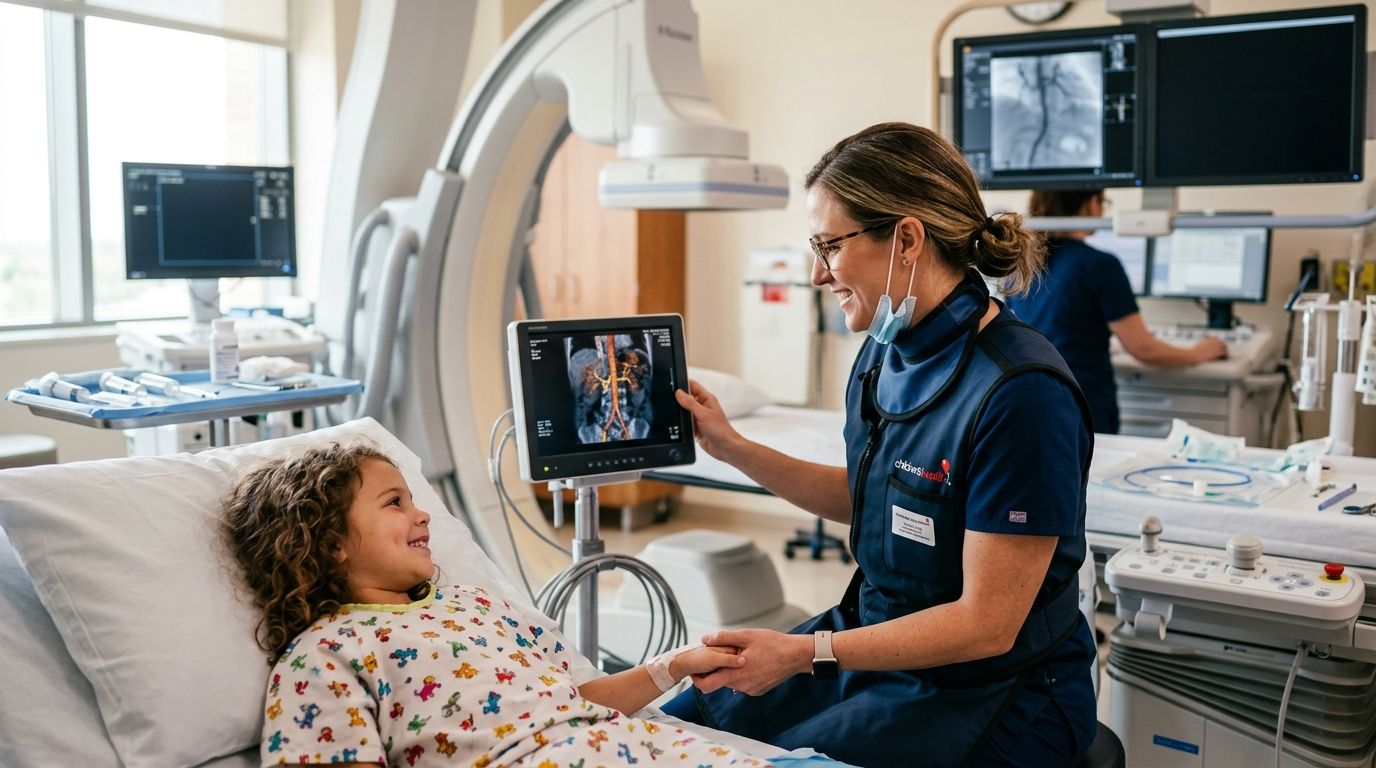
Pediatric interventional radiology jobs are IR positions embedded in children's hospital imaging departments, built to treat vascular malformations, biopsy tumors, and place central lines in patients who can't be handled like small adults on a table. The hiring pool is thinner than adult IR, the equipment settings differ, and sedation protocols add a layer most general IR contracts never touch. If you're fellowship-trained in both IR and pediatric imaging, or IR-trained with peds case volume, the job search looks nothing like a standard diagnostic radiology search.
- Pediatric interventional radiology jobs concentrate at children's hospitals and large academic pediatric IR sections, not community practices.
- RadBoard aggregates 5,000+ radiology positions from 20 sources, filterable down to pediatric IR listings by subspecialty tag.
- Dual fellowship training (IR plus pediatric radiology, or an ACGME peds IR pathway) is the baseline credential most children's hospitals screen for first.
- Call coverage and sedation-team dependency vary more between pediatric IR jobs than salary does — vet the coverage model before the offer.
Why pediatric interventional radiology matters for children's hospitals
Children's hospitals can't outsource IR the way some adult systems lean on teleradiology or locum coverage for overflow. Pediatric procedures — sclerotherapy for lymphatic malformations, image-guided biopsies in a 4-year-old, PICC placement under general anesthesia — require an operator who reads pediatric anatomy daily, not occasionally. That narrows the hiring pool to a handful of fellowship-trained physicians per graduating class nationally, which is why postings for pediatric interventional radiology jobs stay open longer than general diagnostic slots and why children's hospitals recruit early, often before fellows finish training.
The search itself behaves differently too. These roles rarely show up labeled plainly — postings get folded into "pediatric radiology" or "interventional radiology" categories on general job boards, which means a targeted search misses listings unless you cross-check multiple sources. RadBoard pulls from 20 sources into one aggregated pool specifically so a subspecialty this narrow doesn't get buried under general adult IR volume.
Confirm your fellowship credentials before you search
Most children's hospitals screen on training pathway before anything else. Get this sorted before you burn time applying to programs that will reject on credentials alone.
- Confirm whether the program wants an ACGME-accredited pediatric IR fellowship or accepts dual IR plus pediatric radiology training
- Check state licensing requirements for pediatric sedation privileges, which some boards handle separately from general IR credentialing
- Verify your case log meets the program's minimum for pediatric-specific procedures (vascular access, tumor biopsy, GI/GU intervention)
- Ask whether board eligibility versus board certification changes your candidacy timeline for the role
- Line up references from attendings who supervised your pediatric case volume specifically, not general IR volume
Search hospital-specific postings and aggregators together
Children's hospital career pages post pediatric IR openings months before they hit general job boards, but checking each hospital site individually is slow and you'll miss postings from systems you didn't think to check.
- Check individual children's hospital career pages for IR-specific listings, updated on their own schedule
- Cross-reference against pediatric radiology job postings for children's hospital radiologists to catch roles filed under the broader pediatric category
- Search academic medical center listings, since many pediatric IR sections sit inside larger university hospital systems
- Set alerts for "pediatric IR" and "pediatric interventional" separately — hospitals use both phrasings inconsistently
- Filter an aggregated platform by subspecialty tag rather than scrolling every general radiology posting
Map the procedure mix at each program
Not every pediatric IR job does the same work. Some sections are heavy on vascular anomalies, others lean into oncologic intervention or GI access, and the mix determines whether your training actually matches the role.
- Ask for a monthly procedure log or case mix breakdown from the section chief during the interview, not after signing
- Confirm what percentage of cases are vascular malformation treatment versus general access and biopsy
- Check whether the program has a dedicated vascular anomalies clinic or handles those referrals ad hoc
- Ask how oncology-adjacent cases are staffed — some programs route tumor ablation to adult IR on shared cases
- Review whether neurointerventional pediatric cases stay in-house or get transferred, since neurointerventional radiology jobs for stroke thrombectomy sit in a distinct staffing lane from general peds IR
Evaluate call schedule and coverage model
Call in pediatric IR looks different from adult IR because emergency pediatric procedures are rarer per capita but often higher-stakes when they happen — a bleeding AVM in a toddler doesn't wait for the next business day.
- Ask how many attendings share overnight and weekend call, and how that number has changed over the last two years
- Confirm whether call includes backup from adult IR for shared equipment or whether pediatric IR covers independently
- Check if the program uses locum tenens or moonlighting coverage for gaps — a pattern worth reviewing against locum tenens pediatric radiology jobs for hospital fill-ins if you're weighing supplemental coverage work yourself
- Ask directly what the average number of overnight call-ins per month has been for the past year
- Confirm sedation team availability at night, since pediatric IR without anesthesia backup changes the entire call calculus
Negotiate compensation for a low-volume, high-acuity subspecialty
Pediatric IR salary structures often diverge from general IR because RVU-based models undercount the time complexity of pediatric procedures relative to case volume.
- Ask whether compensation is RVU-based, salary-based, or hybrid, and how pediatric case complexity factors into the RVU weighting
- Request comparison data specific to pediatric IR rather than general IR salary benchmarks, since the subspecialty skews differently
- Clarify whether academic appointments carry a base salary floor independent of clinical productivity
- Confirm CME allowance and conference stipend coverage for pediatric IR-specific conferences, which run separately from general radiology CME budgets
- Ask about signing bonus and relocation terms in writing before verbal agreement, and get sabbatical or extended leave terms in writing too
Vet credentialing and malpractice terms specific to pediatric cases
Malpractice coverage and credentialing timelines for pediatric procedures can run longer than general radiology onboarding, and gaps here delay start dates.
- Confirm malpractice tail coverage terms before signing, especially for high-acuity pediatric procedures
- Ask how long hospital credentialing typically takes for pediatric IR privileges specifically
- Check whether the offer includes non-solicitation or non-compete language that would restrict practicing at nearby children's hospitals
- Confirm whether board-eligible status is accepted for a defined window while you complete certification
Build a network inside children's hospital IR sections
The subspecialty is small enough that most pediatric IR hiring happens through direct referral before a posting ever goes public.
- Attend pediatric IR-focused sessions at national IR and pediatric radiology conferences
- Reach out directly to section chiefs at target hospitals, even when no posting is live
- Ask your fellowship program director for direct introductions to programs hiring in your target region
- Stay visible in pediatric IR-specific case discussion forums and society committees
Search live pediatric IR openings now
Filter 5,000+ aggregated radiology jobs down to pediatric interventional listings.
Comparing your options for pediatric IR work in 2026
| Setting | Best for | Key limitation |
|---|---|---|
| Academic children's hospital, employed | Physicians wanting full procedure mix and teaching load | Slower promotion timeline, heavier committee load |
| Community hospital with a pediatric IR service line | Physicians who want pediatric focus without a full academic appointment | Lower case volume for rare procedures, may require adult IR backup |
| Locum tenens pediatric IR coverage | Physicians testing a region or covering gaps between permanent roles | Inconsistent scheduling, no long-term continuity of care |
| Adult hospital with limited pediatric IR service | Generalist IR physicians who want occasional pediatric case exposure | Thin pediatric case volume keeps skills from deepening |
The verdict: full-scope pediatric IR practice concentrates almost entirely inside academic children's hospitals as of 2026, and physicians who want to keep pediatric procedure volume high should prioritize those postings over hybrid adult-pediatric setups.
Common mistakes in the pediatric IR job search
- Applying with adult IR case logs as the primary credential. Children's hospitals want pediatric-specific procedure counts, not general IR volume padded with adult cases.
- Skipping the sedation-team question. A program without reliable overnight anesthesia coverage changes what call actually looks like, and physicians who don't ask find out after signing.
- Assuming salary benchmarks from general IR apply. Pediatric IR compensation models differ enough that using adult IR RVU data to negotiate leaves money on the table or sets unrealistic expectations.
- Waiting for public postings instead of networking early. Direct referral fills a large share of these roles before a job ever goes live on a board.
- Ignoring non-compete language in a small specialty. A restrictive non-solicitation clause can functionally block you from every other children's hospital IR job within driving distance.
FAQ
What training do pediatric interventional radiology jobs require?
Most children's hospitals require either an ACGME-accredited pediatric IR fellowship or dual training in interventional radiology and pediatric radiology. Programs also verify pediatric-specific case logs during credentialing, not general adult IR volume.
Are pediatric interventional radiology jobs harder to find than adult IR jobs?
Yes, because the hiring pool of both employers and qualified candidates is smaller. Postings concentrate at academic children's hospitals and often get filled through direct referral before appearing on general job boards.
Is pediatric IR better paid than general interventional radiology?
Compensation structures differ rather than being uniformly higher or lower — RVU-based models often undercount pediatric case complexity, so ask each program directly how its compensation formula accounts for pediatric procedure time.
Do pediatric IR jobs require overnight call?
Most academic children's hospital IR sections include overnight and weekend call, shared across a small attending pool. Ask specifically how many attendings split call and whether sedation coverage is available overnight.
Can a general IR-trained physician work in pediatric IR without a peds fellowship?
Some community hospitals with limited pediatric IR volume will hire general IR physicians with documented pediatric case experience, but full-scope academic children's hospital roles almost always require pediatric-specific fellowship training.
Where do most pediatric interventional radiology jobs get posted?
Children's hospital career pages post many roles directly, but aggregated platforms pulling from multiple sources catch listings that individual hospital searches miss, since pediatric IR postings often get filed under general pediatric radiology or general IR categories.
How long does credentialing take for a pediatric IR role?
Credentialing timelines for pediatric procedure privileges typically run longer than general radiology onboarding. Confirm the expected timeline with the hospital's medical staff office before your planned start date.
One last thing
The pediatric IR hiring cycle runs on fellowship graduation timing more than any other radiology subspecialty — programs recruit fellows a full year before they finish training, which means the best pediatric interventional radiology jobs for 2026 and 2026 start dates were already in conversation during 2026 interview season. If you're finishing a fellowship now, the posting you want may never reach a public board before it's filled.