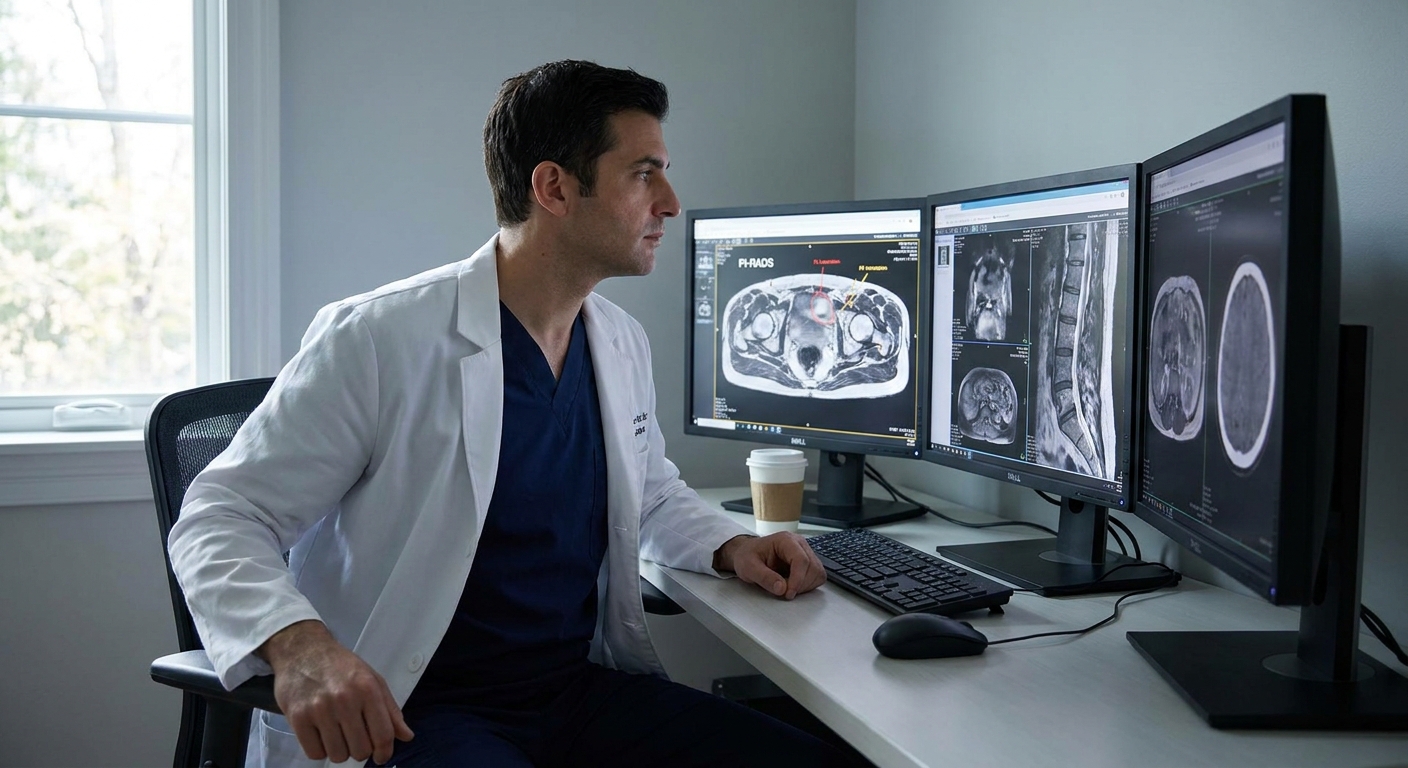
Prostate MRI radiologist jobs reward radiologists who can score PI-RADS v2.1 lesions fast and consistently, not radiologists who happen to read a prostate MRI once a month between general body studies. This guide separates real subspecialty openings from listings that bolt "PI-RADS" onto a generic body imaging job description.
- Prostate MRI radiologist jobs pay for volume — target practices reading prostate MRI regularly, not shops that see one every few weeks.
- Subspecialty-only reading contracts are among the fastest-growing prostate MRI radiologist jobs in 2026 — confirm the PI-RADS QA feedback loop before signing.
- Fellowship-trained GU and abdominal radiologists get RVU premiums on prostate MRI relative to general body imaging reads.
- Skip listings where prostate MRI is one line inside a 40-study-type job description — no dedicated volume means no calibration.
Why this matters
Prostate MRI volume has grown every year since the AUA and ACR started recommending multiparametric MRI (mpMRI) ahead of biopsy, and PI-RADS v2.1 — the current version of the scoring rubric since its 2019 update — is now the default language between radiology and urology. That growth created a split in the job market: some employers built real subspecialty infrastructure around it, and others just added the study type to an existing generalist's plate.
RadBoard aggregates listings from 20 sources into one radiology job platform, and the prostate MRI-specific roles inside that pool look nothing alike. Search radiology jobs on RadBoard and you'll see the split immediately: dedicated GU imaging positions with defined reading volume sitting next to "body imaging, all comers" roles where prostate MRI is an afterthought.
Who this is for
This guide is for radiologists with fellowship training in abdominal imaging, genitourinary (GU) imaging, or body imaging who read PI-RADS-scored prostate MRI regularly and want a job where that skill is the point, not a side task. It's also useful for radiologists finishing fellowship who are trying to figure out whether a listing's "prostate MRI experience preferred" line means real volume or just a checkbox.
What to look for in prostate MRI radiologist jobs for PI-RADS interpretation
Documented mpMRI volume, not a vague estimate
A real prostate MRI radiologist job states or can tell you the weekly or monthly mpMRI volume. If a recruiter can't give you a number, the study type probably isn't concentrated enough to keep your PI-RADS calibration sharp. Volume is what separates a subspecialty job from a generalist job with a prostate MRI line item.
A PI-RADS QA and feedback loop
Groups serious about prostate MRI track PI-RADS 4-5 calls against biopsy pathology and MRI-fusion biopsy results. That feedback loop is how you improve and how the group defends its accuracy to referring urologists. No feedback loop means no way to know if your calls are calibrated to the local biopsy population.
Fusion biopsy integration with urology
The best prostate MRI jobs sit inside or next to a urology practice running MRI-fusion biopsies. Reads that feed directly into a fusion biopsy program carry more clinical weight — and usually more RVU value — than isolated diagnostic-only reads with no downstream correlation.
Compensation tied to study complexity, not flat per-study rates
Prostate mpMRI takes longer to read carefully than a routine abdominal CT, and PI-RADS-scored studies with structured reporting requirements should compensate accordingly. Flat per-study RVU models that treat a prostate MRI the same as a screening study undervalue the work.
Subspecialty scope versus general body imaging overflow
Some roles are GU-only or subspecialty-only reading positions. Others are general body imaging jobs where prostate MRI shows up occasionally between CTs and ultrasounds. Decide which model fits your career goal before you apply — subspecialty-only roles build depth faster, general roles keep you broader.
Call burden and integration with the rest of the practice
Prostate MRI is elective and scheduled, not emergent, so a job heavy on prostate MRI volume should carry lighter overnight call than a general diagnostic role. If a listing promises high prostate MRI volume and full call rotation, the math on your week doesn't add up.
Top picks for prostate MRI radiologist jobs in 2026
Body imaging and abdominal subspecialty groups — the volume play. These practices route prostate MRI through a small pool of GU-trained radiologists instead of spreading it across the whole department, which keeps individual reading volume high and PI-RADS calibration consistent. Body imaging radiologist jobs for abdominal imaging specialists is where these roles concentrate on RadBoard. Verdict: Buy if the group can name its monthly prostate MRI volume.
Subspecialty-only reading contracts — the specialist track. These are teleradiology or hybrid contracts where prostate MRI (and sometimes other GU studies) is the entire job, not a slice of it. They're growing faster than general body imaging postings in 2026 because health systems without in-house GU coverage need to outsource the volume somewhere. Radiology jobs for physicians who want subspecialty-only reading covers what to check before signing. Verdict: Buy for radiologists with 2+ years of dedicated PI-RADS experience.
Fellowship-linked academic GU tracks — the credential builder. Academic prostate imaging positions tied to a fellowship program give you teaching credit and research output alongside clinical volume, which matters if you want to move into a director or informatics role later. Best radiology fellowships for high-paying subspecialty jobs breaks down which fellowships translate into the strongest job offers. Verdict: Consider if academic output matters to your five-year plan; otherwise the pay gap versus private practice makes this a harder sell.
General body imaging roles with occasional prostate MRI — the volume trap. These list prostate MRI as one of a dozen study types with no dedicated PI-RADS QA process and no fusion biopsy integration. You'll read prostate MRI rarely enough that your calibration never sharpens. Verdict: Skip unless the base role is strong enough on its own merits that prostate MRI is genuinely a bonus, not the reason you're applying.
What to avoid
- Listings with no stated prostate MRI volume. If the job posting or recruiter can't quantify it, assume it's low.
- Roles with no PI-RADS QA or biopsy correlation process. Without feedback, you can't confirm your PI-RADS 4-5 threshold matches the group's biopsy outcomes.
- Flat per-study RVU models on complex mpMRI. These undervalue the extra read time structured PI-RADS reporting requires.
Find prostate MRI radiologist jobs faster
Search 5,000+ radiology listings from 20 sources with AI-powered filters.
Verdict comparison
| Setting | PI-RADS Volume | Compensation Model | Verdict |
|---|---|---|---|
| Body imaging / GU subspecialty group | High, concentrated among few readers | RVU or salary tied to study complexity | Buy |
| Subspecialty-only reading contract | High, dedicated to GU/prostate studies | Per-study or contract rate, often teleradiology | Buy |
| Academic GU fellowship track | Moderate, split with teaching/research | Salary, typically below private practice | Consider |
| General body imaging, occasional prostate MRI | Low, inconsistent | Flat per-study RVU | Skip |
FAQ
What's the best radiology job for PI-RADS interpretation in 2026?
Subspecialty-only reading contracts and dedicated GU/body imaging groups are the strongest prostate MRI radiologist jobs in 2026 because they concentrate volume enough to keep PI-RADS calibration sharp. General body imaging roles that read prostate MRI occasionally are the weakest fit.
Is a fellowship required for prostate MRI radiologist jobs?
Most subspecialty prostate MRI radiologist jobs prefer abdominal or GU fellowship training, though it's not always mandatory. Practices with high mpMRI volume typically screen for demonstrated PI-RADS reading experience over the fellowship credential alone.
Do subspecialty-only reading roles pay more than general body imaging jobs?
Subspecialty-only reading contracts generally value complex, structured-reporting studies like prostate MRI higher than flat per-study general body imaging rates. Compare the compensation model, not just the headline number, before comparing offers.
Is teleradiology a good fit for prostate MRI reads?
Teleradiology works well for prostate MRI when the contract specifies dedicated GU volume and a PI-RADS QA feedback process. It works poorly when prostate MRI is mixed into general overnight or overflow reads with no subspecialty focus.
What PI-RADS version should radiologists know for jobs in 2026?
PI-RADS v2.1, updated in 2019, remains the standard scoring system radiology employers expect in 2026. Job listings referencing PI-RADS interpretation assume familiarity with this version's lesion scoring criteria.
How do I know if a prostate MRI job has real volume?
Ask the recruiter or hiring group for a monthly or weekly prostate MRI study count before applying further. A group that can't answer that question likely doesn't have concentrated enough volume to keep your PI-RADS calls calibrated.
Is academic radiology a good path for prostate MRI subspecialists?
Academic GU fellowship tracks offer teaching and research exposure alongside prostate MRI volume, which suits radiologists targeting leadership or informatics roles later. Private practice and subspecialty-only contracts typically pay more for the same clinical volume.
What should I check before signing a prostate MRI teleradiology contract?
Confirm the contract states dedicated prostate MRI or GU study volume, a PI-RADS QA feedback mechanism, and how compensation scales with study complexity. Contracts silent on all three usually mean lower actual volume than advertised.
One last thing
The fastest way to tell a real prostate MRI radiologist job from a generic listing is to ask one question the recruiter should answer instantly: how many prostate MRIs does the group read per month, and who reads them. If that number takes more than a day to get back to you, the volume probably isn't there — RadBoard's 3,700+ tracked listings in 2026 make it easy to compare answers across dozens of practices before you waste time on a call.