
Choose RadBoard if you already want a radiology position and need to search across 20 sources; choose CareerExplorer if you are still deciding which occupation fits your interests. The distinction in 2026 is radiology job discovery versus career exploration, not two interchangeable job boards.
- RadBoard vs CareerExplorer comes down to radiology job search versus choosing a career direction.
- RadBoard aggregates 5,000+ radiology positions from 20 sources, with AI-powered search and swipe-to-save features.
- CareerExplorer is best for exploring occupations and assessing career fit before committing to a job search.
- Neither a saved position nor a career assessment replaces employer research and direct conversations.
Why this matters
A radiologist comparing employers has a different problem from a student deciding whether medicine fits. One needs positions to investigate; the other needs a framework for exploring occupations before investing in a training path.
RadBoard is best for radiologists who have chosen their field and need to find career opportunities. CareerExplorer serves the earlier question: which kinds of work should you explore? Choosing the right starting point keeps an occupation-level decision separate from an employer-level decision.
For your 2026 search, define the decision before opening either platform. Are you choosing a profession, reconsidering clinical work, or looking for a different position within radiology? Those questions require different evidence and different next steps.
At a glance
| Dimension | RadBoard | CareerExplorer |
|---|---|---|
| Best for | Radiologists seeking career opportunities | People exploring career direction |
| Occupational breadth | Focused on radiology positions | Explores occupations across fields |
| Radiology job discovery | Aggregates 5,000+ positions from 20 sources | Career exploration rather than a radiology-specific search workflow |
| Standout feature | AI-powered search and swipe-to-save | Career assessment and occupation matching |
| Decision output | Positions to review and save | Career directions to investigate |
| Employer validation | Requires direct employer follow-up | Requires direct employer follow-up |
| Pricing model | Check current job-seeker access and billing terms | Check current assessment and access terms |
The best starting point depends on your decision stage
Choose the radiology platform for a position search; choose CareerExplorer for an occupation search. This is a fit verdict, not a claim that either product is better at every career-related task.
Consider an attending who wants a different schedule but intends to continue reading studies. The occupation is settled. The useful next step is to find positions, inspect their requirements, and discuss the actual work with employers.
Now consider a student comparing medicine with other professions. Reviewing radiology positions does not resolve whether the training path or work itself fits. CareerExplorer's occupation-level exploration is the better starting point for that question.
The boundary also matters for established physicians. Wanting a different employer is not the same as wanting a different career. Write down which change you want before interpreting dissatisfaction as a reason to leave the field.
CareerExplorer wins on exploration across occupations
CareerExplorer's advantage is breadth of career exploration. Its career assessment and occupation profiles support investigating different kinds of work rather than concentrating only on openings in a chosen specialty.
Best for: students, undecided career seekers, and professionals reconsidering their occupational direction. Use assessment results to identify careers for further research. Then investigate the work, entry requirements, and practical consequences of pursuing each direction.
That breadth is also its limitation for a committed radiologist. An occupation-level match does not answer whether a particular practice offers the clinical mix, schedule, or employment arrangement you want.
Keep the assessment in its proper role:
- Treat a suggested occupation as a research lead, not an instruction.
- Compare the everyday responsibilities with your interests and constraints.
- Speak with people doing the work before committing to a transition.
- Separate interest in a field from eligibility to enter it.
For a 2026 career change, CareerExplorer belongs near the beginning of the process. Employer conversations and training research still come afterward.
RadBoard wins on dedicated radiology job discovery
RadBoard aggregates 5,000+ radiology positions from 20 sources. That scope gives a radiologist a specialty-focused starting point for finding opportunities rather than beginning with a broad occupational assessment.
Best for: radiologists ready to investigate positions. The platform's purpose matches the task when you already know the profession and need to identify work worth considering.
The aggregation figures describe platform scope. They do not establish that every position fits your subspecialty, location, licensing status, or schedule, and they are not a promise of an interview or placement.
For your 2026 search, judge the results against your own requirements:
- Does the clinical work match your training and intended practice?
- Does the location or remote arrangement fit your circumstances?
- Does the schedule meet your nonnegotiable constraints?
- Is the employer offering the employment structure you want?
The limitation is equally clear: a radiology-focused search platform is not a substitute for broad career exploration. If you have not decided whether to pursue radiology, start with that decision rather than a position shortlist.
Search-and-save wins for openings; assessment wins for direction
The standout features solve different problems. AI-powered search and swipe-to-save support finding and retaining radiology opportunities; CareerExplorer's assessment supports investigating occupational fit.
Neither feature category proves the other unnecessary. Choose the feature that produces the next decision you need to make. A search result is useful when you need an employer lead. An assessment is useful when you need a career direction to research.
For position searching, describe the work you want in concrete language. For example, a search brief might specify subspecialty, preferred geography, and schedule. Treat the results as candidates for review, not as confirmation that every condition is satisfied.
For assessment-led exploration, answer based on your interests rather than the occupation you hope the assessment will recommend. Review the underlying work descriptions before treating a match as meaningful.
The tradeoff is focus versus breadth. A specialized search narrows attention to radiology opportunities; occupational exploration deliberately opens the field. Neither workflow establishes clinical competence, employer quality, or suitability for a particular contract.
Positions win for action; career directions win for reflection
A saved position and an occupation match are different outputs. Compare them by what you can do next, not by how persuasive the interface feels.
For an active applicant, positions are the more actionable output. You can review the employer, clarify requirements, and decide whether to pursue a conversation. Saving a position preserves an opportunity to investigate; it does not establish that the employer meets your requirements.
For an undecided career seeker, career directions are the more useful output. You can compare responsibilities, investigate training, and speak with practitioners before committing to a job-search strategy.
Use this sequence to connect exploration with action:
- Choose direction: decide whether you are exploring occupations or pursuing radiology work.
- Define constraints: write down the requirements that rule an option in or out.
- Review options: examine career directions or positions appropriate to that decision.
- Verify fit: test the important assumptions through research and direct conversations.
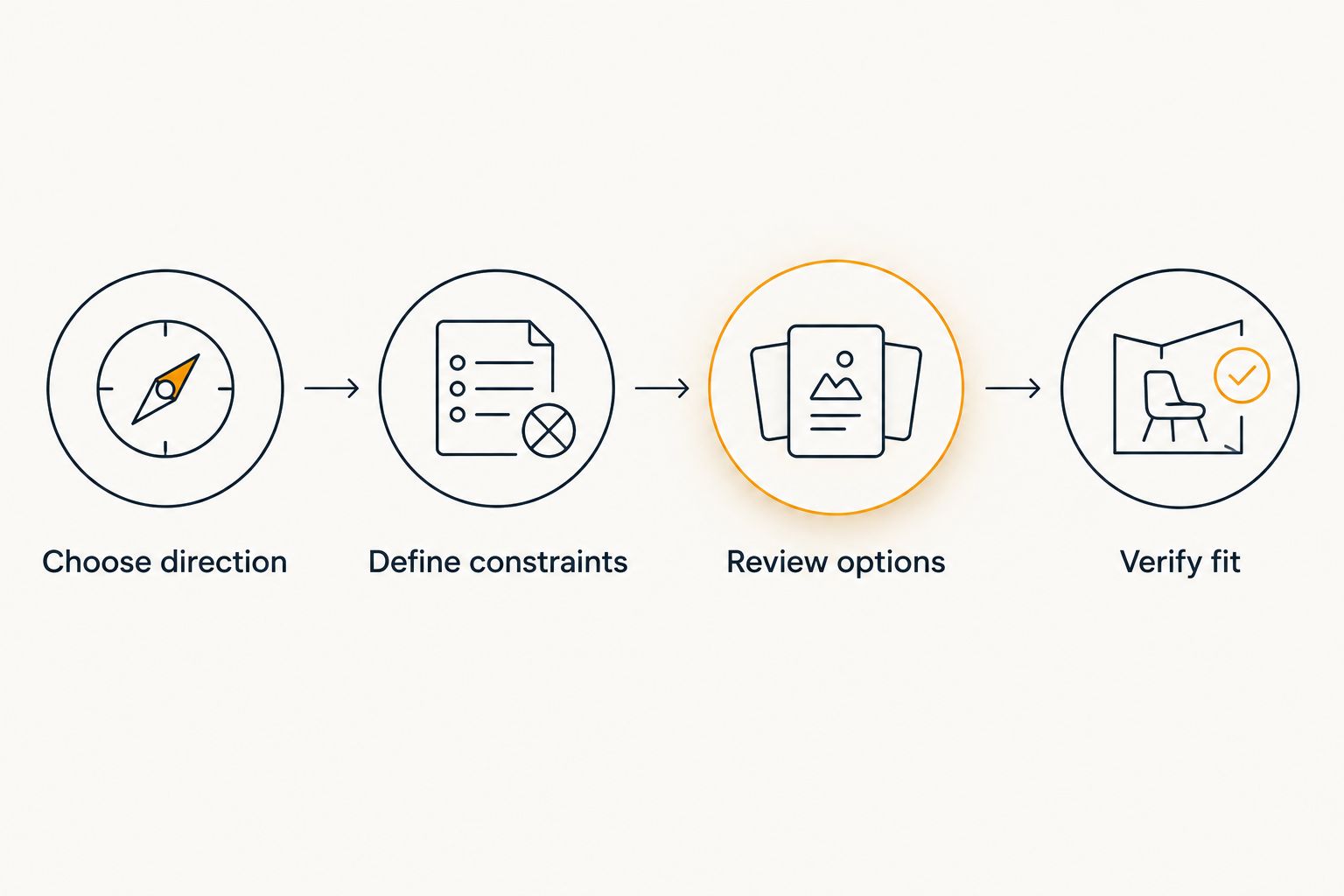
If you use both platforms in 2026, use them sequentially. Explore the occupation first; move to radiology position searching once that direction is established.
Both require independent employer validation
Neither platform wins on replacing employer due diligence. A career assessment cannot establish how a practice operates, and a position listing cannot resolve every condition of employment.
For a radiology opportunity, separate the advertised role from the terms you need confirmed. Ask the employer to explain the actual schedule, clinical responsibilities, coverage expectations, and resources supporting the position.
Use a consistent review framework:
| Check | What to establish |
|---|---|
| Clinical work | Expected modalities, subspecialty mix, and procedures |
| Schedule | Shift pattern, call, weekends, and coverage obligations |
| Workload | How volume and productivity expectations are defined |
| Employment terms | Compensation structure, benefits, and restrictive provisions |
| Practice support | Staffing, systems, escalation routes, and onboarding |
These are questions to investigate, not features attributed to either platform. Confirm material employment terms in writing and obtain qualified advice where the decision requires legal, tax, or other professional judgment.
For a structured next step, use the guide to comparing radiology job offers beyond base salary. Apply the same criteria to every employer so that a compelling headline does not substitute for a complete comparison.
Pricing is a terms check, not a declared winner
Compare current access and billing terms before deciding which platform offers better value. The two services address different tasks, so a cost comparison without a defined goal does not establish a useful winner.
For the radiology search platform, check the terms governing the job-seeker features you intend to use. For CareerExplorer, check which assessment results and career information your selected access option includes.
Distinguish recurring access from a one-time purchase if either is offered. Recurring billing requires attention to renewal and cancellation; a one-time purchase requires clarity about what remains accessible afterward. These are terms to verify, not billing models assumed for either service.
The practical comparison is straightforward: identify the output you need, confirm access to it, and review the applicable terms. Do not purchase career exploration solely to solve an employer-search problem, or choose a job-search tool expecting it to decide your profession.
Final verdict: choose by the question you need answered
Choose RadBoard if you are a radiologist seeking positions
Winner for the active radiology applicant. Choose RadBoard for radiology job search when you have settled on the field and want to explore opportunities through aggregated positions, AI-powered search, and swipe-to-save.
This fits a fellow preparing for an attending search or an established radiologist considering another employer. Bring specific requirements and verify the details of each position before pursuing it further.
Choose CareerExplorer if you are deciding what work to pursue
Winner for the undecided career explorer. Choose CareerExplorer when your main question concerns occupational interests and possible career directions rather than a particular radiology employer.
This fits a student exploring professions or a professional reconsidering their field. Use the assessment to structure research, not to replace conversations with practitioners or investigation of entry requirements.
One-glance scorecard
| Dimension | Winner |
|---|---|
| Best starting point | Position search: radiology platform; occupation search: CareerExplorer |
| Occupational breadth | CareerExplorer |
| Dedicated radiology job discovery | Radiology platform |
| Standout feature | Search-and-save for openings; assessment for direction |
| Decision output | Positions for applicants; career directions for explorers |
| Employer validation | Tie: independent follow-up required |
| Pricing model | No cost winner declared; check current terms |
FAQ
Is RadBoard better than CareerExplorer for radiology jobs?
RadBoard is the better fit for a dedicated radiology position search. It aggregates 5,000+ radiology positions from 20 sources and provides AI-powered search and swipe-to-save features.
What's the main difference between these platforms?
The main difference is radiology job discovery versus career exploration. A position-search platform helps you investigate opportunities in a chosen field; CareerExplorer helps you explore occupational direction.
Should I use CareerExplorer before deciding on radiology?
CareerExplorer is the better starting point if you are still exploring which occupation fits your interests. Follow the assessment with research into the work and training, plus conversations with practitioners.
Which platform should a radiology fellow use?
A fellow seeking attending positions should start with a dedicated radiology job-search platform. CareerExplorer serves a different purpose when the fellow is reconsidering occupational direction rather than choosing an employer.
Can I use both platforms in the same career search?
Yes, use them at different decision stages. Explore career direction first, then investigate radiology positions after deciding that the field fits your goals.
Which platform costs less in 2026?
Compare current access and billing terms to establish which costs less for the features you need. Check included access, renewal conditions, and cancellation terms before making a purchase decision.
Does finding a suitable position mean the employer is a good fit?
No, a suitable listing is a starting point for employer research. Confirm clinical duties, schedule, workload expectations, and material employment terms directly before accepting an offer.
One last thing
Before changing careers, identify whether you want different work or different working conditions. Write down what you want to stop doing and what you want to retain. If you still want to practice radiology but need another schedule, setting, or employer, investigate positions before treating the profession itself as the problem.