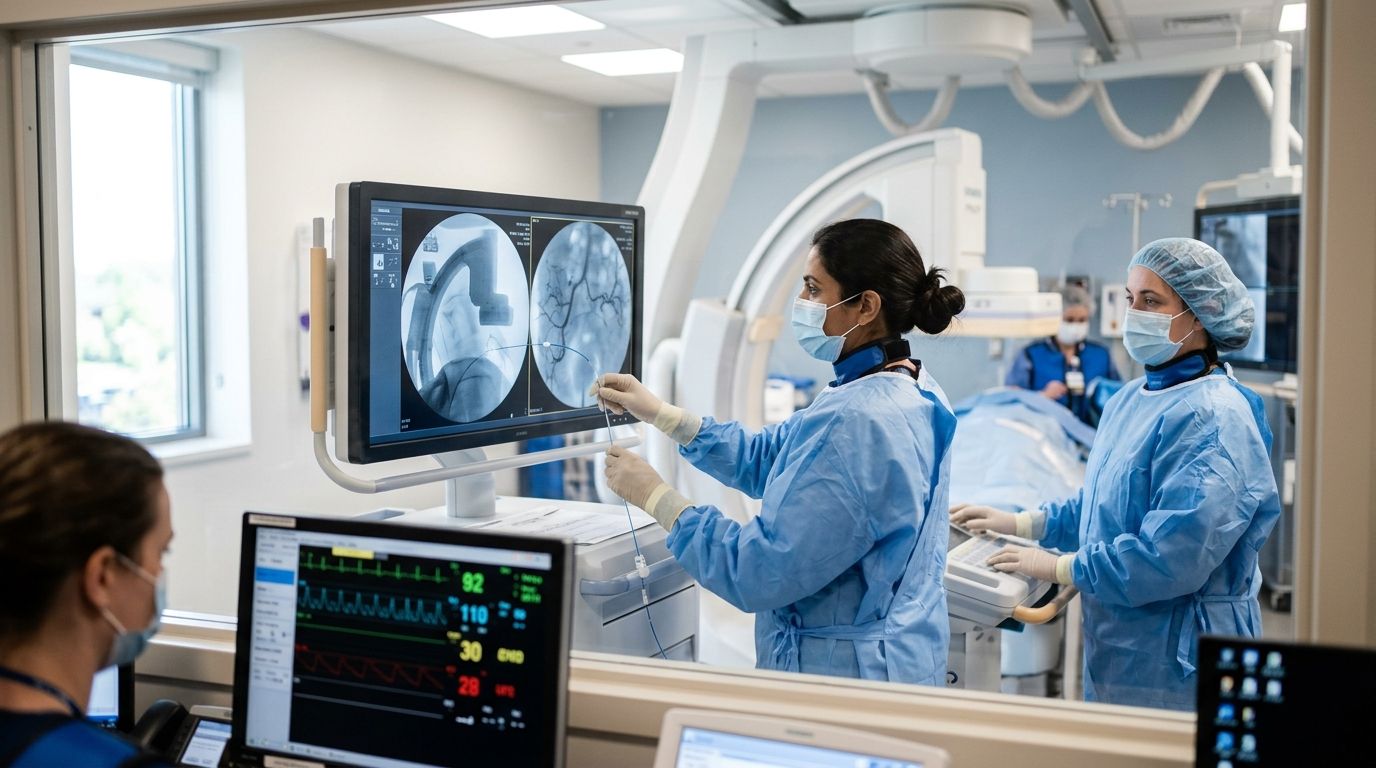
Clinical radiologists leave the reading room for industry or consulting by identifying which specific skill has payable value outside a PACS terminal, then targeting one of four exit lanes: medical-device and AI companies, legal and IME expert witness work, quality assurance and peer review, or radiology informatics. Board certification and an active state license remain the baseline requirement on most postings, even for roles that never touch a workstation again.
The hidden catch nobody mentions upfront: most non-clinical roles pay less per hour than a full clinical panel in 2026, and you have to rebuild a professional network outside your current group or hospital system almost from scratch.
- Non-clinical radiology roles trade RVU pay for stability, but hourly compensation usually drops in the first 1-2 years after the switch.
- Medical-device and AI imaging companies hire radiologists for clinical validation, not coding, so residency-level Python is not required.
- Expert witness and IME work pays per case and stacks onto part-time clinical work instead of replacing it outright.
- Quality assurance and peer review roles are the lowest-friction exit because they still require an active state license and board certification.
- RadBoard tracks 5,000+ radiology postings from 20 sources, including a growing 2026 category for non-clinical and industry roles.
Why this matters
Radiologists searching "how to leave clinical radiology" in 2026 are usually not burned out on imaging itself — they're burned out on volume, call, and productivity metrics attached to it. Industry and consulting roles remove the volume pressure but they don't remove the credentialing bar: nearly every posting for a medical director, clinical advisor, or peer-review radiologist still lists active board certification as non-negotiable.
The practical problem is discoverability. Non-clinical radiology jobs don't show up on the same boards as staff attending postings, and they get filled through networks faster than they get posted publicly. Knowing where these roles live, and how to package a CV that reads as an asset rather than a departure, is most of the work.
How to leave clinical radiology for industry and consulting
The transition follows a repeatable sequence regardless of which lane you pick:
- Audit your transferable skill, not your subspecialty. Protocol design, structured reporting, and workflow QA translate directly to industry; reading volume does not.
- Pick one lane before you start applying. Splitting effort across non-clinical radiology jobs at AI and imaging tech companies, expert witness work, and informatics at once dilutes your pitch in every interview.
- Keep your license and boards active during the search. A lapsed license disqualifies you from re-entry paths and from most IME and peer-review contracts.
- Start part-time before going all-in. Locum shifts or per-diem reads fund the 6-12 month runway most non-clinical searches take in 2026.
- Target the hiring manager, not the job board. Medical-device companies and staffing firms fill clinical-advisor roles through referrals before they post publicly.
Comparing the four exit lanes
| Exit lane | Best for | Trade-off |
|---|---|---|
| Medical-device / AI companies | Radiologists who want product influence over a specific modality | Slower ramp; requires business fluency, not just clinical judgment |
| Legal / IME expert witness | Radiologists who want to keep reading part-time while adding income | Irregular caseload; requires deposition and report-writing comfort |
| Quality assurance / peer review | Radiologists who want the lowest-friction, license-preserving exit | Still tied to case volume, just someone else's cases |
| Radiology informatics | Radiologists with PACS, HL7, or workflow-integration experience | Steep learning curve if IT exposure has been limited |
Medical-device and AI companies: the highest-ceiling lane
Companies building CAD, triage, or reporting-automation software need practicing or recently-practicing radiologists to validate outputs against real reads. This is the fastest-growing non-clinical category on RadBoard in 2026, and it rewards radiologists who can articulate exactly where an algorithm's false negatives cluster. Verdict: best for radiologists with strong opinions about AI accuracy who want to shape a product instead of just using one.
Legal and IME consulting: the lane that pairs with clinical work
Expert witness and independent medical examination work doesn't require leaving clinical radiology outright — most radiologists doing it in 2026 still read part-time. Cases pay per file or per deposition, and the credentialing bar is simply active board certification plus a clean history. Review expert witness radiologist jobs for legal and IME consulting before assuming this requires a full departure from patient-facing reads.
Quality assurance and peer review: the lowest-friction exit
QA and peer-review roles keep you inside the clinical credentialing system — active license, active boards, sometimes hospital privileges — while removing daily read-volume targets. Health systems and radiology groups added more of these postings through 2026 as malpractice and accreditation pressure increased. Verdict: best for radiologists who want out of the reading queue without walking away from clinical credentialing entirely.
Radiology informatics: the technical bridge
If you've built structured-reporting templates, worked PACS migrations, or sat on an informatics committee, that experience converts directly into a full-time informatics role. These jobs sit closer to IT than to a reading room, and demand for them grew alongside AI-assisted dictation and reporting tools in 2026. Verdict: best for radiologists who already have hands-on PACS or HL7 exposure, not for radiologists hoping to learn it on the job.
Why the timeline varies
- Subspecialty demand. Neuroradiology and body imaging translate more easily into device-validation roles than niche procedural work.
- Existing network. Radiologists who've sat on hospital committees or vendor advisory boards move faster because the referral already exists.
- License and boards status. A lapsed license or certification adds months to any non-clinical application.
- Willingness to go part-time first. Radiologists who keep 0.5-0.6 FTE clinical work while searching close offers faster than those who quit outright.
- Geographic flexibility. Remote-friendly non-clinical roles draw far more applicants than location-tied ones, which slows the process for competitive listings.
Search non-clinical radiology jobs now
Browse 5,000+ radiology postings from 20 sources, filtered by category.
Do you need a fellowship to leave clinical radiology for industry?
No fellowship is required to move into most non-clinical radiology roles in 2026 — board certification and a clean licensing history matter more than subspecialty training for device-validation, QA, and informatics jobs. Fellowship-trained radiologists still have an edge in roles tied to a specific modality, like breast imaging AI or cardiac CT software.
Can you keep reading clinically while transitioning?
Yes, and most radiologists do — part-time or locum clinical work funds the search runway and keeps licensure active during a non-clinical transition in 2026. Expert witness, IME, and some QA roles are explicitly built to run alongside a reduced clinical schedule rather than replace it.
How do you find non-clinical radiology job postings?
Non-clinical postings rarely appear on general job boards, so filtering by category on an aggregator built for radiology, rather than searching hospital career pages one by one, is the fastest route in 2026. Setting up AI-powered job matching against a specific non-clinical category surfaces listings that generic search engines miss entirely.
FAQ
How do you leave clinical radiology without losing your license?
You keep your license and board certification active throughout the transition, since nearly every non-clinical radiology role in 2026 still requires both as a baseline. Letting either lapse closes off re-entry to clinical work later.
What non-clinical radiology jobs pay the most?
Medical-device and AI clinical-advisor roles generally offer the highest ceiling because compensation ties to equity or leadership scope, not RVUs. Legal and IME consulting pays well per case but depends on caseload volume rather than a fixed salary.
Is quality assurance radiology a good first step out of clinical work?
Quality assurance and peer review is the lowest-friction first step because it keeps your license and boards active while removing daily read-volume pressure. It's a good bridge role for radiologists unsure which non-clinical lane fits long term.
Do you need coding experience for radiology informatics jobs?
No, most radiology informatics roles in 2026 prioritize PACS, HL7, and workflow-integration experience over coding ability. Radiologists who've led a PACS migration or built reporting templates are stronger candidates than those with only theoretical IT interest.
Can radiologists do expert witness work part-time?
Yes, expert witness and IME consulting is structured as per-case work, so most radiologists doing it in 2026 keep a part-time clinical schedule alongside it. It functions as supplemental income rather than a full replacement for clinical pay.
How long does it take to transition from clinical to industry radiology?
Most radiologists report a 6-to-12 month runway between starting the search and landing a non-clinical offer in 2026, funded by part-time or locum clinical shifts. Radiologists with an existing industry network or committee experience move faster.
Do non-clinical radiology jobs require board certification?
Yes, active board certification is listed on nearly every non-clinical radiology posting in 2026, including device-validation, QA, and informatics roles. It functions as a credibility signal even when the job never touches a PACS terminal.
One last thing
The radiologists who land non-clinical offers fastest in 2026 aren't the ones with the most polished CV — they're the ones who picked one lane and stopped applying to all four at once. A scattered application history across device companies, law firms, and informatics teams reads as indecision to every hiring manager reviewing it.