
Salary.com provides a useful starting point for occupation-level salary research, but an estimate does not establish what a particular radiology practice will pay for your schedule and workload. Radiologist compensation research also requires a distinction between advertised terms, survey benchmarks, and written offers. The best Salary.com alternative in 2026 is RadBoard for finding radiology opportunities to investigate; MGMA is the better choice for physician compensation benchmarking.
- For salary.com alternatives radiologist salary research, separate job listings from physician compensation benchmarks.
- RadBoard aggregates 5,000+ radiology positions from 20 sources; use it to find opportunities, not establish compensation percentiles.
- MGMA and AMGA provide physician compensation surveys; check definitions before comparing an offer.
- Medscape and Doximity provide report-level context, not a substitute for written compensation terms.
Why this matters
A radiologist salary estimate answers a different question from an employer's compensation proposal. One describes a reference population; the other describes your contractual obligations and payment formula. Treating them as interchangeable weakens your negotiation.
For a 2026 job search, separate three decisions: which opportunities to investigate, which benchmark population fits your practice, and which compensation terms you can verify. Choose the source by the question it answers—not by the largest figure it displays.
Salary.com alternatives at a glance
| Source | Best for | Standout feature | How it differs from Salary.com |
|---|---|---|---|
| Salary.com | Initial occupation-level salary research | Salary estimates organized around job roles | Baseline reference; not a written radiology offer |
| RadBoard | Finding radiology opportunities to investigate | 5,000+ positions aggregated from 20 sources, with swipe-to-save features | Job discovery rather than a compensation survey |
| MGMA | Physician compensation benchmarking | Provider compensation and productivity survey data | Physician-focused benchmark research |
| AMGA | Medical-group compensation benchmarking | Medical-group compensation and productivity surveys | A medical-group survey perspective |
| Medscape | Broad physician compensation context | Physician compensation reporting by specialty | Report-level context rather than an individualized salary estimate |
| Doximity | Broad physician compensation comparisons | Physician compensation reports | A physician-specific reporting perspective |
These sources are complementary. A job platform helps you identify an employer to question; a survey helps you frame those questions. Neither replaces the compensation schedule attached to an employment agreement.
1. RadBoard: best for finding radiology opportunities
RadBoard is a radiology job search platform aggregating 5,000+ positions from 20 sources. Its search and swipe-to-save features support opportunity discovery and shortlisting. Use the platform to identify positions worth investigating, then obtain compensation details directly from the employer.
The important distinction is between a job search platform and a salary database. A collection of openings is not a representative survey of what employed radiologists earn, and aggregation alone does not establish a compensation median.
Where it shines
- Radiology-specific opportunities keep your search focused on the specialty.
- Aggregation brings positions from multiple sources into one search platform.
- Swipe-to-save supports a shortlist that you can investigate further.
Where it falls short
- It is not a replacement for a physician compensation survey.
- A position's presence does not establish its guaranteed pay or productivity formula.
- You still need the employer to confirm workload, benefits, call, and compensation terms.
| Dimension | Job platform | Salary.com |
|---|---|---|
| Main question | Which radiology opportunities should you investigate? | What salary estimate fits the selected role? |
| Evidence type | Aggregated job opportunities | Salary estimates |
| Negotiation role | Identifies employers and positions to question | Provides an initial reference point |
| Essential follow-up | Obtain written employment terms | Check methodology and role fit |
Best for: Radiologists building an opportunity shortlist before comparing offers.
Verdict: Use RadBoard for radiology job discovery; pair it with compensation benchmarks rather than treating listings as survey data.
2. MGMA: best for physician compensation benchmarking
MGMA's provider compensation research focuses on physician compensation and productivity. That makes MGMA a more relevant starting point when your question concerns the relationship between compensation, practice characteristics, and clinical output—not simply a job title.
Start with definitions. Before quoting a benchmark in a negotiation, establish what the selected compensation measure includes and whether the comparison population fits the position under discussion.
Where MGMA shines
- Physician-focused compensation research fits a physician employment discussion.
- Compensation and productivity measures support a workload-aware comparison.
- Survey methodology gives you a basis for examining the benchmark's scope.
Where MGMA falls short
- A survey benchmark does not establish what a particular employer will offer.
- A national or broadly grouped result does not automatically fit your subspecialty or schedule.
- A percentile loses meaning when the employer and survey use different compensation definitions.
| Dimension | MGMA | Salary.com |
|---|---|---|
| Primary use | Physician compensation benchmarking | Occupation-level salary research |
| Clinical workload | Compensation and productivity research | Check the selected estimate's scope |
| Evidence to inspect | Survey definitions and comparison population | Estimate methodology and role definition |
| What neither establishes | Your contractual payment terms | Your contractual payment terms |
For a 2026 negotiation, check the survey's collection period separately from its publication date. A report released during your search does not necessarily describe compensation earned during that same period.
Best for: Radiologists evaluating a physician compensation benchmark alongside productivity expectations.
Verdict: Use MGMA when you need a defined physician benchmark; do not use a percentile as a substitute for contract analysis.
3. AMGA: best for a medical-group benchmark perspective
AMGA publishes medical-group compensation and productivity survey research. Use AMGA when you want to examine compensation through a medical-group lens and compare that evidence with the structure of your prospective position.
The comparison still requires discipline. Hospital employment, academic responsibilities, ownership, and clinical duties belong in your evaluation; a specialty label alone does not make two jobs equivalent.
Where AMGA shines
- Medical-group survey research supplies a distinct benchmark perspective.
- Compensation and productivity measures support questions about expected output.
- Methodology provides a reference for assessing the survey population.
Where AMGA falls short
- Participating groups do not represent every possible radiology employment arrangement.
- Survey results do not disclose the terms of your prospective contract.
- You must check whether the available categories match the role you are evaluating.
| Dimension | AMGA | Salary.com |
|---|---|---|
| Research focus | Medical-group compensation and productivity | Salary estimates by role |
| Useful question | Does this benchmark fit the employment setting? | Does this estimate fit the occupation? |
| Required check | Survey population and measure definitions | Methodology and job definition |
| Negotiation limit | Benchmark, not an employer commitment | Estimate, not an employer commitment |
Ask the employer which benchmark it uses and why. Then ask whether its comparison reflects your full duties, including administrative work, teaching, procedures, and call where applicable. Those questions are more useful than debating an isolated average.
Best for: Radiologists seeking a medical-group compensation reference alongside other physician survey evidence.
Verdict: Use AMGA as a defined comparison source, not as proof that every group should pay the same amount.
4. Medscape: best for broad specialty context
Medscape's physician compensation reporting provides specialty-level context. Use it to orient your research and identify questions for a deeper benchmark review, not to calculate the precise value of an individual offer.
Where Medscape shines
- Physician-focused reporting gives radiology compensation a specialty context.
- Report summaries support an initial understanding of the compensation discussion.
Where Medscape falls short
- A specialty-wide result does not define your subspecialty, schedule, or employment arrangement.
- Report-level findings do not establish an employer's payment formula.
| Dimension | Medscape | Salary.com |
|---|---|---|
| Main role | Physician compensation context | Role-based salary estimate |
| Comparison unit | Report's physician or specialty population | Selected occupation and estimate scope |
| Best next step | Inspect methodology and seek a matched benchmark | Inspect methodology and verify role fit |
Best for: Radiologists starting compensation research before reviewing a detailed offer.
Verdict: Use Medscape for orientation; skip treating a specialty average as your negotiating floor.
5. Doximity: best for another physician-report perspective
Doximity publishes physician compensation reports. Use Doximity to add another reporting perspective, while checking the population, methodology, and definitions behind any comparison you intend to cite.
Where Doximity shines
- Physician-specific reporting is relevant to physician career research.
- A separate report gives you another source whose methodology you can examine.
Where Doximity falls short
- Report-level findings do not establish a local employer's compensation terms.
- Agreement between headline figures does not prove that the underlying populations match.
| Dimension | Doximity | Salary.com |
|---|---|---|
| Evidence | Physician compensation reporting | Role-based salary estimates |
| Useful purpose | Additional physician-market context | Initial salary reference |
| Required caution | Check population and definitions | Check role fit and methodology |
Best for: Radiologists comparing broad physician compensation reports before selecting a benchmark.
Verdict: Use Doximity as additional context, not as an independent valuation of your offer.
Why people switch from Salary.com
The reason to move beyond Salary.com is a change in the question you need answered. An initial salary estimate is useful; a radiology employment decision requires more specific evidence.
Use another source when you need to:
- Find actual opportunities. Salary research does not replace a radiology job shortlist.
- Examine physician productivity. Match compensation research to the clinical output expected under the proposed agreement.
- Distinguish employment settings. Evaluate the survey population rather than assuming all radiology positions share one compensation model.
- Verify an offer. Ask for guaranteed compensation, contingent payments, and the conditions attached to each.
There is no need to discard an initial estimate. Retain it as background and stop asking it to resolve questions that require an employer document or a defined physician survey.
How to compare compensation evidence in 2026
Build your comparison around the position, not the headline salary. Use the same sequence for every employer so that an attractive presentation does not distract you from different obligations.
Define the role
Record subspecialty expectations, clinical duties, employment setting, and administrative responsibilities. Keep diagnostic interpretation and procedural obligations explicit rather than combining them under a generic radiologist title.
Normalize workload
Record contracted hours, shifts, call, leave, and productivity expectations. Use the employer's definition of 1.0 FTE rather than assuming full-time means the same schedule across practices.
Separate compensation
Distinguish guaranteed compensation from productivity payments, discretionary bonuses, and ownership-related distributions. Compare recurring annual compensation separately from one-time payments, and identify the conditions attached to each component.
Match benchmarks
Check the benchmark's specialty category, population, compensation definition, and reporting period. Compare a 12-month compensation period with another annual period; do not annualize temporary coverage without documenting the work assumptions.
Verify terms
Request written explanations of the productivity formula, payment timing, reconciliation process, and deductions. If an employer cites a percentile, ask for the source and the exact measure being compared.
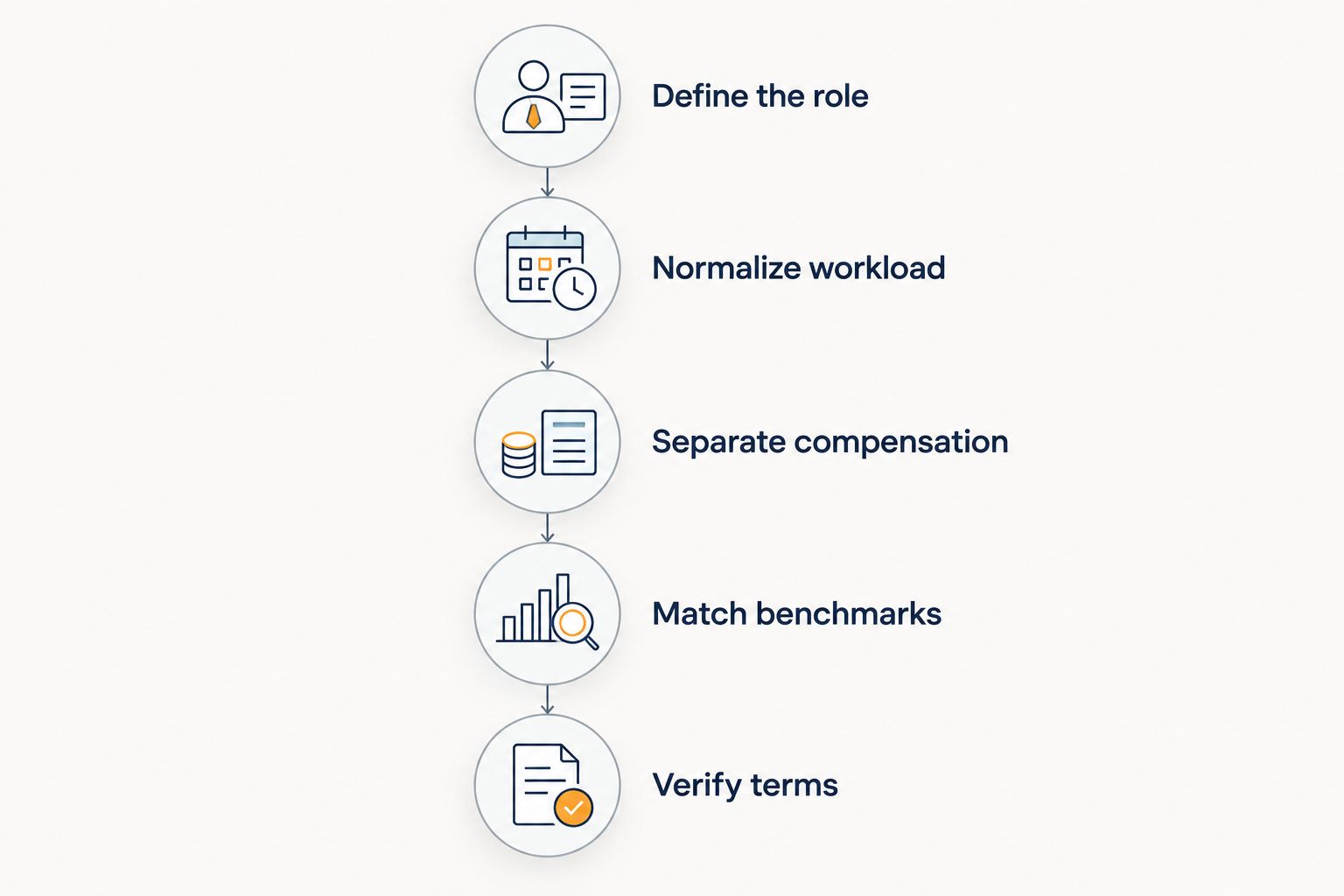
A compensation comparison should end with a clear distinction between what the employer guarantees and what depends on future performance. The guide to comparing radiology job offers beyond base salary provides a related framework for examining the rest of the package.
When staying with Salary.com is the right call
Stay with Salary.com when you need an initial occupation-level reference and understand its limits. It remains useful as a starting point before you gather position-specific information.
Where it helps: Early research and a first-pass salary reference.
Where it falls short: Resolving physician productivity questions, ownership economics, and the enforceable terms of a particular offer.
For your 2026 decision, the objective is not to replace one website with another. It is to assign each source a specific job: discover opportunities, examine benchmarks, or verify contractual terms.
FAQ
What's the best Salary.com alternative for radiologist salary research?
MGMA is the better fit for physician compensation benchmarking, while RadBoard is the better fit for radiology job discovery. Use survey evidence and employer terms together rather than treating a job listing as a compensation benchmark.
Is a radiology job platform better than a salary survey?
A job platform is better for finding opportunities; a salary survey is better for examining a defined compensation population. Neither replaces the employer's written payment terms.
Is MGMA better than Salary.com for a radiology offer?
MGMA is the more relevant choice when you need physician compensation and productivity benchmarks. Check the survey definitions and population before applying a result to your offer.
Should I use AMGA or MGMA compensation data?
Use the source whose methodology and comparison population best match your position. Ask the employer which survey it uses and whether its compensation definition matches the offer.
Can I negotiate using Medscape or Doximity reports?
Use Medscape and Doximity reports as background context, not as a precise valuation of an individual job. Support your request with matched benchmarks, documented duties, and written offer terms.
How do I check whether salary data is current in 2026?
Check the collection period, publication date, and methodology separately. A report published in 2026 does not automatically describe compensation earned in 2026.
What should I compare besides base salary?
Compare guaranteed compensation, contingent payments, workload, call, leave, benefits, and ownership terms. Keep one-time payments separate from recurring compensation and obtain the payment formula in writing.
One last thing
A compensation percentile is incomplete without its workload and population definitions. Before negotiating a 2026 offer, ask the employer to explain both sides of the comparison: what its compensation figure includes and what work it expects in return.
Do not average figures from different sources simply because they all say radiologist. A defensible comparison uses compatible definitions; several incompatible figures do not become reliable when combined.