
Choose RadBoard if you want a radiology-specific search across 5,000+ positions from 20 sources; choose PracticeMatch if you want a physician career platform covering multiple specialties. For your 2026 search, the main distinction is specialty-focused aggregation versus broader physician recruitment—not a proven difference in hiring outcomes.
- RadBoard vs PracticeMatch comes down to radiology-specific aggregation versus a broader physician career platform.
- RadBoard is best for radiologists who want aggregated job search and swipe-to-save shortlisting.
- PracticeMatch is best for physicians comparing opportunities across multiple medical specialties.
- Neither platform replaces direct confirmation of compensation, call responsibilities, case mix, or contract terms.
Why this matters
A radiology opening is useful only when its clinical work and employment terms match your requirements. A recognizable employer name does not answer whether you will read within your subspecialty, cover overnight shifts, perform procedures, or rotate between facilities.
Choose your search platform around how you discover jobs; choose your employer around the work you will actually do. Those are separate decisions. This comparison addresses the first and gives you a practical framework for the second.
For a 2026 search, distinguish platform features from employer promises. Search tools help you identify possibilities, but the employer must confirm the schedule, compensation structure, clinical expectations, and hiring process.
At a glance
| Dimension | RadBoard | PracticeMatch |
|---|---|---|
| Best for | Radiologists seeking a specialty-specific search | Physicians seeking a broader medical career platform |
| Specialty scope | Radiology-focused | Covers multiple physician specialties |
| Source coverage | Aggregates 5,000+ radiology positions from 20 sources | Physician job-search platform; do not assume equivalent aggregation |
| Search workflow | AI-powered search and swipe-to-save | Physician opportunity search across specialties |
| Multi-specialty planning | Focused on the radiologist's search | Better fit when your search includes different physician specialties |
| Standout feature | Aggregation combined with search and swipe-to-save | Breadth beyond a single medical specialty |
| Offer verification | Confirm terms directly with the employer | Confirm terms directly with the employer |
| Pricing model | Check current candidate and employer access terms separately | Check current candidate and employer access terms separately |
A radiology-only search favors the specialist platform
RadBoard is best for radiologists who want aggregated radiology job discovery and swipe-to-save shortlisting. Its stated scope is specific: 5,000+ positions gathered from 20 sources, with search features built around finding career opportunities in radiology.
That makes it the clearer starting point when you already know the profession and need to narrow the actual job. Your questions concern subspecialty, location, practice setting, schedule, and clinical responsibilities—not which medical specialty to enter.
The limitation is equally clear. A radiology-focused platform is not a substitute for a broader physician search when you need opportunities outside radiology. Specialty focus is an advantage only when it matches the scope of your decision.
PracticeMatch is the better starting point for a physician whose search spans different specialties. For a radiologist conducting a strictly radiology search, that broader scope is not, by itself, an advantage.
PracticeMatch fits a broader physician search
PracticeMatch serves physician recruitment across medical specialties. Its advantage is breadth when your decision includes more than radiology. That is a different problem from collecting radiology opportunities into a specialty-specific search.
Consider a relocating physician household with a radiologist and a physician in another specialty. A multi-specialty platform fits the shared task of exploring medical opportunities in the same region, while a radiology-only platform addresses just one person's search.
Do not confuse broader specialty coverage with better radiology coverage. A platform's ability to serve different physician audiences does not establish how many relevant breast imaging, neuroradiology, or interventional radiology openings it contains.
For your 2026 comparison, decide whether you need specialty depth or a shared starting point across specialties. That choice is more useful than treating total platform breadth as an automatic measure of quality.
Aggregation is the specialist platform's concrete distinction
The stated aggregation model brings 5,000+ radiology positions from 20 sources into one platform. That is a concrete discovery feature, not evidence of exclusive jobs or more successful placements.
An aggregated position count also does not tell you how many openings match your geography, training, schedule, or preferred practice structure. Apply those requirements before judging the usefulness of the search results.
Use the source information attached to an opportunity to understand where it originated. When similar descriptions appear during your search, compare the employer, location, clinical responsibilities, and application destination before treating them as separate opportunities.
PracticeMatch remains a separate physician-search option. There is no basis here for declaring either platform's radiology inventory larger, fresher, or more exclusive than the other's. Judge coverage against your requirements, not an unsupported inventory contest.
Search and swipe-to-save suit active shortlisting
The specialist platform combines AI-powered search with swipe-to-save. That combination fits a radiologist who wants to discover opportunities and retain promising listings for closer review. Saving a listing is a screening action, not a clinical or contractual endorsement.
Keep your first pass narrow. Identify the work you want, retain plausible matches, and reject obvious mismatches before spending time on detailed employer discussions.
For example, a subspecialist seeking daytime remote work should distinguish that preference from general diagnostic coverage that includes evenings or weekends. Read the description rather than assuming the job title captures the full schedule.
PracticeMatch is a reasonable choice if you prefer to conduct your search within its broader physician platform. No verified head-to-head usability evidence establishes which interface is faster, so test both against the same requirements instead of accepting a speed claim.
PracticeMatch better fits multi-specialty planning
Choose PracticeMatch for a search that needs to include different physician specialties in the same planning process. This is especially relevant when location is a shared decision rather than an individual radiology preference.
Start with the region, then evaluate each physician's opportunities separately. A location that works for one specialty is not automatically a match for the other, and a shared platform does not turn separate hiring processes into a joint offer.
The tradeoff is focus. A broad medical career search still requires the radiologist to assess radiology-specific issues such as reading responsibilities, procedural expectations, call coverage, and practice ownership.
If only the radiologist is changing jobs, the multi-specialty advantage becomes less relevant. Use the narrower platform for radiology discovery and expand your search when a specific unmet need justifies it.
The standout features solve different discovery problems
The specialist platform's distinctive combination is aggregation, AI-powered search, and swipe-to-save. PracticeMatch's relevant distinction in this comparison is a physician career platform that extends beyond radiology.
Pick the feature that removes a real step from your search. Aggregation matters when you want opportunities collected from different sources. Multi-specialty coverage matters when you need to explore physician careers beyond one field.
Neither distinction proves better job matching. You still need to examine whether the results meet your clinical and employment requirements, and whether the saved opportunities survive direct employer follow-up.
Use a simple test: can you turn a search result into a clear reason to contact the employer? If the answer rests only on an appealing title, you have not yet learned enough to recommend the position to yourself.
Both require the same employer verification
Neither platform replaces employer due diligence. Treat a listing as the beginning of a conversation, then obtain clear answers about the actual position before investing in interviews or relocation planning.
Use the same screening framework regardless of where you found the role. Consistent questions make opportunities easier to compare and prevent a polished description from receiving less scrutiny than a sparse one.
Record these 4 fields for every serious opportunity:
- Clinical work: Ask which modalities, subspecialties, and procedures the position actually covers.
- Schedule: Confirm working hours, time zone, weekends, overnight responsibilities, and call expectations.
- Employment structure: Establish who employs you, where you work, and whether partnership is part of the proposed arrangement.
- Contract terms: Request written detail on compensation structure, benefits, malpractice coverage, and termination obligations.
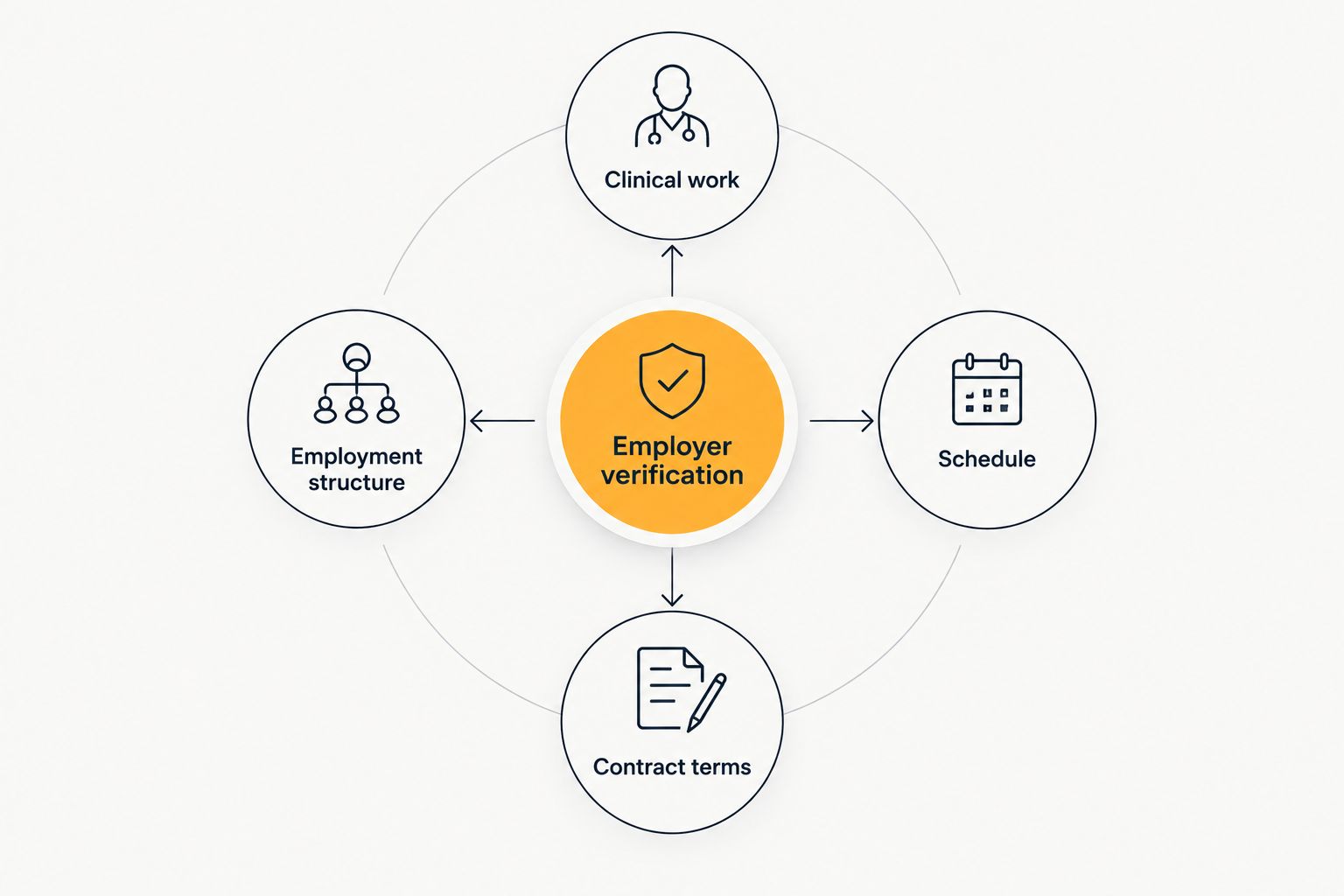
For a 2026 shortlist, mark each field as confirmed or unresolved. Do not convert an unanswered question into an assumed benefit; carry it into your next employer conversation.
Make comparisons at the position level
Two roles with the same title can describe different work. Ask the employer to explain the expected reading mix, procedural responsibilities, coverage locations, and how the proposed schedule operates in practice.
Keep discovery quality separate from offer quality. A platform deserves credit for helping you find a relevant opportunity, but the employer remains responsible for explaining and documenting the job.
Pricing: separate candidate access from employer services
Check each platform's current access and billing terms before committing. Candidate job search and employer recruitment are different uses, so establish which service a quoted charge or subscription actually covers.
For either platform, compare the billing basis, renewal conditions, cancellation terms, and features included in the service you intend to use. Do not assume that an employer recruitment arrangement describes what an individual physician needs.
A subscription model favors predictable recurring access; a usage-based model ties spending to activity. Those are general tradeoffs, not assigned pricing models for either platform in this comparison.
For your 2026 decision, evaluate the terms presented at the point of use. No cost advantage should decide this comparison without matching the same user type, service scope, and billing conditions.
Final verdict: choose by the scope of your search
Choose RadBoard if you are a radiologist building a focused shortlist
Winner for the radiology-only search: the specialist platform. Start here when your priority is aggregated radiology opportunities, AI-powered search, and swipe-to-save rather than a platform covering unrelated medical specialties.
The named user profile is a radiologist who knows the desired profession and needs to compare positions within it. The next move is to define your clinical work, schedule, location, and employment requirements, then screen results against those requirements.
Choose PracticeMatch if you need a multi-specialty physician platform
Winner for the broader physician search: PracticeMatch. Start here when different physician specialties belong in the same exploration—for example, a relocating physician household considering opportunities in a shared region.
The named user profile is a physician or physician household whose search extends beyond radiology. The tradeoff is that broader coverage does not resolve radiology-specific questions; you still need the same position-level screening.
One-glance scorecard
| Dimension | Winner |
|---|---|
| Radiology-only starting point | Specialty platform |
| Coverage across physician specialties | PracticeMatch |
| Explicitly stated multi-source radiology aggregation | Specialty platform |
| Preferred search interface | Test both against your requirements |
| Multi-specialty household planning | PracticeMatch |
| Feature fit | Aggregation versus broader specialty scope |
| Employer and contract verification | Tie: required with both |
| Pricing | Compare current terms for the same user type |
FAQ
Is RadBoard better than PracticeMatch for radiology jobs?
RadBoard is the better starting point for radiologists who want specialty-specific aggregation and swipe-to-save shortlisting. PracticeMatch is the better fit when the search needs to cover multiple physician specialties.
What's the main difference between these job platforms?
The main difference is radiology-focused aggregation versus a broader physician career platform. Choose according to the scope of your search, then assess individual opportunities using the same requirements.
Does PracticeMatch cover specialties outside radiology?
Yes, PracticeMatch serves physician recruitment across multiple medical specialties. That breadth is relevant when you need opportunities outside radiology or are planning a move with a physician in another specialty.
Do 5,000+ aggregated positions mean 5,000+ jobs match my requirements?
No, an overall position count is not a count of matches for your individual search. Check geography, training requirements, clinical work, schedule, and employment structure before adding an opportunity to your shortlist.
Which platform has better radiology salaries?
Neither platform can be named the salary winner from the information in this comparison. Compare employer offers using compensation structure, workload, schedule, benefits, and contractual obligations rather than the platform where you found them.
How should I compare platform costs?
Compare current terms for the same user type and service scope. Separate candidate access from employer recruitment services, then check the billing basis, included features, renewal conditions, and cancellation terms.
Should I use both platforms for my 2026 search?
Use both if each contributes relevant opportunities to your shortlist. Track the employer and position details so repeated descriptions do not become separate applications by mistake.
One last thing
The most useful listing is the one that gives you a reason to contact the employer—and a clear question to ask. Before sending your CV, write down the unresolved issue that would change your decision: call frequency, case mix, onsite obligations, or employment structure.
That question gives your first conversation a purpose. It also keeps platform preference from distracting you from the terms of the actual job.