
Choose RadBoard if you need to find radiology positions across multiple sources; choose Salary.com if you need compensation benchmarks by job title and location. For your 2026 search, the distinction is job discovery versus salary research—not two interchangeable ways to evaluate an offer.
- For radboard vs salary.com, choose RadBoard for radiology job discovery and Salary.com for compensation research.
- The radiology platform aggregates 5,000+ positions from 20 sources and includes search and swipe-to-save features.
- Salary.com is best for researching compensation by role and location, not confirming an employer’s contract terms.
- Use job listings to build your shortlist, salary benchmarks to frame questions, and written offers to make decisions.
Why this matters
A radiology job listing and a salary benchmark answer different questions. A listing identifies a potential employer and role; a benchmark provides compensation context for a defined occupation and market. Neither establishes what a particular practice will put in your contract.
That distinction matters when you compare academic, private-practice, hospital-employed, and teleradiology positions. Before treating compensation figures as comparable, establish what work they cover. Call responsibilities, employment status, clinical duties, and productivity requirements belong beside compensation—not in a separate decision made afterward.
Use the right source for each decision: discover positions, research compensation, then verify the offer. Keeping those tasks separate prevents a broad salary estimate from becoming your only screening criterion.
At a glance
| Dimension | RadBoard | Salary.com |
|---|---|---|
| Best for | Radiologists building a job shortlist | Candidates researching compensation |
| Job discovery | Aggregates 5,000+ radiology positions from 20 sources | Best used here as a compensation research resource |
| Salary benchmarking | Start with the terms disclosed in individual listings | Research compensation by job title and location |
| Specialty focus | Dedicated radiology job search platform | Compensation research across occupations |
| Standout feature | Search and swipe-to-save | Role-and-location salary research |
| Geographic research | Explore positions in your target markets | Compare compensation context across locations |
| Offer validation | Confirm listing details with the employer | Match the benchmark’s definition to the offer |
| Pricing model | Review current access and billing terms | Review terms for the specific research product |
Radiologists need different tools at different decision stages
For an active applicant, the useful output is a shortlist of positions worth discussing. For an employed radiologist preparing for a compensation conversation, the useful output is a defensible set of market questions. Those are different assignments.
Start by writing the decision you need to make in one sentence. Examples include finding a subspecialty role near family, comparing markets before relocating, or preparing to discuss compensation at your current practice. Then select the resource that directly serves that task.
This comparison does not treat job volume as evidence of salary accuracy, or salary research as evidence of employer fit. A tool wins when its output matches your immediate decision. That is the basis for the verdicts below.
RadBoard wins for building a radiology job shortlist
The radiology job search platform aggregates 5,000+ positions from 20 sources. Its search and swipe-to-save features support the task of identifying roles and retaining positions for further review.
RadBoard is best for radiologists who need a focused job-search shortlist. The practical benefit is access to aggregated radiology positions, rather than using compensation research as a substitute for finding employers.
Keep the limitation clear: aggregation is not employer due diligence. A position still needs review for clinical responsibilities, schedule, qualifications, and the terms that matter to you. Do not interpret the platform’s overall position count as the number matching your subspecialty or preferred city.
For a 2026 search, define your non-negotiables before saving roles. Separate required conditions from preferences so an attractive compensation headline does not displace your actual requirements.
Salary.com wins for role-and-location compensation research
Salary.com is best for candidates whose immediate question concerns compensation rather than finding a position. Its salary research organizes compensation information around roles and locations, making it a better starting point for that specific task.
Use the closest relevant occupation and geography, then read what the figure measures. Base salary and total compensation are not interchangeable. Neither are employee compensation and independent-contractor receipts.
The limitation is the distance between a benchmark and your actual duties. A radiologist covering procedures, overnight work, or leadership responsibilities needs to establish whether those responsibilities match the comparison being used.
Use Salary.com to frame a compensation discussion, not to declare an offer fair from a single figure. Ask the employer to explain the compensation structure and the work attached to it before drawing a conclusion.
A dedicated radiology platform wins on specialty focus
A radiology-specific search starts with the profession you already practice. That makes the platform’s scope directly relevant when your objective is to find another radiology position, rather than explore compensation across unrelated occupations.
Specialty focus does not remove the need to read the job description. A title alone does not establish how much of the work falls within your preferred subspecialty, whether procedures are required, or which responsibilities extend beyond image interpretation.
Ask about the actual clinical mix. For an academic position, distinguish clinical time from teaching and research expectations; for a private-practice role, clarify general coverage and any partnership discussion separately.
Salary.com serves the broader research question instead: what compensation context applies to a particular occupation and location? That breadth is useful for compensation research, but it does not replace a radiology-specific assessment of the work.
Search and salary research produce different useful outputs
Search and swipe-to-save support a shortlist. Role-and-location compensation research supports a benchmark. Neither output replaces the other. This dimension is a tie because the features serve different stages of a career decision.
Keep your workflow to 3 stages:
- Find roles: Identify positions that meet your clinical and geographic requirements.
- Compare compensation: Research the relevant role and market, and identify differences in compensation definitions.
- Verify terms: Request written details from the employer before making an employment decision.
Saving a position is an organizational action, not an endorsement. Likewise, finding a salary estimate is a research action, not confirmation that a particular employer pays that amount.
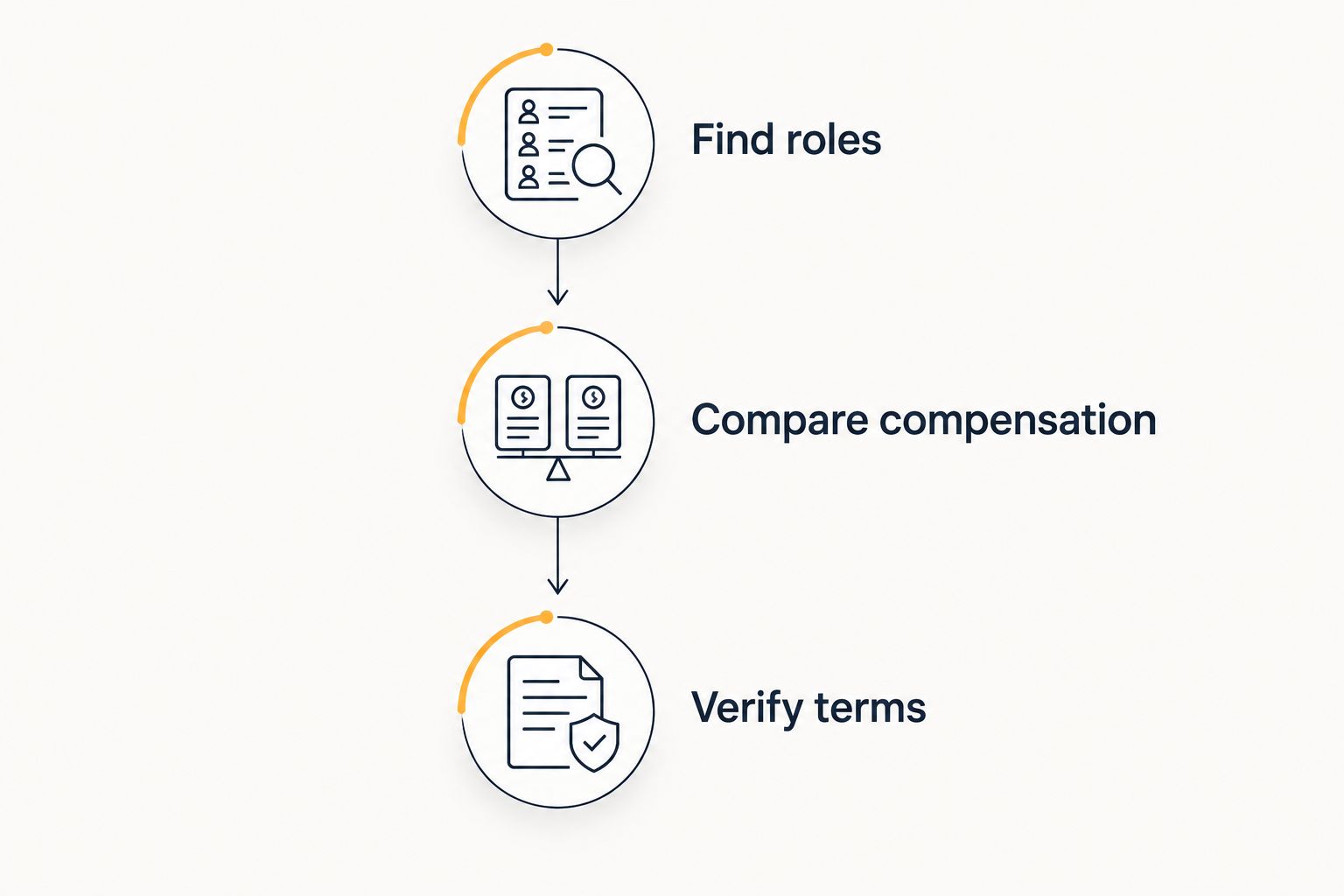
Use this sequence during your 2026 search even when compensation is your main reason for moving. First establish that the work is relevant; then evaluate the compensation attached to it. Otherwise, you risk comparing figures for jobs you would not accept.
Salary.com wins for a compensation-first geographic comparison
Salary.com is the better starting point when you want salary context for different locations before choosing where to search. Keep the occupation consistent while changing the geography, and check whether each comparison uses the same compensation definition.
That is different from asking where suitable radiology positions exist. A location-level benchmark does not identify an employer willing to offer your preferred schedule or clinical mix. Compensation research narrows questions; position-level research identifies opportunities to investigate.
For relocation planning, write down both questions explicitly:
- What compensation context applies to this role and location?
- Which positions meet my clinical, schedule, and employment requirements?
Do not let a geographic salary comparison answer the second question by default. For your 2026 relocation decision, use the benchmark as context and the employer’s written proposal as the basis for comparing actual employment terms.
Neither platform replaces offer verification
This is an honest tie. Job-search information and compensation research both require a final check against the employer’s proposed agreement.
Use the same checklist for every serious opportunity:
- Compensation: Separate guaranteed pay, variable compensation, and conditional payments.
- Workload: Clarify clinical expectations, productivity requirements, and nonclinical duties.
- Schedule: Confirm working hours, call, weekends, and coverage responsibilities.
- Employment structure: Establish employee or contractor status and the associated obligations.
- Benefits and expenses: Identify which party pays for relevant professional expenses.
- Exit terms: Review notice requirements, repayment obligations, and post-employment restrictions.
These are questions to investigate, not claims that either platform supplies every answer. Get clarification from the employer and have the proposed agreement reviewed by an appropriately qualified adviser.
A benchmark cannot resolve ambiguous contract language. A listing cannot establish that a verbal promise will appear in the agreement. When sources conflict, request clarification before accepting the role.
Pricing: compare access terms, not assumed billing models
Review the current access terms for both platforms before committing to a paid product or service. Check exactly which search or research functions the arrangement includes, along with billing frequency, renewal, cancellation, and export conditions where applicable.
Predictability and flexibility are useful buying criteria, but they are not interchangeable. A recurring arrangement requires a different decision from a one-time research purchase; evaluate the actual terms rather than assuming either platform uses the model you prefer.
For a 2026 job search, define the result you need before evaluating access. A candidate building an employer shortlist needs different functionality from a physician preparing a compensation discussion. Do not purchase a broader research package merely because it contains more features.
Final verdict: choose by your next decision
Choose RadBoard if you are an active radiology applicant
Winner for the active applicant: RadBoard. Choose the radiology job search platform when you need to discover positions and build a shortlist using aggregated listings, search, and swipe-to-save.
This profile includes a fellow seeking an attending role or an experienced radiologist planning a move. The advantage is alignment with job discovery; the limitation is that every shortlisted position still needs employer-level verification.
Choose Salary.com if you are researching compensation
Winner for the compensation researcher: Salary.com. Choose it when you already know the role and location you want to investigate, or when you need market context before discussing compensation.
This profile includes an employed physician preparing for a pay discussion. The advantage is compensation-focused research; the limitation is that a benchmark does not capture every responsibility or establish your employer’s proposed terms.
| Dimension | Winner |
|---|---|
| Best for active radiology applicants | Dedicated radiology job search platform |
| Aggregated radiology job discovery | Dedicated radiology job search platform |
| Role-and-location salary benchmarking | Salary.com |
| Radiology-specific search scope | Dedicated radiology job search platform |
| Search versus research output | Tie: different tasks |
| Compensation-first geographic research | Salary.com |
| Employer offer verification | Tie: verify independently |
| Pricing model | Compare current access terms |
FAQ
Is RadBoard better than Salary.com for radiology jobs?
RadBoard is the better fit for radiology job discovery because it aggregates 5,000+ positions from 20 sources and includes search and swipe-to-save. Salary.com is the better fit when your immediate task is compensation research by role and location.
What is Salary.com best for in a radiology career search?
Salary.com is best for researching compensation context by job title and location. Check what each figure measures before comparing it with an employer’s proposed compensation.
Should I research salary before applying for radiology jobs?
Research salary to establish context, but do not use a benchmark as your only application filter. First confirm that a role fits your clinical interests, schedule requirements, and employment preferences.
Does a salary benchmark show what a specific practice will pay?
No, a salary benchmark does not establish what a specific practice will offer. Request the employer’s compensation structure and written terms before evaluating the proposal.
Can I compare an employed radiologist’s salary with contractor compensation?
Do not compare the headline figures alone. Account for differences in benefits, professional expenses, insurance responsibilities, and other obligations before assessing the arrangements.
What should I check before paying for a job-search or salary-research service?
Check the included functions and current billing, renewal, and cancellation terms. Choose access that serves your immediate task rather than assuming a larger feature set is necessary.
What should I do when a job listing and recruiter describe different terms?
Ask the employer to clarify the discrepancy in writing. Confirm that the proposed agreement reflects the terms you intend to accept before making an employment decision.
One last thing
Before your next recruiter call, create two columns: documented and unconfirmed. Put every decision-critical claim in one of them, including compensation, call, clinical mix, and employment structure.
A saved position and a salary benchmark belong in your research file. Move a claim into the documented column only when you have evidence for that specific role. This simple distinction makes your next conversation more useful than collecting another broad salary estimate.