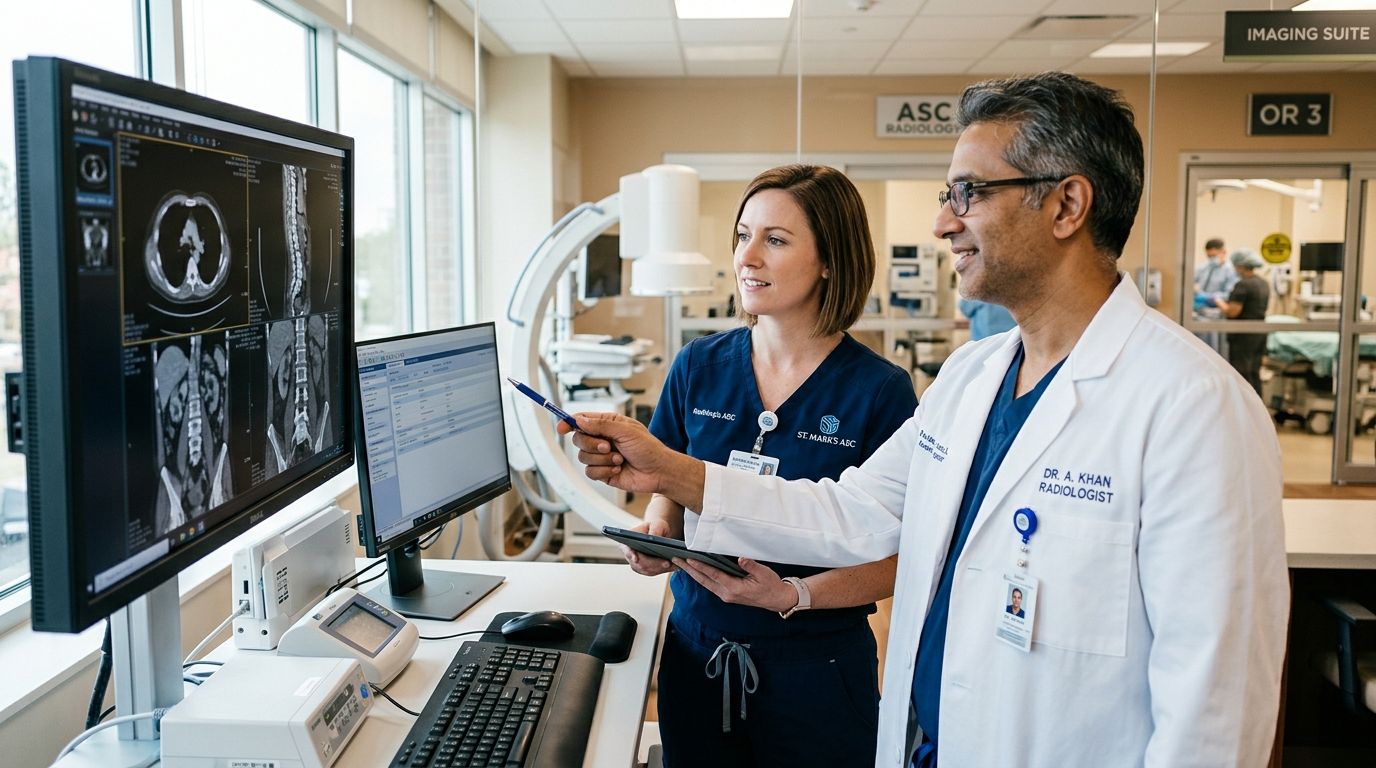
Ambulatory surgery center radiology jobs are outpatient roles built around same-day surgical volume — reading pre-op imaging, guiding pain and MSK procedures under fluoroscopy or ultrasound, and turning reports fast enough to keep an OR schedule on time. Unlike hospital diagnostic work, ASC imaging leans procedural: joint injections, arthrograms, spine blocks, and pre-surgical clearance studies rather than trauma or inpatient consults.
- Ambulatory surgery center radiology jobs in 2026 favor MSK- and pain-trained radiologists over general diagnostic generalists.
- RadBoard aggregates 5,000+ radiology positions from 20 sources, including outpatient imaging center listings with no-call schedules.
- Same-day turnaround and procedural fluency matter more than raw RVU volume at most ASC contracts.
- PE-backed ASC imaging groups pay competitively but carry non-compete and equity terms worth reading before signing.
Why ASC imaging jobs matter for radiologists
ASCs run tighter schedules than hospitals. A knee scope, a spine injection, or a rotator cuff repair all depend on imaging that's read and communicated before the surgeon walks in — not queued behind an ED backlog. That structure is why outpatient imaging center jobs with no call and daytime no-call outpatient reads show up so often in searches from radiologists moving away from hospital call rotations.
For radiologists tired of nights, weekends, and unpredictable trauma volume, ASC-adjacent work offers a defined patient population and a defined clock. It's not a fit for everyone — the case mix is narrower and the procedural skill bar is real — but for the right subspecialty, it's one of the more predictable schedules in the field in 2026.
RadBoard indexes these roles alongside broader outpatient and diagnostic listings, which means the search filters that matter for this segment are modality (MSK, pain, GI-adjacent procedural imaging), schedule (daytime, no call), and facility accreditation status.
Map the ASC imaging landscape before you apply
ASC imaging isn't one job type. It spans in-house radiologist reads at multi-specialty surgery centers, contracted coverage from independent groups, and teleradiology support for centers without an on-site reader.
- Confirm whether the role is on-site, hybrid, or remote-read coverage
- Check if the ASC is single-specialty (ortho, pain, GI) or multi-specialty
- Ask who owns the ASC — hospital system, physician group, or private equity
- Look at whether imaging is bundled into the surgical case or billed separately
- Verify the facility's accreditation status before you assume standard protocols apply
Confirm the modality mix and volume
Most ASC imaging leans fluoroscopy, ultrasound, and plain film — not cross-sectional. Volume is lower per shift than a hospital diagnostic block, but each study ties directly to a scheduled procedure, so turnaround windows are tight.
- Ask for a typical daily study count, not a monthly average
- Find out if MRI or CT referrals route out to a separate imaging center
- Confirm whether ultrasound-guided injections are read by the proceduralist or a radiologist
- Ask how many surgeons or specialties feed the imaging queue
- Check if pediatric or bariatric cases require different protocols
Check credentialing and call requirements
Credentialing at an ASC often moves faster than a hospital system because there's a smaller medical staff office and fewer committees. That's an advantage if you're trying to start quickly, but it also means less oversight redundancy if something falls through.
- Ask for the average credentialing timeline in weeks, not months
- Confirm whether privileges transfer from a parent hospital system automatically
- Verify if call coverage exists at all, or if the role is genuinely daytime-only
- Check malpractice tail coverage terms before signing anything
- Ask who covers reads if the ASC closes for a holiday block
Evaluate the compensation model
ASC radiology pay structures vary more than hospital-employed roles. Some are straight RVU, some are flat per-session, and PE-backed groups increasingly tie a portion of comp to case volume growth across multiple sites.
- Ask whether comp is RVU-based, per-diem, or salaried
- Confirm if there's a guaranteed minimum floor during ramp-up months
- Check whether equity or profit-sharing applies, and under what vesting terms
- Ask if productivity bonuses stack on top of base RVU pay
- Compare the offer against how to compare radiology job offers beyond base salary before you sign
Filter for ASC-friendly schedules
Search 5,000+ radiology listings by modality, schedule, and facility type.
Vet the corporate structure behind the ASC
ASCs sit under three ownership models in 2026: hospital-affiliated, physician-owned independent, and private-equity-backed multi-site chains. Each changes how contracts, non-competes, and long-term equity actually work.
- Ask how many sites the parent group operates and whether coverage rotates across them
- Check whether the contract includes a non-compete radius clause
- Confirm if leadership or ownership changed in the last 24 months
- Ask how decisions about staffing and equipment upgrades get made
- Verify whether the group has a documented partnership track or if equity is discretionary
Negotiate schedule and no-call terms
The single biggest reason radiologists move toward ASC work is schedule control. Get the actual terms in writing rather than relying on a verbal "no weekends, no call" pitch.
- Confirm exact days and hours in the written offer, not a general description
- Ask what happens during surgeon vacation weeks or slow periods
- Check if you're expected to cover overflow at a sister facility
- Verify PTO and holiday closure policy in writing
- Ask how schedule changes get communicated and how much notice you get
Ask about equipment and turnaround expectations
Surgical schedules don't wait. A pre-op imaging read that lags by even a few hours can bump a case, and ASCs track that metric closely.
- Ask for the expected turnaround time from study to signed report
- Confirm what PACS and dictation systems are in use
- Check if AI-assisted dictation tools are part of the workflow
- Ask whether you'll read remotely for any portion of the week
- Verify backup coverage exists if equipment goes down mid-day
Comparison: ASC imaging job structures
| Option | Best For | Key Limitation |
|---|---|---|
| Independent multi-specialty ASC contract | Radiologists wanting schedule control without PE terms | Smaller support staff, narrower case backup |
| Hospital-affiliated ASC role | Radiologists wanting system stability and benefits | Less schedule flexibility than a true independent ASC |
| PE-backed ASC imaging group | Radiologists comfortable trading equity clarity for pay | Non-compete and multi-site coverage clauses are common |
| Teleradiology coverage for ASC cases | Radiologists who want remote reads without site commitment | Limited procedural involvement, mostly diagnostic support |
Verdict: independent, single or multi-specialty ASC contracts win on schedule predictability in 2026, but PE-backed groups often win on total compensation — the trade-off is contractual, not clinical.
Common mistakes radiologists make with ASC imaging jobs
- Assuming lower volume means lower skill demand. Procedural imaging at ASCs requires real MSK and fluoroscopy fluency, not general diagnostic experience.
- Not confirming turnaround expectations before day one. A surgical schedule treats a delayed read as a scheduling failure, not a minor delay.
- Skipping the ownership check. A group that looks independent on a job posting can be three layers deep in private-equity ownership by 2026.
- Ignoring the non-compete radius. ASC groups tied to multi-site chains often write broader geographic restrictions than a single hospital employer would.
- Treating "no call" as a given. Confirm it in the written contract — verbal assurances during recruiting calls aren't binding.
FAQ
What subspecialty background helps most for ambulatory surgery center radiology jobs?
MSK, pain management, and general procedural imaging experience help most, since ASC cases center on joint, spine, and orthopedic pre-op studies. General diagnostic training alone is less competitive for these roles in 2026.
Do ASC radiology jobs usually include call coverage?
Most true ASC imaging roles are daytime-only with no call, since surgical schedules run on fixed business hours. Confirm this in writing, since some PE-backed groups add overflow coverage at sister facilities.
How is pay structured for ASC imaging radiologists?
Pay varies between RVU-based, per-session flat rate, and salaried models, with PE-backed groups increasingly adding volume-tied bonuses. Ask for a guaranteed minimum floor during any ramp-up period.
Are ASC radiology jobs remote or on-site?
Both exist. Some centers use on-site radiologists for same-day turnaround, while others route reads to teleradiology coverage, especially for lower-volume or single-specialty ASCs.
How fast does credentialing move at an ambulatory surgery center?
Credentialing at ASCs typically moves faster than large hospital systems because the medical staff office is smaller, though timelines still depend on the parent ownership structure.
Is private equity ownership common in ASC imaging groups in 2026?
Yes, private-equity-backed multi-site ASC chains have expanded steadily, which changes contract terms like non-competes and equity vesting compared to independent, physician-owned centers.
What's the biggest downside of ASC radiology work compared to hospital diagnostic roles?
Case volume and modality variety are narrower at ASCs, since the work centers on pre-op and procedural imaging rather than a full diagnostic caseload.
One last thing
The fastest-growing complaint from radiologists in ASC roles isn't pay or schedule — it's turnaround pressure tied to surgical bumps, which most job postings never mention. Ask for the actual average time from study completion to signed report before you accept, not just the advertised daily case count.