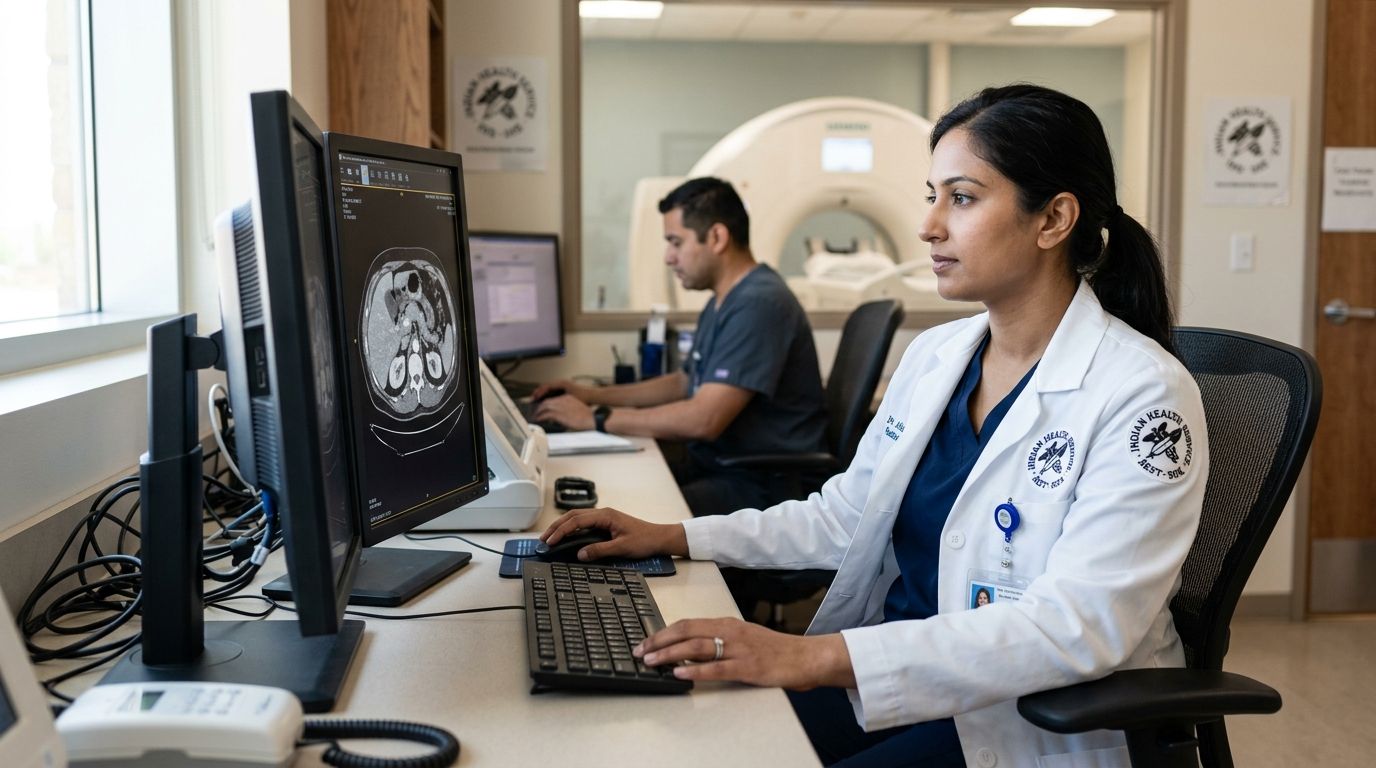
Indian Health Service radiology jobs place you inside a federal health system that serves roughly 2.6 million American Indian and Alaska Native patients across more than 600 hospitals, clinics, and health stations, with loan repayment, federal benefits, and rural or remote postings shaping the pitch differently than a private practice offer. Radiologists weighing an IHS position need a separate playbook from the standard hospital-employed search: the credentialing path runs through federal channels, the pay structure follows government scales rather than RVU models, and the postings rarely show up on general job boards.
- Indian Health Service radiology jobs offer up to $50,000 in loan repayment through the IHS Loan Repayment Program for a two-year service commitment.
- Most IHS imaging sites need general diagnostic coverage, not narrow subspecialty reads, because staffing is thin.
- J-1 visa waiver physicians can use Conrad 30 slots tied to IHS and tribal facilities in underserved areas.
- RadBoard aggregates federal and underserved-area radiology listings alongside 5,000+ openings from 20 sources.
- Verdict: IHS radiology jobs suit radiologists who want federal benefits and loan repayment over top-market salary.
Why Indian Health Service radiology jobs matter for this segment
Radiologists searching for IHS radiology jobs in 2026 are usually not chasing the highest RVU rate. They are weighing federal loan repayment, Public Health Service Commissioned Corps benefits, or a genuine interest in tribal health work, and none of those variables show up on a salary-sorted job board.
IHS facilities also sit in places general staffing agencies rarely cover — Navajo Nation, Alaska Native villages, Northern Plains reservations — so the listings pool is smaller and harder to find than for a metro hospital system. That scarcity is the actual signal. If you are searching this term in 2026, you are past the generic-job-board stage and need direct-source information: how credentialing works, what the loan repayment terms require, and whether the call schedule matches a one- or two-radiologist department.
How to find and land Indian Health Service radiology jobs
Check federal and IHS-direct postings first
IHS radiology positions post through federal hiring channels before they appear anywhere else, and most staffing agencies do not carry them at all.
- Search USAJOBS.gov directly for "Indian Health Service" plus "radiologist" or "diagnostic radiology"
- Check IHS area offices separately — Navajo, Alaska, Great Plains, and Oklahoma City areas each post on their own timeline
- Look at tribally operated facilities under Public Law 93-638 self-determination contracts, which hire outside the federal system
- Confirm whether the role is direct IHS employment, a tribal-operated facility, or a Commissioned Corps billet — benefits differ across all three
Confirm loan repayment and service commitment terms
The IHS Loan Repayment Program is the single biggest draw for early-career radiologists in 2026, and it comes with real strings attached.
- Verify the award cap and confirm it applies per two-year contract cycle
- Check the facility's priority designation, since higher-need sites get funding first
- Read the service-obligation clause before signing; extensions carry separate annual awards
- Compare the terms against radiology jobs with loan repayment assistance at nonprofit hospitals before committing
Verify licensure, credentialing, and visa pathways
Federal credentialing moves on its own timeline, and international medical graduates have a specific route into IHS and tribal facilities.
- Confirm state license requirements for the specific IHS area; Alaska and Southwest postings often need extra processing time
- Ask whether the facility sponsors J-1 waivers through Conrad 30, which allots 30 slots per state per year
- Review the rules for J-1 visa waiver physicians under Conrad 30 before picking a service area
- Ask the medical staff office for credentialing turnaround in writing; federal onboarding runs longer than a private-practice hire
Evaluate the location and lifestyle fit
IHS facilities sit almost exclusively in rural and remote regions, and that geography is the real filter for whether the job works long-term.
- Map the service area — Alaska, Navajo Nation, Northern Plains, and Oklahoma carry distinct climate, isolation, and travel realities
- Ask about on-site housing, which many remote IHS and tribal facilities provide
- Confirm outpatient volume and modality mix; smaller sites may run a single CT with limited MRI access
- Compare against community health centers serving underserved areas, which share staffing patterns without federal employment structure
Assess call schedule and subspecialty scope
Most IHS imaging departments run lean, which means broad general-diagnostic coverage rather than narrow subspecialty reads.
- Ask how many radiologists staff the department full-time versus teleradiology overnight backup
- Confirm whether mammography, ultrasound, and fluoroscopy fall to the same radiologist
- Check whether interventional cases transfer out or get handled on site
- Ask for exact weekend and holiday call frequency; two- and three-radiologist departments often run one-in-two or one-in-three
Negotiate federal pay scale and benefits
Federal compensation runs on GS or Title 38 special pay scales rather than RVU production, so the negotiation levers are different in 2026.
- Ask about locality pay adjustments tied to the specific IHS area
- Confirm FERS retirement, health insurance, and paid leave accrual
- Check whether a Public Health Service Commissioned Corps billet is available and what it changes about pay
- Ask about relocation and housing allowances specific to remote postings
Track new IHS and tribal postings as they open
Once you know the terms you want, the bottleneck becomes finding openings before they close, because federal postings stay up for a limited window.
- Set standing searches for IHS and tribal facility names on USAJOBS
- Cross-check IHS area office pages, which sometimes list openings before USAJOBS catches up
- Use RadBoard's AI-powered search to filter 5,000+ aggregated radiology listings from 20 sources, then swipe to save federal and underserved-area postings
- Set alerts so a new opening does not sit unseen for weeks
Find open radiology jobs faster
Search 5,000+ aggregated radiology listings from 20 sources with AI-powered filters.
Comparison: paths into IHS and related federal radiology work
| Option | Best for | Key limitation |
|---|---|---|
| Direct IHS employment | Radiologists prioritizing loan repayment and federal benefits | GS and Title 38 scales cap earning upside versus private practice |
| Tribally operated facility (P.L. 93-638) | Physicians wanting tribal-community focus outside federal HR | Benefits and hiring vary by tribe, not standardized |
| Commissioned Corps billet | Physicians wanting uniformed federal service with rank-based pay | Requires commissioning process and service commitment |
| Locum coverage at IHS sites | Testing an area before a multi-year commitment | No loan repayment eligibility; contracts run short |
| VA hospital radiology | Federal benefits without the remote-location trade-off | Different patient population — see VA hospital radiology jobs |
Direct IHS employment is the strongest fit for radiologists who want the loan repayment cap and federal benefits and can accept a rural posting. Buy the direct-employment route if loan repayment drives the decision. Hold and take locum coverage first if you are unsure about the location.
Common mistakes radiologists make with IHS applications
- Assuming pay negotiates like private practice. GS and Title 38 scales have fixed steps. The real room is locality pay and housing, not base salary.
- Skipping the service-obligation math. Signing a two-year loan repayment contract without checking extension terms leaves you stuck if the posting does not fit.
- Underestimating credentialing timelines. Federal onboarding for remote Alaska or Southwest sites runs longer than typical hospital credentialing.
- Ignoring call coverage before signing. Departments with two or three radiologists mean frequent call. Get the exact rotation in writing.
- Confusing tribal and federal employers. A P.L. 93-638 facility is not direct IHS, and the benefits package differs accordingly.
FAQ
What is the loan repayment amount for Indian Health Service radiology jobs?
The IHS Loan Repayment Program awards up to $50,000 for an initial two-year service commitment, with annual extension awards available afterward. Priority goes to higher-need facilities, so availability varies by site.
Do Indian Health Service radiology jobs qualify for J-1 visa waivers?
Many IHS and tribal facilities in underserved areas qualify for Conrad 30 J-1 waivers, which allot 30 slots per state each year. Confirm the specific facility's eligibility before applying, since not every site participates.
How does IHS radiology pay compare to private practice?
IHS pay follows federal GS or Title 38 scales rather than RVU-based production, which typically caps earnings below private practice or PE-backed groups. The trade-off is loan repayment eligibility plus FERS retirement and federal health benefits.
Are Indian Health Service radiology jobs mostly rural?
Yes. IHS facilities sit almost exclusively in rural and remote regions including Alaska, the Navajo Nation, and Northern Plains reservations. Housing and relocation support are common given the isolation of many sites.
What subspecialty coverage do IHS radiology jobs require?
Most IHS imaging departments need general diagnostic radiologists covering CT, ultrasound, mammography, and fluoroscopy rather than narrow subspecialty reads. Interventional cases often transfer to larger regional centers.
Can locum tenens radiologists work at IHS facilities?
Yes, and locum coverage is a common way to test an area before a permanent commitment. Locum contracts do not carry loan repayment eligibility and generally run shorter than direct-hire terms.
What is the difference between IHS and a tribally operated facility?
Direct IHS employment follows federal hiring and benefits structures, while tribally operated facilities under Public Law 93-638 set their own hiring process and benefits. Both serve the same patient population but differ in employment terms.
How do I find open Indian Health Service radiology jobs fast?
Search USAJOBS.gov for IHS radiology postings and check individual IHS area office pages, since listings appear there before reaching general job boards. RadBoard aggregates federal and underserved-area radiology listings alongside 5,000+ openings from 20 sources.
One last thing
The loan repayment award is capped per contract cycle, not per career. Radiologists who stay past the initial two years and re-up annually stack awards well beyond the first $50,000, which changes the math entirely for anyone treating an IHS posting as a short stop rather than a multi-year commitment in 2026 and beyond.