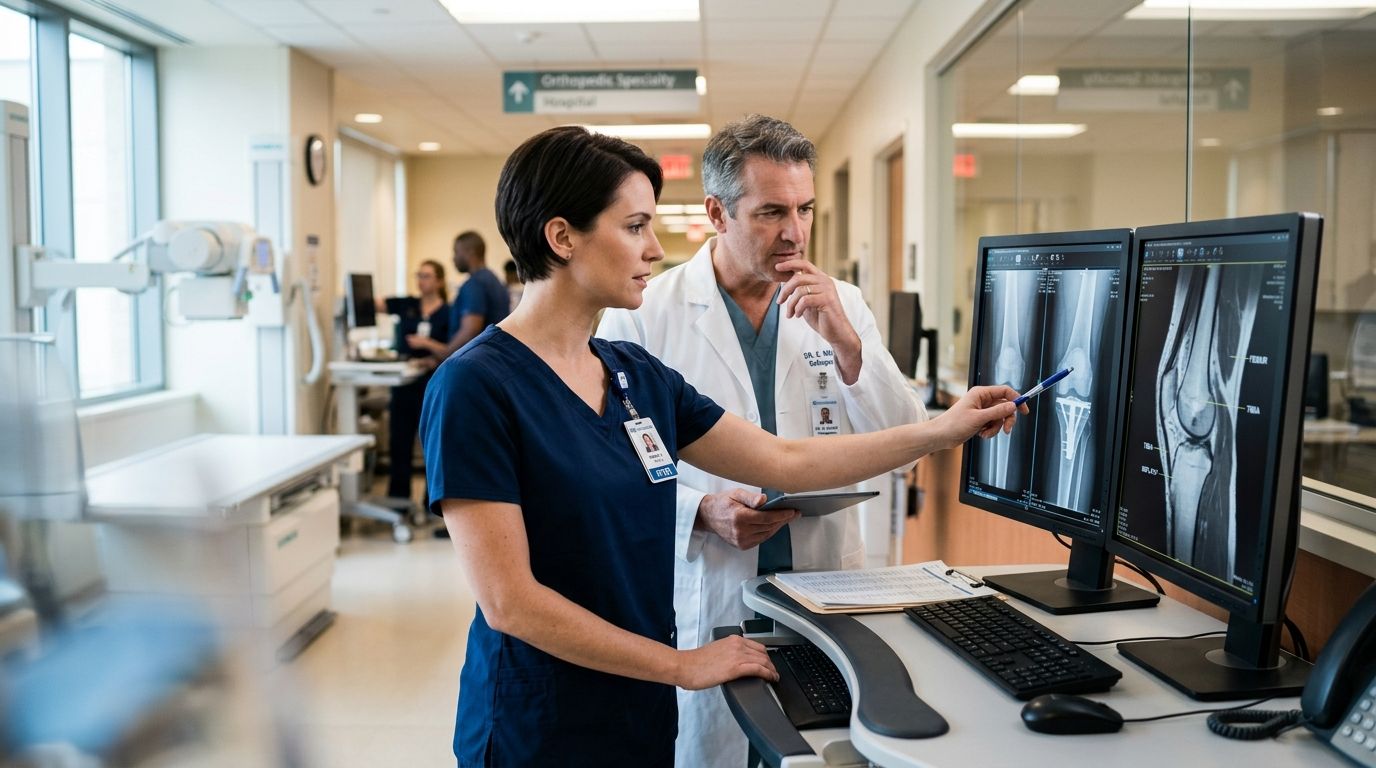
Orthopedic hospital radiology jobs are radiologist positions at single-specialty surgical hospitals built around joint replacement, spine, and sports medicine caseloads, with the aim of matching MSK-trained physicians to high-volume elective imaging rather than the mixed trauma-and-outpatient load of a general hospital. These roles run on a different clock than a community hospital job: surgical planning drives same-day turnaround expectations, and the referring physician pool is almost entirely orthopedic surgeons rather than primary care.
- Orthopedic hospital radiology jobs favor MSK fellowship-trained radiologists reading MRI, X-ray, and CT for surgical planning.
- Locum tenens musculoskeletal radiology jobs fill volume swings at ortho hospitals during staff turnover in 2026.
- Independent MSK groups and teleradiology contracts now compete directly with employed staff roles at orthopedic-only facilities.
- Referral pipelines from orthopedic surgeon groups and sports medicine programs, not ER volume, drive imaging demand here.
- RadBoard aggregates 5,000+ radiology postings from 20 sources, letting MSK-trained radiologists filter for orthopedic hospital openings directly.
Why orthopedic hospital radiology jobs matter for MSK-trained radiologists
Orthopedic specialty hospitals run almost entirely on elective surgical volume: joint replacements, spine fusions, sports medicine repairs. That means the imaging queue is predictable, procedure-heavy, and tied directly to surgeon block schedules rather than an emergency department feed.
A radiologist who trained broad and reads a little of everything will find the caseload narrow by comparison. The upside is depth: MSK fellowship-trained radiologists read a concentrated mix of MRI, X-ray, CT, and fluoroscopy day after day, which builds procedural speed fast. Musculoskeletal radiology jobs for sports medicine imaging sit adjacent to this niche and pull from the same referral base.
Orthopedic hospitals also tend to own their imaging outright rather than contracting to a national chain, which changes who actually signs your paycheck and who controls call schedules. That distinction matters more here than at a general hospital, where imaging is frequently outsourced regardless of who owns the beds.
Confirm the facility is a true single-specialty orthopedic hospital
Not every hospital with "orthopedic" in its marketing runs a single-specialty model. Some are general hospitals with a large ortho service line; others are freestanding, physician-owned specialty hospitals with no ER and no medicine floor.
- Check whether the facility has an emergency department or only elective admitting privileges
- Look up physician ownership structure, since many orthopedic specialty hospitals are surgeon-owned
- Confirm imaging equipment on-site: dedicated MSK-protocol MRI, weight-bearing CT, fluoroscopy suites for injections
- Ask whether radiology is hospital-employed or contracted through an outside group
- Verify accreditation status directly with the facility rather than assuming it matches a larger health system's credentials
Map the imaging modality mix to your training
Orthopedic hospital caseloads skew heavily toward a handful of modalities, and the mix should match what your fellowship or residency actually prepared you to read at volume.
- MRI for pre-surgical joint and spine planning, the highest-volume study at most ortho hospitals
- Weight-bearing and standard X-ray for post-op follow-up and alignment checks
- CT for complex fracture mapping and 3D surgical planning
- Fluoroscopy for joint injections and arthrograms performed same-day as clinic visits
- MSK ultrasound for tendon, ligament, and guided injection work
Radiologists without arthrogram or joint injection experience should expect a learning curve, since arthrogram and joint injection jobs for MSK procedure rads require hands-on procedural comfort that pure diagnostic training doesn't always cover.
Verify subspecialty and procedural expectations before applying
Job postings at orthopedic hospitals often list "MSK fellowship preferred" but bury the actual procedural load in the fine print. Get specifics before you interview.
- Ask how many joint injections or arthrograms are expected per week, not per month
- Confirm whether spine imaging cross-coverage is part of the role or handled by a separate neuroradiology contract
- Find out if sports medicine imaging (return-to-play MRI reads) carries a faster turnaround requirement
- Check whether the hospital expects same-day preliminary reads to support surgical scheduling decisions
- Clarify whether procedural work counts toward RVU targets separately from diagnostic reads
Evaluate the call and coverage model
Orthopedic specialty hospitals rarely run 24/7 trauma call, which is one of the biggest quality-of-life differences versus a general hospital radiology job. But "low call" doesn't mean "no call," and elective surgical schedules create their own crunch points.
- Ask whether weekend coverage exists for post-op complications or is fully outsourced to teleradiology
- Confirm whether Monday morning reads pile up from a weekend backlog before elective cases start
- Check if the hospital uses a rotating on-call model among a small staff or a single-coverage arrangement
- Verify whether off-hours reads route to an outside teleradiology contract, and if so, who covers that gap when you're off
- Ask directly about holiday and vacation coverage, since small ortho hospital staffs have less redundancy than large systems
Check the referral network and surgeon relationships
Imaging volume at an orthopedic hospital is a direct function of how many surgeons admit there and how busy their clinics run. A hospital tied to one large orthopedic group has different volume risk than one serving several independent practices.
- Find out how many orthopedic surgeon groups actively refer to the facility
- Ask whether a sports medicine program or team physician relationship feeds a steady MRI pipeline
- Confirm whether spine surgery volume is in-house or referred out, since spine imaging often requires separate cross-coverage; spine imaging radiologist jobs for orthopedic referral networks covers this overlap directly
- Check whether the hospital has an affiliated ambulatory surgery center pulling volume away from the main site
- Ask how volume has trended over the past two years, since elective surgery volume is more sensitive to reimbursement changes than trauma volume
Compare compensation structures across ortho hospital settings
Compensation models at orthopedic specialty hospitals vary more than at general hospitals because staffing arrangements themselves vary: employed, contracted, locum, or independent group.
| Option | Best For | Key Limitation |
|---|---|---|
| Employed staff radiologist at an orthopedic specialty hospital | MSK-trained radiologists wanting steady salary-plus-RVU pay tied to surgical volume | Compensation moves with elective surgery volume and can dip during slow surgical seasons |
| Locum tenens MSK radiology coverage | Radiologists filling short-term gaps between permanent contracts | Assignments end once staffing normalizes, and benefits are typically absent |
| Teleradiology contract reading ortho hospital studies | Radiologists who want off-site reads without relocating near the facility | Limited direct interaction with referring orthopedic surgeons, which can slow relationship-building |
| Independent MSK radiology group contracted to an ortho hospital | Radiologists targeting partnership tracks outside PE-backed practices | Buy-in terms and partnership timelines vary widely by group |
Verdict: employed staff roles fit radiologists who want stability tied to a single facility's surgical calendar, while locum coverage fits radiologists testing the orthopedic niche before committing long-term.
Use AI-powered search to filter listings by subspecialty and setting
Once you know the modality mix, call structure, and referral network you want, filtering generic hospital radiology postings for the orthopedic-specific ones by hand is slow. Postings rarely use consistent language: some say "orthopedic hospital," others say "MSK specialty facility" or just list the surgical services offered.
RadBoard's AI-powered search reads job descriptions for MSK-specific signals — arthrogram volume, sports medicine ties, single-specialty status — instead of relying on exact title matches, and the swipe-to-save function lets you build a shortlist across 5,000+ aggregated postings from 20 sources without re-searching each site separately.
Find MSK-focused radiology openings
Filter 5,000+ aggregated listings for orthopedic and sports imaging roles.
Common mistakes radiologists make chasing orthopedic hospital jobs
- Treating it like a general hospital search. Surgical planning turnaround expectations at ortho hospitals are tighter than typical outpatient reads, and applicants who don't ask about same-day reporting standards get surprised after starting.
- Underestimating procedural volume. Joint injections and arthrograms show up as a line item in job postings but often carry a real weekly quota that diagnostic-only radiologists aren't prepared for.
- Not checking who owns the imaging. A hospital contracting radiology to a national chain has a different employer relationship than one running an employed staff model, and that changes everything from call schedule control to benefits.
- Skipping the referral network question. A single-surgeon-group hospital carries more volume risk than one serving several independent practices, and that risk shows up in your RVU-based pay.
- Assuming spine and sports imaging are automatically included. Some ortho hospitals cross-cover spine through a separate neuroradiology contract; confirm this before assuming it's part of your role.
FAQ
What's the best radiology subspecialty for orthopedic hospital jobs?
MSK fellowship training is the strongest fit for orthopedic hospital radiology jobs in 2026, since the caseload centers on joint, spine, and sports medicine imaging tied to surgical planning. General diagnostic training works too but usually means a steeper procedural learning curve on arthrograms and injections.
Is MSK radiology in higher demand at orthopedic specialty hospitals than general hospitals?
Orthopedic specialty hospitals concentrate their entire imaging volume around MSK studies, so MSK-trained radiologists see a narrower but denser caseload than at a general hospital where MSK is one service line among many.
Do orthopedic hospitals hire locum tenens radiologists?
Yes, orthopedic specialty hospitals use locum tenens coverage for staff transitions and volume spikes, similar to how general hospitals use locum MSK radiology coverage between permanent hires.
What imaging modalities do orthopedic hospital radiologists read most?
MRI for pre-surgical planning is typically the highest-volume study, followed by X-ray for post-op follow-up, CT for complex fracture mapping, and fluoroscopy for joint injections performed same-day.
Can teleradiologists cover orthopedic hospital reads remotely?
Yes, some orthopedic hospitals route off-hours or overflow reads to teleradiology contracts, though same-day surgical planning reads are more often handled on-site given the turnaround requirements.
Is a fellowship required for orthopedic hospital radiology jobs?
Most postings prefer MSK fellowship training, but requirements vary by facility; some smaller orthopedic hospitals hire general diagnostic radiologists willing to build procedural volume on the job.
How do I find orthopedic hospital radiology job openings fast?
Filtering aggregated job platforms for MSK-specific language, rather than searching hospital career pages one at a time, surfaces orthopedic hospital radiology jobs faster since postings rarely use consistent titles.
One last thing
Check who actually owns the imaging equipment before you sign, not just who signs your offer letter. A surgeon-owned orthopedic specialty hospital that keeps radiology in-house gives you more control over call schedules and equipment upgrades than one that contracts imaging out to a national chain, even when the base pay looks identical on paper.