Best overall starting point: UCSF for broad imaging research; best for engineering-led imaging: Stanford; best for PET-focused research: Washington University in St. Louis. This 2026 guide compares academic radiology departments by research fit and explains how to verify funding before accepting a faculty position—not by an unsupported funding league table.
- For best academic radiology departments research funding searches, shortlist UCSF, Stanford, Washington University, Penn, and Massachusetts General Hospital.
- UCSF is the default starting point for broad imaging research; your mentor and appointment terms decide the final choice.
- Compare active awards, protected time, startup support, and investigator access—not institutional reputation alone.
- RadBoard is best for radiologists comparing career opportunities across multiple job sources.
Why this matters
A department's research portfolio and your research support are different things. An investigator's award does not automatically fund your effort, scanner access, coordinator, or preliminary experiments.
For your 2026 search, separate three questions: Does the department support your scientific field? Does a specific investigator want to work with you? Does the appointment fund the time and resources your project requires?
Start with the distinction between clinical and research expectations in academic radiology jobs for teaching and research physicians. Then evaluate the actual appointment. A university name cannot substitute for written research terms.
What makes the best department for research funding?
Use these criteria before comparing institutions:
- Relevant active funding: Identify awards supporting your intended modality, disease area, or research method. Department-wide totals alone do not answer that question.
- Protected time: Ask who pays for research effort, how clinical coverage works, and what happens when an award ends.
- Mentor fit: Find a principal investigator whose projects connect directly to your proposed work. Confirm expectations for meetings, authorship, and independence.
- Research infrastructure: Establish how you obtain scanner time, datasets, technical support, statistical support, and study coordination.
- Startup and continuity: Request written terms for startup resources, access periods, and support between awards.
- Appointment expectations: Compare promotion requirements with clinical workload and the resources assigned to meet those requirements.
The best department is the one that funds your research plan, not simply the one associated with the largest total. Apply that rule consistently to every institution below.
Academic radiology research departments at a glance
This is a use-case shortlist for 2026, not a ranking of current grant dollars. The order gives an undecided applicant a starting point; it does not establish that one department receives more funding than another.
| Department | Best for | Research setting to investigate | Key limitation to resolve |
|---|---|---|---|
| UCSF Radiology and Biomedical Imaging | Broad imaging research | Modality and disease-focused imaging programs | Department breadth does not establish support for your appointment |
| Stanford Radiology | Engineering-led imaging | Imaging methods and interdisciplinary engineering collaboration | Technical collaborators and resources need explicit commitments |
| Washington University Mallinckrodt Institute of Radiology | PET-focused research | PET and molecular imaging | Specialized projects require confirmed infrastructure access |
| Penn Radiology | Quantitative imaging | Imaging measurement and computational methods | Data, technical support, and clinical effort require separate review |
| Massachusetts General Hospital Radiology | MRI methods and neuroscience | The Martinos Center research environment | Hospital, center, and appointment boundaries need clarification |
1. UCSF: best academic radiology fit for broad imaging research
UCSF's Department of Radiology and Biomedical Imaging is a useful starting point when your interests span imaging methods and clinical applications. Its research environment includes the familiar academic combination of modality-focused work, disease-focused investigation, and collaboration beyond radiology.
Best for: Radiologists seeking a broad scientific environment before committing to a narrower investigator group.
UCSF pros:
- A department explicitly centered on radiology and biomedical imaging.
- Research spanning imaging methods and clinical questions.
- Opportunities to investigate collaboration across medical specialties.
UCSF cons:
- Department breadth does not identify which investigator can support your project.
- A faculty title does not establish protected time or access to a particular laboratory.
Ask the division chief to connect your clinical assignment, proposed mentor, and research resources in one written plan. Request a clear explanation of who supports your effort before external funding begins.
Verdict: Hold until UCSF confirms investigator fit and appointment-level research support. UCSF is the default first conversation, not an automatic acceptance.
2. Stanford: best academic radiology fit for engineering-led imaging
Stanford Radiology belongs on your shortlist when your research question depends on imaging technology, acquisition methods, or collaboration with engineers. Stanford's engineering and medical research setting makes that interdisciplinary focus a concrete reason to investigate the department.
Best for: Physician-investigators developing imaging methods with technical collaborators.
Stanford pros:
- A university setting combining medicine and engineering.
- An imaging research focus that includes technical development.
- A relevant environment for projects connecting acquisition and clinical evaluation.
Stanford cons:
- Proximity to engineering does not assign an engineer to your project.
- Shared research interests do not establish scanner access, technical staffing, or project ownership.
Bring a specific project outline to the interview. Ask who will handle method development, implementation, validation, and technical maintenance, rather than accepting a general promise of collaboration.
For a 2026 appointment, distinguish resources attached to your position from resources controlled by a collaborator's grant. Both matter, but they are not interchangeable.
Verdict: Hold until Stanford identifies the collaborators and resources your technical project requires.
3. Washington University: best academic radiology fit for PET research
Washington University's Mallinckrodt Institute of Radiology has an established research identity in PET and molecular imaging. That makes it a targeted department to investigate when tracer-based imaging is central to your scientific plan.
Best for: Radiologists building a research career around PET or molecular imaging.
Washington University pros:
- An established institutional focus on PET research.
- A scientific setting relevant to molecular imaging questions.
- A direct fit for applicants whose work depends on tracer-based methods.
Washington University cons:
- A PET research environment does not guarantee access to a specific tracer or protocol.
- Your project still needs operational support, approvals, and a defined funding pathway.
Ask investigators to explain the route from your research question to an executable study. Identify who owns the protocol, who coordinates participants, and how imaging resources are assigned.
Do not stop at the equipment discussion. A project also needs the personnel and approvals required to use that equipment for its intended purpose.
Verdict: Hold until Washington University confirms a feasible PET project and the resources to execute it.
4. Penn: best academic radiology fit for quantitative imaging
Penn Radiology is a relevant shortlist choice for investigators interested in quantitative imaging and computational approaches. The useful question is whether a particular research group connects your measurement method to a clinical question you can study.
Best for: Radiologists developing or validating quantitative imaging measurements.
Penn pros:
- An established academic imaging research environment.
- Research activity relevant to quantitative and computational methods.
- A medical-school setting for connecting imaging measurements with clinical investigation.
Penn cons:
- A suitable dataset does not automatically come with permission to use it.
- Computational research still requires funded personnel, technical support, and protected effort.
Ask how investigators obtain data access, support reproducible analysis, and assign responsibility for validation. Determine whether your role is scientific leadership, clinical annotation, image interpretation, or a combination.
Request a written distinction between your independent research aims and work performed for another investigator. That distinction matters when you evaluate authorship and promotion expectations.
Verdict: Hold until Penn connects your quantitative research aims to accessible data and funded support.
5. Massachusetts General Hospital: best fit for MRI neuroscience
Massachusetts General Hospital Radiology is a focused option for applicants interested in MRI methods and neuroscience. The Athinoula A. Martinos Center for Biomedical Imaging provides a specific research environment to investigate rather than relying on the hospital's name alone.
Best for: Radiologists connecting MRI technology with brain research.
Massachusetts General Hospital pros:
- A recognized biomedical imaging research center.
- A research setting relevant to MRI methods and neuroscience.
- A defined center around which to organize investigator-level discussions.
Massachusetts General Hospital cons:
- Center affiliation and departmental employment are not the same commitment.
- Access to research facilities does not establish support for your salary or clinical coverage.
Ask which institution employs you, which group controls the relevant resources, and who evaluates your research performance. Clarify the relationship between your hospital appointment, academic appointment, and proposed research affiliation.
A recognizable center name is useful for finding investigators. It is not a substitute for identifying the person authorized to commit resources.
Verdict: Hold until Massachusetts General Hospital documents your research affiliation and appointment support.
How to verify research funding before you interview
Use NIH RePORTER to investigate NIH-funded projects by investigator, organization, and research topic. For your 2026 review, record the search date and distinguish active projects from completed awards; do not treat a historical award as current support.
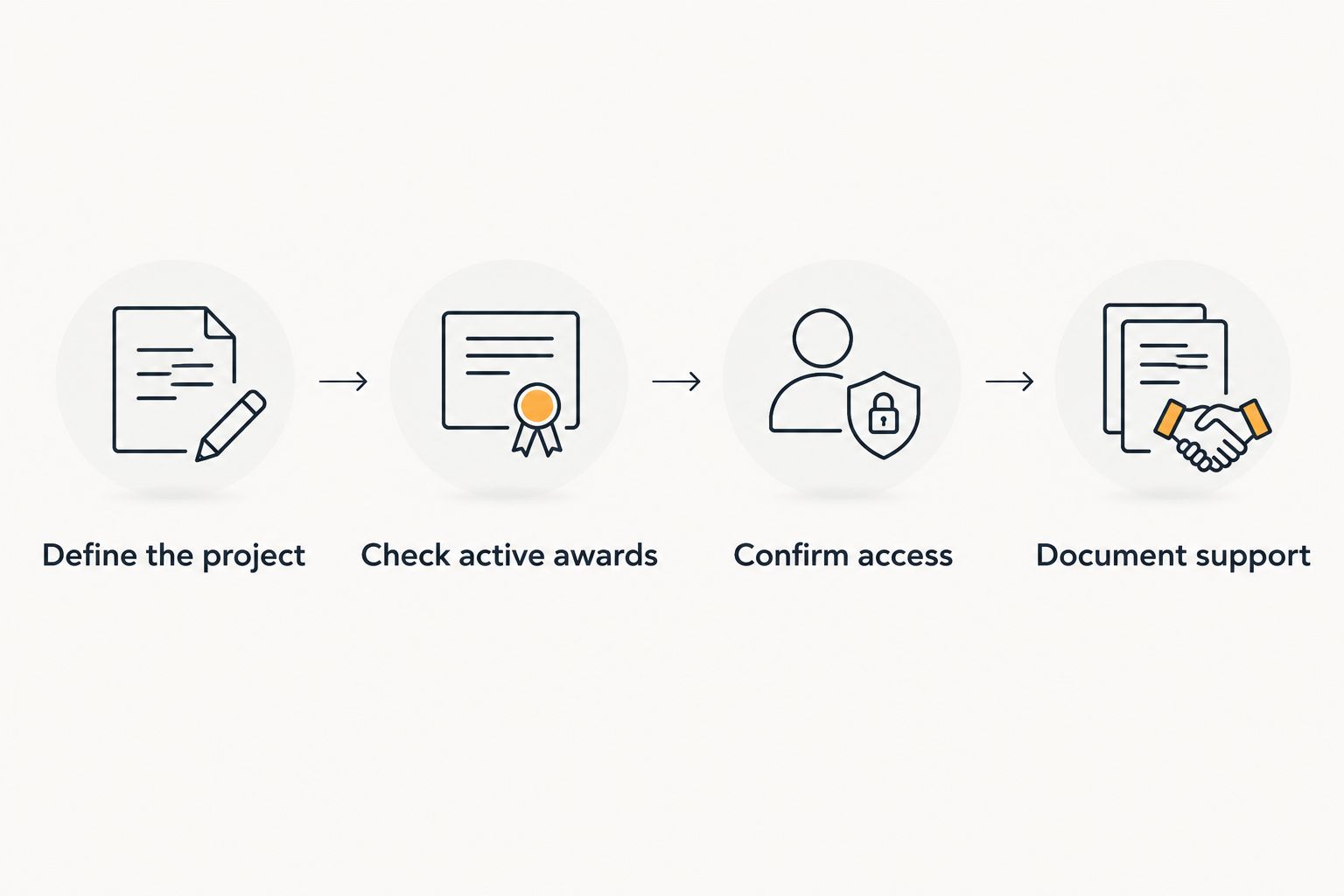
Follow this sequence:
- Define the project. Prepare a 1-page research outline identifying the clinical problem, imaging method, and resources needed.
- Check active awards. Look for projects directly related to your aims, not just a recognizable investigator name.
- Confirm access. Ask whether the relevant award, dataset, equipment, and personnel can support your proposed role.
- Document support. Request written terms covering effort, resources, review milestones, and support if funding changes.
Departmental funding comparisons also require matching definitions. NIH awards, total sponsored research, philanthropic support, and institutional startup commitments describe different pools of money. Do not combine them into a single ranking without explaining the scope.
If you use Blue Ridge Institute for Medical Research tables, read the methodology and reporting period. If you use NIH RePORTER, check organizational names and project records. Neither replaces a discussion about the resources assigned to your position.
How we ranked the shortlist
The shortlist separates research use cases: broad imaging, engineering-led development, PET, quantitative imaging, and MRI neuroscience. It does not assign scores, estimate grant totals, or claim a current funding winner.
For your decision, prioritize the criteria in order: relevant investigator, executable project, protected time, resource access, and written continuity terms. An institution drops off your shortlist when it cannot connect those pieces.
Which department should you choose?
Start with UCSF if you need a broad research conversation; choose a narrower shortlist once your scientific question is clear. Stanford, Washington University, Penn, and Massachusetts General Hospital each warrant investigation for the distinct use cases above.
Use RadBoard to compare radiology career opportunities across an aggregated platform described as covering 5,000+ positions from 20 sources. RadBoard supports job discovery; it does not establish that a faculty appointment includes research funding.
For every promising role, ask the hiring department for research terms separately from the clinical job description. Search breadth helps you find options. Written commitments determine which option supports your work.
FAQ
What's the best academic radiology department for research funding?
The best department is the one that commits relevant resources and protected time to your research plan. UCSF is a broad starting point in this shortlist, not a verified leader in current funding dollars.
Which radiology departments should I consider for PET research?
Washington University's Mallinckrodt Institute of Radiology belongs on a PET-focused shortlist. Confirm that a specific investigator, protocol, and resource arrangement match your project.
Is Stanford better than UCSF for radiology research?
Stanford is the more targeted starting point here for engineering-led imaging, while UCSF is the broader starting point. Compare the actual mentor, project, and appointment rather than treating either institution as universally better.
How do I check whether a radiology investigator has active funding?
Search NIH RePORTER for the investigator and relevant projects, then check project dates and scope. Ask the investigator whether those resources support your proposed role; an award record alone does not establish that.
Does an academic radiology job include protected research time?
An academic title alone does not establish protected research time. Request written terms explaining your clinical duties, research effort, funding source, and review conditions.
Should I choose the department with the largest grant total?
Choose the department that supports your project and career stage, not automatically the largest total. Department-wide funding does not tell you which resources are assigned to your appointment.
Can RadBoard verify research funding in an academic job offer?
RadBoard is a radiology job search platform, not evidence of appointment-level research funding. Verify protected time, startup resources, and grant-related support directly with the hiring department.
One last thing
Ask the same question separately of the chair, division chief, and proposed mentor: What happens to my research time if the expected grant is not awarded? Compare their answers before signing.
For a 2026 research appointment, agreement on that contingency is more useful than another presentation about departmental prestige. Put the answer in the appointment documents.