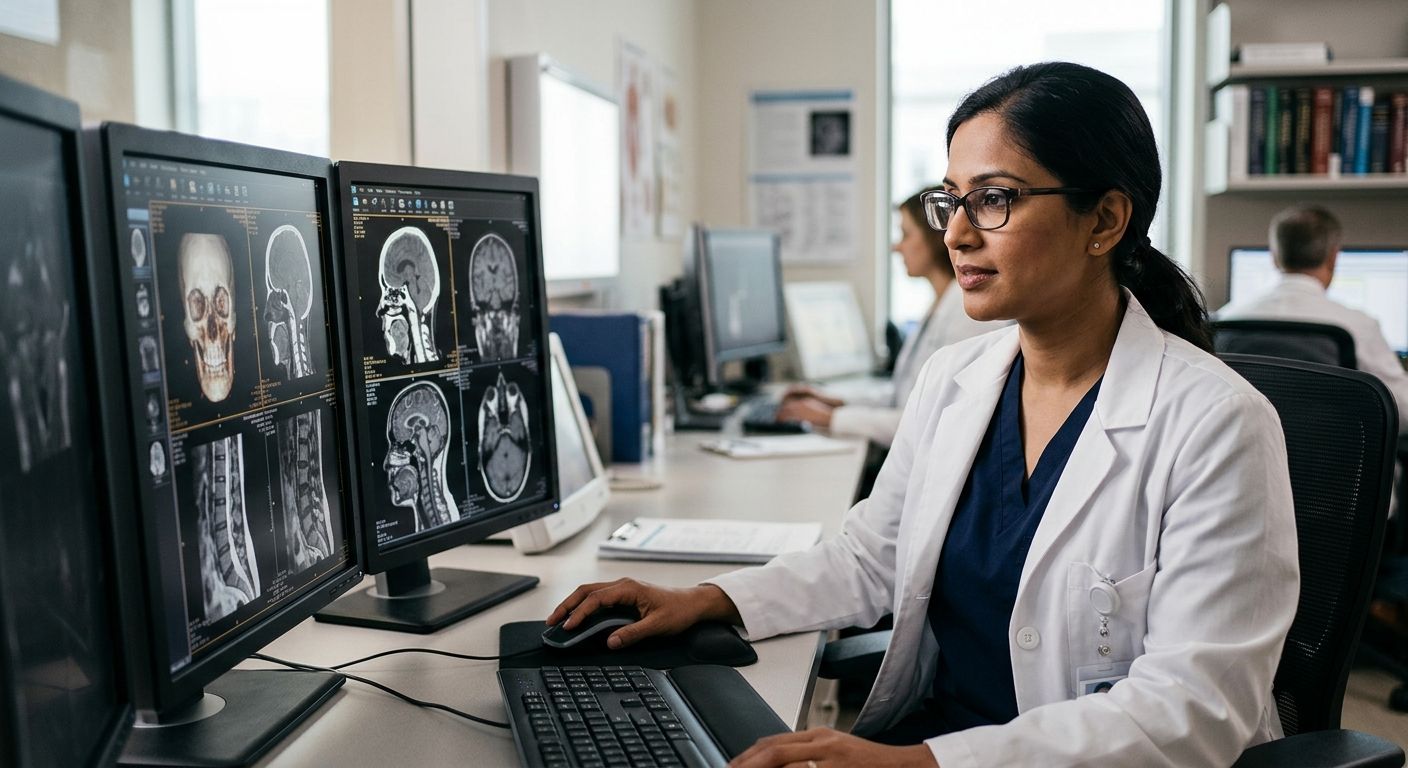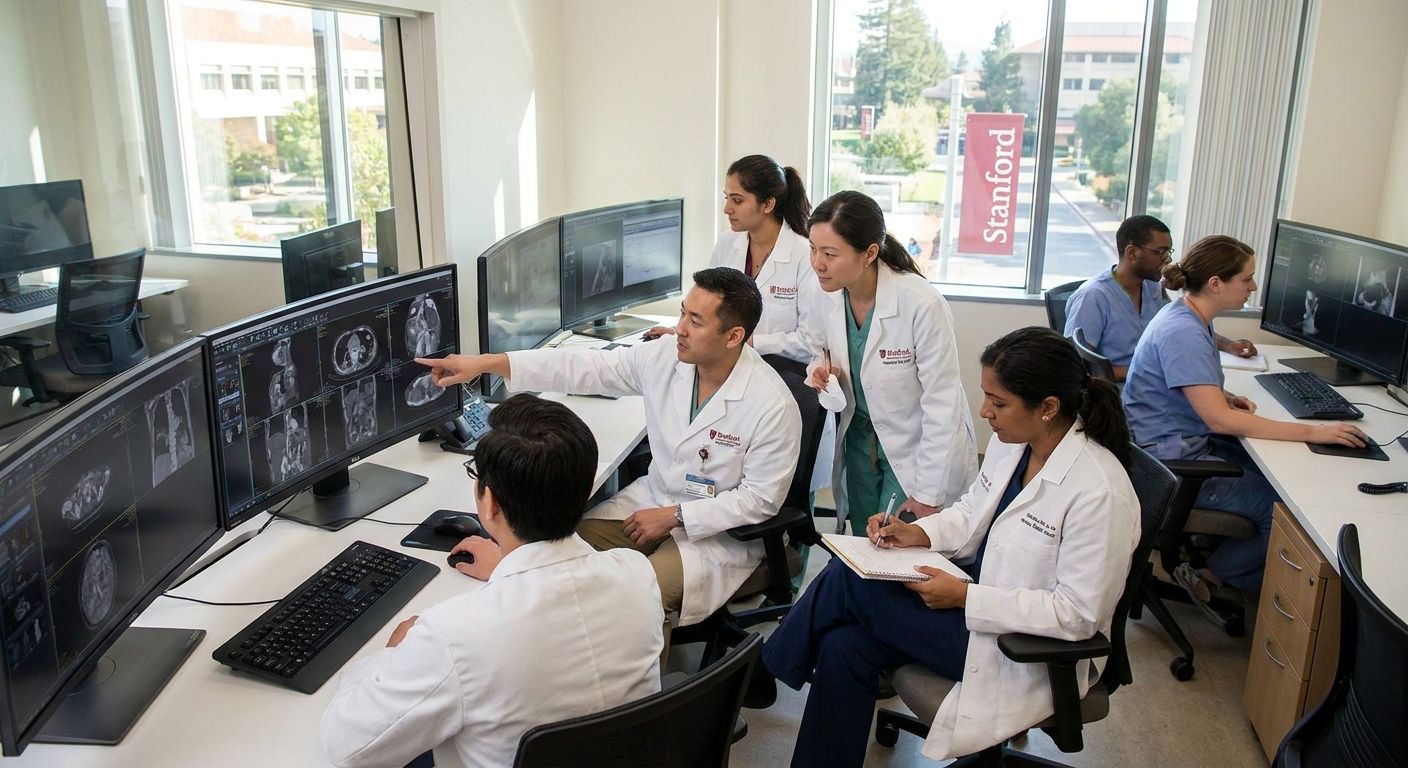
Stanford radiology jobs for academic and research physicians are faculty and fellow-track positions at Stanford University School of Medicine and its affiliated hospitals, built around grant-funded research output and subspecialty teaching rather than pure RVU volume. What separates this segment from a community hospital opening is the interview loop itself: a research talk, a teaching demonstration, and a conversation about protected non-clinical time before anyone discusses call schedule. If your CV reads like a private practice résumé, it will not clear the first screen.
Academic radiology jobs at institutions like Stanford compete for a small pool of candidates who have both board eligibility and a publication record, and the postings rarely sit in one place. They show up split across a university HR portal, a subspecialty society board, and word-of-mouth faculty networks. Comparing that fragmented landscape against academic radiology jobs for teaching and research physicians at other university medical centers gives you a benchmark for what a competitive offer actually looks like in 2026.
- Stanford radiology jobs for academic and research physicians prioritize publication record and grant history over clinical RVU volume.
- Diagnostic radiology residency runs four years; most academic subspecialty tracks require one to two additional fellowship years.
- RadBoard aggregates 5,000+ radiology openings from 20 sources, including academic postings that rarely appear on a single job board.
- Compare protected research time and start-up funds against other academic centers before you accept, not after.
Why radiology jobs matter for Stanford-track academic physicians
An academic radiology job at a Stanford-caliber center is not interchangeable with a hospital-employed diagnostic role. The compensation model runs on a mix of clinical RVUs and grant support, the promotion clock ties to publications and teaching evaluations, and the hiring calendar follows the academic year rather than a rolling private-practice pipeline. Missing a July 1 start-date window can push your search out a full year.
The candidate pool is also thin by design. Academic radiology departments hire for subspecialty fit first, which means a neuroradiologist with a K08 award and a body imaging fellow with three first-author papers are competing for entirely different lines even inside the same department. Searching generic radiologist openings and filtering by hand wastes weeks that a targeted, subspecialty-aware search does not.
Update your CV for an academic search
A clinical CV and an academic CV are not the same document, and reviewers on a faculty search committee will notice the gap in the first thirty seconds.
- List peer-reviewed publications in reverse chronological order with your author position marked
- Include current and pending NIH or foundation grant support, even if it is a K-award
- Add teaching evaluations from residents and fellows, not just attending peer review
- Note committee service (tumor board, quality assurance, curriculum) that signals institutional citizenship
- Cut RVU or productivity numbers unless the posting is a hybrid clinical-research track
Track Stanford-level academic openings systematically
The manual route works, but it takes discipline: check the Stanford Medicine careers page directly, monitor ACR and RSNA subspecialty job boards, and ask your fellowship program director about unposted openings, since academic departments often fill lines through faculty referral before a listing ever goes public.
The faster path is an aggregated, AI-matched search. RadBoard pulls 5,000+ radiology positions from 20 sources and lets you swipe past the non-academic noise to isolate faculty and research-track postings by subspecialty and institution type.
- Filter by academic medical center instead of browsing every radiologist listing in a metro area
- Save postings that mention protected research time or grant support explicitly
- Set alerts for subspecialty-specific academic roles rather than checking boards weekly by hand
- Cross-reference openings against your fellowship's alumni placement history
Build a research narrative that survives the interview
Search committees want a coherent story: what you have published, what you are funded to study next, and how that pipeline benefits the division. A candidate with five scattered case reports loses to a candidate with two focused papers and a clear next project.
- Frame your last two years of research as one continuous question, not a list of unrelated projects
- Name the specific K-award, R01, or foundation grant mechanism you plan to pursue
- Identify which current faculty member's work your research would extend or complement
- Prepare a one-slide summary of your research trajectory for the chair meeting
Negotiate protected research time before you negotiate salary
Base salary at academic centers typically trails private practice, and the real negotiation is over non-clinical time, start-up funds, and mentorship structure, not the RVU rate.
- Ask what percentage of your effort is protected for research versus clinical reading
- Request start-up funds in writing, including what they cover (biostatistics support, data access, RA hours)
- Confirm whether protected time shrinks after your first renewal cycle
- Compare the offer against how private practice radiology jobs for partnership tracks structure income to understand what you are trading away
If you are weighing a move out of private practice entirely, read through switching from private practice to academic radiology before you sign anything, since the transition affects both income timing and research ramp-up.
Prepare for the academic interview loop
The interview day at a university medical center runs longer than a community hospital visit and tests more than clinical judgment.
- Rehearse a 20-minute research talk aimed at a mixed audience of radiologists and non-radiologists
- Prepare a teaching case for a simulated resident conference
- Expect a one-on-one meeting with the division chief focused on five-year trajectory, not just fit
- Ask current junior faculty directly how protected time actually plays out day to day
Time your search around the academic hiring calendar
Academic radiology hiring clusters around the July 1 fiscal and academic year start, and most search committees begin interviewing 9 to 12 months ahead of that date. Fellows finishing training in June 2026 who start looking in the spring are already behind on the strongest lines.
- Start applications in the fall of your final fellowship year, not the spring
- Track grant cycle deadlines (NIH standard cycles fall in February, June, and October) if a K-award is part of your negotiation
- Confirm whether the position is tenure-track, clinician-educator, or non-tenure research, since the timeline and expectations differ sharply between tracks
Comparing academic radiology career paths
| Option | Best for | Key limitation |
|---|---|---|
| Academic medical center faculty track | Physicians building a research and publication record | Lower base compensation than private practice |
| Community teaching hospital with residency | Physicians who want teaching without a heavy grant burden | Less protected research time and fewer core facilities |
| Non-clinical research or industry role | Physicians moving away from daily clinical reading | Board maintenance and clinical skills can lapse |
| Locum coverage during fellowship transition | Physicians bridging income before a faculty start date | No protected research time or institutional support |
Verdict: an academic faculty track is the right call for radiologists who need protected research time and an institutional research infrastructure; a community teaching hospital is the better fit for physicians who want teaching exposure without committing to a grant-funded research agenda.
Common mistakes academic and research candidates make
- Submitting a clinical CV to a research-heavy search — committees skim for grants and first-author papers first, and a productivity-focused CV reads as a mismatch.
- Negotiating salary before protected time — base pay is rarely the flexible line item; research time and start-up funds are.
- Ignoring the academic calendar — starting a search in March for a July start date the same year is almost always too late.
- Assuming one institution's postings represent the whole market — academic openings are scattered across at least a handful of source types, and checking only the university career page misses fellowship-referral and society-board postings.
- Underestimating the interview load — a research talk and a teaching demo require separate preparation, not a single generic slide deck.
Search academic radiology openings faster
Filter 5,000+ radiology jobs by subspecialty and academic track with AI-powered search.
FAQ
What makes Stanford radiology jobs different from community hospital roles?
Stanford radiology jobs for academic and research physicians weight publication history, grant funding, and teaching evaluations alongside clinical output. Community hospital roles typically screen on clinical volume and call availability instead.
How long does it take to become eligible for an academic radiology faculty position?
Diagnostic radiology residency runs four years, and most academic subspecialty tracks require one to two additional fellowship years before a faculty search will consider you. Total training time before an academic faculty offer typically runs five to six years post-residency start.
Is academic radiology pay lower than private practice?
Academic base salaries generally trail private practice because part of the compensation model funds protected research time rather than clinical RVU output. The trade-off is grant support, start-up funds, and a research infrastructure private practice does not offer.
When should I start applying for an academic radiology faculty job?
Start applications in the fall of your final fellowship year, roughly 9 to 12 months before a July 1 start date. Academic hiring calendars follow the academic year, not a rolling private-practice pipeline.
Do academic radiology jobs require an NIH grant already in hand?
No, but a K-award or a clear pending grant application strengthens a candidacy significantly. Search committees evaluate research trajectory, not just current funding status.
Where do academic radiology openings get posted?
Academic openings appear across university HR portals, subspecialty society job boards, and fellowship-referral networks, rarely in one place. RadBoard aggregates listings from 20 sources to cut down on manual checking.
Can I negotiate protected research time in a radiology faculty offer?
Yes, and it is usually more negotiable than base salary. Get the percentage of protected time and any renewal-cycle changes in writing before accepting.
One last thing
The single detail candidates overlook most: protected research time in a first faculty contract often shrinks at the first renewal cycle unless it is written into the offer letter as a standing term, not a starting-year courtesy. Ask the division chief directly whether the protected-time percentage is fixed or subject to review, and get the answer in writing before you sign.