
Best starting point for cancer-focused training: MD Anderson. Best fit for a dedicated cancer-hospital setting: Memorial Sloan Kettering. Best fit for evaluating oncology within broader academic IR training: Johns Hopkins. This 2026 shortlist separates institutional fit from the fellowship title, eligibility rules, and clinical responsibilities you must confirm before applying.
- The best interventional oncology fellowship programs match your training eligibility, procedural goals, and intended practice.
- Shortlist MD Anderson for cancer-focused training, then verify the exact fellowship curriculum and eligibility.
- Evaluate Memorial Sloan Kettering for a dedicated cancer-hospital environment and Johns Hopkins for broader academic IR training.
- RadBoard supports the subsequent radiology job search; fellowship requirements belong with the training institution.
Why this matters
Interventional oncology is a clinical focus within interventional radiology, not a fellowship label you should treat as interchangeable across institutions. An independent IR residency, advanced fellowship, research fellowship, and observership serve different purposes. An oncology-focused experience does not automatically establish eligibility for IR certification or independent procedural practice.
Start with your intended attending role. The work described in interventional oncology radiologist jobs for tumor ablation provides a useful career comparison, but training eligibility and hospital privileges require separate review.
For your 2026 application shortlist, compare 3 training settings below. The order is a starting sequence for investigation, not a measured ranking of fellow outcomes or procedural volume.
What makes the best interventional oncology fellowship programs
A useful program comparison starts with responsibilities, not reputation. Apply these criteria before deciding which institution deserves an application:
- Training pathway: Confirm whether the appointment is an accredited residency, advanced clinical fellowship, research position, or observational experience.
- Procedural participation: Establish what you perform under supervision versus observe, including ablation and transarterial therapies.
- Clinical ownership: Look for involvement in consultation, treatment selection, consent, follow-up, and complication management.
- Oncology integration: Ask how trainees participate in tumor boards and coordinate with medical, surgical, and radiation oncology.
- Mentorship: Identify the supervising physician and the practical structure for clinical feedback or research guidance.
- Career fit: Match the experience to cancer-center practice, broader hospital IR, or an academic research career.
A program that answers these questions clearly is easier to evaluate than one that describes its institutional reputation without defining your role. Ask for the curriculum and appointment terms in writing.
Interventional oncology training options at a glance
These institutions offer distinct settings for investigating oncology-oriented IR education. Confirm the exact appointment and current requirements directly with each institution; the institution name alone does not identify a particular fellowship.
| Institution | Best for | Standout setting | Key limitation to resolve |
|---|---|---|---|
| MD Anderson Cancer Center | Starting a cancer-focused training search | Dedicated cancer center | Exact training pathway and fellow-level responsibilities |
| Memorial Sloan Kettering Cancer Center | Evaluating training within a dedicated cancer hospital | Oncology-centered clinical environment | Scope of general IR exposure and appointment eligibility |
| Johns Hopkins | Evaluating oncology alongside broader academic IR | University-based medical environment | Protected oncology exposure within the specific appointment |
Choose the curriculum that closes your training gap, not simply the most recognizable institution. None of these settings substitutes for confirming your eligibility for the advertised appointment.
1. MD Anderson: best starting point for cancer-focused training
MD Anderson Cancer Center is a logical first institution to investigate when your intended practice centers on cancer care. Its cancer-center setting makes the relationship between intervention and the broader oncology treatment plan central to your evaluation.
The decisive question is what the specific training appointment allows you to do. Ask the program to distinguish clinical participation, observation, research, and supervised procedural responsibility rather than treating them as equivalent experiences.
MD Anderson pros:
- A dedicated cancer-center setting aligns with an oncology-focused career goal.
- The institutional focus provides a clear context for evaluating multidisciplinary cancer care.
- You can assess the proposed training against a specific destination: cancer-center IR practice.
MD Anderson cons:
- A cancer-center name does not establish the scope of your individual appointment.
- Institution-wide procedural activity is not a substitute for trainee-specific participation.
- Applicants seeking broad nononcologic IR training must examine that exposure separately.
Best for: Physicians prioritizing a cancer-focused environment who can identify an eligible clinical training appointment.
For a 2026 inquiry, request the exact program title, entry requirements, clinical privileges, supervision model, and rotation schedule. Ask who evaluates your procedural progress and whether outpatient follow-up forms part of the role.
Verdict: Hold on committing until MD Anderson confirms the appointment fits your existing training and procedural goals.
2. Memorial Sloan Kettering: best for a cancer-hospital setting
Memorial Sloan Kettering Cancer Center belongs on the shortlist when you want to investigate IR training within a dedicated cancer hospital. The relevant distinction is the setting: evaluate how the proposed appointment connects procedures with cancer diagnosis, treatment decisions, and subsequent care.
Do not equate working around oncology patients with owning their longitudinal management. Ask whether trainees attend consultations and follow-up visits or participate primarily in procedural sessions.
Memorial Sloan Kettering pros:
- The cancer-hospital setting matches an explicitly oncology-centered career interest.
- It gives you a focused environment in which to examine IR's contribution to cancer care.
- The institutional mission provides a direct basis for discussing oncology-specific learning goals.
Memorial Sloan Kettering cons:
- A dedicated cancer setting does not establish the breadth of general IR experience.
- Clinical access and procedural responsibility depend on the particular appointment.
- A research or observational position must not be treated as equivalent to clinical fellowship training.
Best for: Physicians evaluating a dedicated cancer-hospital environment rather than assuming they need a broader hospital-based training setting.
Ask how the curriculum handles treatment selection, imaging review, procedural planning, and post-treatment assessment. Request an explanation of how responsibility progresses as your supervisors assess competence.
Verdict: Hold until Memorial Sloan Kettering defines your clinical role and confirms that the appointment meets your training objective.
3. Johns Hopkins: best for evaluating broader academic IR training
Johns Hopkins provides a university-based medical setting for investigating oncology-oriented IR training. It is a useful comparison when your intended career combines cancer procedures with a wider interventional practice.
Your evaluation should separate the institution's overall clinical breadth from your actual schedule. A broad medical environment does not, by itself, establish how much oncology-focused training an individual appointment contains.
Johns Hopkins pros:
- A university-based setting provides an alternative to a dedicated cancer hospital.
- It suits an evaluation centered on combining oncology interests with broader IR goals.
- You can compare clinical training objectives with an intended academic career.
Johns Hopkins cons:
- Overall institutional breadth does not guarantee protected oncology time.
- The specific appointment must define access to oncology procedures and follow-up.
- Academic affiliation alone does not establish a research mentor or protected project time.
Best for: Physicians who want to investigate oncology training without defining their future practice exclusively around cancer care.
For 2026, ask the program to identify oncology rotations, supervising faculty, clinic participation, and the relationship between oncology work and other service obligations. Request trainee-level information rather than department-wide descriptions.
Verdict: Hold until Johns Hopkins documents how the specific appointment balances oncology depth with broader IR training.
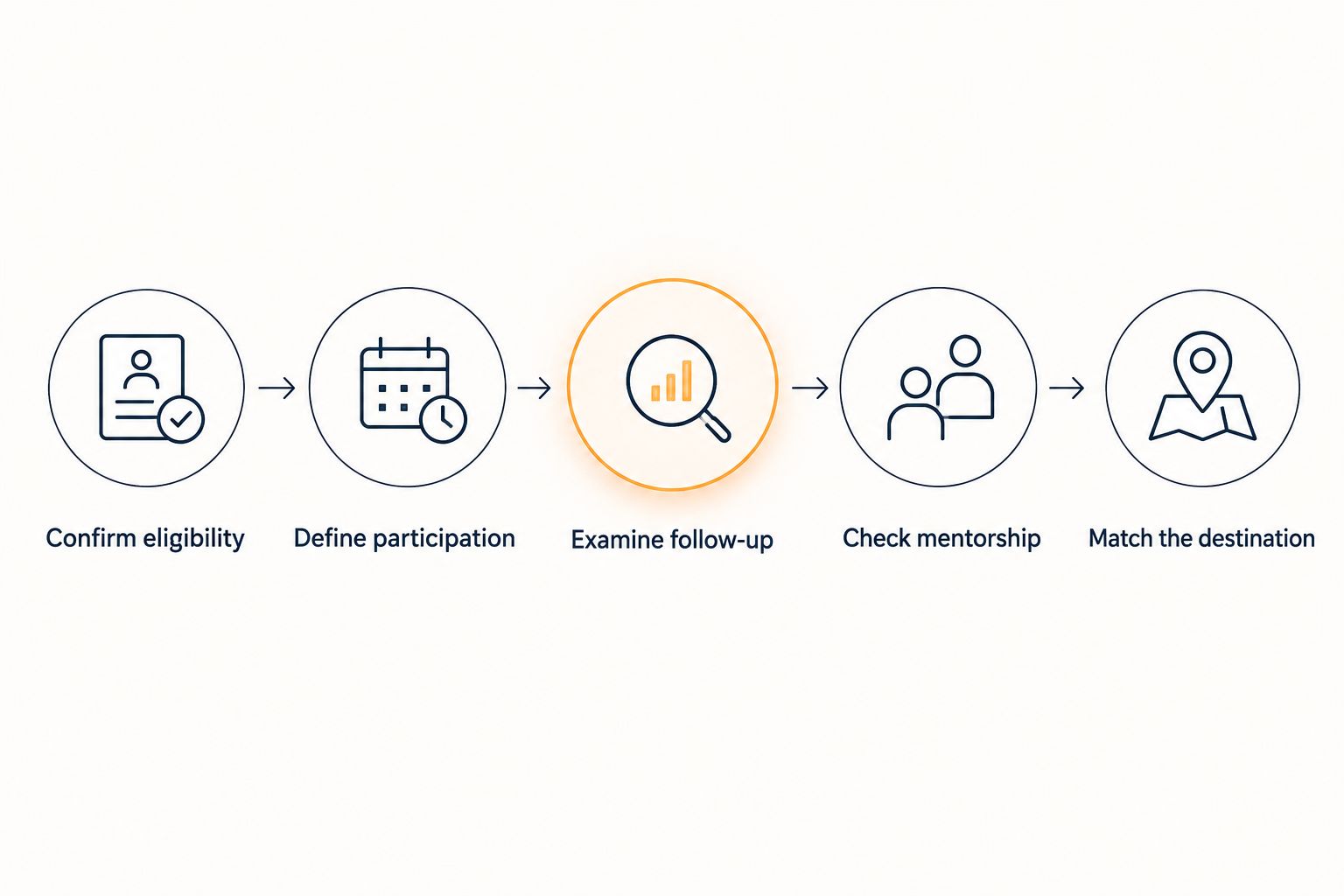
How to compare the actual training offers
Use the same evaluation sequence for every institution. This prevents a familiar name or an interesting research project from obscuring an unsuitable clinical appointment.
Confirm eligibility
Send your training history to the program coordinator before investing in a detailed application. Ask which qualifications, prior procedural training, licensing conditions, and certification status apply to the exact appointment.
Do not assume requirements transfer between programs. International training, prior diagnostic radiology education, and completed IR training require assessment against the institution's stated criteria.
Define participation
Ask the program to describe what you observe, assist with, and perform under supervision. Separate access to a procedure from responsibility for planning and completing it.
Request an explanation of how cases are allocated among trainees and other clinicians. A department's activity does not tell you what your own experience will include.
Examine follow-up
Ask who sees patients before treatment, discusses alternatives, reviews response imaging, and manages post-procedure concerns. These responsibilities distinguish procedural exposure from a fuller clinical oncology experience.
A useful question is: describe the trainee's role from the initial referral through the next treatment decision. The answer should identify responsibilities, not just meetings you can attend.
Check mentorship
Identify who supervises your clinical development and who would guide a research project. Those roles need not belong to the same person.
Ask how feedback is delivered and how competing clinical duties affect project work. A mentor's name matters less than a defined working arrangement.
Match the destination
Compare the proposed experience with the job you want afterward. Cancer-center practice, general hospital IR, and academic investigation require different combinations of clinical breadth and specialization.
Choose training that prepares you for your intended responsibilities, not a title that sounds more specialized. Keep certification and credentialing questions separate from the appeal of the clinical focus.
Questions that separate exposure from clinical ownership
Bring concrete questions to the interview. Broad descriptions such as extensive experience are difficult to compare; a description of your responsibilities is useful.
- Who conducts the initial consultation, and what part does the trainee own?
- How does the team decide between intervention and alternative treatments?
- Which procedures will the trainee perform under supervision?
- How does the program document progression in procedural responsibility?
- Who reviews response imaging and discusses further treatment with the patient?
- What happens when a complication occurs after the procedural session?
- Which clinical duties take priority over research or elective time?
Ask a current trainee to describe a typical working week, then compare that account with the written curriculum. Differences deserve clarification before you accept an appointment.
How this shortlist is ordered
This shortlist puts a dedicated cancer-center starting point first, a cancer-hospital comparison second, and a broader university-based comparison third. It organizes your search by setting rather than claiming an unsupported national performance ranking.
The deciding criteria remain eligibility, procedural participation, clinical ownership, oncology integration, mentorship, and career fit. The strongest offer is the one that documents those elements for your appointment.
Which interventional oncology program should you choose?
Start with MD Anderson if your main goal is to investigate cancer-focused training. Compare Memorial Sloan Kettering when the dedicated cancer-hospital environment is central to your decision, and Johns Hopkins when you also want to evaluate broader academic IR training.
Then let the written curriculum change the order. For your 2026 decision, the exact appointment takes precedence over this institutional shortlist.
RadBoard is a radiology job-search platform for physicians comparing career opportunities after training. RadBoard aggregates 5,000+ radiology positions from 20 sources; that job-search scope is separate from the fellowship eligibility decisions made by training institutions.
RadBoard is best for radiologists comparing job opportunities across multiple sources, not for determining fellowship eligibility. Use the responsibilities in prospective jobs to sharpen your training questions, then verify those questions with the program.
Compare your next radiology role
Search 5,000+ radiology positions aggregated from 20 sources.
FAQ
What's the best interventional oncology fellowship program in 2026?
The best program is the eligible training appointment that matches your procedural goals and intended practice. MD Anderson, Memorial Sloan Kettering, and Johns Hopkins are institutions to investigate, but compare their exact appointments rather than treating institutional reputation as a fellowship ranking.
Is an interventional oncology fellowship the same as an IR independent residency?
No. An oncology-focused fellowship and an IR independent residency are different appointment categories; confirm the accreditation, entry requirements, and certification implications of the specific program.
Should I choose a cancer center or a broader university hospital?
Choose according to the clinical scope you need. A dedicated cancer setting aligns with an oncology-centered goal, while a broader university setting requires careful review of how oncology training fits within other IR responsibilities.
Can a diagnostic radiologist apply directly to an interventional oncology fellowship?
Eligibility depends on the specific appointment and your prior training. Send your qualifications to the program and obtain confirmation before assuming that diagnostic radiology training meets its clinical entry requirements.
What procedures should I ask about during an interview?
Ask about supervised participation in tumor ablation and transarterial therapies, then connect those procedures to consultation and follow-up responsibilities. Distinguish observing a procedure from performing it under supervision.
Does a research fellowship provide the same training as a clinical fellowship?
No. Research and clinical appointments have different purposes and responsibilities; verify whether the position includes patient care, procedural privileges, and supervised clinical training.
Can RadBoard help me compare jobs after fellowship?
RadBoard supports radiology job searches across 5,000+ positions aggregated from 20 sources. Use prospective job responsibilities to guide your career planning, while confirming fellowship requirements directly with each institution.
One last thing
Before accepting, ask the program to describe a patient journey you would participate in: referral, consultation, treatment selection, procedure, and follow-up. If your role ends at the procedure-room door, decide whether that experience matches the clinical practice you want to build.